-
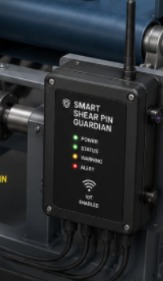
Smart Shear Pin Guardian: An IoT-based system that monitors machine conditions and provides early warnings to reduce unexpected failures.
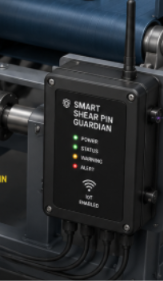
About the Project Smart Shear Pin Guardian
Smart Shear Pin Guardian is an AI-enabled predictive maintenance system designed to reduce unexpected and premature shear pin failures in industrial machinery.
Shear pins are widely used as mechanical safety components in machines such as conveyors, agricultural equipment, gearboxes, mixers, and other rotating systems. They are designed to break during excessive overload and protect expensive components such as motors, shafts, and gearboxes.
However, shear pins can sometimes fail unexpectedly due to conditions such as continuous vibration, repeated shock loads, increased mechanical load, overheating, misalignment, and long operating hours. Such failures can cause unplanned downtime, production loss, and maintenance costs.
Our solution aims to monitor the machine conditions surrounding the shear pin and provide an early warning when abnormal operating conditions increase the risk of premature failure.
What Inspired Us
The inspiration for this project came from a simple question:
Why should maintenance teams wait for a shear pin to fail before taking action?
While a shear pin is designed as a sacrificial safety component, an unexpected failure can still stop an entire machine or production process.
We wanted to explore whether sensor data and intelligent analysis could help maintenance teams identify abnormal machine conditions early and take preventive action before an unnecessary breakdown occurs.
This led to the concept of the Smart Shear Pin Guardian.
How It Works
The system is designed as an external retrofit monitoring device.
Instead of attaching sensors directly to the shear pin, the system monitors the operating conditions that can influence the stress experienced by the mechanical drive system.
The system monitors: Vibration – to identify abnormal machine vibration and repeated mechanical shocks. Motor current – to estimate changes in machine loading. Temperature – to identify abnormal heating in the gearbox or bearing area. RPM – to monitor changes in shaft rotational speed. Operating hours and events – to track machine usage and abnormal conditions over time.
The sensor data is sent to the ESP32 microcontroller, which processes the data and calculates a machine health or risk status.
The system then provides a simple warning:
🟢 Healthy – Normal operating condition 🟡 Warning – Abnormal conditions detected; inspection recommended 🔴 Critical – High risk condition; maintenance action recommended
Alerts can be provided through LED indicators, a buzzer, display, and wireless communication.
System Workflow
Machine → Sensors → ESP32 → Data Processing → Condition Analysis → Health Status → Alert → Preventive Maintenance
Detailed flow: The machine starts operating. Sensors continuously collect vibration, temperature, current, and RPM data. The ESP32 receives the sensor inputs. Noise is filtered and meaningful parameters are extracted. Current operating conditions are compared with normal operating patterns. The system detects abnormal trends such as increasing vibration, unusual load, overheating, or speed variation. A health or risk score is generated. The system displays the current condition and sends an alert when required. Maintenance can be scheduled before an unexpected machine stoppage. How We Built It
The proposed prototype consists of a compact industrial monitoring unit containing:
ESP32 microcontroller Power supply circuit Signal conditioning circuit Vibration sensor interface Temperature sensor interface Motor current sensor interface RPM sensor interface Wi-Fi and Bluetooth communication Memory for event logging Status LEDs Buzzer Optional OLED/LCD display Terminal blocks and industrial sensor connectors
The system is designed to be installed externally on existing machinery, reducing the need for major mechanical modifications.
Challenges We Faced
One of the biggest challenges was determining how to monitor the condition of a small mechanical component that may rotate and is replaced after failure.
Initially, we considered monitoring the shear pin directly. However, placing electronics directly on a rotating and replaceable pin would make the system complex and difficult to maintain.
We solved this challenge by focusing on the surrounding machine conditions.
Another challenge was understanding that the system should not prevent a shear pin from breaking during a genuine overload. The shear pin must still perform its original safety function.
Therefore, our system focuses on identifying abnormal operating trends and conditions that may contribute to unexpected or premature failures, while preserving the original mechanical protection mechanism.
What We Learned
Through this project, we learned about:
Predictive maintenance Condition monitoring Industrial IoT Sensor integration ESP32 embedded systems Vibration monitoring Motor current analysis RPM measurement Data processing Machine health monitoring AI and machine learning concepts Preventive maintenance strategies
Most importantly, we learned that a practical engineering solution is not always about replacing an existing component. Sometimes, innovation comes from making an existing system smarter.
Future Scope
Future versions of the Smart Shear Pin Guardian could include:
Machine learning-based anomaly detection Remaining Useful Life (RUL) estimation Cloud-based monitoring dashboard Mobile application Predictive maintenance reports Maintenance history tracking Multi-machine monitoring Industrial communication protocols such as Modbus and RS-485 Automated maintenance scheduling Our Vision
Smart Shear Pin Guardian transforms a simple mechanical protection component into part of an intelligent predictive maintenance ecosystem.
Predict. Monitor. Protect.

Log in or sign up for Devpost to join the conversation.