Inspiration
According to the Ministry of Social Justice and Empowerment, 339 people died while cleaning sewers and septic tanks between 2018 and 2023. Despite its illegality, manual sewage cleaning without safety equipment is still practiced throughout the country. Some poisonous gases, such as hydrogen sulfide, ammonia, methane, carbon monoxide, and sulfur dioxide, can cause major health issues or even death. The main gas found in sewers is hydrogen sulfide. Prolonged hydrogen sulfide exposure can result in nausea, headache, dizziness, loss of consciousness, and tremors.
What it does
To prevent these dire circumstances, we have created a smart sewage rescue system to monitor and save the workers while they are doing their jobs. The presence of toxic gases is monitored by the gas sensors, and if their concentration rises, a safety alert is generated. We have used a wristband to monitor the workers' health and ensure that their heart rates don't become too high. An added advantage of our system is that along with the alerts, we can get real-time updates through a website in the regional language so that a supervisor will also get all the necessary information. The supervisor can also detect the water level using an ultrasonic sensor so that the workers do not get swept away as the water level in the sewer rises. Suppose an unfortunate situation arises where the toxic level of the gas and the heart rate of the worker increases. In that case, we use an automatic oxygen mask so that the workers will have enough time to evacuate the sewers without being harmed.
How we built it
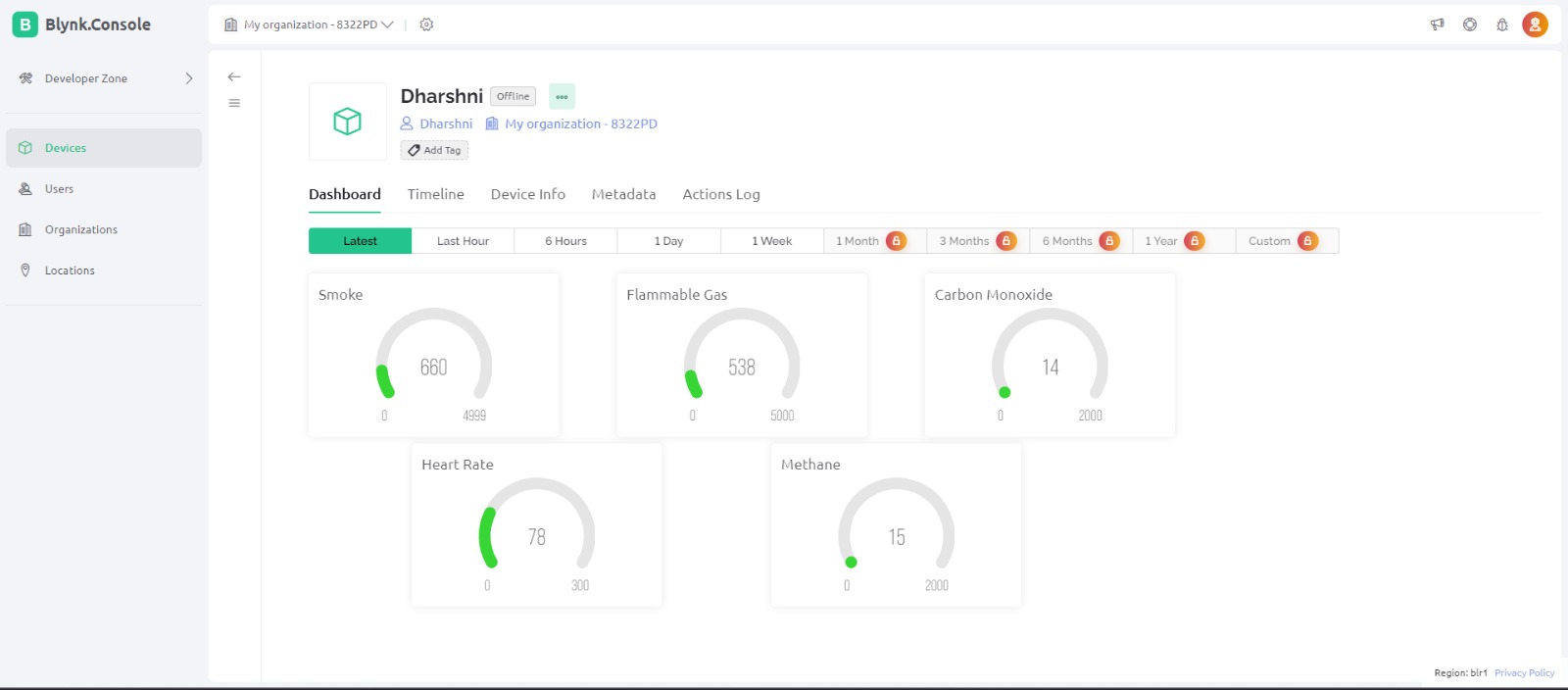
The main component we used in our project is the ESP8266 wifi module. It is a processor with an inbuilt wifi module. Five gas sensors will detect harmful gases and the concentration of the gases is displayed on a webpage using the ESP8266. The heart rate of the worker is measured using the heart rate and pulse oximeter sensor and this can also be viewed on the webpage. The automatic oxygen is supplied using a servo motor and a processor which will decide when to supply the oxygen. We have used Arduino Ide for all our programming needs and used Blynk to display our values.
Challenges we ran into
It has been difficult to figure out how to connect multiple sensors to a single processor but we did figure it out in the end. It is also difficult to get our hands on some of the more harmful gases to be able to test our product more efficiently. We also had to ensure that the product worked even if there was no internet connectivity.
Accomplishments that we're proud of
We are proud to be able to supply oxygen to the workers automatically so that even if the person has no idea about whether their heart rate is decreasing, they will be supplied with oxygen and we will be able to rescue their life. In the sewers, there may not been proper internet connectivity so we have also added a Bluetooth module to make sure the product will work without any hindrance.
What we learned
It has been a great learning experience while developing this project to learn a lot about how hard some people work and as fellow citizens, it is our job to ensure they have all the safety measures required. It would be best if we could eliminate manual scavenging but a more immediate solution is to ensure that no lives are lost.
What's next for Smart Sewage Rescue System
In the future, hydrogen peroxide can be added to get rid of the hydrogen sulfide gas. The presence of dissolved oxygen brought about by the slow breakdown of peroxide causes the sulfides to be oxidized to elemental sulfur. The existence of this molecule, or elemental sulfur, is not dangerous, thus no further treatment for removal is required.
Built With
- arduino
- blynk


Log in or sign up for Devpost to join the conversation.