-
-
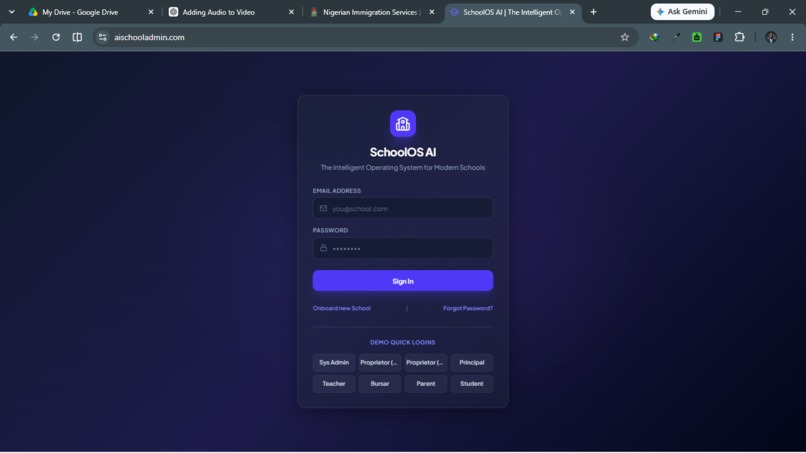
Sign up page
-
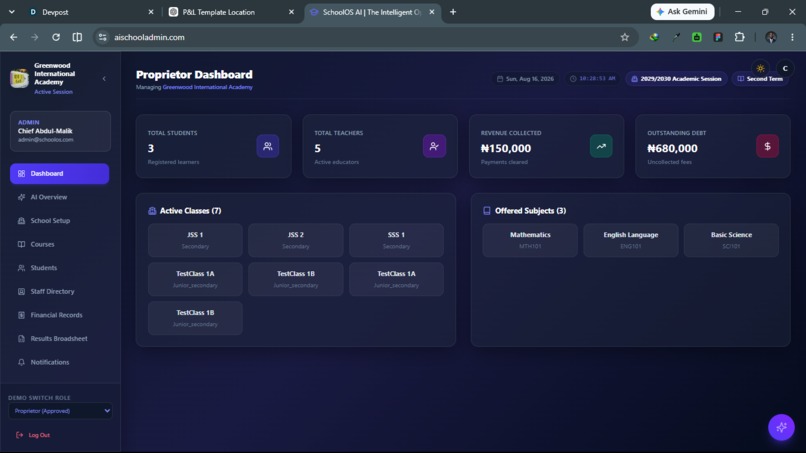
Proprietor's Dashboard
Inspiration
SchoolOS AI was inspired by a simple observation: schools are doing too much manual work with too many disconnected tools.
In many schools, student records, results, assignments, payments, communication, and administrative activities are managed across paper files, spreadsheets, messaging applications, and separate software. This creates unnecessary workload for administrators and teachers and makes it harder for parents and students to access important information.
We began asking: What if a school had one intelligent system that could not only manage its operations, but also actively help people carry out those operations?
That question became the foundation of SchoolOS AI.
Our goal is to move beyond traditional school management software and build an AI-native School Operating System that brings administrators, teachers, students, and parents into one connected platform.
What it does
SchoolOS AI is a web-based intelligent school management platform that brings core school operations into one system.
Schools can onboard their institution, classes, teachers, and students. Teachers can manage classes, upload results, create assignments, and access academic tools. Students can view results and access assignments, while parents can monitor their children's academic information and make school payments digitally.
The key difference is the AI layer.
We are integrating AI into major user workflows rather than treating it as a standalone chatbot. AI capabilities are designed to assist with school onboarding, administration, academic analysis, financial workflows, user support, and automation.
Our vision is for the platform to evolve from simply managing school information to actively helping schools operate.
How we built it
We started by mapping the major stakeholders and workflows within a school and identifying where technology could remove unnecessary friction.
We designed SchoolOS AI around four primary user groups:
Administrators: Manage school operations, students, teachers, records, finance, and other administrative processes. Teachers: Manage classes, results, assignments, and academic activities. Parents: Access student information, monitor results, receive relevant updates, and make payments. Students: Access results, assignments, and other school services.
We then translated these workflows into the product architecture and user experience of the platform.
For the AI layer, we developed specialized capabilities around areas such as Admissions/Onboarding, Academics, Finance, Administration, and user assistance. We are taking an agent-oriented approach so that AI capabilities can operate within specific workflows while respecting the permissions and context of each user.
The platform is being developed as a scalable SaaS product, with AI integrated through APIs and a dedicated intelligence layer.
Challenges we ran into
One of our biggest challenges has been AI integration.
Generating an AI response is relatively straightforward. Building an AI system that can securely authenticate, understand application data, respect user permissions, interact with existing software, and perform useful actions reliably is significantly more complex.
During development, we encountered challenges around API integration, authentication, permissions, and connecting our AI capabilities to the underlying platform.
These challenges taught us that an AI-powered application is not simply an AI model connected to a user interface. It requires a carefully designed system around the model.
We also faced the challenge of deciding where AI genuinely adds value. We don't want to add AI simply because it is popular. Every AI capability needs to reduce friction, automate repetitive work, provide useful insights, or improve the experience for a real user.
Accomplishments that we're proud of
One of our biggest accomplishments is turning the idea of an AI-powered School Operating System into a functioning product.
We have built a working web platform with core school-management workflows covering school onboarding, teacher and student management, academic results, assignments, parent access, and payments.
We are also proud of developing a broader AI architecture that goes beyond a generic chatbot. We have mapped AI capabilities to specific school workflows and are working toward making intelligence a fundamental part of how the platform operates.
Most importantly, we have moved from simply asking "Can AI be used in school management?" to actually building and testing what that future could look like.
What we learned
The biggest lesson we learned is that AI integration is as much a systems problem as it is an AI problem.
A powerful model alone does not make an intelligent product. The AI needs reliable data, authentication, context, permissions, APIs, well-defined workflows, and clear boundaries.
We also learned the importance of designing around the user's actual workflow rather than designing around technology.
For example, a teacher does not necessarily need "an AI assistant." They need to upload results faster, understand which students are struggling, create useful assignments, and spend less time on repetitive administrative work.
That distinction has influenced how we approach every AI feature in SchoolOS AI.
What's next for SchoolOS AI
Our next step is to move from product development and testing toward real-world school deployment and validation.
We want to onboard our first cohort of schools, observe how administrators, teachers, parents, and students use the platform, and use that feedback to improve the product.
We also plan to strengthen our AI infrastructure, particularly authentication, permissions, workflow automation, contextual intelligence, and reliability.
Long-term, we want SchoolOS AI to become an AI-native School Operating System for Africa, beginning with Nigeria.
Our ambition is not simply to digitize schools.
It is to build intelligent infrastructure that helps schools operate better, make better decisions, reduce administrative workload, and give every stakeholder a better experience.
The future we are building toward is one where school software doesn't just record what happened.
It helps schools decide what to do next.
Built With
- antigravity
- cloud
- express.js
- gemini
- javascript
- mysql
- node.js


Log in or sign up for Devpost to join the conversation.