-
-
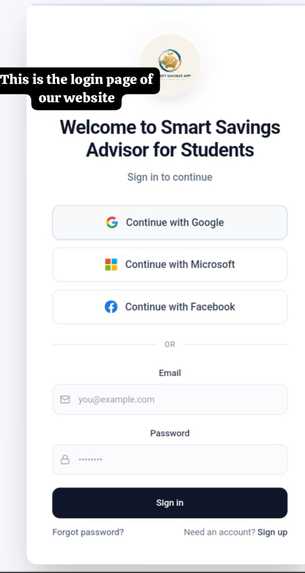
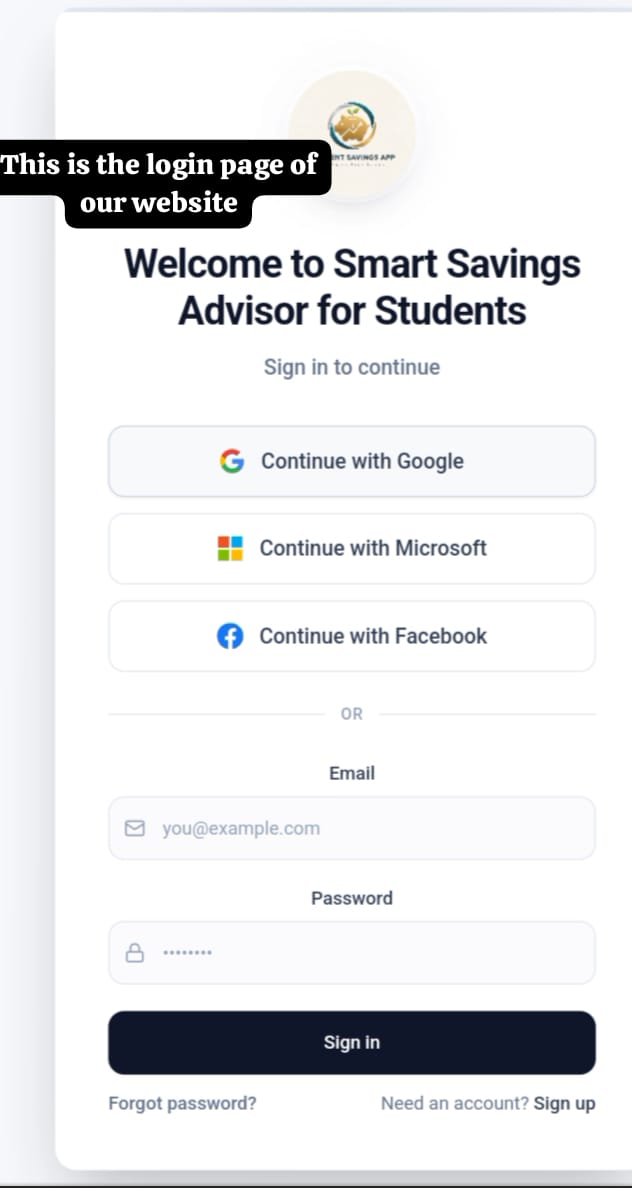
this is our login page
Students often struggle to manage their monthly allowances because they don’t track their daily spending properly. They end up overspending, run out of money early, and fail to maintain consistent savings. Existing budgeting tools are either too complicated or require coding knowledge. Students also miss many expenses because they don’t manually record them. As a result, they lack a clear understanding of where their money goes and how to build good financial habits.
What it does
What it does (brief) • Track & auto-capture: Users add expenses manually or the app parses SMS/Gmail receipts (user-reviewed) and creates expense entries. • Predict & alert: Calculates daily average, predicts run-out date, and sends overspend / low-balance alerts. • Budget breakdown: Automatically recommends monthly budgets per category based on current spending patterns and shows remaining amounts. • Mandatory savings: Reserves a fixed locked amount each month (usable only if user enables emergency mode). • Feedback & gamification: 1–5 star feedback, streaks and badges to reward good saving behaviour. How it works (brief) • Data model: Users, Daily_Spending (with source + approval), Tips, Feedback tables. • Formulas & rules: Rollups and formulas compute totals, percentages, run-out date, recommended budgets, and usable balance. • Workflows: Auto-captured items queue for user approval; rules block spending beyond usable balance; alerts run on thresholds. • Privacy note: Auto-capture requires explicit consent; parsed fields (amount, merchant, date) stored, not full messages. Why it solves the problem (brief) • Automates tracking (fewer missed entries). • Provides forward-looking predictions so students can act early. • Gives actionable, category-wise guidance and enforces savings via the locked amount. • Lightweight, no-code implementation makes it fast to build and iterate.
Built With
- base44
- css
- html
- javascript

Log in or sign up for Devpost to join the conversation.