Inspiration
The Smart Resilience Hub draws its inspiration from my real-world policy submissions to India’s national leadership. In my Letter to the Hon’ble President of India (2022), I highlighted how millions still go to bed hungry despite welfare schemes. Later, in my G20 Development Working Group submission (2023), I proposed affordable technologies for farmers to strengthen food production and income. Finally, in my Mann Ki Baat 100th Episode Proposal (2023), I emphasized the urgent need for governance accountability and social audits at the local level. These experiences demonstrated that technology can bridge the gap between policy intent and actual impact, ensuring no family is left behind.
What it Does
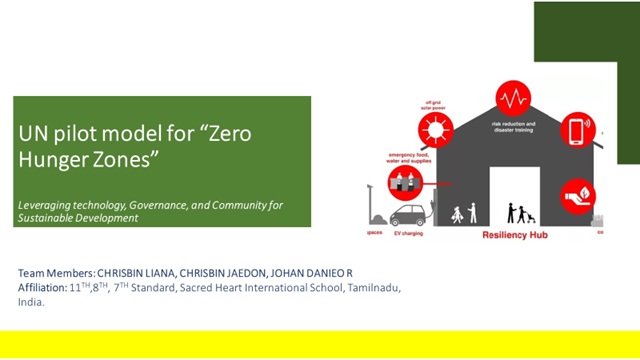
The Smart Resilience Hub is a digital platform designed to eliminate poverty and hunger by combining artificial intelligence, governance accountability, and community participation. Its core features include: • AI-Powered Beneficiary Tracker: Uses AI and GIS mapping to identify families excluded from welfare delivery, such as those without Aadhaar or ration cards, and automatically alerts administrators. This supports the crucial government duty to identify and include all citizens who are hungry or lack ration cards. • Agri-Tech for Farmers: Provides soil testing, localized weather alerts, and digital marketplaces to improve crop yields and farmer income. • Zero Hunger Zones & Community Kitchens: Monitors ration distribution in real time and mobilizes NGOs and local kitchens to ensure no child or family goes hungry. • Governance & Accountability Dashboard: Tracks the performance of Panchayats, health departments, and service agencies in real time, rewarding effective service and flagging negligence. This dashboard ensures that local authorities fulfill their responsibility to find and support citizens in need, creating transparency and accountability in welfare delivery.
How We Built It
The Hub was built using a modern, scalable technology stack. A React frontend ensures accessibility across web and mobile platforms, while a Node.js with Express backend provides fast and reliable data processing. Beneficiary and farmer data are securely stored in MongoDB or Firebase databases, and TensorFlow AI/ML models power beneficiary inclusion prediction and agri-advisory. The system integrates Aadhaar verification, weather data, and GIS mapping APIs to provide real-time updates and insights. Hosting on AWS or Google Cloud ensures scalability, and an optional blockchain layer can provide tamper-proof ration distribution records.
Challenges We Ran Into
One major challenge was translating policy ideas into a technical prototype that is simple yet effective. Designing a system that balances data privacy with accurate beneficiary tracking was another challenge, ensuring that vulnerable citizens are not excluded. Developing a platform that works in low-connectivity rural areas while remaining scalable and affordable for nationwide deployment was also difficult.
Accomplishments That We Are Proud Of
We successfully transformed policy proposals into a hackathon-ready solution. The platform aligns with UN SDG 1 (No Poverty) and SDG 2 (Zero Hunger), demonstrating how student-led innovation can integrate technology, governance, and community participation. The Hub introduces a transparent, accountable system for local governance, combining real-time monitoring with reward and penalty mechanisms to ensure authorities fulfill their duties.
What We Learned
This project reinforced that policy without technology often leaves critical gaps, while technology guided by strong policy can be transformative. Hackathons provide a unique space to test and refine ideas collaboratively. Solving real-world challenges like hunger and poverty requires interdisciplinary approaches, combining coding, AI, governance, community engagement, and social innovation.
What's Next for Smart Resilience Hub – Tech for Zero Poverty & Zero Hunger
The next step is to develop a minimum viable product (MVP) focusing on AI beneficiary tracking and real-time ration monitoring. Partnerships with NGOs and local governments will allow pilot deployments in rural districts. Future expansions include food redistribution systems connecting restaurants and markets with hunger-relief centers, IoT-based agriculture monitoring such as soil sensors and rainfall collectors, and gamified youth volunteer networks to operate Zero Hunger Kitchens. Ultimately, the vision is to scale the Hub globally, offering a replicable model for poverty and hunger alleviation in other developing nations. https://drive.google.com/file/d/1gTa_S0kUq_1iuqO7aSCZCy49edGRcSfc/view?usp=drive_link https://drive.google.com/file/d/1K5F8HfLMs31UE_OBVqCJRUmylpU-Uy9L/view?usp=drive_link https://drive.google.com/file/d/1CQIxFkSEyfbKxlXh-RCmOFTNj94F807w/view?usp=drive_link
Built With
- api


Log in or sign up for Devpost to join the conversation.