-
-
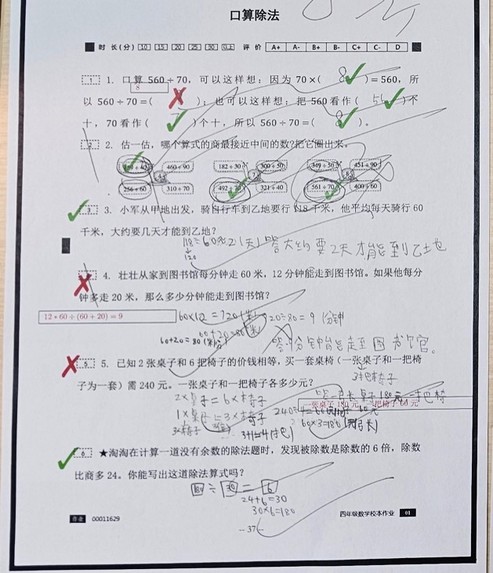
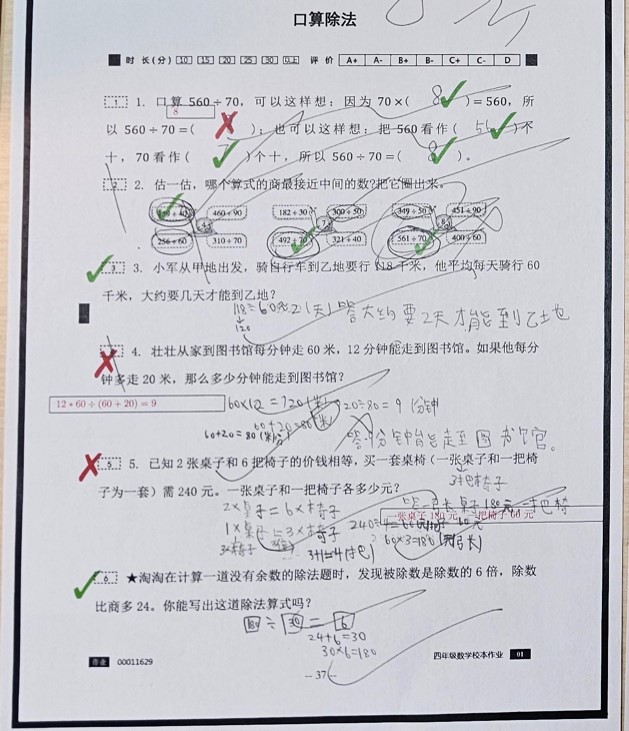
This is the test paper that has been graded using AI
Inspiration
Our AI-Powered Smart Grading Assistant tackles the challenge of grading large volumes of assignments, particularly in courses like Data Structures and Algorithms (DSA). Teachers often lack time for personalized feedback, so we developed a solution that automates grading, provides detailed feedback, and promotes deeper learning.
Using large language models (LLMs) and advanced AI, the assistant automates one-click scanning and correction of paper-based homework, identifying errors in algorithmic logic and code structure. It supports Socratic-style learning by asking reflective questions, helping students find solutions and build critical thinking skills. The system also creates personalized "error notebooks" to track and improve students' understanding over time.
Technically, the assistant uses OCR to digitize homework and is built on scalable cloud infrastructure, making it suitable for handling large volumes of assignments with high accuracy. Overall, it streamlines grading while enhancing student learning through guided feedback.
What it does
One-Click Scanning and Trace Correction The assistant includes a one-click scanning feature that digitizes paper homework submissions, making it easy for instructors to upload and analyze student work. Once the homework is scanned, the system performs trace correction, identifying common errors such as logical mistakes, inefficient code structures, and incorrect algorithmic implementations. This feature significantly reduces the manual effort involved in grading while ensuring high accuracy.
Advanced Error Analysis and Personalized Feedback After grading the assignments, the system generates personalized comments tailored to each student's specific mistakes. Rather than merely pointing out the errors, the assistant provides targeted feedback that encourages students to reflect on their thinking process. For example, the system might ask: "Is there a way to optimize the time complexity of your sorting algorithm?" This feedback helps students move toward the correct solution while understanding why their initial approach was flawed.
Custom Error Notebook One of the standout features of the system is the ability to create a personalized error notebook. This notebook is generated based on the mistakes the student makes in their assignments, allowing them to review and correct their errors gradually. Over time, the notebook helps students identify patterns in their mistakes, fostering a deeper understanding of the subject matter and encouraging continuous improvement.
Data-Driven Analysis and Reporting The system supports data analysis by tracking common mistakes across multiple students or assignments. This allows educators to identify areas where students struggle the most, offering insights into how to adapt their teaching methods. The assistant can also generate comprehensive reports for both individual students and entire classes, summarizing performance trends, common errors, and areas for improvement.
How we built it
We built the machine by integrating cutting-edge AI models, OCR (optical character recognition) technology, and a highly efficient scanning process. The system works by scanning student homework papers in bulk, uploading them to a cloud platform, and analyzing each answer using a large multimodal model. This AI model compares the student's answers with a database of correct solutions and marks the assignments accordingly. The final feedback is printed directly onto the original homework sheets, allowing students to see their mistakes and corrections in context.
For the technical backbone, we leveraged Google’s Vertex AI API and the gemma2:2b model for local deployment to enhance the system’s efficiency. This ensured fast and accurate processing of scanned images and the generation of real-time corrections.
Challenges we ran into
One of the main challenges was ensuring the accuracy of the system across a wide variety of question formats, such as multiple-choice, free-form answers, and connection questions. We also faced technical difficulties in processing different handwriting styles, ensuring the system could accurately interpret the text without manual intervention.
Another challenge was developing a user-friendly interface that would appeal to teachers who may not be familiar with advanced technology. We needed to strike a balance between technical sophistication and ease of use to ensure the system could be seamlessly integrated into schools without extensive training.
Accomplishments that we're proud of
We are proud to have successfully deployed the Paper-Based Homework Correction Machine in two schools, where it has processed over 10,000 test papers with an accuracy rate of more than 97%. The system has reduced teachers' workload significantly, allowing them to focus on providing more targeted, individualized feedback to students. Our project has garnered widespread attention, with over 5 million views on social media platforms and hundreds of teachers actively applying to test the system in their classrooms.
What we learned
Throughout this project, we gained a deep understanding of the education sector and the unique challenges that teachers face. We also learned how to apply cutting-edge AI and machine learning technologies to practical problems, balancing the need for high performance with ease of use. Another key lesson was the importance of continuous iteration and improvement, as we incorporated feedback from teachers to refine the system's functionality.
What's next for Smart Printer
- In subsequent versions, we aim to integrate the assistant with popular coding environments (e.g., VS Code) to provide real-time feedback as students work on their assignments. This would extend the Socratic questioning process to live coding sessions.
- We plan to expand the assistant’s capabilities to support additional subjects beyond DSA, such as mathematics and computer science, broadening its application across academia.
- Enhancements to the adaptive learning system will allow for more dynamic feedback, evolving in response to student performance trends and offering increasingly personalized hints and suggestions as students improve.

Log in or sign up for Devpost to join the conversation.