-

Product Hero
-

Product Concept
-
Interactive Simulation
-
Arm64 Evidence
-
System Architecture
-

Human Impact



Inspiration
Medication routines look simple until something unusual happens: a dose window passes without an opening, the wrong compartment is selected, the same compartment is opened twice, or the internet goes down when a reminder matters most.
These moments are also deeply private. A medication-support device should not need to stream every interaction to the cloud before it can provide a useful response.
Smart Pillbox AI began as a broader medication-care product. For the Arm Create: AI Optimization Challenge, we built a new standalone Physical AI edition around a focused question:
Can privacy-sensitive pillbox events become fast, local and bounded safety actions on Arm64, even when internet connectivity is unavailable?
What it does
Smart Pillbox AI converts pillbox interaction events into medication-adherence risk signals and clear, bounded actions.
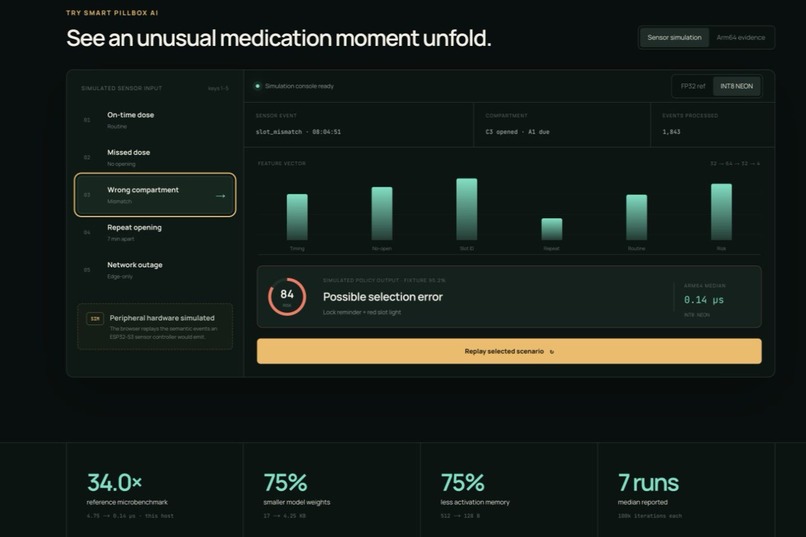
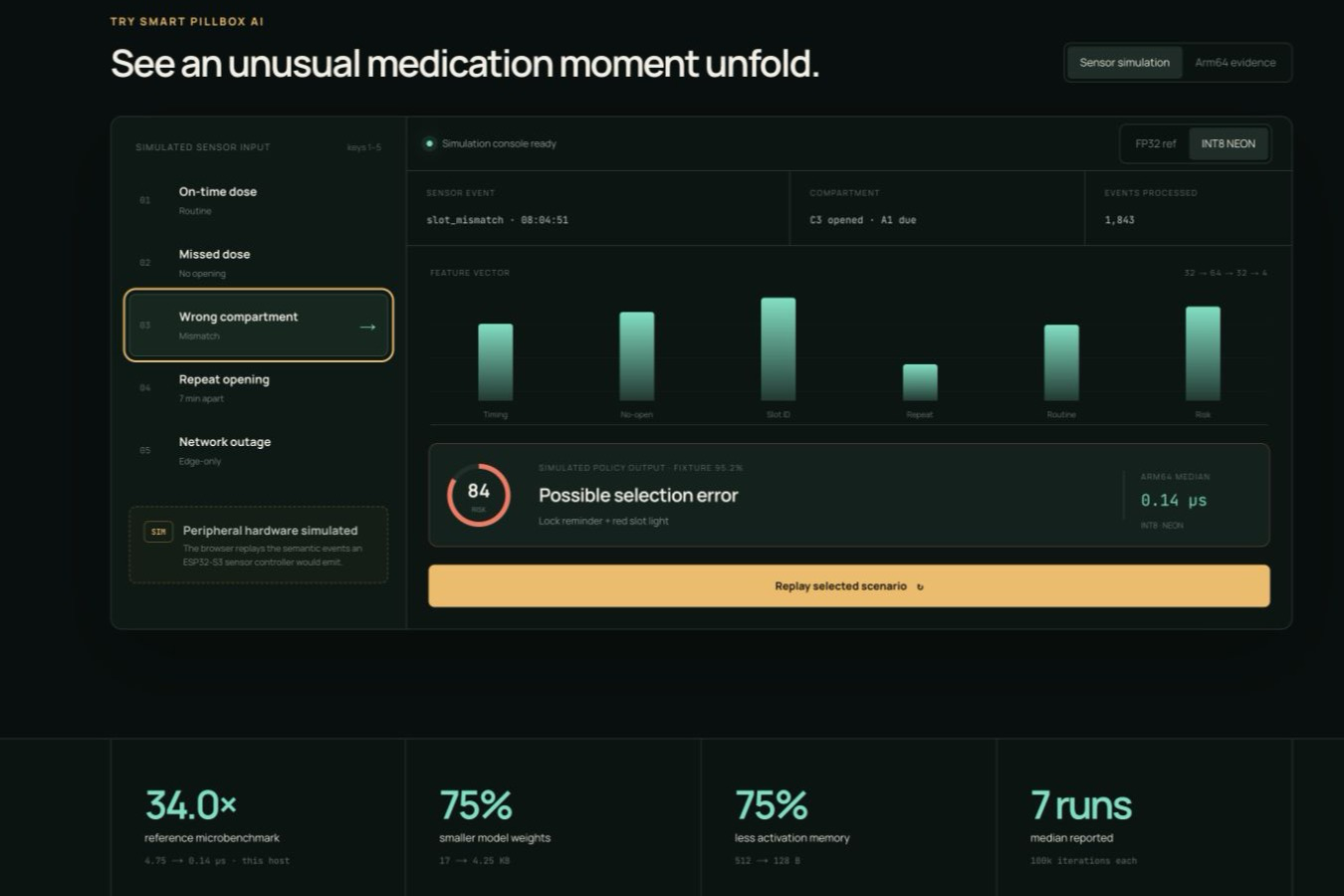
The interactive judge experience replays five production-shaped sensor scenarios: an on-time compartment opening, a scheduled dose window with no opening, a wrong-compartment selection, a repeated opening shortly after a previous event, and a network outage requiring an offline response.
These scenarios use the same semantic boundary intended for a future physical pillbox: timing, compartment, repeat-opening, routine-deviation and connectivity signals.
A compact 32 × 64 × 32 × 4 representative MLP inference kernel produces four risk scores on Arm64: expected routine, missed window, selection error and duplicate risk. A deterministic safety policy maps those scores to bounded actions such as a green confirmation light, an amber reminder, a red compartment light, a confirmation hold, an offline queue or a caregiver alert.
Smart Pillbox AI does not claim that medication was swallowed. It does not change dosage guidance or diagnose a condition. It observes compartment interactions and schedule-risk patterns, then helps a person or caregiver decide whether follow-up may be useful.
How we built it
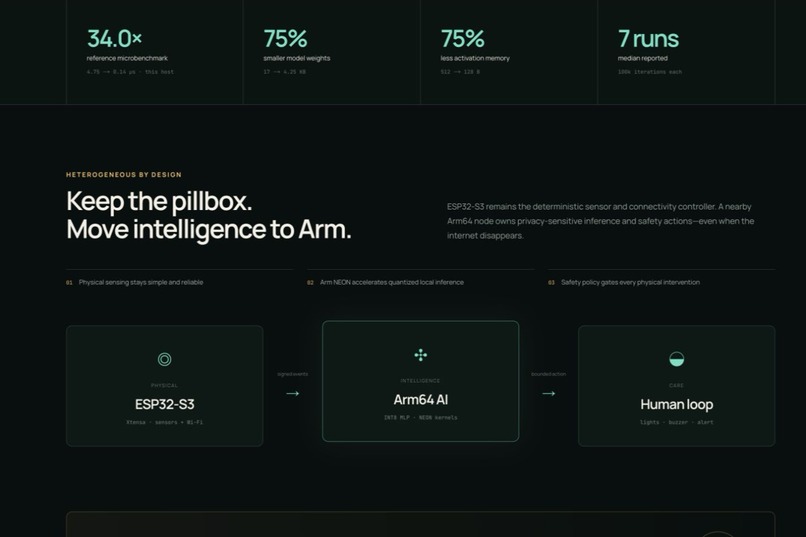
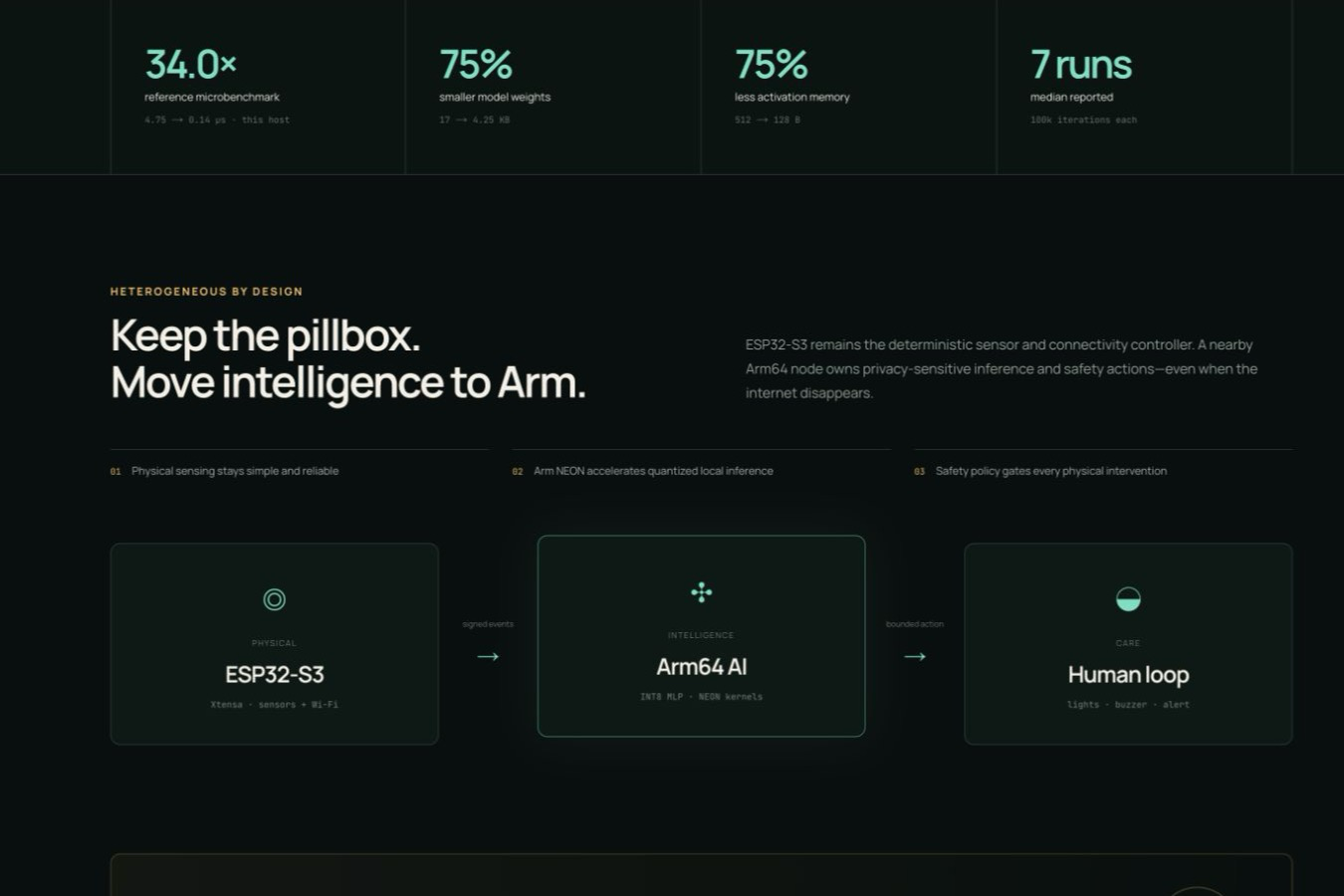
The architecture deliberately separates sensing, intelligence and human action.
Pillbox interaction or simulated sensor fixture
                    ↓
ESP32-S3 sensor and connectivity controller (Xtensa LX7)
                    ↓
Signed semantic event envelope
                    ↓
Arm64 local inference module (INT8 + Arm NEON)
                    ↓
Deterministic safety policy
                    ↓
Light · reminder · local queue · caregiver alert
The ESP32-S3 is not an Arm processor. It remains the low-level sensing and connectivity controller. The AI inference tier runs on nearby Arm64 compute.
Because physical pillbox hardware was not available during this competition build, the browser uses clearly labelled simulated sensor fixtures. The native optimization evidence was measured separately on an Apple Silicon Arm64 machine. A physical device can later replace the fixtures without changing the event-to-inference interface.
The native inference kernel is written in portable C. It includes an INT8 weight and activation path, AArch64 Arm NEON intrinsics for vector multiply-accumulate, fixed-point activation and requantization, a deliberately scalar FP32 reference path, a scalar fallback for non-NEON compilation and an Arm64-gated benchmark harness.
The product experience was built with React, TypeScript and Next.js-compatible server rendering, then deployed independently on Cloudflare Workers.
Arm optimization and measurable results
This project is not only an application running on an Arm computer. It includes a directly inspectable Arm-specific inference optimization.
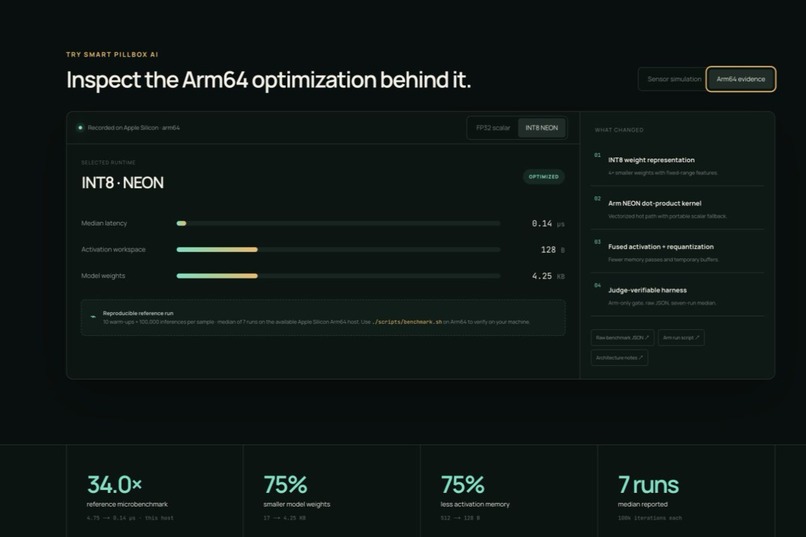
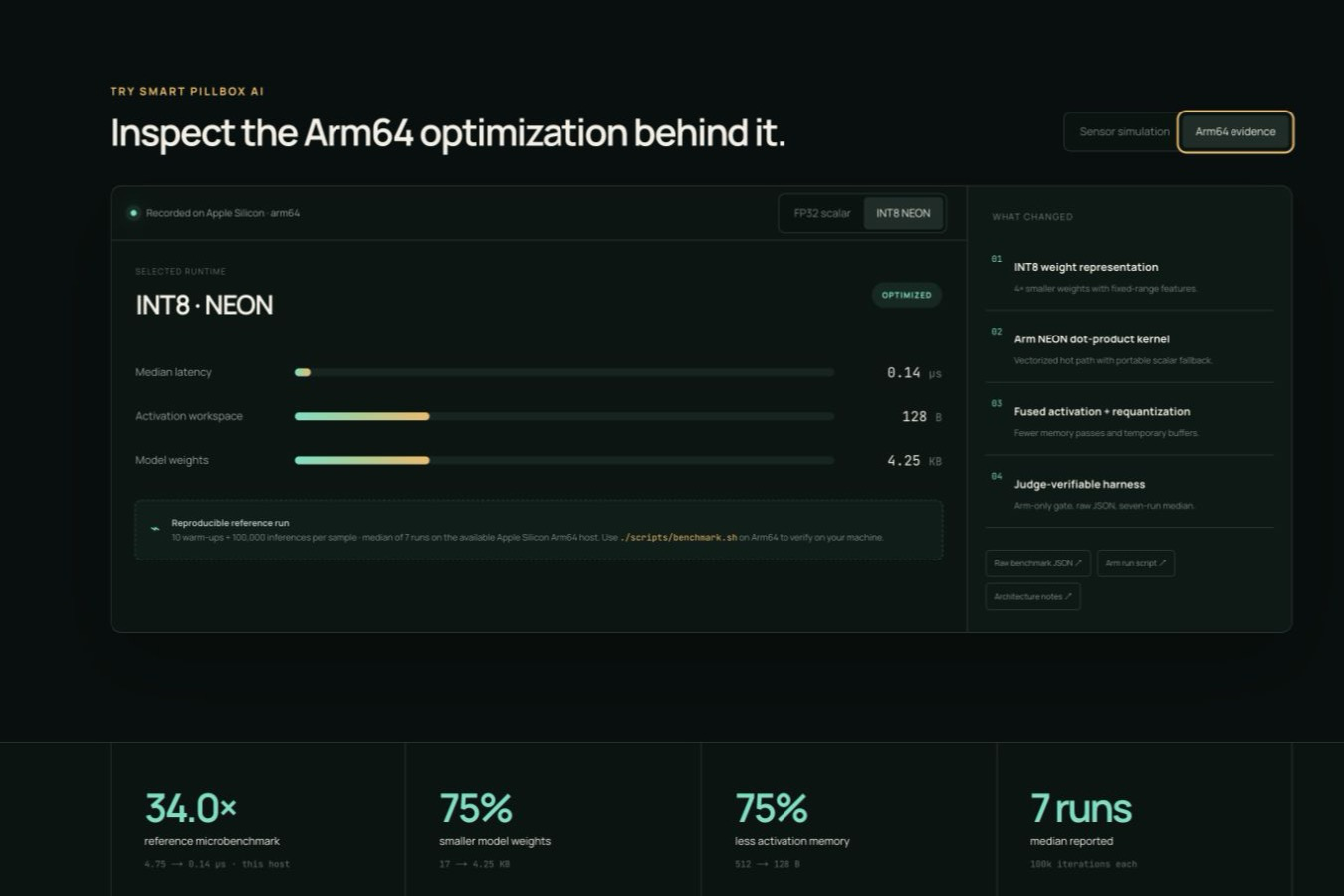
The optimized path uses INT8 weights and activations together with Arm NEON vector operations. The reference path uses FP32 data and is deliberately kept scalar so the effect of the optimized data path is reproducible and visible.
On the recorded Apple Silicon Arm64 development host:
| Measurement | FP32 scalar reference | INT8 Arm NEON | Improvement |
|---|---|---|---|
| Median inference latency | 4.751 µs | 0.140 µs | 34.02× faster |
| Weight storage | 17,408 bytes | 4,352 bytes | 75% smaller |
| Activation workspace | 512 bytes | 128 bytes | 75% smaller |
The benchmark uses an Arm64 architecture check, native -O3 compilation, 10 warm-up iterations, 100,000 inference iterations per run, seven measured runs and the median result.
These are host-specific kernel measurements, not universal device-performance claims or end-to-end clinical results. The raw JSON, source code and benchmark command are included so judges can reproduce the result on Apple Silicon, Raspberry Pi 4/5 or another Arm64 Linux machine.
Significant competition-period upgrades
Smart Pillbox AI existed before the challenge, but this submission is a new standalone competition sibling rather than a rename of the original product.
During the competition period we added a standalone public competition repository, a native Arm64 C inference kernel, an INT8 Arm NEON fast path, a scalar FP32 comparison path, a reproducible Arm64-only benchmark harness, checked-in raw performance evidence, an explicit ESP32-S3 versus Arm64 architecture, five simulated Physical AI sensor scenarios, deterministic medication-safety action boundaries, a judge-facing interactive product experience, independent Cloudflare deployment and competition-specific documentation.
The original Smart Pillbox AI repository and production deployment remain separate and unchanged.
Challenges we ran into
ESP32-S3 is not Arm
The original hardware concept used an ESP32-S3, whose CPU is Xtensa LX7. Calling that an Arm inference platform would have been technically incorrect.
We solved this by treating ESP32-S3 as the deterministic sensor controller and introducing a real Arm64 inference tier. This produced a more honest and reusable heterogeneous edge architecture.
Demonstrating Physical AI without physical hardware
We did not have access to the pillbox or an Arm single-board computer during the competition build. Instead of pretending the browser was physical hardware, we separated the evidence into two layers: simulated, production-shaped sensor fixtures for the product interaction, and native measurements collected on an actual Arm64 host for the inference optimization.
Every simulated element is labelled in the interface and documentation.
Safety boundaries
Medication software must not turn a model score directly into medical advice. We therefore placed a deterministic policy after inference. The model can identify an unusual interaction pattern, but only bounded reminder and confirmation actions are allowed.
Accomplishments that we are proud of
- Built a public demo that judges can use without hardware, login credentials or installation
- Produced a native, reproducible Arm64 optimization artifact instead of only displaying simulated metrics
- Reduced kernel weight and activation memory by 75%
- Measured a 34.02× latency improvement over the scalar FP32 reference on the recorded Arm64 host
- Kept the ESP32-S3 and Arm64 roles technically accurate
- Created an offline-capable sense–decide–act loop with explicit human safety boundaries
- Packaged the architecture, benchmark, evidence and product story into a reusable open-source reference
What we learned
The most important lesson was that running an AI application on an Arm device is not the same as optimizing it for Arm.
A strong optimization story needs a visible baseline, an inspectable technical change, measurable results, reproducible instructions and honest limitations.
We also learned that Physical AI does not require pretending that every prototype is already finished hardware. A well-defined simulated sensor boundary can support rapid development, provided the simulation and native evidence are clearly separated.
What's next for Smart Pillbox AI
The next phase is to connect the semantic event interface to real ESP32-S3 firmware and an Arm Linux edge module such as a Raspberry Pi.
We also plan to train and calibrate the risk model with consented medication-routine data, add automated FP32/INT8 output-agreement and safety-policy tests, measure end-to-end latency and power consumption on Raspberry Pi, sign and authenticate events between the sensor controller and Arm module, test offline caregiver synchronization and evaluate Arm embedded deployment targets for a smaller production device.
Build and validation
git clone https://github.com/stephenovo/Smart-Pillbox-AI-Arm-Physical-AI.git
cd Smart-Pillbox-AI-Arm-Physical-AI
npm install
npm test
npm run dev
Then open http://localhost:3000.
Reproduce the native benchmark on Apple Silicon, Raspberry Pi 4/5 or another Arm64 Linux machine with a C compiler:
uname -m
npm run benchmark:arm -- 100000
The script refuses to report an Arm benchmark on a non-Arm64 host.
Why it should win
Smart Pillbox AI combines a relatable real-world problem, an immediately usable product experience and a measurable Arm-specific optimization.
It is honest about what is simulated, reproducible where performance is claimed, careful about medication-safety boundaries and structured so other developers can reuse the Arm64 inference kernel, benchmark harness and heterogeneous Physical AI architecture.
Built With
- arm
- arm64
- c
- cloudflare
- edge
- esp32-s3
- int8
- neon
- next.js
- node.js
- physical
- react
- typescript
- vite
- workers
- wrangler

Log in or sign up for Devpost to join the conversation.