-
-
IU Demo
Inspiration
Have you ever been excited to try a top-rated restaurant, only to walk away feeling that the experience didn't live up to the stars? That exact feeling inspired me. We all know the most honest feedback is buried in the comments, revealing the real details about food, service, and ambiance. But who has the time to sift through all of them?
This project was designed to address that issue. It does the hard work for you, analyzing what previous diners are really saying to give you clear, trustworthy insights. The goal is simple: to help you find the perfect dining experience, every time.
What it does
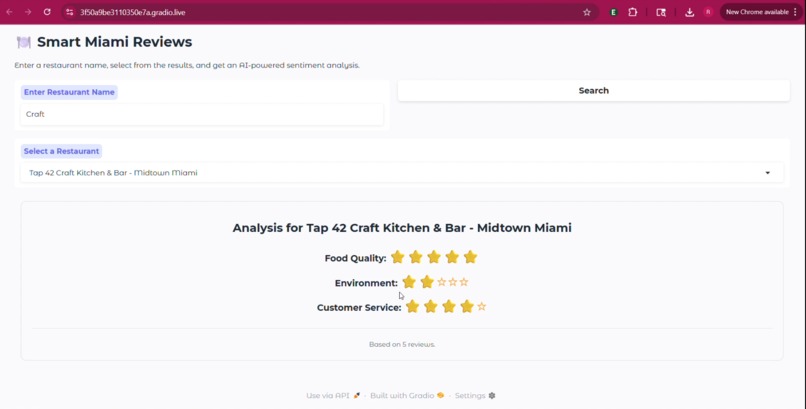
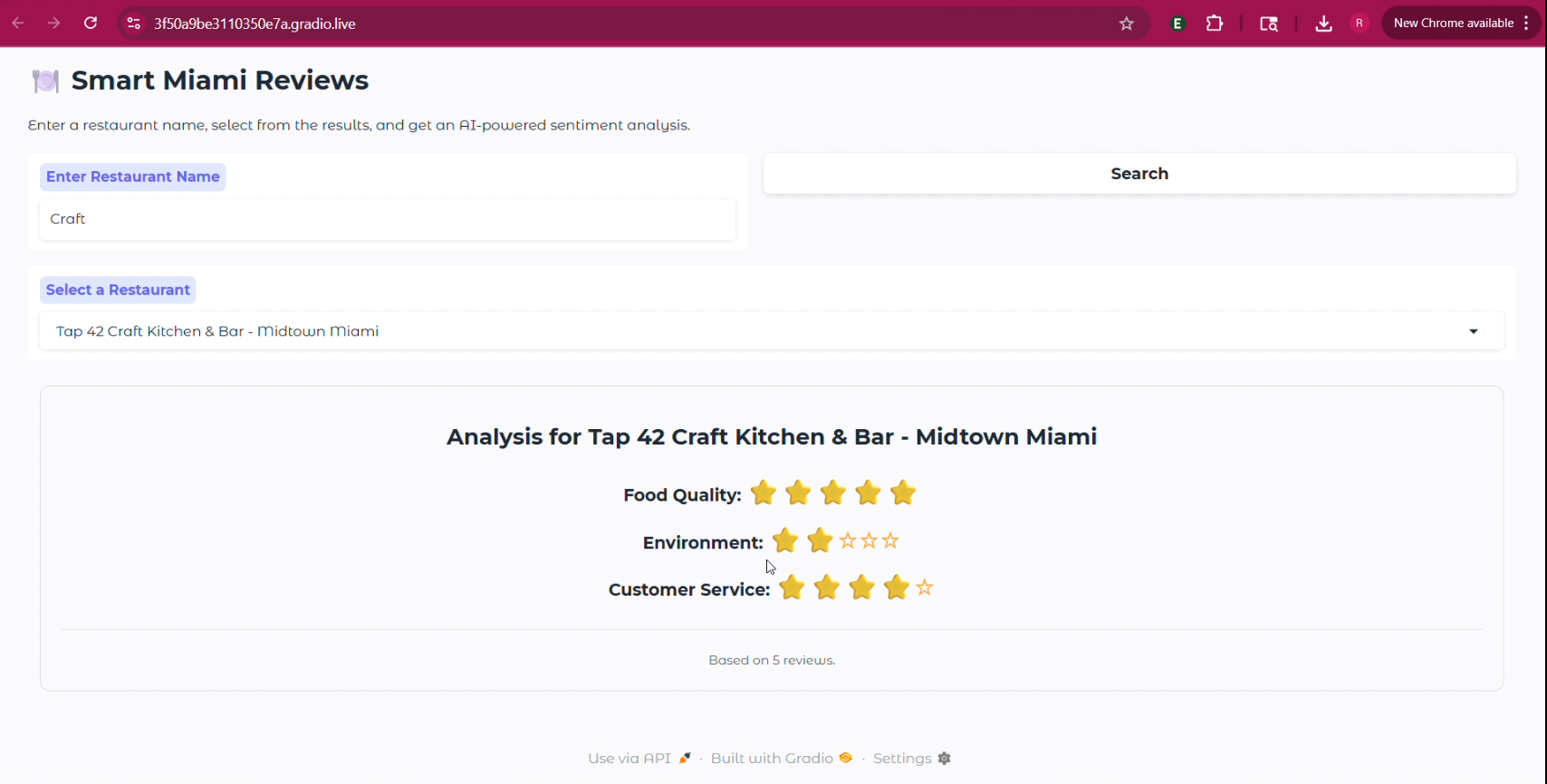
Smart Miami Reviews begins by collecting real user comments for restaurants across Miami directly from sources like Google Maps. Instead of taking star ratings at face value, the tool uses the AI power of Google's Gemini API to analyze the text of each review, looking for nuanced feedback. The analysis specifically evaluates sentiment across three key aspects: Food Quality, Environment, and Customer Service. Finally, these insights are delivered through a simple, interactive dashboard where users can instantly see an AI-generated summary, helping them make smarter and more informed dining decisions.
How we built it
The process began with data extraction, using the Google Maps API to collect user reviews for restaurants in Miami. Each review's text was then cleaned and prepared for analysis through a standard preprocessing pipeline using Python libraries like pandas and nltk. The core analysis was performed by sending the processed text to Google's Gemini API, which used a zero-shot learning prompt to classify sentiment for three key aspects: Food Quality, Environment, and Customer Service. Finally, the results were integrated into an interactive web dashboard built with Gradio, providing an accessible interface for users to explore the AI-generated insights.
Challenges we ran into
One of the main challenges we faced was API integration and rate limiting, particularly with securely handling keys for Google Maps and Gemini while staying within usage constraints. During testing, the Gemini API’s free-tier limits frequently caused quota errors, emphasizing the need for strong error handling and awareness of real-world API restrictions. We also encountered data volume constraints, since the Google Maps API only returns a limited number of relevant reviews, leaving even popular restaurants with smaller datasets than desired. Addressing this would require more advanced data collection strategies beyond the project’s scope.
Accomplishments that we're proud of
Designing an End-to-End NLP Pipeline A major accomplishment of this project was the successful design and implementation of a complete Natural Language Processing pipeline. We orchestrated a full-stack workflow that starts with live data extraction from the Google Maps API, moves through a robust text cleaning and preprocessing stage with NLTK, performs advanced analysis using the Gemini API, and concludes by presenting the results in a user-friendly web interface.
Implementing an Interactive Gradio Dashboard We successfully developed a clean and intuitive user interface using Gradio that makes the complex AI-driven insights accessible to anyone. This dashboard serves as a powerful proof-of-concept, effectively demonstrating the practical value of the sentiment analysis by allowing users to interact with the results in a simple and direct way.
Effective API Integration Under Constraints Despite the inherent API challenges, particularly the limitations on the volume of reviews that could be fetched at one time, we are proud of successfully integrating both the Google Maps and Gemini APIs. The project proved that even with a limited dataset, our methodology could produce meaningful, aspect-based sentiment scores, validating the core concept of the tool.
What we learned
Practical API Implementation This project provided valuable hands-on experience in implementing and managing multiple external APIs. A key lesson was the importance of secure API key management, which we handled using Google Colab's secrets management. We also learned how to build a resilient pipeline that can handle real-world API constraints, such as the rate limiting encountered with the Gemini API.
** Pipeline Design with LangChain ** We gained significant experience in designing an end-to-end NLP pipeline using modern frameworks. A major takeaway was learning how to effectively use LangChain to orchestrate the interaction between our preprocessed data and the Gemini large language model. This project demonstrated how to structure a complex workflow, from initial data gathering all the way to a final, user-facing application.
What's next for Smart Miami Reviews
Looking ahead, we aim to expand our data ingestion pipeline to overcome review limitations by exploring strategies for extracting larger volumes from the Google Maps API and integrating additional platforms to build a more comprehensive dataset. On the user experience side, we plan to enhance the dashboard with dynamic visualizations such as sentiment trend charts, word clouds, and map-based views to make insights more engaging and intuitive. Ultimately, our long-term vision is to develop a dedicated mobile application for iOS and Android, giving tourists and residents real-time, AI-powered dining recommendations on the go and fully positioning the project as a practical smart city tool.


Log in or sign up for Devpost to join the conversation.