-
-
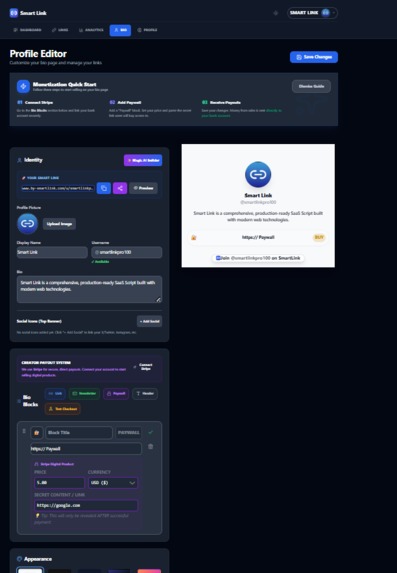
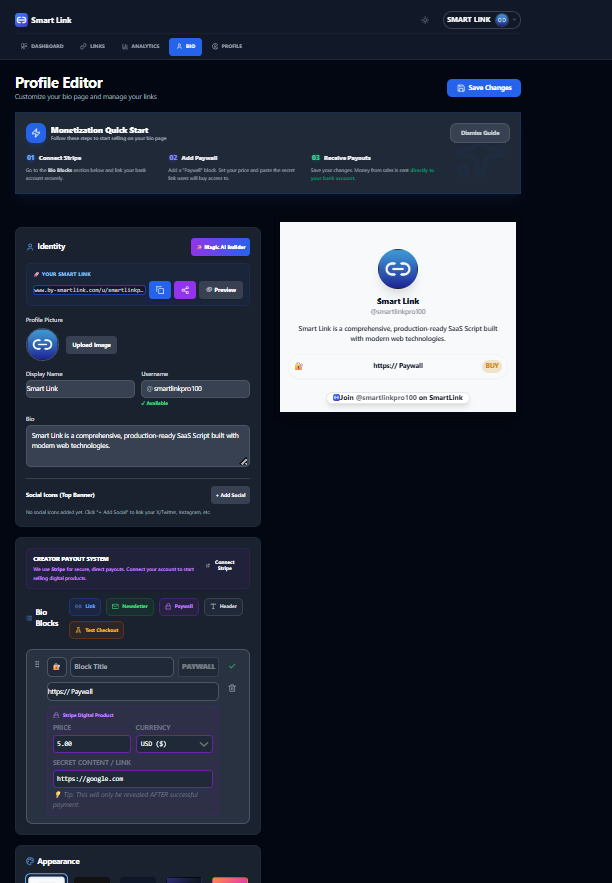
Bio Page Builder: Interface allowing users to design and customize landing pages with custom links and themes.
-
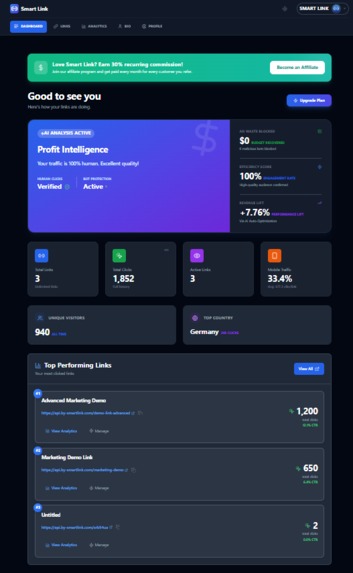
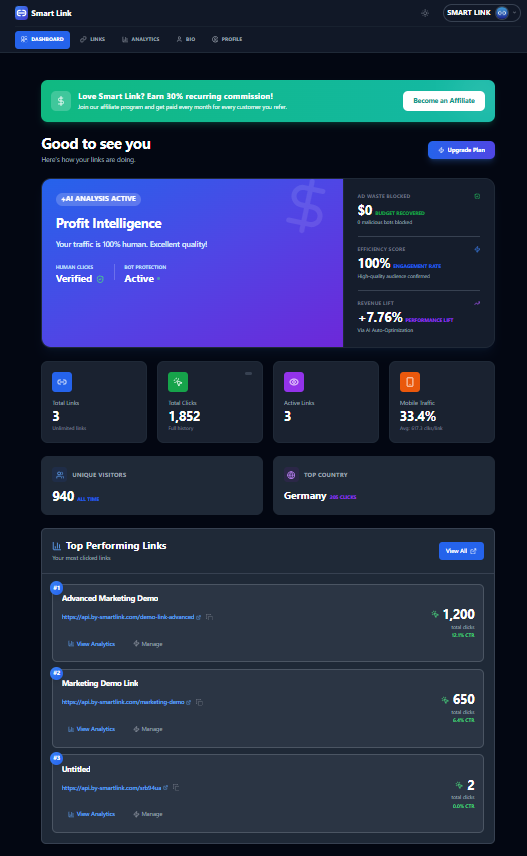
User Dashboard: Main interface displaying real-time link clicks, total redirects, and traffic analytics.
-
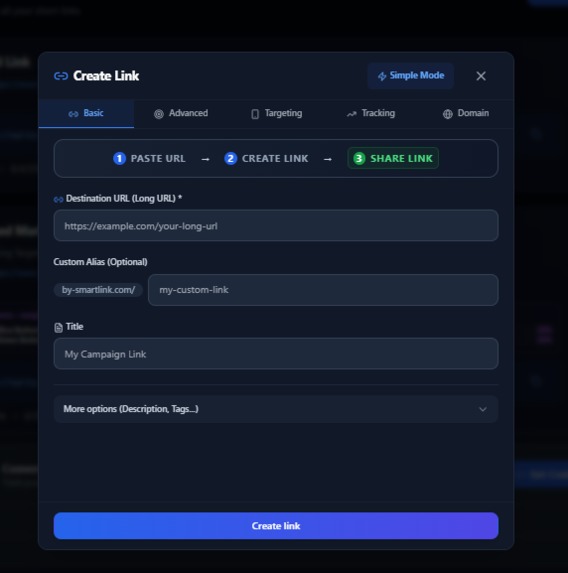
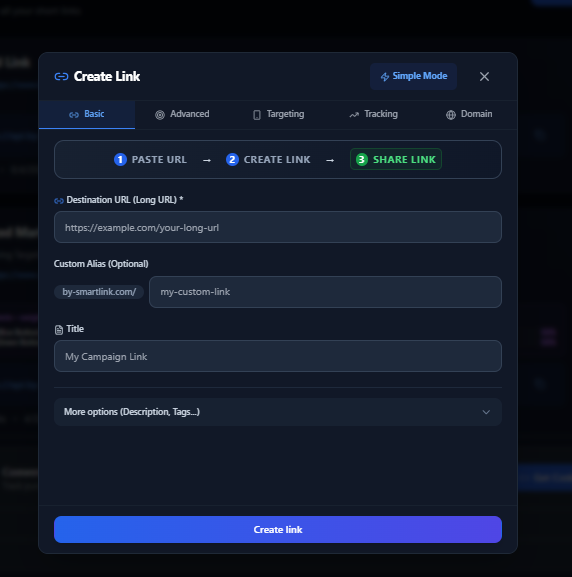
Link Creator: Simple and fast interface to generate new short links with custom routing parameters.
-
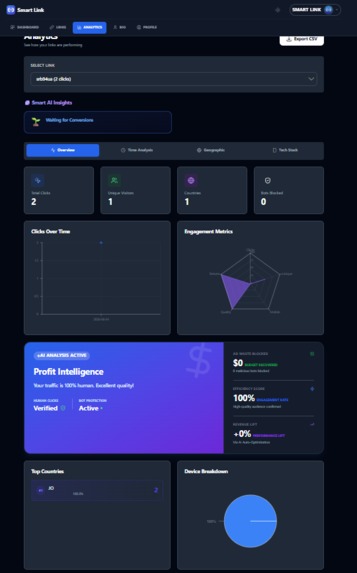
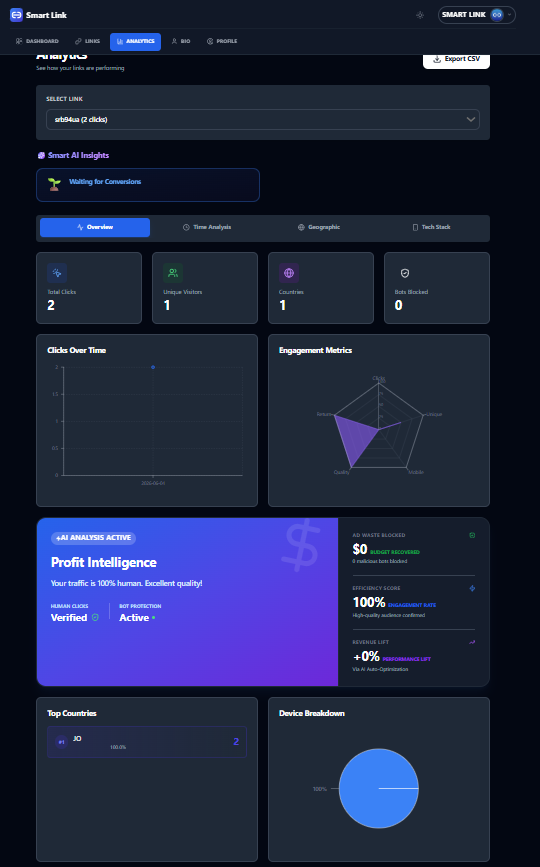
Link Analytics: Granular details showing device types, referrers, and geolocations for short links.
Content creators, influencers, and small business owners spend hundreds of dollars monthly on tools like ClickMagick, Voluum, and Linktree — just to manage links and track who clicks them. We wanted to build one unified platform that replaces all of them, and takes it a step further by letting AI agents do the complex marketing setup work on behalf of the user.
What it does
Smart Link is a link management and bio page platform with native WebMCP agent support.
Users can create short links, build bio landing pages, track real-time analytics by country and device, run A/B tests to find the best-performing URL, and protect their links from bot traffic automatically.
What makes Smart Link unique is its agent-native design. When opened in ChatGPT's in-app browser or Chrome with WebMCP enabled, the platform exposes structured WebMCP tools that AI agents can use:
shorten_url: Instantly shortens any URL and enables bot protection in a single step.get_link_analytics: Retrieves total clicks, human vs. bot breakdown, top countries, device types, and performance statistics for any link by short code.calculate_ad_savings: Calculates wasted ad spend saved from bot and datacenter traffic filtering based on monthly ad spend.check_url_reputation: Analyzes destination URLs for potential proxy, VPN, or datacenter bot flags before launching paid ad campaigns.
How we built it
The platform is built with a full-stack architecture using React, Tailwind CSS, and Vite on the frontend, deployed on Vercel. The backend runs on Node.js with Express.js, MongoDB Atlas for persistence, and Redis for caching and rate limiting, deployed on Render. We use Brevo for email campaigns and Lemon Squeezy for subscription billing.
For WebMCP, we registered the agent tools directly using document.modelContext.registerTool() and window.navigator.modelContext.registerTool(). We built dedicated API endpoints hosted on Render that AI agents call to perform URL shortenings, analytics queries, and ROI calculations seamlessly.
Challenges we ran into
The biggest technical challenge was achieving sub-150ms redirect speeds while simultaneously recording click analytics and running bot detection in real time. We solved this by caching redirect targets in Redis and processing analytics asynchronously in the background on our Render backend.
For WebMCP, the challenge was designing structured public APIs that expose advanced features to AI agents while preventing abuse through strict rate limiting and URL safety checks on every request.
Accomplishments that we are proud of
Smart Link is a live production application with real tracked clicks — built and running smoothly on Render. We are proud of achieving sub-150ms redirect performance and being one of the first link management platforms to expose agent-native WebMCP tools, allowing marketers to set up complex bot-protected campaigns through a single natural language conversation.
What we learned
We learned how to design APIs that serve both humans and AI agents — with clear parameter descriptions, meaningful error messages, and structured responses that agents can reason about. We also deepened our understanding of Redis caching strategies for high-traffic systems on cloud platforms like Render.
What's next for Smart Link
We plan to add create_bio_page and run_ab_test as new WebMCP tools, letting agents build full landing pages and launch experiments without touching the UI. We also plan to add AI-powered UTM suggestions and integrate Facebook Pixel and Google Tag Manager firing directly through the agent tools.
Built With
- a/b-testing
- axios
- bot-detection
- brevo
- express.js
- geo-targeting
- github
- google-safe-browsing-api
- javascript
- jwt
- lemon-squeezy
- mongodb
- mongoose
- node.js
- qr-code
- rate-limiting
- react
- redis
- render
- rest-api
- tailwind-css
- utm-tracking
- vercel
- vite
- webmcp

Log in or sign up for Devpost to join the conversation.