-
-
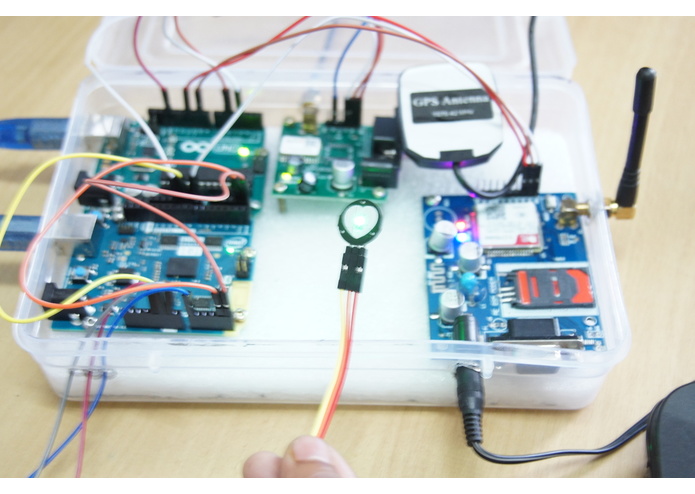
Our system ;)
-
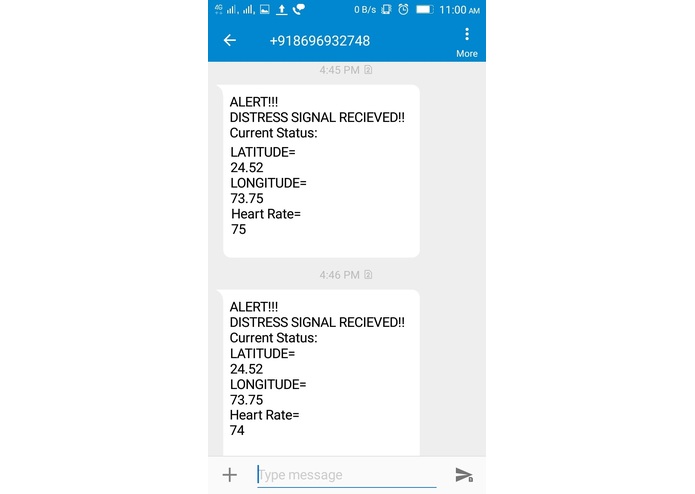
Message recieved

Inspiration
In any emergency situations like air crash or shipwreck, a life jacket plays a very important role in saving one’s life. But the survivors may have to wait for very long for rescueing as the rescuers don’t have the precise location of the victim. The victim may die during these hours. Here our smart jacket comes handy . Using this, the rescue operation can be done very easily and in the short duration .
What it does
This smart life jacket houses various sensors to track and transmit various parameters. This jacket consists of pulse sensor that is used to track the Heart rate of the victim in BPM A GPS module is also fitted in the jacket which acquires the GPS coordinates and transmits them A GSM module is provided which transmits the data to the concerned authority through mobile phone over GSM network All these modules are interfaced with an ARDUINO 101 board which fetches the data from sensors, analyze them and sends it.
How we built it
Firstly, We interfaced all the sensors to Arduino 101. The sensors included arduino 101, GSM Module, GPS Module, Pulse sensor and a GSM Module. Using arduino IDE, we programmed arduino 101. At last the, whole system was integrated to form a unit which was then waterproofed and then attached on the Life jacket.
Challenges we ran into
The path was not at all easy. At the beginning, We implemented the whole concept on arduino uno and everything went just perfectly. When we switched to arduino 101, Problems kicked in. It was heartbreaking to know that 101 does not support Software serial which means we cannot use GSM Module on 101 and our whole project came to a hault. Then finally we decided to connect the GSM Module on arduino uno and connected the uno and 101 through I2C protocol.
Accomplishments that we're proud of
Getting our idea selected in top 150 ideas in intel hacks 2017 was the biggest achievement for us which we are really proud of. And completing the project successfully is also an achievement for us.
What we learned
We learned many things because of this project. We learnt how two controllers communicate using I2C protocol. Learnt how the pulse sensor works. Got to know a lot about hardwae programming.
What's next for Smart Life Jacket
With some more modification like adding solar panels to power the system. Right now, the system works on 12V DC batteries.
Built With
- arduino-101
- ardunio-uno
- c
- cpp
- gps-module
- pulse-sensor


Log in or sign up for Devpost to join the conversation.