
Inspiration
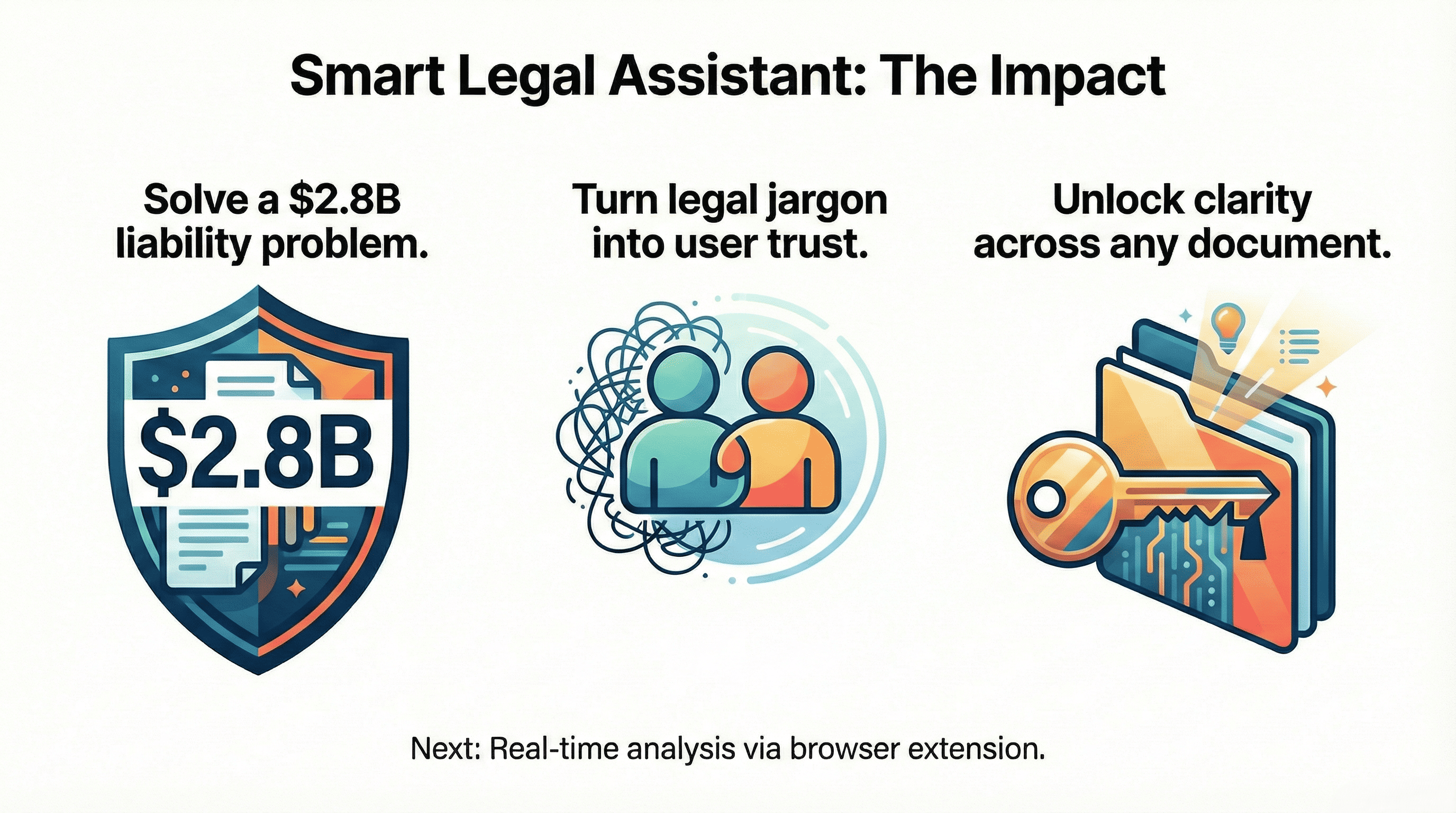
Digital consent has become a broken ritual. Users routinely accept Terms & Conditions they do not understand, while companies expose themselves to regulatory, reputational, and legal risk through opaque agreements. Despite rising enforcement under regulations like GDPR and CCPA, there is still no simple, user-facing way to see and understand legal risk before consent is given.
We were inspired by this imbalance: one side signs blindly, the other side accumulates silent power. We wanted to build a system that restores transparency without requiring users to be lawyers or companies to overhaul their legal processes.
What it does
Smart Legal Assistant for Digital Consent analyzes digital contracts (Terms & Conditions, Privacy Policies, user agreements) and converts them into clear, visual risk intelligence.
The system:
- Identifies high-risk clauses such as mandatory arbitration, liability limitations, data sharing, and rights transfers
- Translates complex legal language into plain-English explanations
- Assigns structured risk scores across key legal categories
- Visualizes risk using dashboards that allow instant comparison and understanding
- Clearly distinguishes informational analysis from legal advice
The result is a fast, understandable overview of what a user is really agreeing to—and where the risk lies.
How we built it
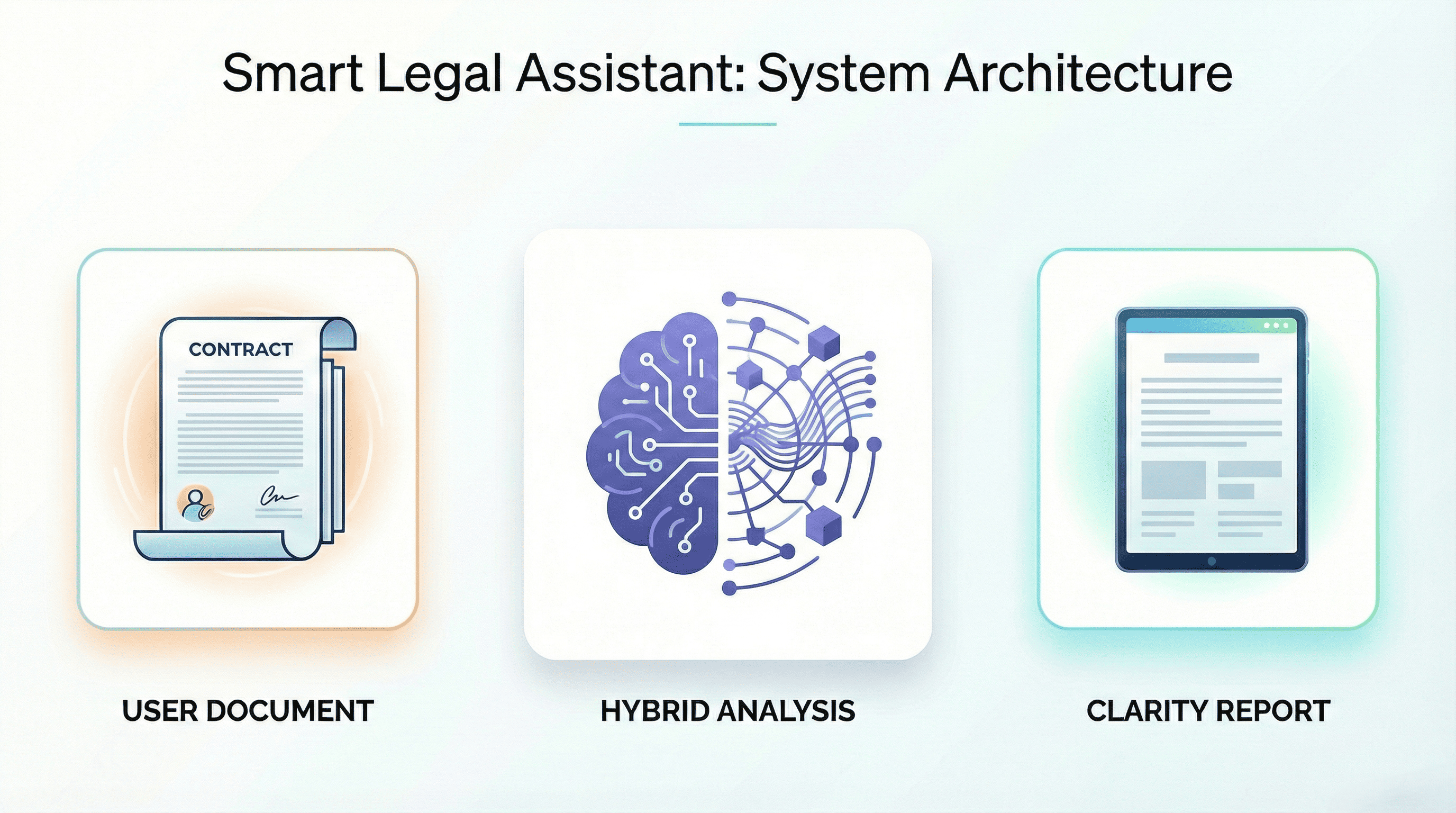
We designed the system as a hybrid intelligence pipeline, prioritizing reliability, explainability, and production realism.
Core architecture:
- Deterministic rule engine (regex + legal patterns) to anchor detection of known high-risk clauses
- Gemini API for semantic analysis of nuanced legal language and context
- Structured JSON output to ensure consistent downstream visualization
- Risk aggregation logic combining rule-based certainty with AI-based interpretation
- Visualization layer that converts analysis into intuitive risk dashboards
The frontend is built with a modern React + TypeScript stack, while the analysis layer is designed to work in both live AI mode and deterministic fallback mode (DEV_MODE), ensuring demo reliability and architectural robustness.
Challenges we ran into
- LLM reliability: Legal language is precise, and hallucinations are unacceptable. We addressed this by anchoring the system with deterministic rules and using AI only where semantic understanding is necessary.
- Scope control: Legal tech easily becomes unbounded. We deliberately limited scope to digital consent instead of attempting to solve “all legal analysis.”
- Explainability: Risk scores without explanations are meaningless. We ensured every flagged item includes a human-readable justification.
- Demo safety: External APIs can fail. We implemented a full fallback mode so the system remains functional and demonstrable under all conditions.
Accomplishments that we're proud of
- Built a hybrid AI system, not just an LLM wrapper
- Created a demo that transforms real, well-known Terms & Conditions into instantly understandable insights
- Achieved high clarity without offering legal advice or making compliance claims
- Designed the system to be reusable across domains (finance, healthcare consent, employment contracts)
- Delivered a production-minded architecture within hackathon constraints
What we learned
- Judges value clarity and trust more than model complexity
- Hybrid systems outperform pure AI approaches in high-stakes domains
- Visualization is a force multiplier for understanding risk
- Strong scope discipline is more impressive than feature breadth
- Real-world problems with regulatory implications resonate deeply with technical decision-makers
What's next for Smart Legal Assistant for Digital Consent
- Browser extension for real-time consent analysis before users click “I Agree”
- Domain adapters for employment contracts, insurance policies, and financial agreements
- Organization-level dashboards for compliance and legal teams
- Support for additional regulatory frameworks and jurisdictions
- Open-sourcing parts of the rule engine to encourage transparency and community trust

Log in or sign up for Devpost to join the conversation.