-
-
Laundry Care demo_1
-
Laundry Care demo_2

Inspiration
The concept for Smart Laundry Scanner emerged from a widespread challenge: the complexity of clothing care labels often leads to laundry errors, resulting in damaged garments or wasted resources. This common issue inspired an AI-powered mobile app designed to simplify laundry care, preserve clothing, and promote sustainable practices, targeting a global audience of students, professionals, and households with eco-conscious solutions.
What it does
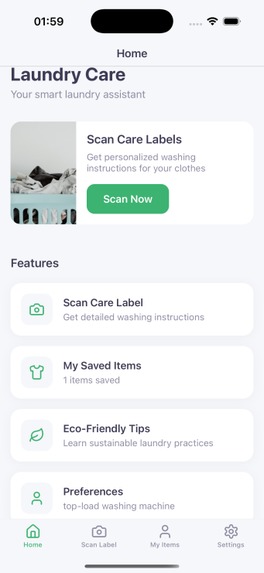
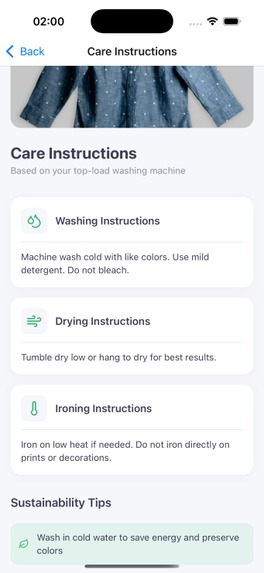
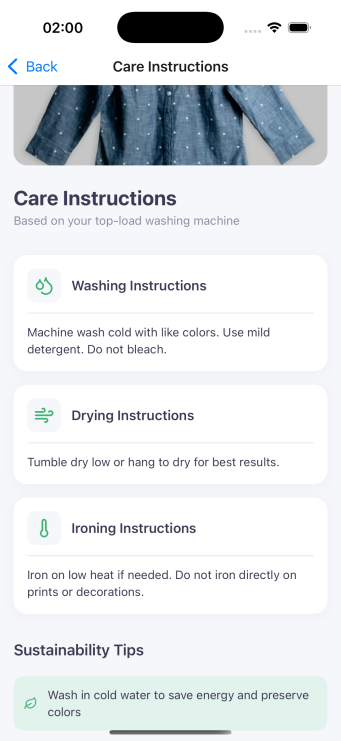
Smart Laundry Scanner enables users to photograph clothing care labels, leveraging AI to decode symbols and provide clear, tailored washing instructions, such as “Machine wash at 30°C, air dry.” It also offers eco-friendly tips, like using cold water to reduce energy consumption, to extend clothing lifespan and minimize environmental impact. The app aims to make laundry intuitive and sustainable through a user-friendly interface, addressing a universal pain point for a global audience.
How we built it
The plan is to develop a beta Minimum Viable Product (MVP) during the AIWA Hackathon with the following features:
- Photo Upload: A React Native interface for capturing care label images via the device camera.
- AI Symbol Recognition: Using AI APIs (e.g., Gemini) to identify common laundry symbols, paired with a JSON lookup table for instructions.
- Care Instructions: Display simple guidance (e.g., “No tumble dry”) based on AI output.
- Sustainability Tip: Provide one eco-tip per scan (e.g., “Use eco-detergent”).
- UI: A clean, responsive design for demo appeal.
The envisioned tech stack includes React Native for the AI-powered mobile app, Flask (Python) for backend processing, and a JSON dataset of 10-15 common laundry symbols to ensure lightweight development within the 48-hour hackathon.
Challenges we ran into
Several challenges are anticipated in building the MVP:
- AI Accuracy: Achieving reliable symbol recognition with existing AI models may require fine-tuning or a robust rule-based fallback system.
- Data Limitations: Curating a concise dataset of laundry symbols for the MVP is essential to stay within scope.
- Time Constraints: Balancing AI integration, frontend polish, and backend stability in 48 hours will demand strict prioritization.
- User Experience: Designing an intuitive UI for non-technical users requires careful iteration to ensure clarity and engagement.
These challenges will be tackled with mentor guidance and a focus on delivering a functional prototype.
Accomplishments that we're proud of
As an idea submission, the team is proud of conceptualizing a globally relevant solution that combines AI innovation with sustainability. Developing a clear vision for an app that addresses a universal pain point, while planning a feasible MVP for the hackathon, reflects a strong entrepreneurial mindset. Crafting a scalable concept with potential for real-world impact positions Smart Laundry Scanner as a standout entry.
What we learned
Through ideating Smart Laundry Scanner, insights were gained into the potential of AI-driven computer vision to solve everyday problems. Researching laundry care challenges highlighted the global demand for sustainable solutions. Planning the MVP taught the importance of prioritizing core features and leveraging AI models to meet tight deadlines, while envisioning a user-centric design emphasized the value of accessibility.
What's next for Smart Laundry Scanner
Post-hackathon, the goal is to refine the MVP into a fully functional app with additional features:
- Eco-Product Integration: Partner with eco-friendly detergent brands via APIs for tailored recommendations.
- Multilingual Support: Expand accessibility for global users.
- Scalability: Explore integrations with smart washing machines or retail platforms.
Smart Laundry Scanner aims to become a leading solution for sustainable laundry care, empowering households and brands worldwide to reduce waste and preserve clothing.


Log in or sign up for Devpost to join the conversation.