-
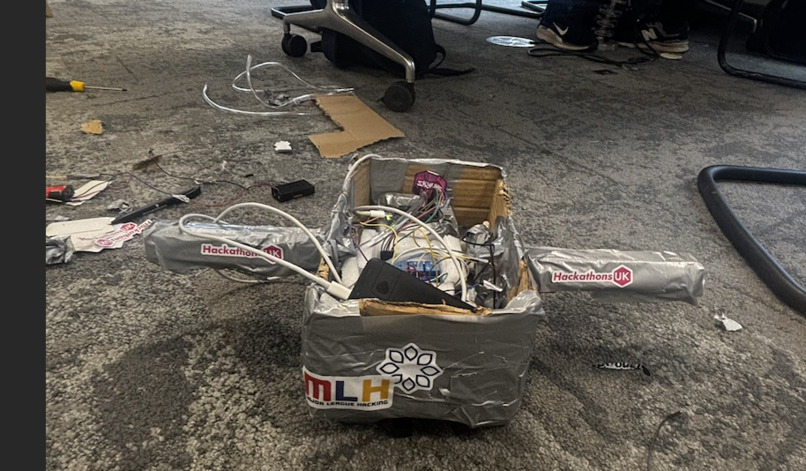
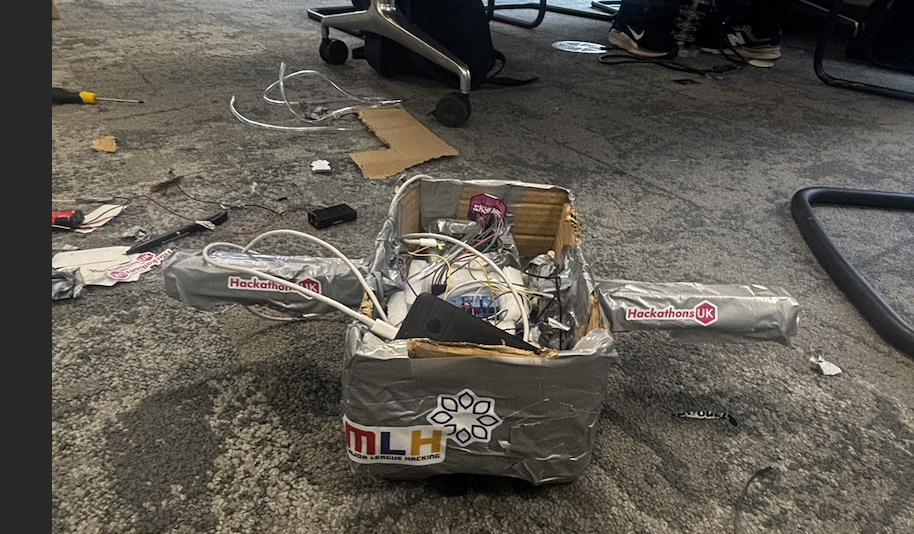
my prototype
-
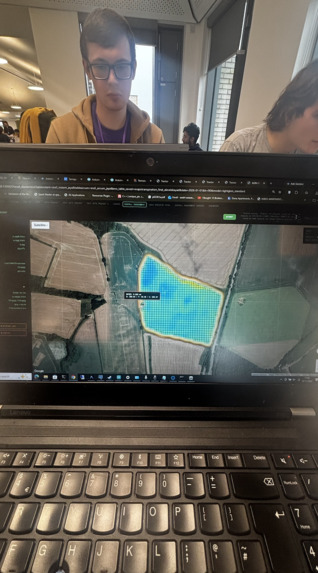
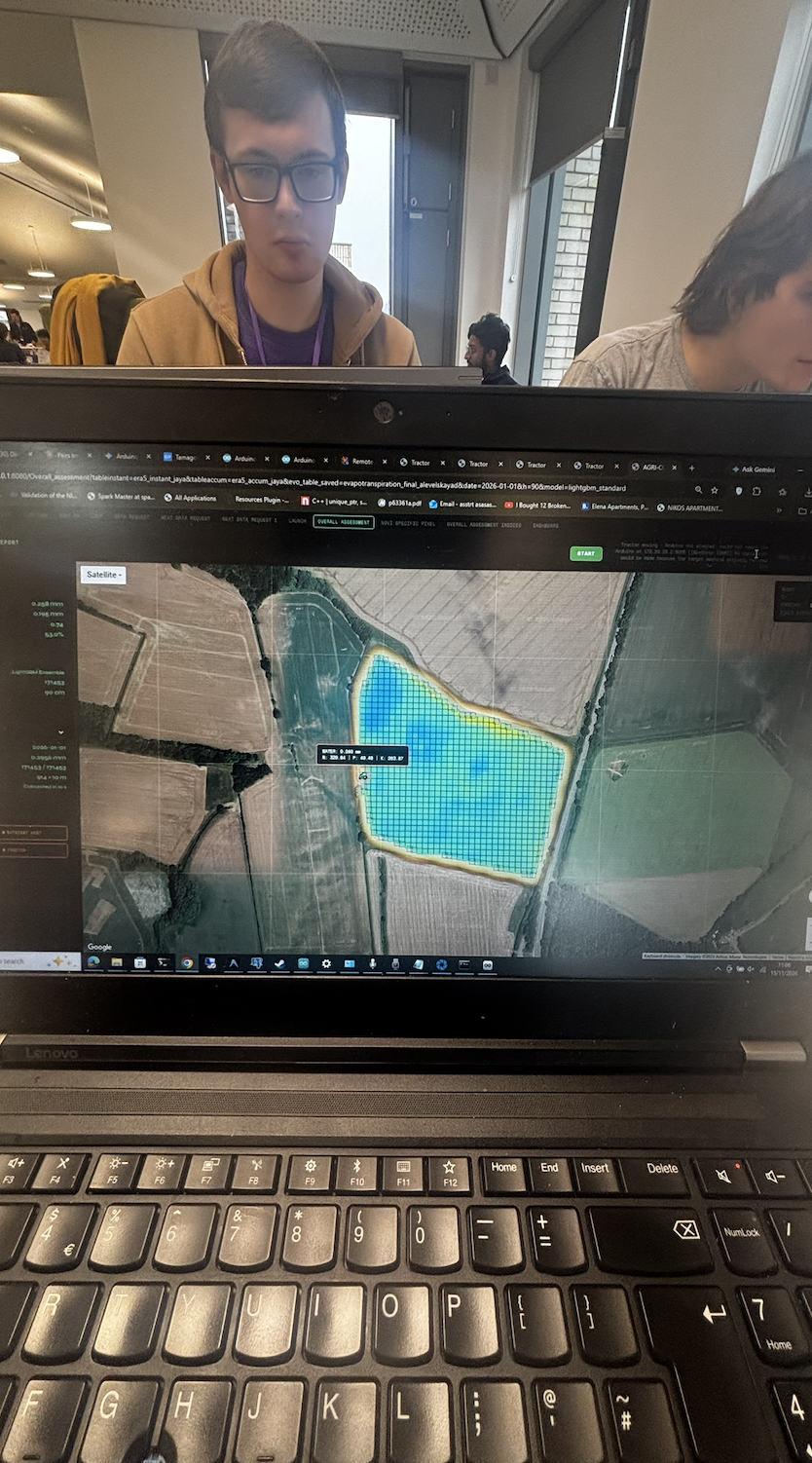
heatmap
Inspiration
Farming uses around 70% of the world's fresh water, and much of it is wasted. Meanwhile, the conversation about technology and resources is dominated by AI, not by food security. I wanted to build something that puts precision technology in the hands of farmers who can't afford it. Commercial precision-irrigation software costs around £10,000 a month, and a suitable tractor around £200,000. Farmers in water-scarce, low-income countries are priced out of the very tools that would help them most.
What it does
Smart-irrigation tells a farm exactly how much water, nitrogen, phosphorus and potassium each part of a field needs, then delivers it.
- It pulls free satellite and weather data and forecasts crop water demand ahead of time.
- It produces a heat map of the field showing how much water and which nutrients are needed in each area, down to roughly one square metre.
- The farmer sends that map wirelessly to an Arduino-controlled robot, which drives up and down the field on its own and irrigates each section according to the map, to the millimetre.
The software is completely free and the hardware costs about £20. It is designed to retrofit onto any tractor rather than replace it.
How we built it
Physical prototype: An Arduino, a relay board, two servo motors and two drive motors. Together they drive the vehicle up and down a field autonomously and trigger solenoid valves to irrigate.
Data pipeline:
- Satellite imagery comes from Copernicus (Sentinel-2) and weather data from ERA5 and other meteorological sources.
- Everything streams into Tiger Data (time-series Postgres), which stores the raw data and the model outputs.
- Models are trained on a high-performance machine, and the results are written back to Tiger Data so they can be queried at any time.
The science:
- Vegetation indices (NDVI, NDMI, NDWI, EVI, SAVI) are calculated from the satellite bands.
- The Penman-Monteith equation gives reference evapotranspiration. I then split it into water lost to evaporation and water actually used by the crop, and factor in soil type and surface runoff.
- Satellite data is noisy, so I smooth it with a Savitzky-Golay filter and harmonic reconstruction.
- LightGBM (benchmarked against XGBoost and Random Forest) forecasts future water and nutrient requirements. On validation it reached R² = 0.94 for ET₀ and was 3.7x faster to train than XGBoost.
- Nitrogen, phosphorus and potassium requirements are estimated using empirical formulas from published research.
- The result is a per-pixel heat map that the farmer receives and sends to the robot.
Challenges we ran into
- Clouds. They blank out satellite readings, which is exactly when you still need to decide how much to water. Forecasting the gaps was the core problem.
- Noisy data. My first smoothing method, a Fourier-based filter, didn't hold up, so I switched to Savitzky-Golay.
- Scale. The dataset grew to over a billion pixel rows and my code slowed to a crawl. I had to redesign the pipeline and optimise queries before it became usable.
- Data leakage. Time-series forecasting makes it easy to accidentally let future information into training, so I had to be strict about how I split the data.
- Choosing the right model. LSTMs looked attractive, but Sentinel-2 only goes back to 2015, which isn't enough history per pixel, so I used SARIMA as a stepping stone and LightGBM as the final model.
Accomplishments that we're proud of
- A complete pipeline from raw satellite data to a working robot that drives and irrigates on its own.
- A forecasting model that beats XGBoost and Random Forest on both accuracy and training speed.
- Bringing the hardware cost down to about £20 with entirely free software, so that cost is not what stops a farmer from using it.
What we learned
- Real-world data is messy, and most of the work is cleaning and validating it before any model can be trusted.
- Choosing a model means weighing accuracy against speed, data requirements and cost, not just picking the most advanced one.
- How to connect software, data engineering, machine learning and physical hardware into one system.
What's next for Smart-irrigation
- Field-testing the robot on a real farm and calibrating it against measured soil moisture.
- Handling mixed crops and different growth stages within a single field.
- Daily automatic model retraining on fresh data.
- Partnering with farmers and agricultural groups in water-scarce regions so the tool reaches the people it was built for.
Built With
- machine-learning
- prayers
- python
- sql
- sqlite
- tigerdata

