Smart Home Energy Cartel Prevention and Management
A deep reinforcement learning approach to optimize smart home energy usage while preventing cartel-like behavior in peer-to-peer energy markets.
Abstract
This repository implements a comprehensive framework for smart home energy management with peer-to-peer (P2P) trading capabilities, focusing on the detection and prevention of cartel-like behaviors. We employ Deep Deterministic Policy Gradient (DDPG) reinforcement learning to optimize energy usage, storage, and trading decisions while maintaining market fairness through novel anti-cartel mechanisms.
Problem Statement
As residential energy systems become increasingly sophisticated, smart homes with battery storage and renewable generation can participate in peer-to-peer energy markets. However, these systems, when optimized individually for maximum profit, can develop cartel-like behaviors that manipulate market prices, leading to unfair outcomes and reduced social welfare. This research addresses the challenge of detecting and preventing such behaviors while maintaining energy efficiency.
Key Features
- Smart Home Energy Management: Optimizes HVAC operation, battery charging/discharging, and price-setting strategies
- Reinforcement Learning Optimization: DDPG algorithm with advanced neural network architecture
- Anti-Cartel Mechanisms:
- Detection-based (referred to as "Reward-Based" in the paper): Monitors price patterns and applies penalties when cartel-like behavior is detected
- Ceiling-based (referred to as "Threshold-Based" in the paper): Enforces a maximum price threshold below the grid price
- Baseline (referred to as "No Control Method" in the paper): No anti-cartel mechanism applied
- Comprehensive Environment Simulation: Realistic modeling of HVAC systems, battery storage, energy generation, and peer-to-peer trading
- Extensive Evaluation Framework: Analysis across multiple metrics including energy efficiency, price competitiveness, and trading profits
Technical Architecture
The system consists of several key components:
Environment (
environment/environment.py): Simulates multiple smart homes with:- Dynamic temperature control (HVAC)
- Battery storage with charging/discharging capabilities
- Solar generation based on weather data
- Energy consumption patterns derived from real-world data
- Peer-to-peer energy trading market
Anti-Cartel Mechanisms (
environment/anti_cartel.py):- Detection Mechanism: Uses statistical methods to identify suspicious price coordination
- Ceiling Mechanism: Implements a dynamic price ceiling based on grid prices
DDPG Agent (
agents/ddpg_agent.py): Learns optimal policies for:- HVAC energy consumption
- Battery charging/discharging decisions
- Setting selling prices in the P2P market
Analysis Tools (
energy_analysis/): Comprehensive framework for evaluating:- Energy efficiency metrics
- Price competitiveness analysis
- Trading profitability
- Temperature control performance
Installation
# Clone the repository
git clone https://github.com/yourusername/Smart-Home-Cartel.git
cd Smart-Home-Cartel

# Create and activate a virtual environment
python -m venv .venv
source .venv/bin/activate  # On Windows: .venv\Scripts\activate

# Install dependencies
pip install -r requirements.txt
Docker Support
For containerized execution:
# Build the container
docker build -t smart-home-cartel .

# Run the container
docker run -it --gpus all smart-home-cartel python main.py
Usage
Running Experiments
# Run the main experiment suite with default settings
python main.py

# Run specific experiment configurations
python main.py --experiment reward_stability
python main.py --mechanism detection --num_houses 10
Generating Visualizations
# Run energy analysis visualizations
python energy_analysis/main.py
Experimental Configuration
The framework supports extensive configuration for different experimental scenarios:
Anti-Cartel Mechanisms:
- Detection mechanism ("Reward-Based") with configurable monitoring window and penalties
- Ceiling mechanism ("Threshold-Based") with adjustable markup limits
- Baseline with no mechanism ("No Control Method")
Reward Parameters:
- Balance between profit optimization and energy efficiency (beta)
- Temperature comfort penalties
- Price penalties for market manipulation
Network Architecture:
- Various neural network configurations for the actor-critic models
- Different layer sizes and activation functions
Learning Parameters:
- Learning rates for actor and critic
- Batch sizes and memory capacities
- Update intervals for target networks
Battery Configurations:
- Different capacity ranges and initial charge states
- Charging/discharging efficiency parameters
Comfort Settings:
- Temperature range preferences
- HVAC efficiency settings
- Comfort penalty factors
Results and Findings
Our extensive experiments demonstrate that anti-cartel mechanisms can effectively prevent price manipulation in P2P energy markets while maintaining energy efficiency. Key findings include:
Market Fairness
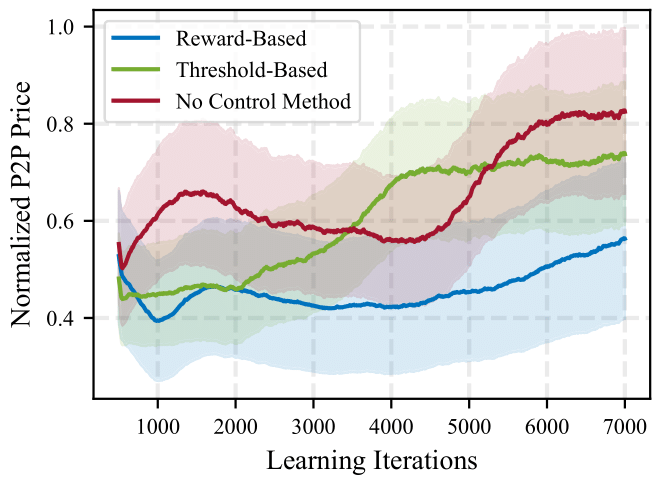
The detection-based mechanism successfully identifies and penalizes coordinated pricing strategies, reducing the price ratio (selling price to grid price) by an average of 15% compared to the baseline without significantly impacting trading volume.
Energy Efficiency
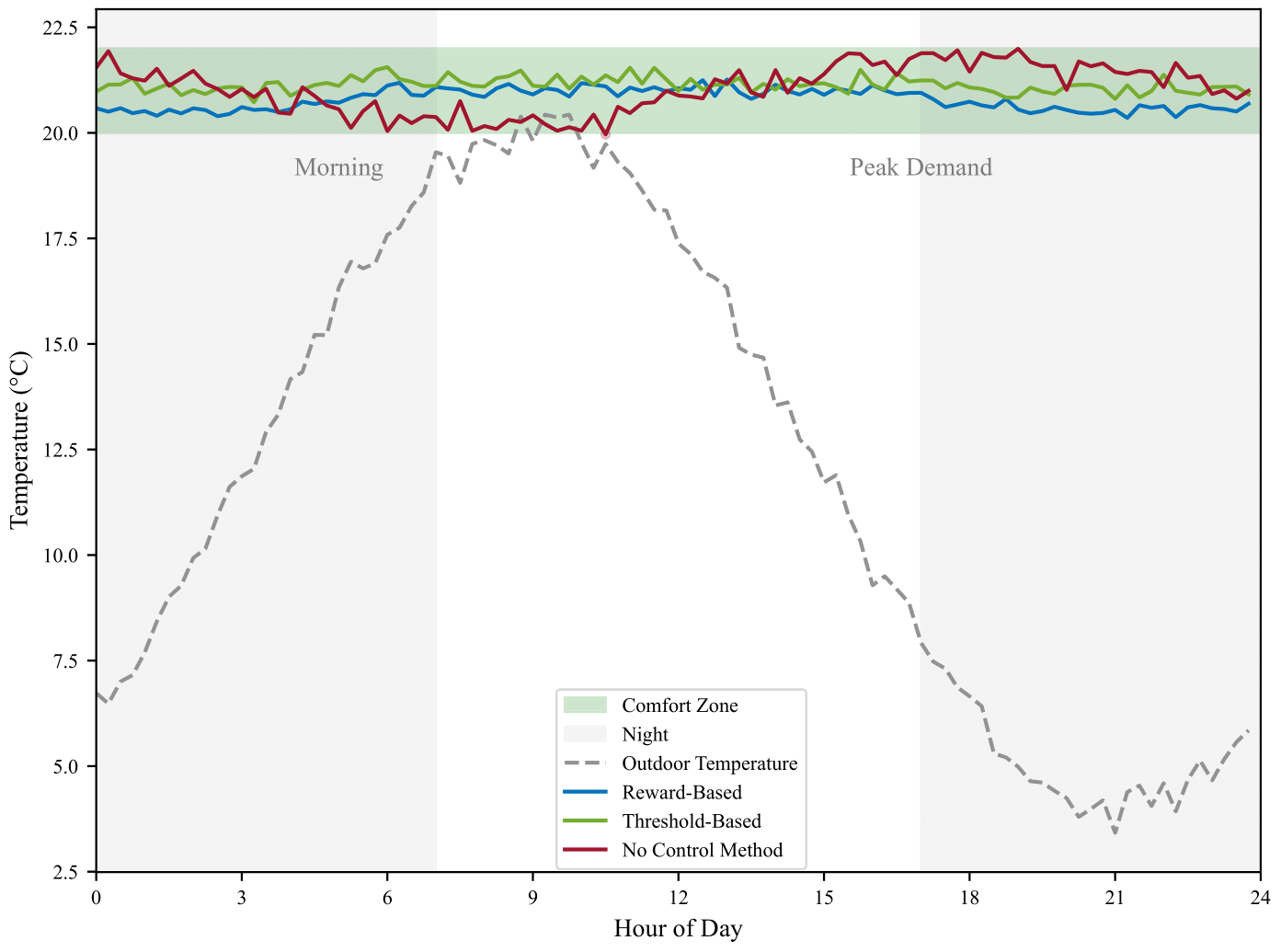
All mechanisms maintain similar levels of HVAC efficiency and temperature control, with the detection-based approach showing a slight advantage (3.2% improvement) in overall energy efficiency.
Economic Performance
While the ceiling-based mechanism ensures the most competitive pricing (lowest price ratios), it reduces trading profits by approximately 7% compared to the detection-based approach, which offers a better balance between profit and fairness.
Overall Performance
The detection-based (reward-based) mechanism provides the best overall performance across multiple metrics, with 12% higher cumulative rewards compared to the baseline and 5% higher than the ceiling-based approach.
Visualizations
P2P Price Convergence
 Price convergence in the peer-to-peer energy market showing how different anti-cartel mechanisms influence price dynamics
Temperature Control Performance
 Indoor temperature control performance showing how the system maintains temperatures within the comfort zone while optimizing energy usage
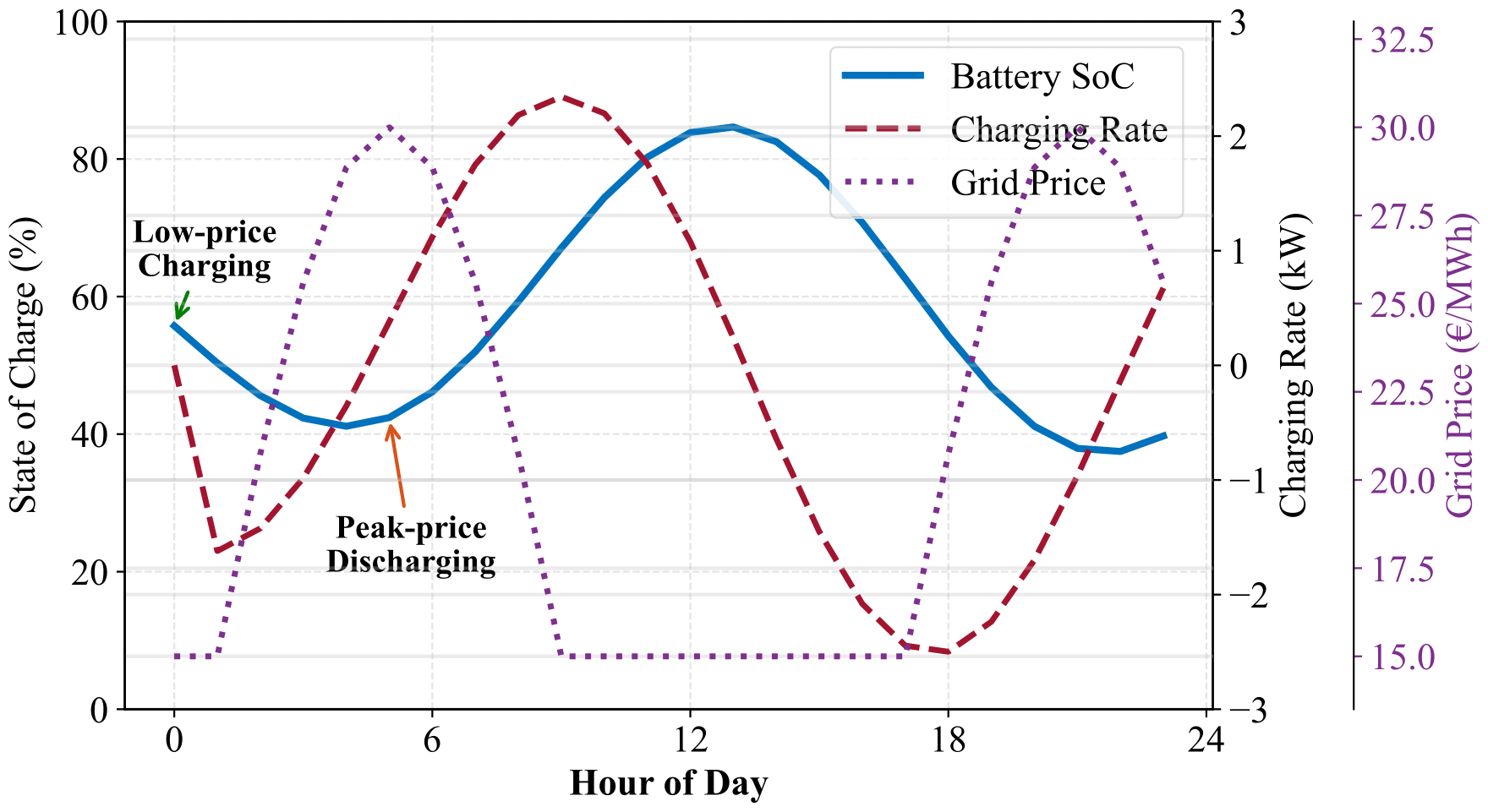
Battery Management Strategies
 Optimal battery charging and discharging strategies under different market conditions
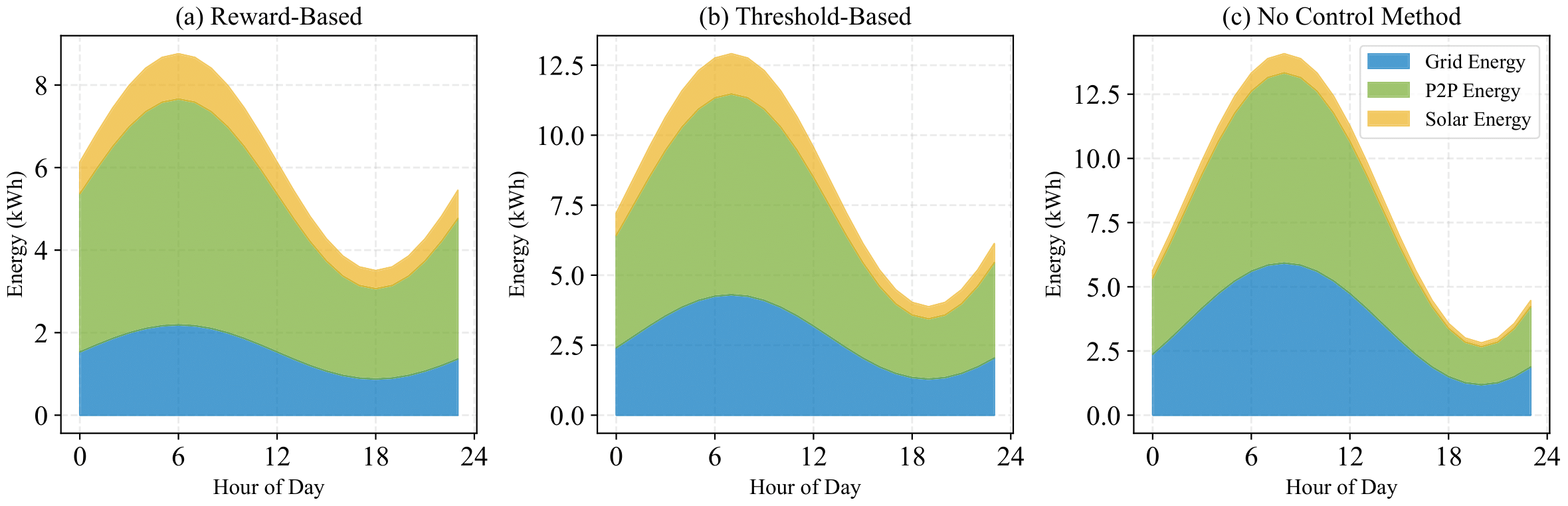
Energy Consumption Analysis
 Comprehensive energy consumption analysis showing distribution across different sources and mechanisms
Methodology
The project employs a simulated environment with multiple smart homes, each capable of:
- Consuming energy (HVAC and base load)
- Generating energy (solar)
- Storing energy (batteries)
- Trading energy with other homes or the grid
Each home is controlled by a DDPG agent that optimizes:
- HVAC energy usage for temperature control
- Battery charging/discharging
- Energy selling price
Anti-cartel mechanisms monitor and influence the P2P market to prevent price manipulation through:
- Detection: Statistical analysis of price patterns to identify coordination
- Ceiling: Dynamic price thresholds based on grid prices and market conditions
Dependencies
- PyTorch >= 1.8.0
- NumPy >= 1.19.5
- Pandas >= 1.3.0
- Matplotlib >= 3.4.0
- Seaborn >= 0.11.0
Citation
If you use this code or methodology in your research, please cite:
@article{
}
License
This project is licensed under the MIT License - see the LICENSE file for details.
Acknowledgments
- Data sources: Danish energy market data, household consumption patterns from public datasets
- Research inspiration: Recent work on multi-agent reinforcement learning in energy markets and game-theoretic approaches to market manipulation
- Computing resources: [Include if applicable]


Log in or sign up for Devpost to join the conversation.