💡 Inspiration
Managing a home involves countless small tasks — controlling devices, planning meals, remembering groceries, and keeping up with cleaning schedules. These responsibilities often require switching between multiple apps and tools.
Inspired by AI-powered assistants like Amazon Alexa, we envisioned Smart Home as something more than a voice assistant: an intelligent companion that understands everyday needs, connects household activities, and helps people manage their homes effortlessly.
Our goal is to make smart living accessible, practical, and beautifully simple.
🏡 What We Built
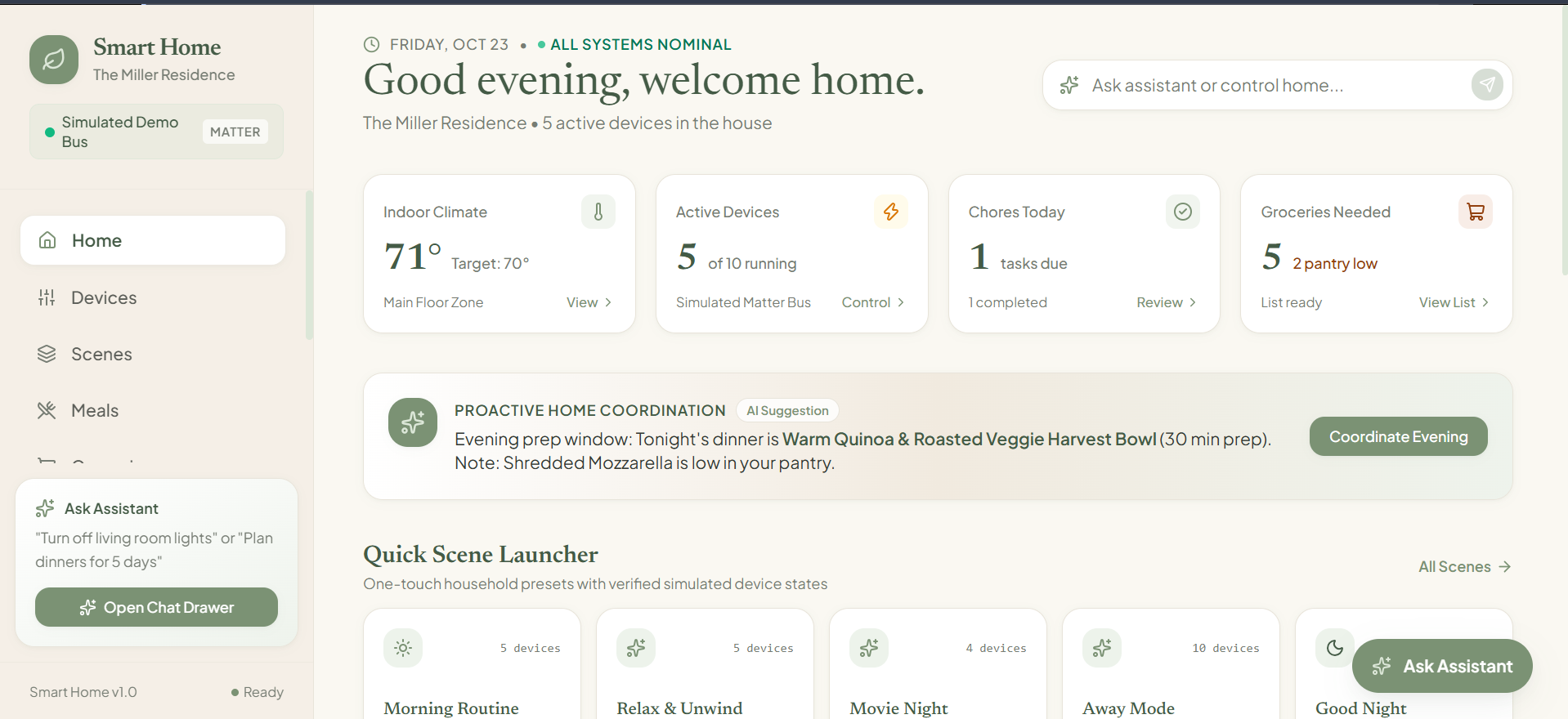
Smart Home is an AI-powered home management assistant that brings everyday household tasks together in one unified platform.
Key features include:
- Smart Device Control: Manage lights, appliances, and room-based devices through a centralized dashboard.
- AI-Powered Home Scenes: Create routines such as Movie Night, Relax, and Good Night.
- Intelligent Meal Planning: Generate personalized meal plans based on preferences and household needs.
- Smart Grocery Management: Organize shopping lists, track pantry items, and identify ingredients needed for planned meals.
- Household Tasks and Reminders: Schedule cleaning, grocery shopping, and recurring chores.
- Conversational AI Assistant: Interact naturally with the system to request actions, organize tasks, and receive helpful suggestions.
- Responsive Experience: Access household management features through a clean, mobile-friendly web interface.
Our vision is to move from simply responding to commands toward helping users coordinate their everyday lives.
🛠️ How We Built It
We approached Smart Home as a modular application with a unified dashboard, dedicated household management modules, and an AI assistant designed to coordinate actions across them.
We focused on creating a minimal, nature-inspired interface using warm beige, sage green, and soft pastel colors to make the experience welcoming and intuitive.
The application concept combines frontend components for device controls, meal planning, groceries, and reminders with an AI orchestration layer that interprets user requests and invokes appropriate application tools.
For the initial prototype, simulated smart devices can demonstrate control workflows without requiring physical hardware. The architecture is designed to support real device integrations and external services as the project evolves.
We also prioritized responsive layouts so that the experience remains accessible across desktops, tablets, and smartphones.
📚 What We Learned
Developing Smart Home helped us explore how AI can be applied to real-world problems beyond simple question-and-answer interactions.
Some key takeaways include:
- Designing AI assistants that can take actions through tools rather than merely generate text.
- Breaking a complex product into smaller, reusable modules.
- Connecting related workflows, such as turning a meal plan into a grocery list.
- Designing responsive interfaces for different devices and screen sizes.
- Understanding the importance of reliable state management, data persistence, and integration boundaries.
- Recognizing why privacy, permissions, and confirmation flows matter when AI interacts with real-world devices.
We also learned that a useful AI assistant needs more than intelligence: it needs context, reliable tools, and clear feedback.
🚧 Challenges We Faced
One of our main challenges was bringing several different household workflows into a single, coherent experience without making the interface complicated.
Another challenge was defining the boundary between AI-generated recommendations and actual actions. For example, suggesting a device command is different from successfully executing it on a connected device.
Integrating real smart-home hardware and external services also introduces compatibility, authentication, and availability challenges. Our approach is to build reliable core workflows first, use clearly labeled simulations where necessary, and introduce real integrations through modular services.
Finally, designing an assistant that is powerful yet simple enough for everyday users required balancing automation with user control.
🚀 What's Next?
We aim to evolve Smart Home into a more proactive and connected household assistant through:
- Integration with compatible smart-home platforms and appliances.
- Voice interaction and spoken responses.
- Grocery delivery integrations.
- Shared household accounts and task assignments.
- Calendar synchronization and smarter notifications.
- Context-aware routines and personalized recommendations.
- Energy monitoring and more efficient household management.
🌿 Our Vision
We believe technology should make everyday life easier, not add another layer of complexity.
Smart Home aims to transform household management from a collection of repetitive chores into a connected, intelligent, and personalized experience — giving people more time to focus on what matters most.
Built With
- ai
- css
- generativeai
- google-antigravity
- html
- react
- tailwindcss
- typescript

Log in or sign up for Devpost to join the conversation.