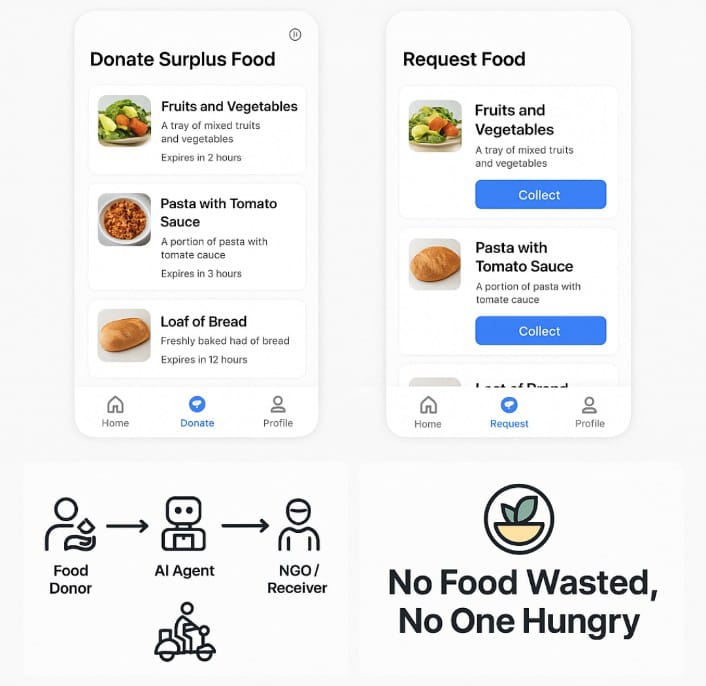
Inspiration We were inspired by the stark contrast we see daily: large amounts of food wasted in hotels, restaurants, and events, while at the same time many people go hungry. This gap motivated us to create a solution that uses Agentic AI to redistribute surplus food efficiently, ensuring that no food is wasted and no person goes hungry.
What it does Our project, Smart Food Redistribution using Agentic AI, acts as a digital Food Agent that connects food donors and receivers in real time. Hotels, restaurants, or event organizers can mark surplus food. AI agents match the food with nearby NGOs or individuals in need. People can either eat onsite or collect parcels. The platform ensures fair distribution, transparency, and accountability.
How we built it Created a simple app interface for providers (to list surplus food) and receivers (to request food). Integrated geo-location and real-time notifications to connect nearby donors and receivers. Used Agentic AI agents for decision-making: food categorization, receiver prioritization, and timing. Developed a backend system to track donations and prevent duplication.
Challenges we ran into Ensuring fair distribution so that food reaches the truly needy. Balancing real-time speed with AI-based decision accuracy. Handling logistics like storage, delivery, and expiry management. Building a solution that can scale across multiple cities.
Accomplishments that we're proud of Building a functional prototype within hackathon time. Successfully applying Agentic AI beyond chatbots, into real-world social impact. Designing an easy-to-use system that both donors and NGOs can adopt. Making progress toward reducing food waste while helping communities.
What we learned How Agentic AI can automate real-world decision-making effectively. The importance of UI/UX simplicity for adoption by non-technical users. How to design systems that balance technology with social good.
What's next for Smart Food Redistribution using Agentic AI Partner with hotels, restaurants, and NGOs for real-world pilots. Add AI-powered demand forecasting to predict food needs in advance. Collaborate with government hunger relief programs. Scale the system nationwide to maximize impact.
Built With
- agentic-ai-models
- firebase
- flask
- google-maps
- javascript
- python
- react-native

Log in or sign up for Devpost to join the conversation.