Inspiration
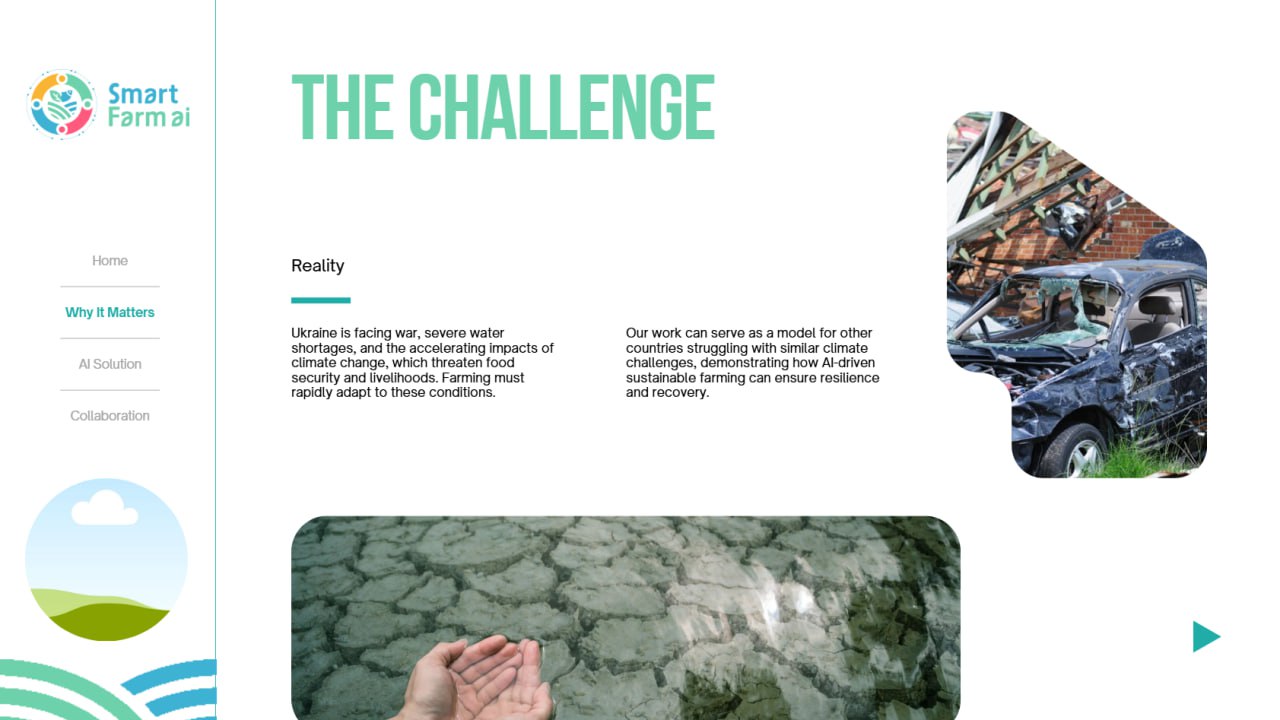
The inspiration arose from Ukraine’s urgent need for resilient agriculture facing war, drastic water shortages, and climate change. Observing the devastation and adaptation struggles of local farmers, Smart Farm AI aims to serve as an example of how technology can secure food supply and livelihoods in crisis.
What it does
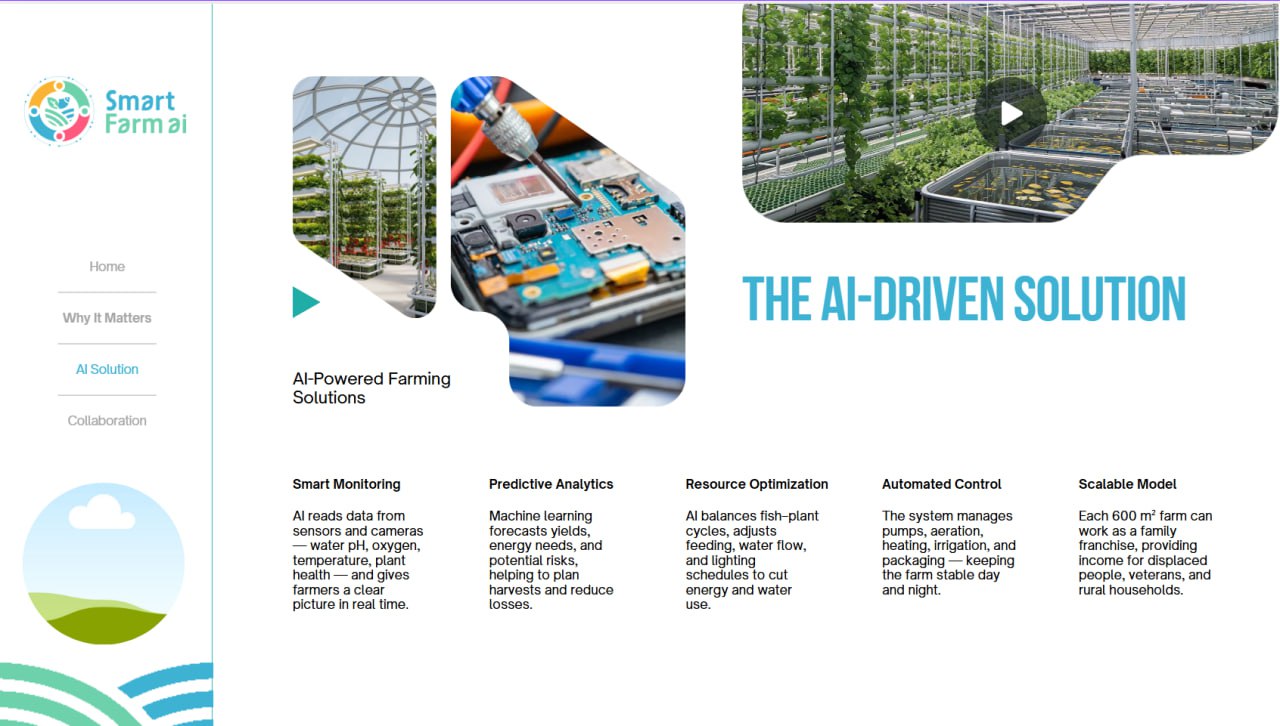
Building the project deepened knowledge in machine learning, IoT, aquaponics, and real-time data management. Experience integrating sensors, computer vision, and automated controls led to practical lessons about scaling sustainable agri-tech under real constraints.
How we built it
Smart Farm AI is being developed by a multidisciplinary team of specialists in agrotech, AI, engineering and IoT. The specialists combine knowledge in design, electronics development, Python and C++ programming, machine learning and computer vision. For the initial prototype, engineers integrated sensors, automated control modules and servers for data analytics. The entire system is being built and tested gradually, involving experts to optimize solutions for Ukrainian conditions.
Challenges we ran into
The team faced challenges such as unstable power supply during wartime, noise in sensor data, and the difficulty of scaling the system to different farms. They also had to solve the problem of safe operation of the equipment in difficult field conditions, balancing the accuracy of the algorithms with ease of operation.
Accomplishments that we're proud of
The team of experts managed to model a sustainable prototype of an autonomous farm that minimizes human intervention and resources. Integrated systems allowed to reduce water and nutrient consumption, as well as maintain stable yields even in extreme conditions. Scientists and engineers have established the modularity of the project for further expansion - this is a significant step towards the implementation of modern technologies in real agricultural production.
What we learned
The experts learned practical lessons on integrating machine learning, IoT, and automation for the agricultural sector. The need to work with unstable infrastructure emphasized the importance of stable architectural solutions and regular data validation. To effectively adapt the system, the team actively interacted with experts from various industries and agricultural enterprises.
What's next for Smart farm AI
In the future, the team of specialists plans to produce various prototypes for testing under different climatic conditions for further scaling Smart Farm AI to large agricultural clusters, implementing advanced AI models for yield forecasting and disease detection. Mobile applications will be developed, remote monitoring and resource optimization using deep learning will be strengthened. Partnerships with agricultural centers and farms will become the basis for technology transfer to sustainable agriculture in Ukraine and other vulnerable regions.
Built With
- azure-machine-learning-for-remote-monitoring-and-scaling.-databases:-sqlite-for-local-data-storage
- between
- control-modules-and-external-agroservices.-other-technologies:-temperature
- data
- embedded-c++-(sensor-management-and-automation).-frameworks:-tensorflow-and-scikit-learn-for-machine-learning
- exchange
- for
- high-resolution-cameras
- humidity
- local-linux-servers-for-data-collection-and-processing.-cloud-services:-aws-iot-implementation-plans
- machine-learning
- mqtt
- opencv-for-computer-vision.-platforms:-raspberry-pi-and-arduino-(hardware)
- ph-sensors
- possible-extension-to-postgresql-for-cloud-solutions.-apis:-standard-rest-apis-for-integration-of-sensors
- programming-languages:-python-(basic-analytics
- server-logic)


Log in or sign up for Devpost to join the conversation.