-
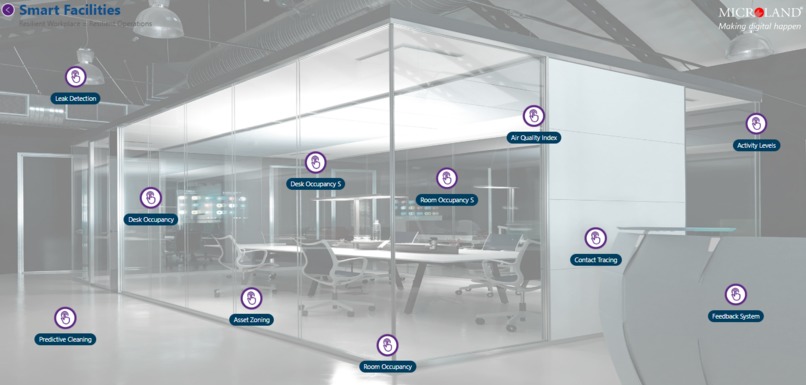
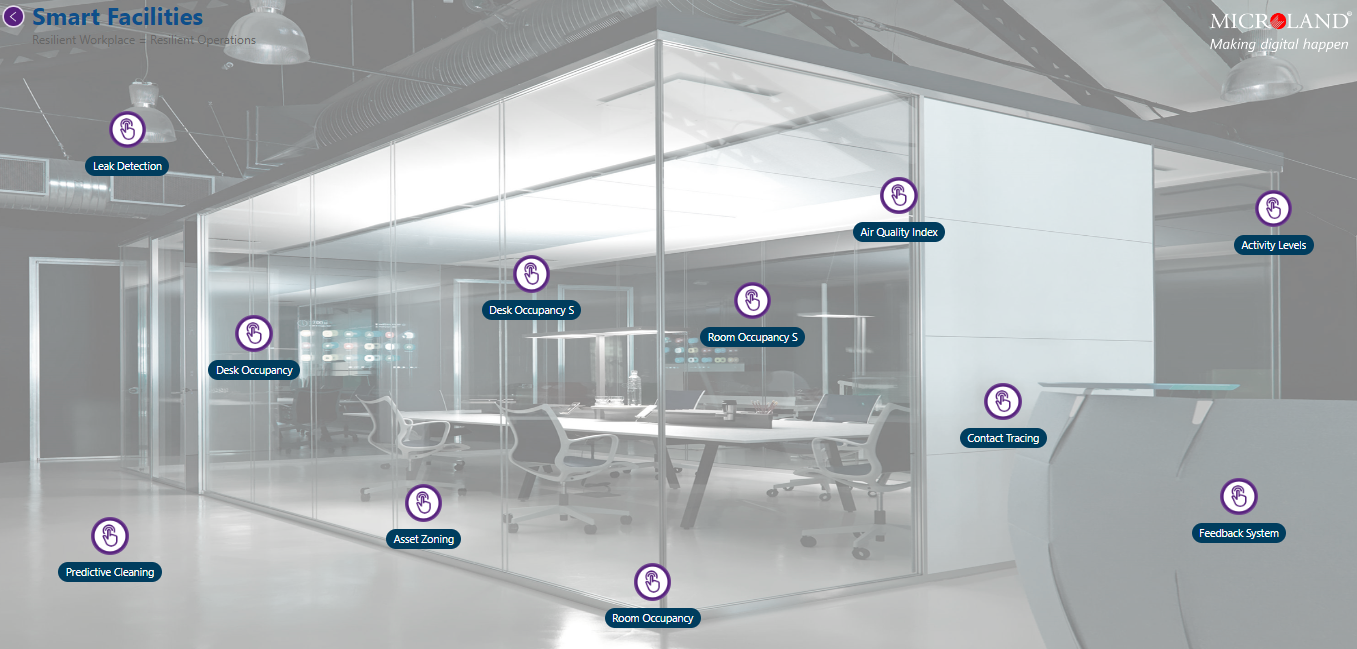
Landing Page
-
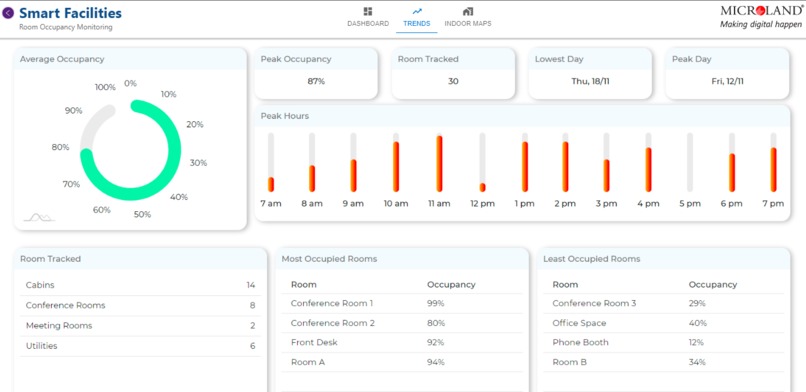
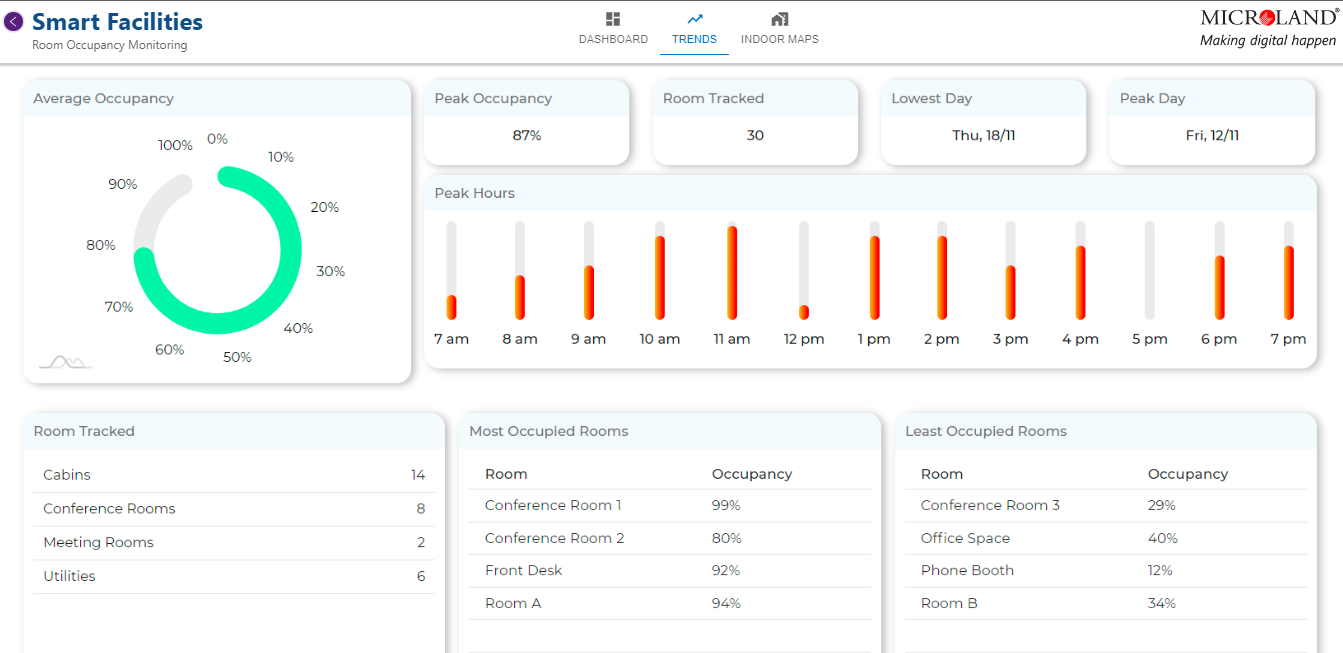
Occupancy Trends
-
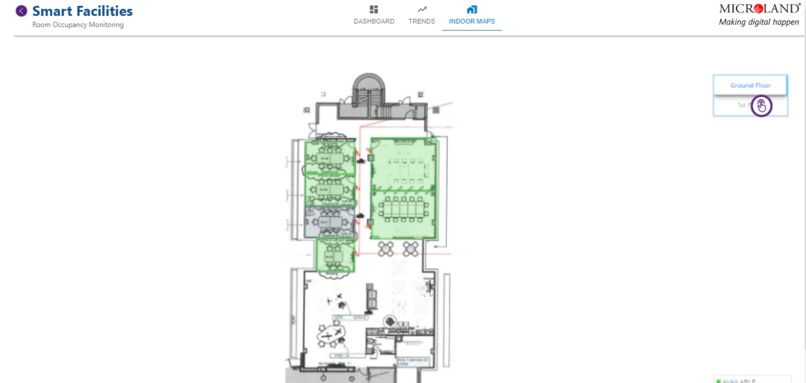
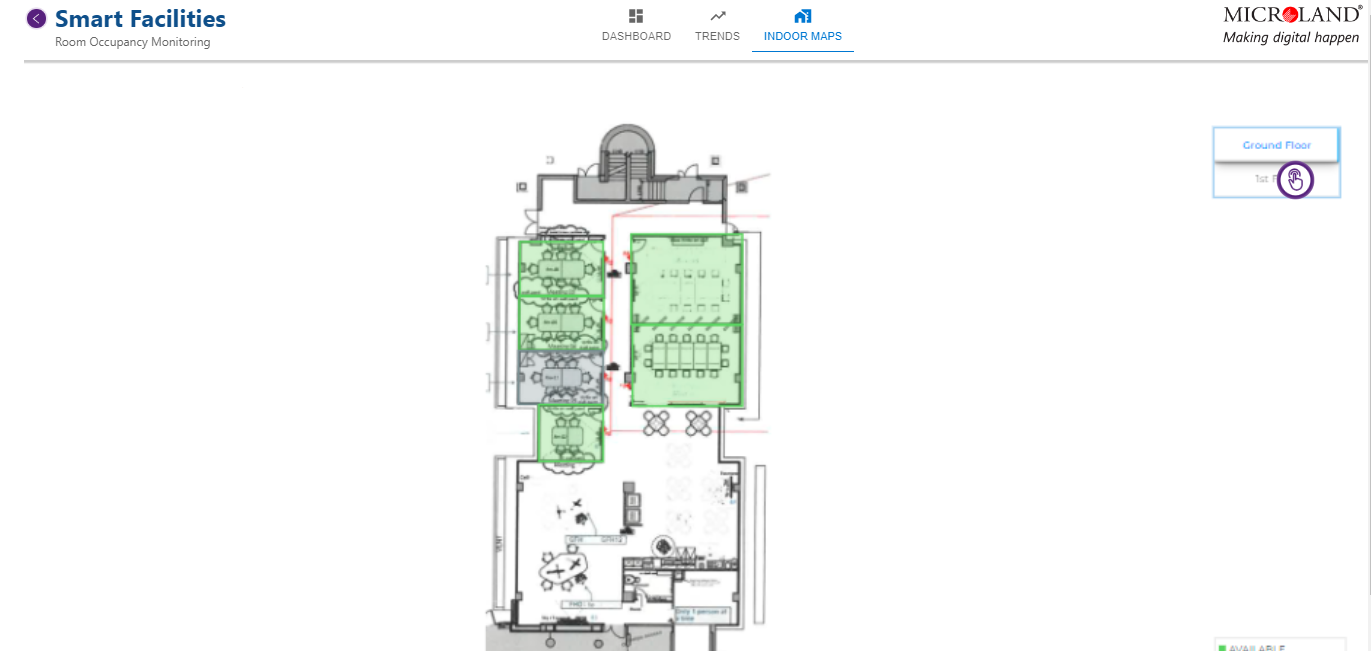
Floor Map view with Rooms Availability
-

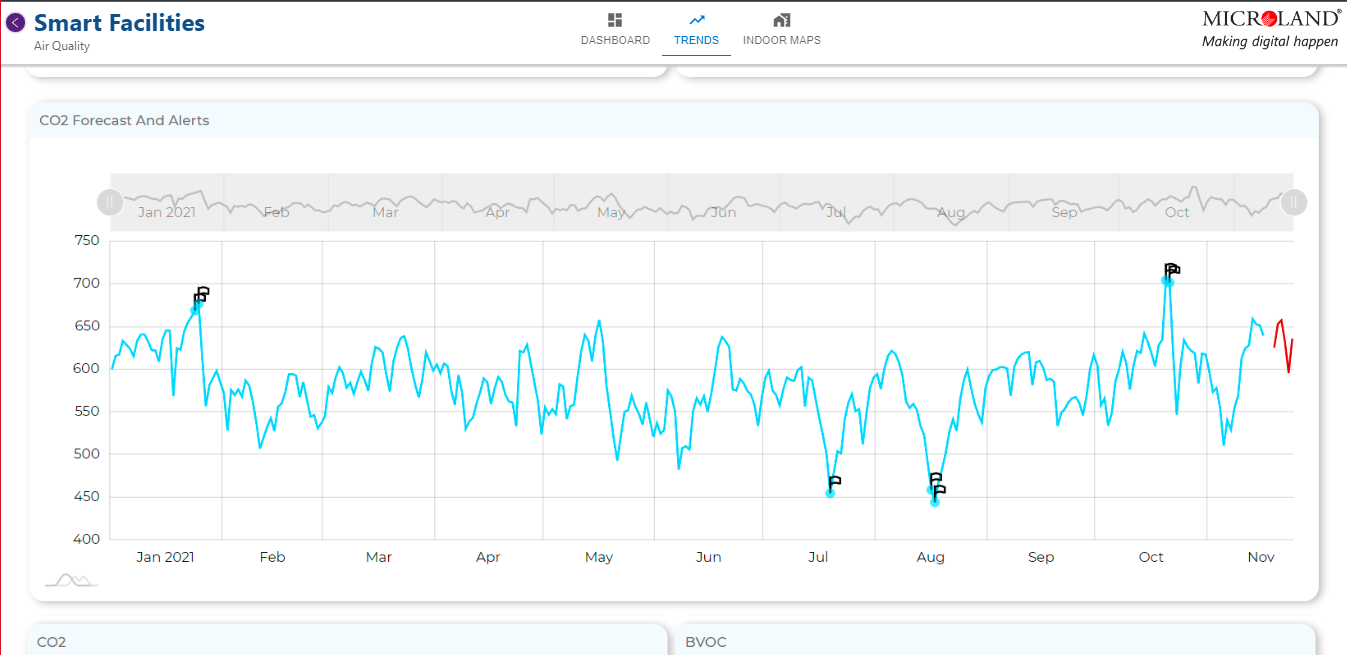
Air Quality CO2 forecast and Anamoly detection
-
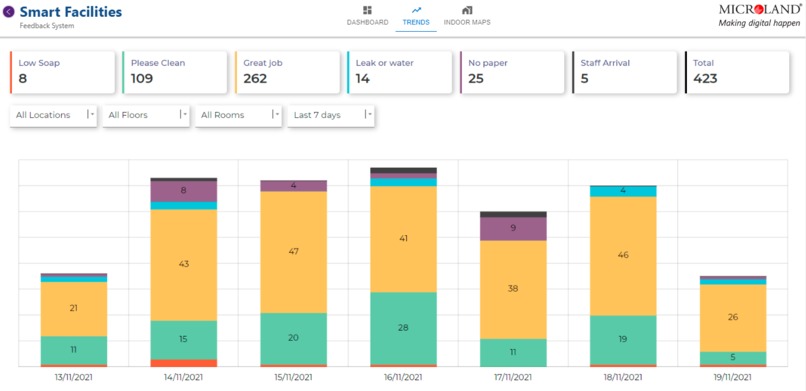
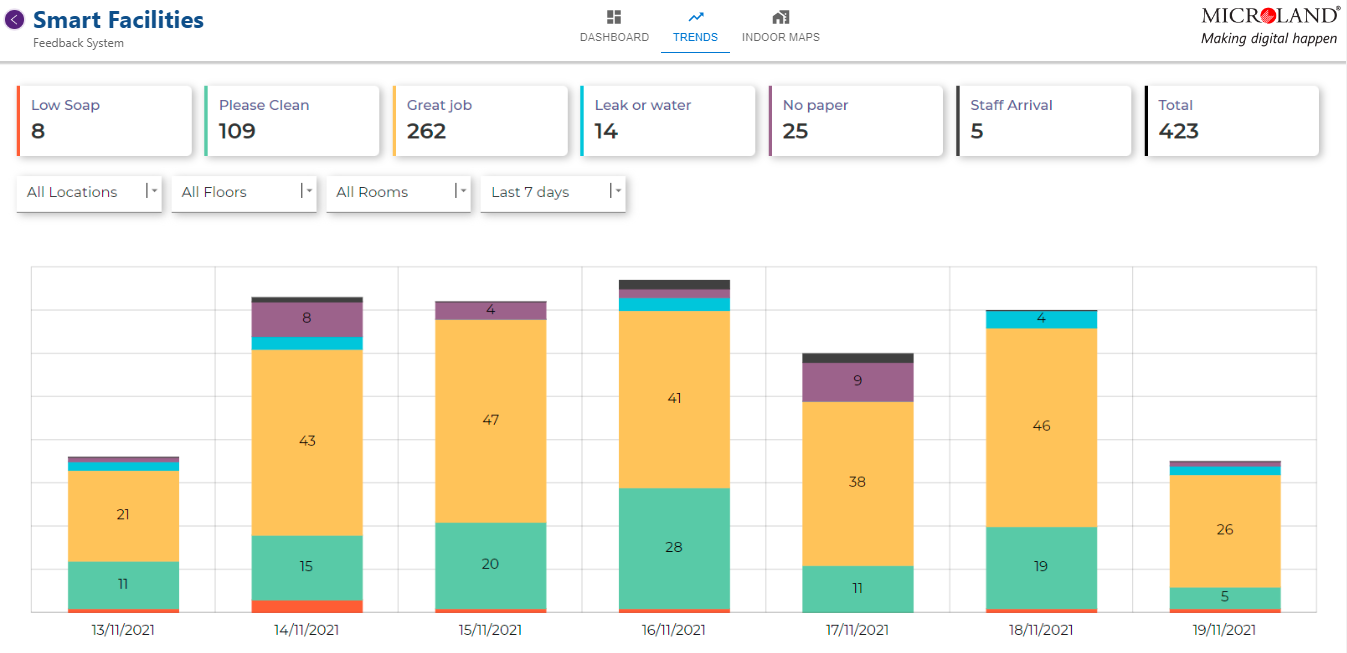
Restrooms Feedback data
Inspiration
The very sustenance of a business depends on how it identifies and tackles risk. Understanding a business’s space and risk profile is key to developing an effective response plan. For example, in an office, the key focus is to enable a finite, repeating group of employees to maintain a safe distance to prevent the spread of the virus and in the event of an incident, have an effective response time to trace contact and prevent further damage. On the other hand, large public spaces like airports are most effectively managed by managing common spaces and having an effective sanitization routine. In a more confined space like a factory, monitoring ventilation and air quality becomes paramount. Regardless of the risk profile, an effective response needs to be developed. However, the industry's expanding use of Internet of Things (IoT) sensors and Smart Facilities which is partly motivated by the potential cost reductions involved, can also offer a cost-effective solution to the gathering of ESG data. Simply put, green buildings and smart buildings are not the same thing, but IoT makes it possible to achieve the latter, especially in older buildings. As businesses have been cautiously reopening over the past year, facility leaders are beginning to reconcile with their new reality - an increased focus on safety, a purpose-built flexible plan for their workforce, including how and when to move people back into the office and what safety measures they may need to adjust and feel safe. Businesses need to build a muscle that makes them resilient and dynamic with the ability to operate in a hybrid setup today. The facility manager's role is becoming more and more prominent and even shifting from an operational to a strategic level. Sustainable, Efficient and Resilient facility operations may seem like an unrealistic goal in this situation, but they are achievable with the right vision, governance, and systematic execution. For comprehensive facility management, a strategic, holistic approach to high-performing facility operations is essential.
What it does
Microland offers a plug-&-play, non-intrusive, low-cost insights-based suite of solutions with reduced risk of large infrastructure investments. This comprehensive approach to connecting and inter-relating workspace, assets, people, and devices, refocuses away from technology and towards actionable data and insights on operational patterns. This is enabled by Sensing technology as a Service, powered by IoT insights. Some of the most popular use cases are around Universal Contact Tracing (no PII captured, no reliance on a cellphone) for the immediate prevention and effective response in case of an outbreak, along with occupancy-related solutions to understand space usage, predictive cleaning (as against scheduled based) for common spaces, and air quality monitoring and airflow management for high-risk spaces. These enablers allow businesses to optimize their facility operations and do more with less. From room occupancy to pest control, to environment monitoring, we have ready-to-deploy solutions for many of the challenges faced by facility managers. Our business dashboards and alerts enable real-time monitoring and management of facilities, leading to better-informed decisions that deliver proven time and cost efficiencies. In addition, asset-tracking technology can track high-value and movable assets within a facility and are particularly useful in hospitals to track critical operational assets like beds, wheelchairs, and nurse carts to optimize hospital operations and asset utilization with the ability to drive huge cost optimization. The solution offers a platform to centralize and contextualize rich data streams enabled by inserting “smart” into your facility. These insights can be valuable and key to facility resilience and optimization.
How we built it
These enterprise-ready solutions come packaged with pluggable sensors and LoRaWAN connectivity that operates independently of any corporate network, offering the ability to put sensor data on the cloud within a matter of hours. This data can then be contextualized to your facility to derive meaningful insights. LoRaWAN particularly suits Facilities Management due to its excellent range; one single access point can cover up to 6 floors, with penetration through thick walls and concrete. The Sensing as a Service concept eliminates the complexity of traditional BMS systems by connecting sensors to the LoRaWAN network independently of any corporate network. Based on the needs of the customer, we deploy the pre-configured sensors, which install in minutes and have a battery life of 5 years on average. These sensors mount to walls and tables with standard screws, tape and silicone. When a local LoRaWAN gateway is activated, all of the sensors are monitored centrally, and data is fed into the Smart Facility Application. The data gathered to used to better manage and monitor your office, hospital, factory, store or facility. Our Rules Engine, Data Modules, Application Accelerators, Digital Twins, and Indoor Maps modules ensure that data is collected, evaluated, and transmitted in a secure and compliant manner to the appropriate party at the right time and in the right format.
Challenges we ran into
Though most of the industries and well-established workplaces had the more advanced Building Management System in place, the Pandemic necessitated converting old facilities with no traditional BMS systems to become smart. Travel restrictions and business slowdown had a major impact in going for implementation of more sophisticated sensors, wirings, and BMS systems. We came up with a business model where the sensors were bundled as a SaaS offering involving sensors, infrastructure and platform which reduced the overhead on customers, and which was completely independent of the IT Infrastructure. With these travel restrictions, it was a challenge to conduct a site survey, onboard devices, or even set up the LoRaWAN network infrastructure. In addition, the remote working model made it a little tricky to convince our clients of the right technology components and the right devices they need to procure to arrive at the desired business outcomes. The user guides designed by us and the robust device onboarding module that we built helped to facilitate the easy onboarding of devices with a few steps. We developed a phased approach which began with building the contact tracing solution with BLE-based sensors with no personal information of employees being captured, the next phase was based on occupancy detection and finally, delivering ESG metrics. Another aspect that was very critical to the customer was establishing the contact history and employee movement within the facility to sanitize the place and isolate the primary contacts. This was conceptually straightforward; however, we needed to make the right decisions with respect to the technological components involved. Ultimately, with the help of signal strengths and contact events from the sensors, we were able to accurately achieve this successfully.
Accomplishments that we're proud of
- We participated and were announced as the runners-up of the Microsoft Incubathon 2021 for our Smart Healthcare Facilities. The solution leveraging the power of Azure IoT and Cloud, we developed a plug-and-play smart healthcare facilities solution that enables real-time visibility and insights into the facility utilization at a hospital and the asset performance to ensure robust operations and the well-being of both healthcare staff and visitors.
- In the past year, a key focus of governance & sustainability reports was for firms taking decisive actions to ensure employee safety and well-being during the pandemic for some of our customers. Our solution enabled employees to maintain a safe distance to prevent the spread of the virus and, in the event of an incident, have an effective response time to trace contact and prevent further damage.
- To keep operations going throughout the epidemic, a worldwide logistics company implemented our solution. During this time, the solution kept a real-time eye on two major warehouses with over 7000 people. We were able to track over 37 zones in the facilities and monitor over 1,000,000 high-risk contact events as defined by the CDC. The solution could contact trace over 117 confirmed cases to assist in taking preventive measures.
- This ESG-centric solution monitored over 1.5 million critical contact events, tracked & confirmed 130+ cases, and significantly reduced the Mean Time to Detect and Respond (MTTR & MTTD) thus preventing the risk of further infections.
What we learned
From our experience deploying multiple use cases across different geographies and clients, we learned that our solutions for monitoring air quality, predictive cleaning, occupancy, temperature, and other factors contribute to the development of real-time data-driven reporting (compliant with standards like GRI), which offers auditors and leaders a higher level of compliance and assurance than conventional manually filled reports. In the workplace, contact tracing has been a crucial solution that has allowed clients to function quite safely despite the pandemic without posing any privacy concerns.
A multinational logistics company adopted our solution to maintain operations throughout the pandemic. Two key warehouses with more than 7000 employees were continuously monitored by the solution during this period. We were able to track more than 37 zones throughout the buildings and keep an eye on more than 1,000,000 CDC-declared high-risk contact occurrences. To help with preventive action, the solution may make contact with over 117 confirmed cases. Over the past year, firms taking decisive action to protect employee safety and well-being throughout the epidemic has been a key topic of governance and sustainability reports.
From a technology viewpoint, we came across features such as indoor navigation, heat maps, occupancy detection, and digital twins of spaces that were novel ideas initially but we have been able to learn and deploy them quickly which ended up being very crucial for our customers.
Additionally, we also learned that the use cases designed for Smart Facilities are repeatable, customizable, scalable, non-intrusive, and plug-and-play. These use cases and their architecture can be very easily expandable cross-industry and cross-domain beyond Office spaces - we have been able to deploy these use cases at hospitals, warehouses, plants, etc. They are industry agnostic.
Our ESG goals with such solutions are well aligned with some of the key SDG goals outlined by the UN - 'Good Health & well-being', 'affordable & clean energy', 'industry, innovation & infrastructure', 'sustainable cities & communities, 'responsible consumption & production' and 'climate action'.
What's next for Smart Facilities & Sustainability using IoT
Smart Facilities has been a very versatile solution that can be easily replicable across industries. That being said, we plan on designing use cases that are most relevant to our customers while we implement new-age technologies that provide a seamless user experience while ensuring we meet the ESG goals. Here are some use cases in the pipeline:
- Space Booking: Chatbot enabled Booking of a meeting room; desk or parking space in a facility allows employees to reserve in advance. This is unlike hot-desking, which allows employees to claim their desks/parking on a first-come, first-served basis. It helps facilities team manage the office space to accommodate the number of employees who plan to be there.
- Integration with Business Applications: Integration with Building Management Systems, Energy Management Systems and HVAC systems with smart facilities data and automating the controls/actions based on events.
- Energy and Water Consumption and Savings: To Gain a more detailed understanding of where electricity is being utilized, uncover off-peak savings opportunities, and eliminate wasteful overnight or holiday consumption.
- Full Spectrum Analysis: Combine gas, water, and other utility bills into a single system to achieve a better understanding of the relationships between energy types and potential savings.
- Preventive Maintenance and Efficiency: Provide a complete overview of HVAC, circuit breakers, and heavy machinery performance, recognizing irregularities that can lead to breakdowns.
- Monitor Progress in Carbon Reductions: As we implement carbon reduction and other sustainability initiatives, we would like to keep a close eye on the trendline. We will attempt to provide verifiable data to support your ESG disclosures and show sustainable progress.


Log in or sign up for Devpost to join the conversation.