-
-
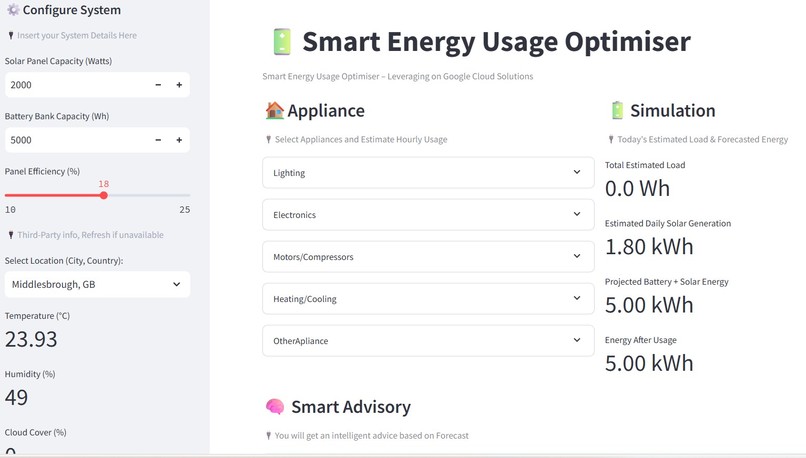
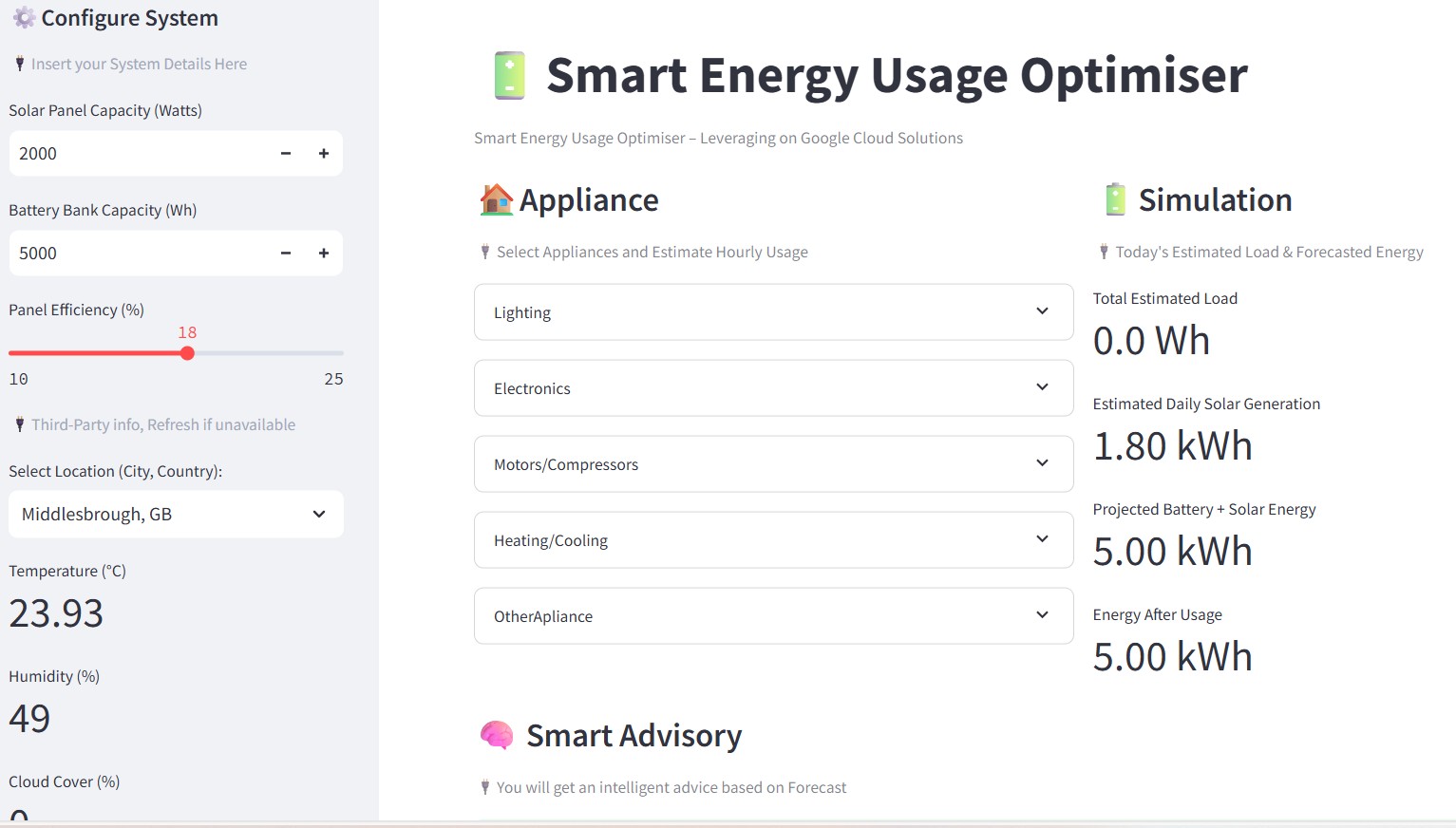
smart-energy-optimiser User Interphase
Inspiration
As an Instrumentation and Control Engineer with years of field experience, I’ve seen firsthand how off-grid and solar-powered homes in developing regions struggle with intelligent energy management. Many rely on guesswork to determine when to run critical appliances, often resulting in outages, overuse of backup generators, or wasted solar energy.
The idea for Smart Energy Usage Optimiser was born from this real-world challenge. I aimed to develop a solution that not only predicts solar energy availability using weather data but also provides intelligent, real-time guidance on how to optimize energy consumption. My passion for IIoT, AI, automation, and sustainability made this an exciting intersection of technology and meaningful impact.
What it does
Smart Energy Usage Optimiser is a cloud-based AI assistant that empowers off-grid and solar-powered households to make informed energy decisions. It:
- Forecasts solar energy availability using real-time weather and irradiance data
- Models household consumption based on user-defined appliance profiles
- Advises users on optimal usage by predicting power shortfalls or excesses
- Logs and visualizes telemetry in real time using MongoDB Atlas and a custom Streamlit dashboard
- Delivers adaptive insights based on system conditions and usage behavior
- Simulates energy generation and consumption dynamically, helping users rationalize usage before depletion — a true decision support system for energy resilience.
How I built it
This project was entirely self-developed, from ideation to deployment. Here's a breakdown:
Frontend Interface
- Developed in Streamlit to provide a clean, interactive GUI for configuring appliances, viewing energy forecasts, and receiving advisory insights.
Telemetry & Forecasting Engine
- Pulled real-time environmental data from the OpenWeatherMap API, including solar irradiance and temperature.
- Built AI forecasting models in Python using Prophet, enabling accurate next-hour solar availability projections.
- Designed logic to simulate charging rates, consumption load curves, and household equipment behavior.
Backend & Storage Layer
- Built a structured MongoDB Atlas schema to store:
- Environment_Telemetry
- Usage_profiles
- AI_Decision_Log
- Utilized time-series data collections and aggregation pipelines to enable efficient querying and dynamic summaries.
Cloud Architecture
- Containerized the application using Docker.
- Deployed the backend on Google Cloud Run for serverless scalability and high availability.
- Built and pushed Docker containers to Artifact Registry using a custom GitLab CI/CD pipeline with secure service account authentication.
Challenges I ran into
Building this as a solo developer meant wearing multiple hats: data scientist, cloud engineer, UI designer, and DevOps architect. The most challenging aspects were:
- Designing accurate, lightweight forecasting models that could operate within a stateless, containerized environment
- Simulating diverse energy usage patterns across varying solar conditions and equipment setups
- Automating CI/CD workflows from GitLab to Google Cloud, including image tagging, pushing to Artifact Registry, and deploying to Cloud Run
- Handling MongoDB time-series data structures, especially to build query-efficient aggregation logic for trends and alerts
- Streamlit’s stateless behavior on Cloud Run, which required thoughtful design to maintain responsiveness and interactivity
Accomplishments that I’m proud of
- Successfully integrated AI forecasting, cloud-native deployment, and real-time telemetry into a seamless platform
- Delivered an intelligent, user-configurable energy model capable of adapting to changing weather and usage scenarios
- Built a full-fledged CI/CD pipeline in GitLab, handling Docker builds, Artifact Registry pushes, and auto-deployments to Cloud Run
- Transformed a raw concept into a working cloud application with the potential to scale and serve communities in real-world energy challenge contexts .
What I learned
- Advanced CI/CD automation using GitLab and Google Cloud services
- Optimizing Streamlit for containerized, serverless environments
- Designing cloud-native telemetry pipelines using MongoDB time-series data
- Forecasting with real-world constraints, and adapting AI models (like Prophet) for short-horizon energy planning
- Most importantly, I reinforced the value of building with purpose, technology that solves meaningful problems, not just technical showpieces
What’s next for Smart Energy Usage Optimiser
This is just the beginning. I plan to:
- Integrate live smart meter and inverter data using protocols like MQTT, Modbus, or BACnet
- Expand the energy model to include battery degradation, peak-shaving strategies, and grid-tie configurations
- Add user notifications, mobile-first UX, and multi-lingual support for broader accessibility
- Extend AI forecasting with LSTM-based models for multi-day planning
- Launch pilot testing in underserved communities in sub-Saharan Africa, partnering with NGOs or energy startups


Log in or sign up for Devpost to join the conversation.