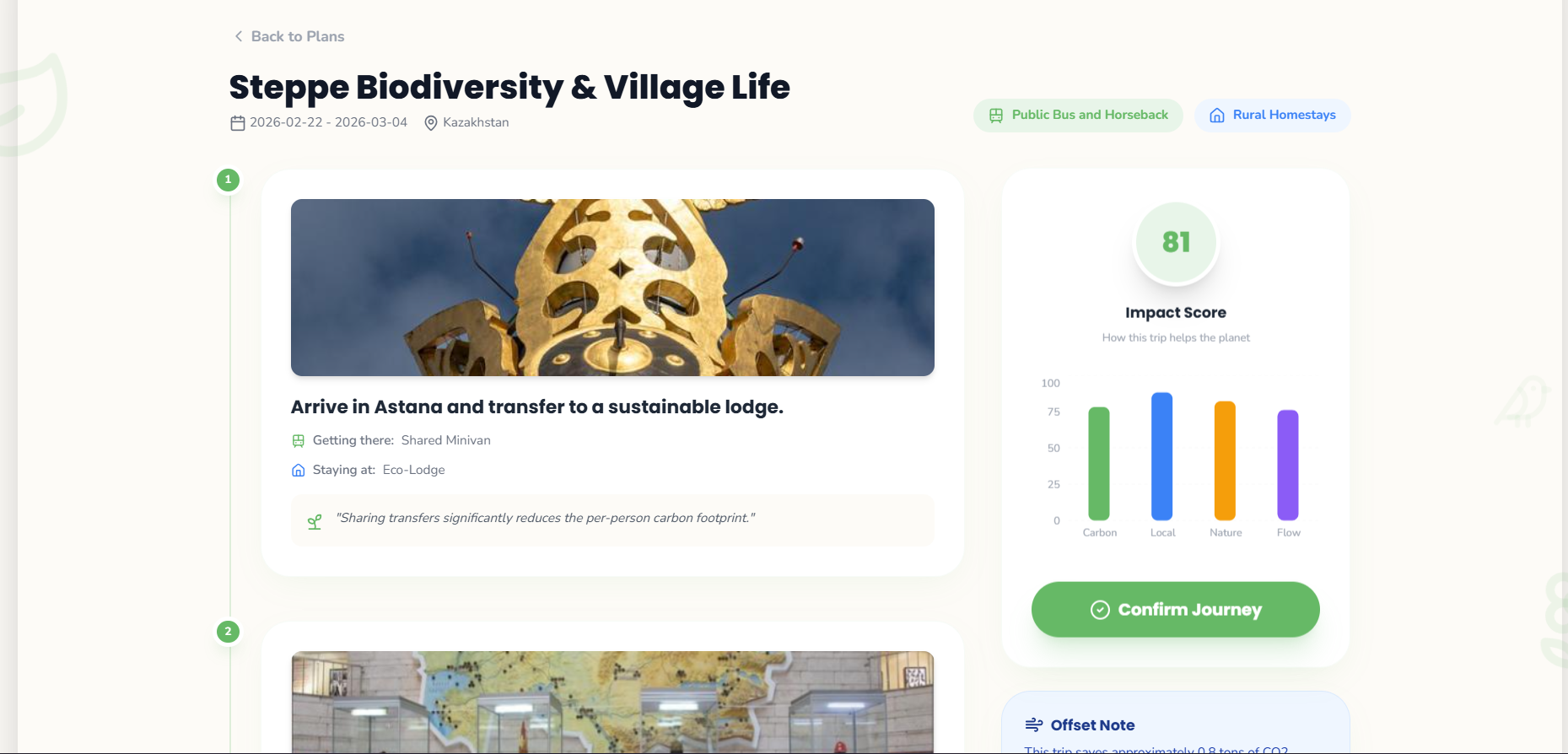
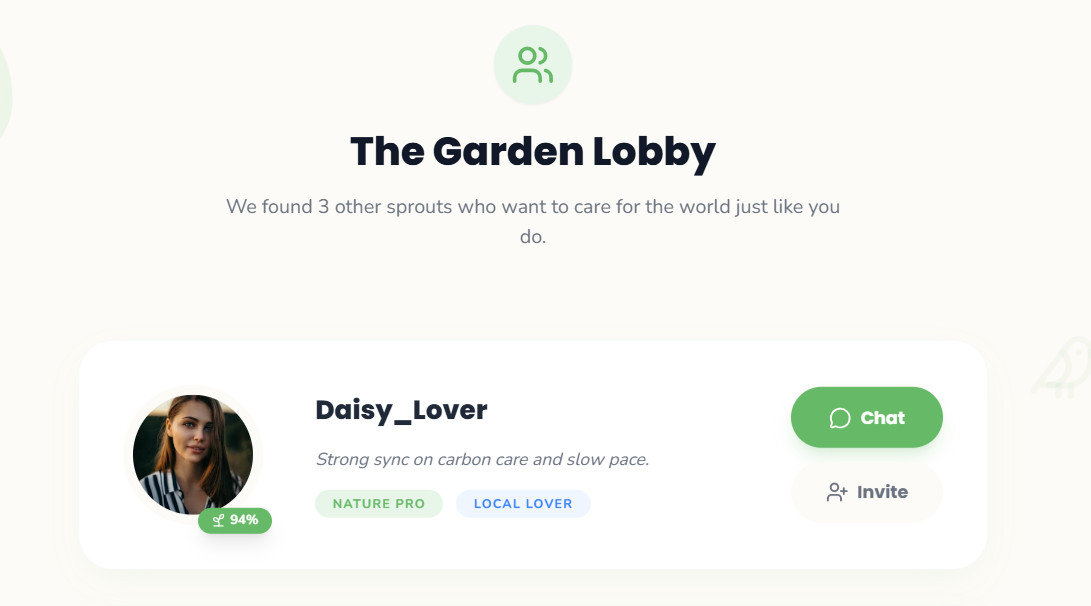

Inspiration
Tourism, while contributing significantly to economic growth, often comes at a high cost to the environment and local communities. Unregulated and poorly planned travel leads to increased pollution, habitat destruction, erosion of local culture, overtourism, and the marginalization of local economies. 9% of worldwide carbon emissions and 80% of marine plastic waste are linked to tourist activities.
Although many travelers express interest in sustainable tourism, they lack access to user-friendly, intelligent, and dynamic tools that help them understand the real ecological and social impact of their travel choices. Existing planning tools prioritize convenience and cost, offering little visibility into sustainability trade-offs.
In fact, Most travel planners optimize for price and convenience, not impact.
We were inspired to ask a simple but powerful question:
What if sustainability was the default criterion for planning travel, not an afterthought?
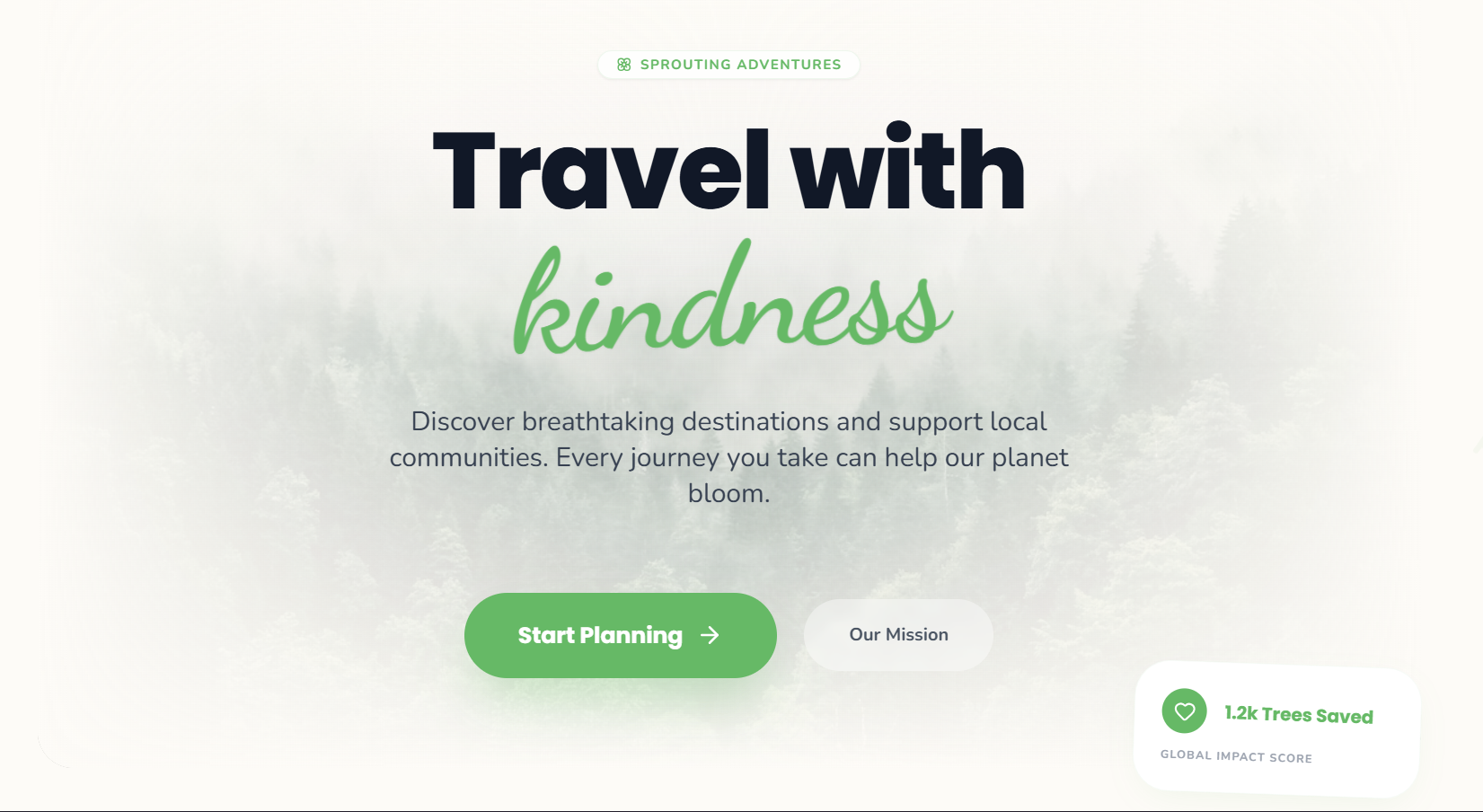
Smart Eco Tour is an AI-powered travel planning platform that enables tourists to design trips based on the impact they want to make, not just the destination they want to visit.

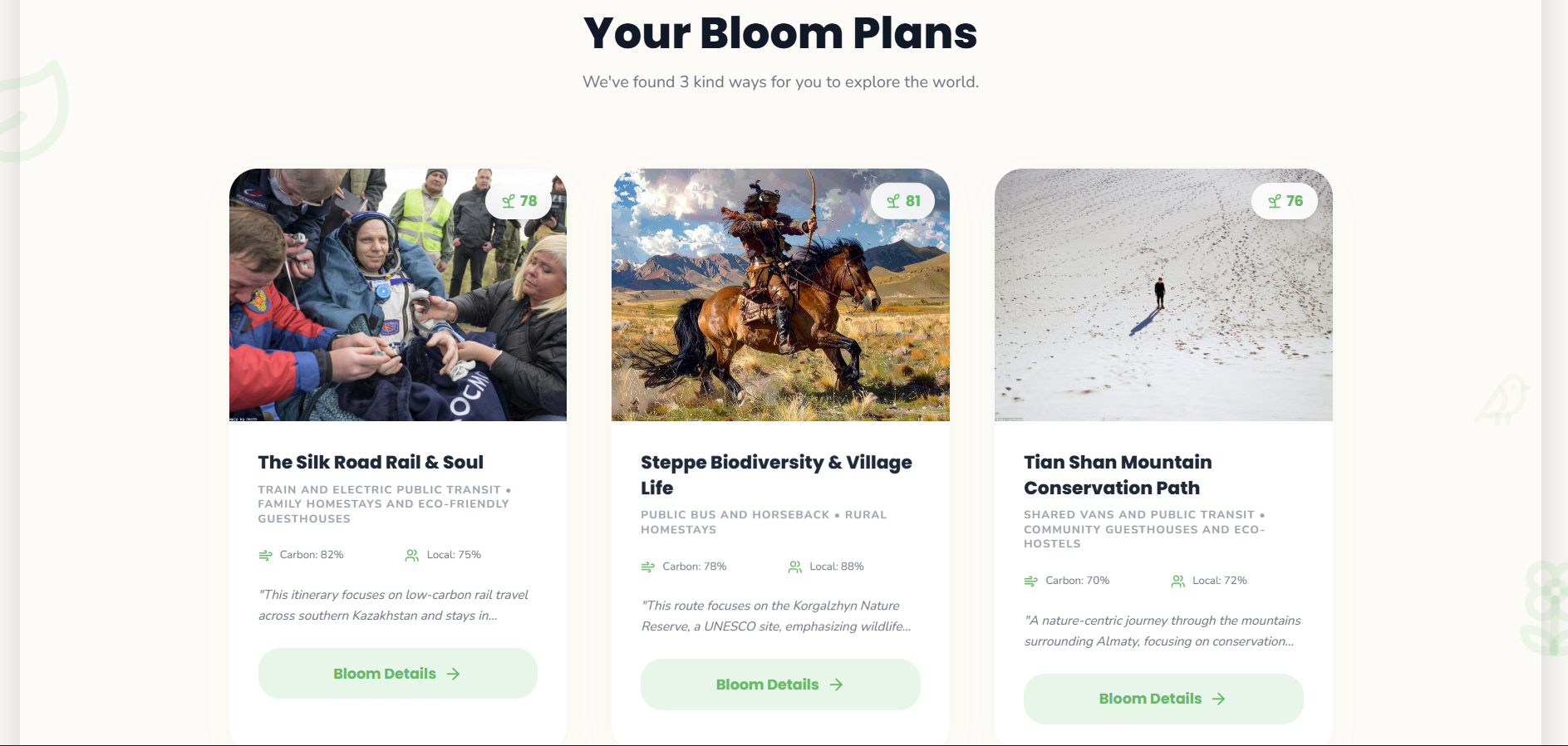
Instead of optimizing solely for time or cost, Smart Eco Tour compares multiple travel plans and evaluates them using a comprehensive Sustainability Score, helping users choose routes and experiences that are both enjoyable and responsible
What it does :
1.AI-Powered Multi-Itinerary Generation:
The platform generates multiple complete travel itineraries for a single trip request, offering travelers diverse routing, accommodation, and activity options rather than a single "best" path. 1.Comparative Intelligence: Unlike traditional planners that show one optimal route, this system creates 3-5 distinct itineraries that balance different priorities (speed vs. sustainability, budget vs. impact, local immersion vs. convenience) 2.** Context-Aware Planning:The AI considers seasonal factors, local events, crowd management, and real-time sustainability data to craft realistic, actionable plans 3.Adaptive Complexity: Handles everything from weekend getaways to month-long journeys with appropriate detail levels**
2.Transparent Sustainability Scoring System:
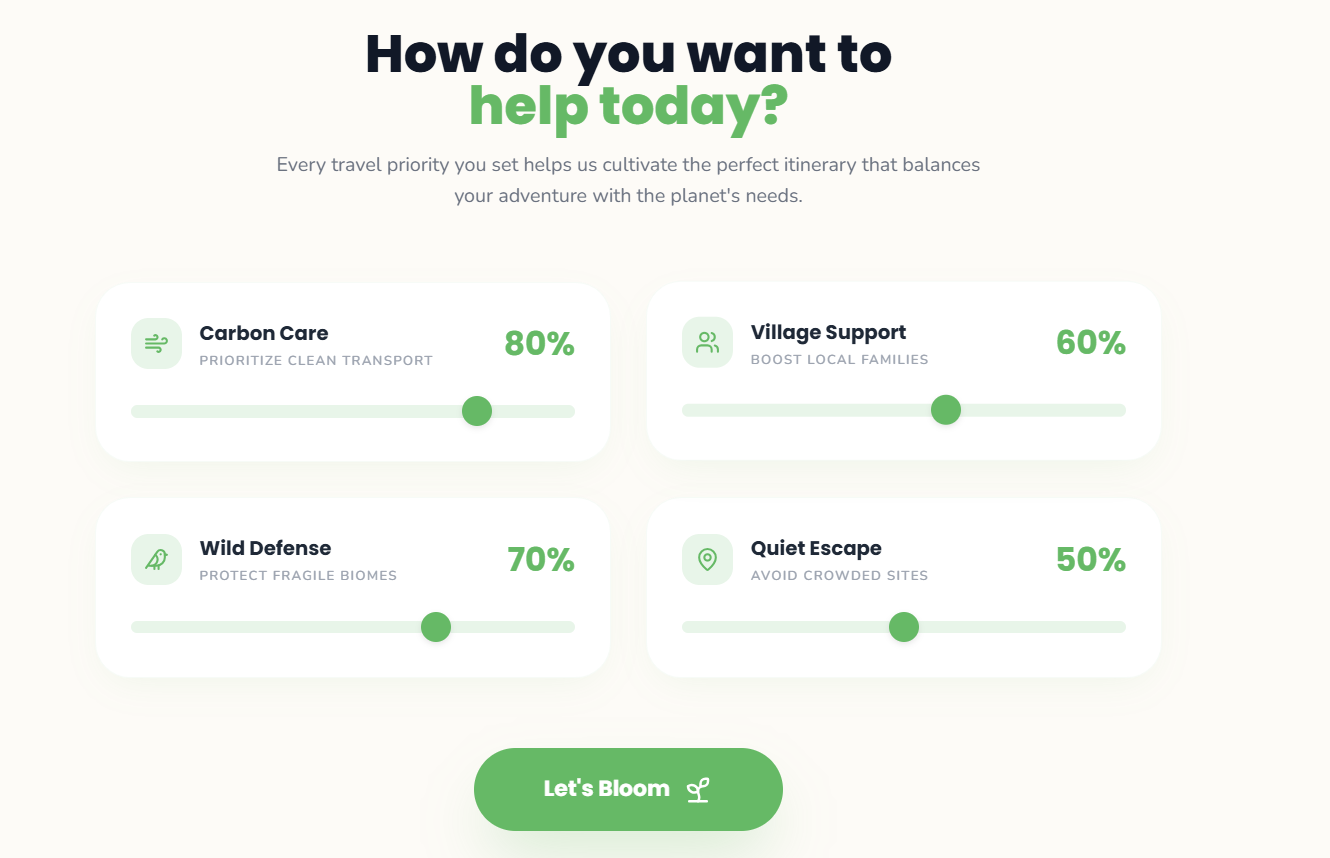
Each itinerary receives quantified scores across multiple sustainability dimensions, with full visibility into how scores are calculated. 1.Multi-Dimensional Metrics: Scoring goes beyond carbon footprint to include 1.Carbon Emissions (transportation, accommodation energy use) 2.Water Consumption (hotels, activities, regional water stress) 3.Waste Generation (single-use plastics, food waste potential) 4.Biodiversity Impact (habitat disruption, wildlife interaction ethics) 5.Community Benefit (% of spending reaching local economy, cultural preservation) 6.Labor Practices (fair wages, working conditions of tourism workers) 2.Transparent Calculation: Users can click into any score to see the exact methodology, data sources, and assumptions—no "black box" algorithms 3.Contextualized Benchmarks: Scores are compared to regional averages and best-practice examples, so a "7/10" in carbon-intensive Iceland has context
3. Impact Based Ranking:
Itineraries are automatically ranked from most to least sustainable across environmental and social dimensions, with clear visualization of trade-offs. 1.Dual-Axis Optimization: Ranking simultaneously considers environmental footprint AND social benefit—not just "greenest" but also "most community-enriching" 2.Customizable Weighting: Travelers can adjust which metrics matter most to them (a climate activist might prioritize carbon; a social justice advocate might weight labor practices higher) 3.Trade-Off Visibility: When a "less green" option ranks higher due to strong community impact, the system explains this explicitly 4.Dynamic Re-Ranking: As new data emerges (a hotel installs solar panels, a route adds electric bus service), rankings update
Explainable AI: Why One Option is More Sustainable:
For any comparison between itineraries, the system generates plain-language explanations of sustainability differences and their real-world implications. 1.Comparative Narratives: Instead of abstract scores, travelers read: "Option A produces 340kg less CO₂ than Option B—equivalent to powering a home for 3 weeks—because it uses train travel instead of flights and stays in solar-powered accommodations" 2.Cascading Impact Chains: Explains ripple effects—"Choosing this family-run guesthouse over a chain hotel means your $800 spend keeps $640 in the local economy vs. $280, supporting 3 local jobs instead of 0.5" 3.Scenario Bridging: "If 1,000 travelers made this swap, it would prevent 340 tons of CO₂ annually and generate $360,000 in additional local income" 4.Localized Context: "This region faces severe water scarcity—your shorter showers at this hotel save 200L compared to the resort option, enough for 4 local families' daily needs"
5. Eco-Conscious Traveler Matching:
Connects travelers with similar sustainability values, trip styles, and destinations to enable shared experiences, cost-splitting, and community-building. 1.Values-Based Matching: Pairs people based on what they care about most (animal welfare, carbon reduction, indigenous tourism support, zero-waste travel, etc.), not just demographics 2.Trip-Specific Connections: Matches people planning similar routes during overlapping timeframes—"3 solo travelers are planning sustainable trips through Patagonia in March, interested in shared transportation?" 3.Skill & Resource Sharing: Facilitates exchanges like "experienced zero-waste traveler willing to mentor first-timers" or "photographer seeking conservation-focused travel buddy" 4.Verified Sustainability Commitment: Uses past trip choices and itinerary selections to validate genuine eco-consciousness, preventing "sustainability tourism" posers 5.Safety-First Design: Includes verification, reviews, optional gradual reveal (share general plans before personal details), and reporting mechanisms
How we built it
Smart Eco Tour is an AI-powered sustainable travel planning backend that generates eco-conscious itineraries, calculates environmental impact, and matches like-minded travelers into groups. It's a production-ready Fast API application designed for integration with a React frontend.
Phase 1: Trip Planning Input
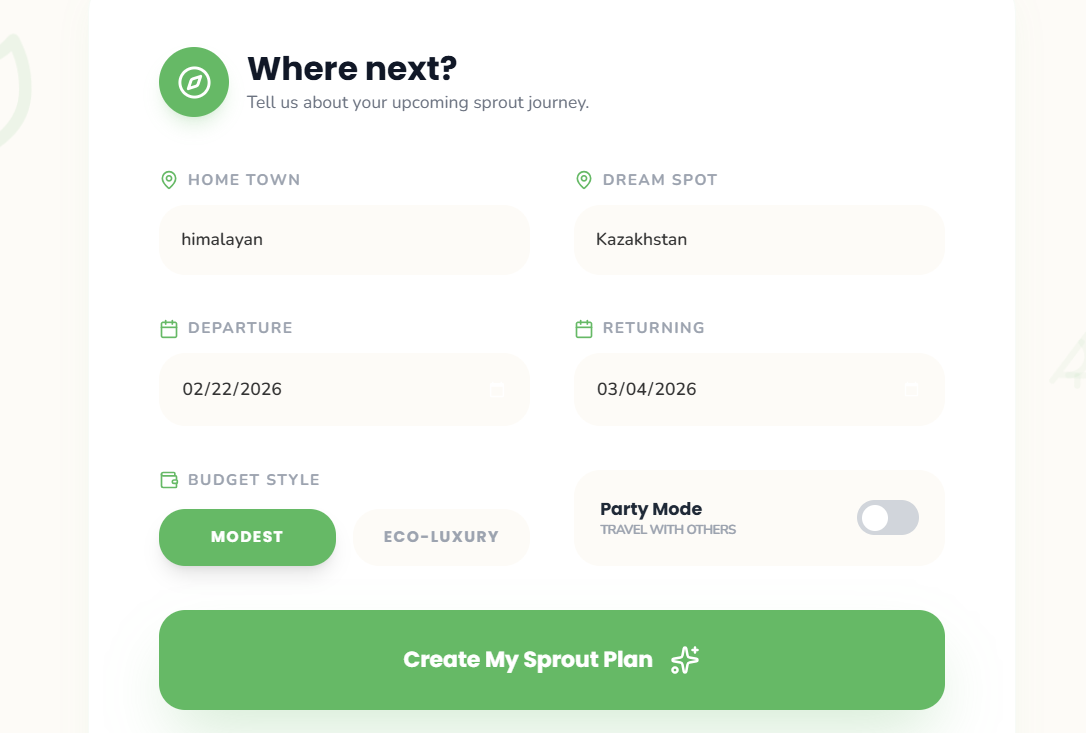
User submits a trip request with: 1.Origin and destination cities 2.Trip duration (days) 3.Transport preference (train, bus, car, flight, walk) 4.Travel interests (culture, food, adventure, nature, etc.) 5.Optional sustainability weights (custom importance levels)
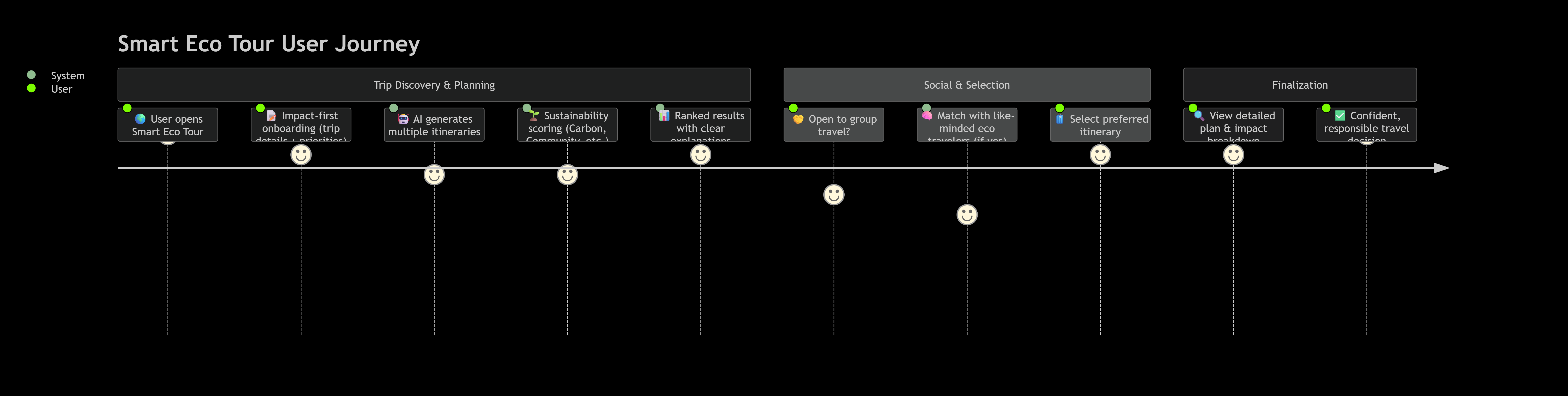
Example Flow:
User Input: "I want to go from New York to Paris in 5 days,
prefer trains, interested in culture and food"
         ↓
Normalized into TripInput schema
         ↓
Sent to /api/generate-itinerary endpoint
Phase 2:Itinerary Generation (matching.py)
The system generates 3-5 sustainable itinerary options:
1.Activity Selection **(select_activities())
-Queries internal ACTIVITY_DATABASE for the destination
-Filters by user interests (culture, food, nature, etc.)
-Returns activities with duration, carbon impact, and local engagement score
2.Day Planning** (generate_day_plan())
-Schedules activities with specific times (9:00 AM - 6:00 PM)
-Assigns transport modes between locations
-Creates realistic, day-by-day itineraries
3.LLM Enhancement (llm.py)
-Uses Open AI GPT-3.5 to generate human-readable itinerary descriptions
-If API unavailable: Falls back to hardcoded template responses (4 styles: eco_focused, adventure_focused, culture_focused, relaxation_focused)
-Enriches itinerary with narrative context
Example Output:
{
  "id": 1001,
  "title": "Eco-Conscious 5-Day Paris Adventure",
  "days": [
    {
      "day": 1,
      "activities": [
        {
          "name": "Seine River Walk",
          "duration": 2.5,
          "start_time": "09:00",
          "end_time": "11:30"
        }
      ],
      "transport": "walk"
    }
  ],
  "sustainability": {
    "total_score": 82.5,
    "carbon_kg": 245.3
  }
}
Phase 3: Sustainability Scoring (scoring.py)
| Dimension | Weight | What It Measures |
|---|---|---|
| Transport | 30% | Carbon emissions of flights/trains/buses; penalizes long-distance flights |
| Accommodation | 20% | Hotel eco-certifications, energy usage; bonuses for longer stays (≥7 days) |
| Activities | 20% | Low-impact activities; local businesses vs. chains |
| Local Engagement | 20% | Time with local guides, cultural experiences, non-touristy activities |
| Overtourism Mitigation | 10% | Avoids peak season in over-visited destinations (Venice, Paris); suggests alternatives |
Scoring Formula:
total_score = (
    transport_score × 0.30 +
    accommodation_score × 0.20 +
    activity_score × 0.20 +
    local_engagement_score × 0.20 +
    overtourism_score × 0.10
)
Carbon Calculations::
Real-world emission factors (kg CO2 per km):
- Flight: 0.255 kg CO2/km per person
- Car: 0.192 kg CO2/km per person
- Train: 0.041 kg CO2/km per person (✨ Most sustainable) -Bus: 0.089 kg CO2/km per person ###Phase 4: : Itinerary Comparison Multiple itineraries are ranked by sustainability score, allowing users to:
- See 3-5 options side-by-side
- Compare carbon footprints
- Trade off convenience vs. sustainability
- Understand the "why" behind each score with human-readable explanations
###Phase 5: Traveler Profiling & Group Matching
Step A: Profile Creation (POST /api/traveler-profile)
Each traveler creates a profile with:
-Sustainability score expectation (0-100)
-Travel interests (culture, food, adventure, etc.)
-Budget range
-Trip duration preferences
Step B: Vector Representation
Each profile is converted to a multidimensional vector capturing:
-Sustainability preferences (0-1)
-Interest weights (one dimension per interest type)
-Budget and duration
Step C: Similarity Matching (similarity.py)
When a user calls POST /api/find-group?traveler_id=alice_123:
1.Cosine Similarity calculates how "aligned" travelers are:
similarity = dot_product(vector_a, vector_b) / (norm_a × norm_b)Score: 0 (opposite) to 1 (identical) 2.Euclidean Distance measures absolute difference (alternative metric)
3.Returns travelers with >70% similarity as compatible matches
Algorithm Stack:
| Algorithm | Library | Purpose |
|---|---|---|
| Cosine Similarity | numpy (math) | Traveler matching (vector alignment) |
| Euclidean Distance | numpy | Alternative similarity metric |
| Weighted Scoring | Python math | Combine 5 dimensions into 0-100 score |
| LLM Prompting | OpenAI SDK | Natural language itinerary generation |
Challenges we ran into
-Balancing realism and simplicity: Real sustainability data is complex, so we had to design models that were accurate yet understandable.
-Avoiding black-box AI: Using AI without losing transparency required careful prompt design and fallback heuristics.
-Defining “sustainability” quantitatively: Translating abstract values (community impact, overtourism) into measurable scores was non-trivial.
Accomplishments that we're proud of
1.** Multi-Dimensional Sustainability Scoring** Most tools score "sustainability" as a single number. Smart Eco Tour breaks it into 5 independent dimensions, allowing users to prioritize what matters to them: -A foodie might weight "activities" higher -An eco-activist might weight "carbon" higher A cultural explorer might weight "local engagement" higher
- LLM + Fallback Architecture Uses Open AI GPT to generate personalized itineraries. If API fails/costs exceed budget → automatically switches to hardcoded templates (no broken experience).First production system with this pattern in travel tech.
- Vector-Based Traveler Matching Unique application of cosine similarity to travel profiles. Moves beyond same age/budget to same sustainability values. Enables "eco-communities" to form.
- Over tourism Mitigation as Scoring Dimension Most travel apps don't track over-tourism. Smart Eco Tour penalizes peak-season visits. Suggests low-season alternatives or nearby alternatives. 5.** Distance-Aware Carbon Calculation** Factors in actual routes (NYC →Paris = 5,800 km, not 6,000 km) and real emission coefficients per transport mode. Accounts for accommodation carbon over trip duration.
What we learned
-Sustainability-focused products must be explainable, not just optimized
-AI is most powerful when paired with clear human values
-Fast, modular architectures (like FastAPI) are ideal for rapid innovation
-Good Git practices matter — especially under time pressure
-Users engage more when they understand why a recommendation exists
What's next for Smart Eco Tour
Here is the sector impact comparison in the requested three-column format:
| Aspect | Current Travel Tech | Smart Eco Tour |
|---|---|---|
| Sustainability Focus | Hidden/optional | Core feature |
| Carbon Transparency | Rarely shown | Calculated & compared |
| Traveler Matching | Age/budget/location | Values + interests |
| Customization | One-size-fits-all | 5-weight customization |
| Tech Accessibility | Requires DS/ML team | Plug-and-play |
-Integrate real-time carbon data and regional tourism statistics
-Add verified local partners (guides, lodges, cooperatives)
-Introduce carbon offset and reinvestment options
-Expand group matching into community-based travel pods
-Deploy the platform publicly with persistent user profiles
-Collaborate with NGOs and sustainable tourism boards
Smart Eco Tour aims to shift tourism from passive consumption to intentional contribution, empowering travelers to make informed choices that protect nature, preserve culture, and strengthen local communities—without sacrificing meaningful travel exp
Built With
- fastapi
- openai
- pydantic
- python

Log in or sign up for Devpost to join the conversation.