-
-
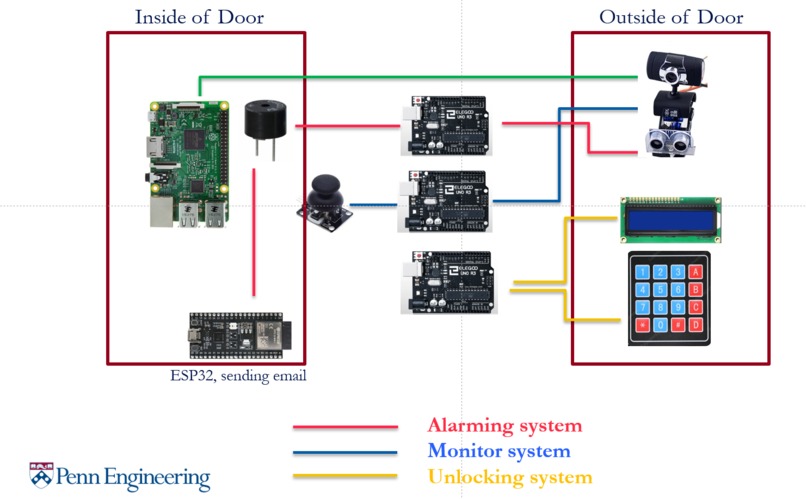
Layout for Smart Door Security System
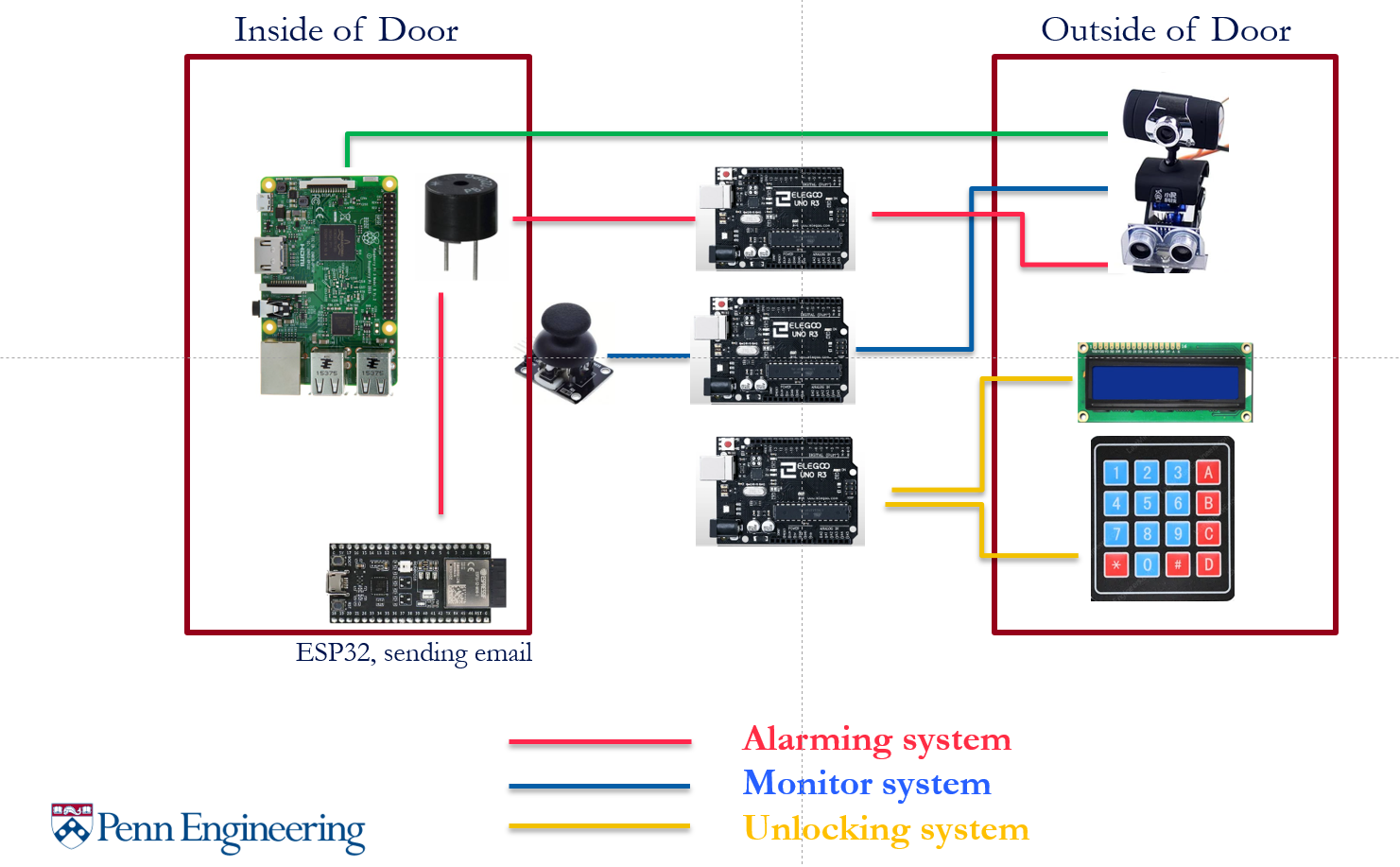
Inspiration
1. Seamless Smart Home Integration:
The system is inspired by the idea of seamlessly integrating security features into the broader concept of a smart home. This ensures that security becomes an integral part of an interconnected ecosystem.
2. Enhanced Security Measures:
The primary inspiration is to provide advanced security measures, including alarming, unlocking, and monitoring functionalities. The system aims to deliver robust protection against potential threats to enhance overall safety.
3. Real-time Environmental Awareness:
The alarming system incorporates real-time monitoring of environmental factors such as temperature and humidity. This feature is inspired by the desire to provide users with comprehensive information about their surroundings, contributing to a more informed and secure living space.
What it does
There 3 systems for our project:
1. Alarming system:
The alarming system serves as a security measure to detect potential threats near the door. When the system identifies a person within 50cm for more than 3 seconds, it triggers an alarm through a buzzer. Simultaneously, an alert email is sent to the host's phone, ensuring that the host is promptly informed of the situation. Additionally, the system displays real-time temperature and humidity data on the screen, providing the host with comprehensive information about the external environment.
2. Unlocking system:
The unlocking system employs a keypad to grant access to authorized individuals. An LCD screen provides feedback messages to guide the user during the password entry process. If the correct password is entered, the door unlocks, allowing authorized individuals to gain entry. This system enhances security by ensuring that only those with the correct credentials can access the protected space.
3. Monitor system:
The monitoring system utilizes a camera to provide real-time surveillance of the area outside the door. The camera is mounted on a platform, which can be controlled using a joystick. This flexibility allows for a broader view of the surroundings, enhancing the system's monitoring capabilities. The monitoring system provides an additional layer of security by offering visual insights into the external environment.
How we built it
Alarming:
We employ the HC-SR04 ultrasound sensor to detect proximity, triggering an alarm when someone approaches within 50cm of the door. The Atmega328p's Timer is utilized to measure the time duration. If someone remains within the specified range for 3 seconds, a passive buzzer is activated to raise an alarm. Simultaneously, the ESP32 receives the signal and executes code to send an email notification to the host's phone.
Unlocking:
The 4x4 keypad captures user input for unlocking the door. The entered numbers are displayed on the LCD (1602) screen. The * button allows users to undo the last entered digit. Upon entering the correct code as set in the system, a prompt message appears on the screen indicating "door opens." Concurrently, a servo motor is triggered to simulate the door opening.
Monitoring:
The monitoring system utilizes a Raspberry Pi 3B+ connected to a P5V04A Sunny camera. Video streaming is achieved using the Real-Time Streaming Protocol (RTSP), displaying the live feed on the screen. The camera is mounted on a platform with two servo motors for controlling movement in two directions. A 2-dimensional joystick is employed to manipulate the camera's movement, offering flexibility in surveillance.
Challenges we ran into
Servo motors not responding to command; Keypad not pressing the right buttons; ESP32 not sending emails when triggered; Camera not providing a constant stream; Temperature and humidity sensors not giving readings.
Accomplishments that we're proud of
We made a full functioning home security system that has wireless communication and a real time stream from the camera with good quality and no delay and the camera can be controlled to change the change of position so you can view in multiple angles, also it has motion sensor that when it detects someone the buzzer rings and an email is sent to the home owner.
What we learned
Throughout this project, we honed our programming skills and adeptly interconnected various components, creating a system where each part relies on the others. Beyond applying knowledge from previous labs and lectures, we delved into new concepts, incorporating elements like the keypad, temperature/humidity sensor, email sending, Raspberry Pi, and the camera. This hands-on experience deepened our understanding of Embedded Systems.
In the final stages, our collaboration strengthened as each team member took responsibility for a specific system. Each system efficiently executed its designated tasks, resulting in a cohesive and successful outcome.
What's next for Smart Door Security System
Currently, the camera movement relies on manual control through the joystick. To enhance the system's intelligence, integrating facial recognition algorithms, such as those available in the OpenCV library, could automate tracking individuals outside the door, ensuring the camera consistently faces the center of the screen.
Moreover, optimizing the delay and refresh rate of the camera stream would contribute to a more stable and seamless viewing experience. A potential future enhancement involves displaying the video stream on a compact FTF screen, aligning the system more closely with embedded system standards and providing added convenience.
Built With
- atmel
- avr
- c
- camera
- lcd
- raspberry-pi
- rtsp
- servo
- vlc


Log in or sign up for Devpost to join the conversation.