-
-
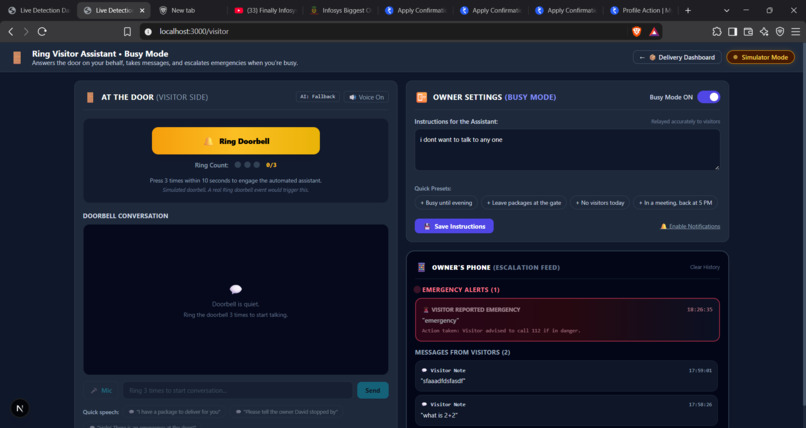
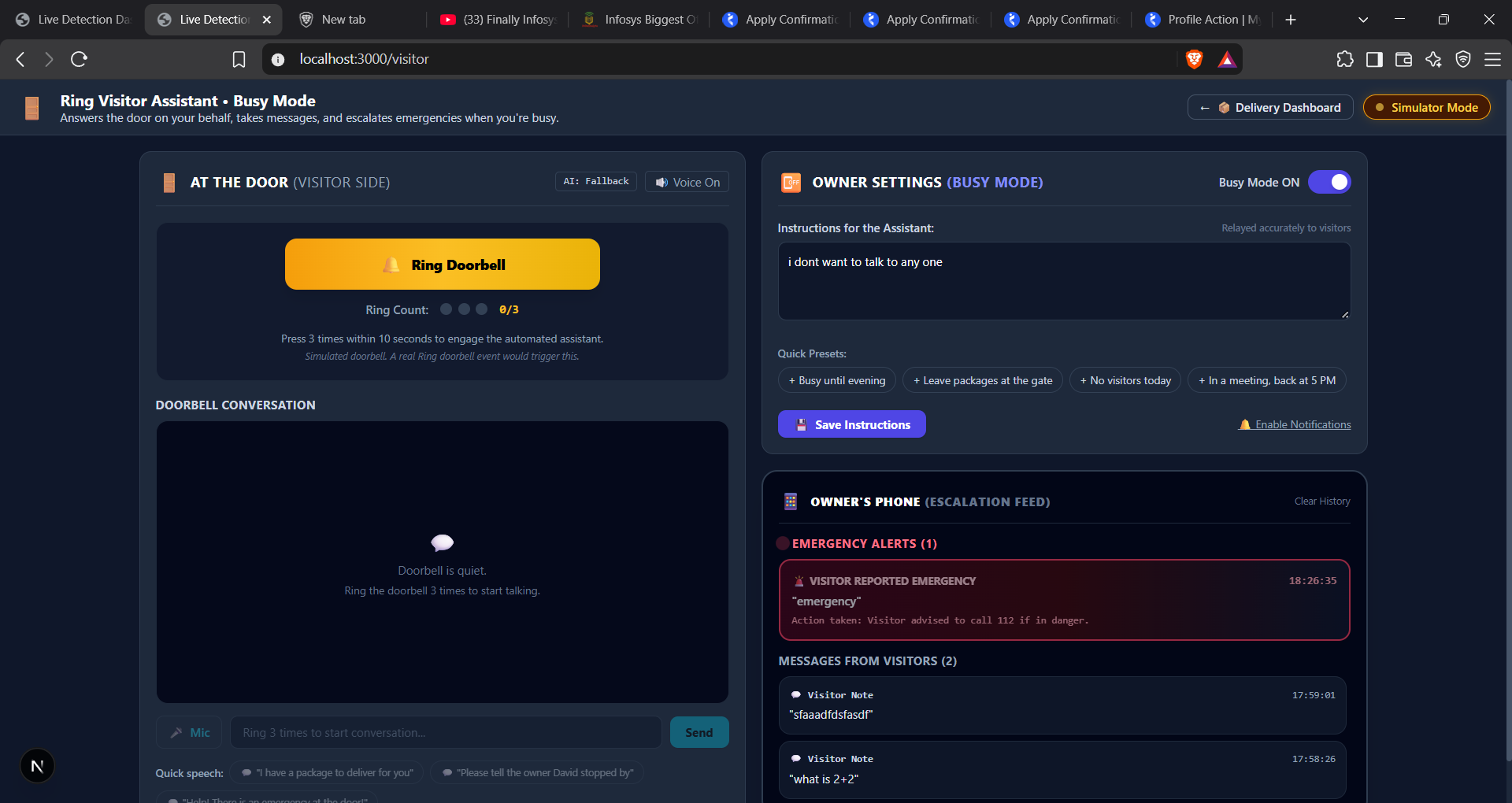
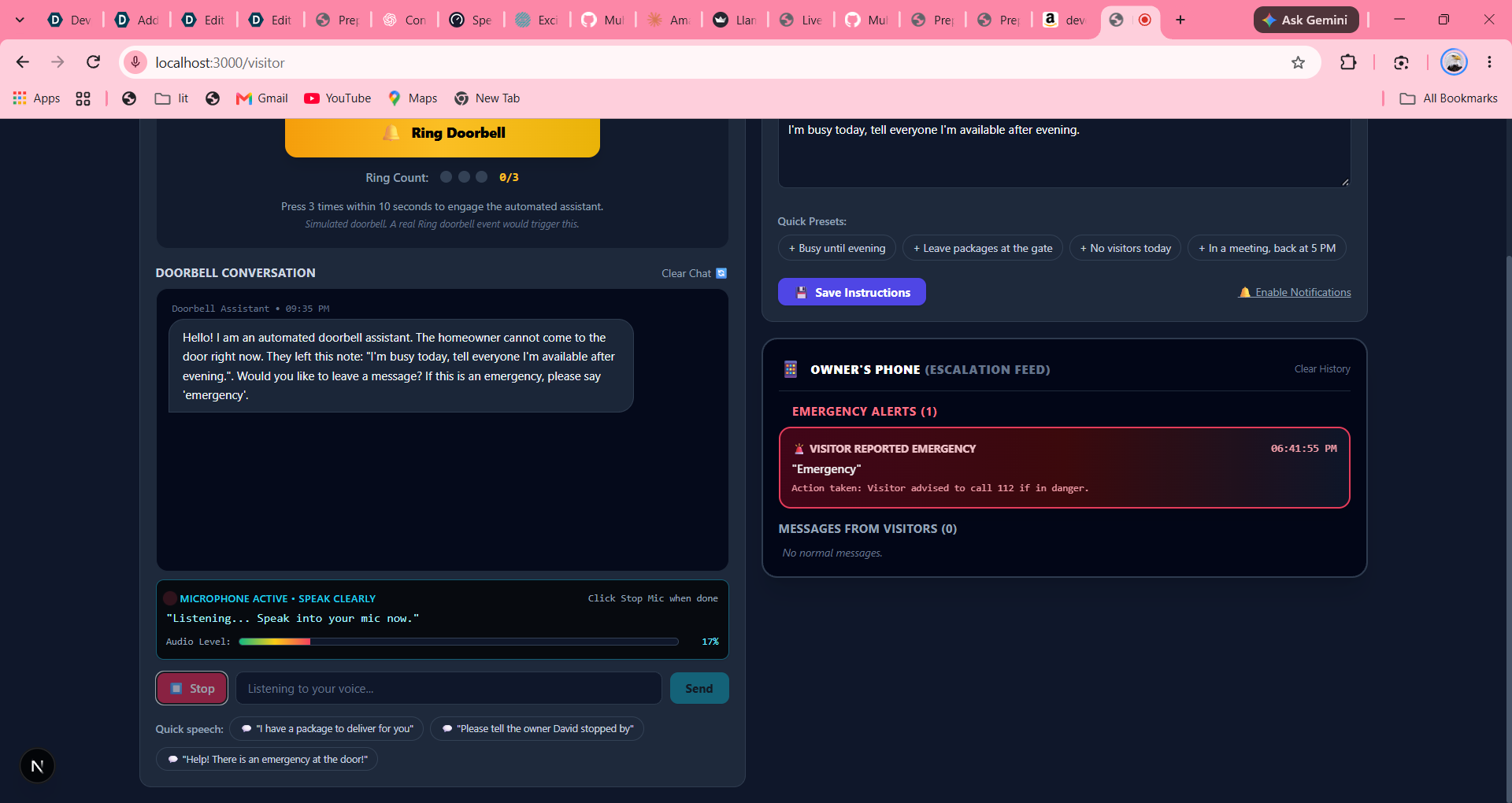
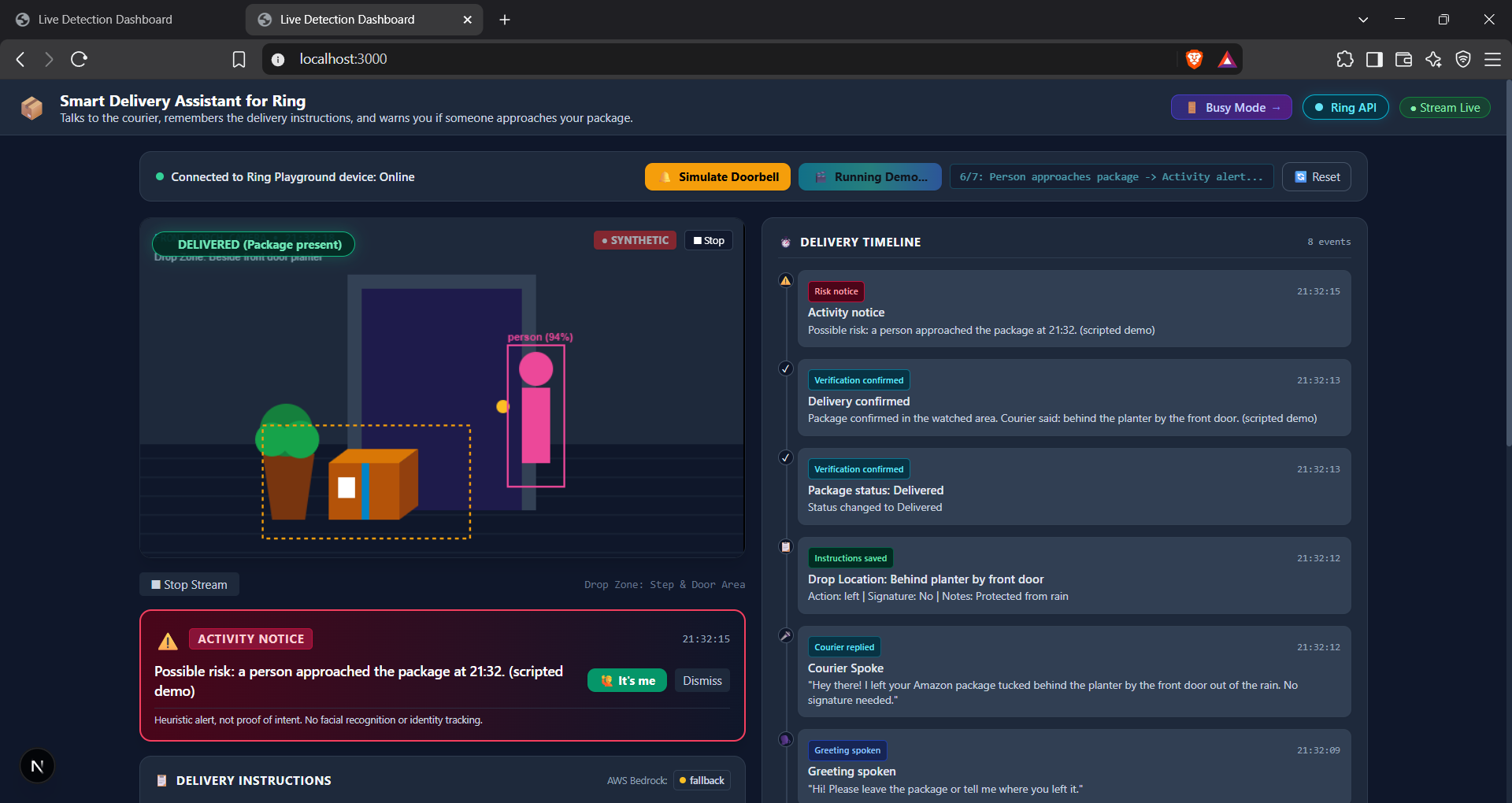
smart visitor assistant
-
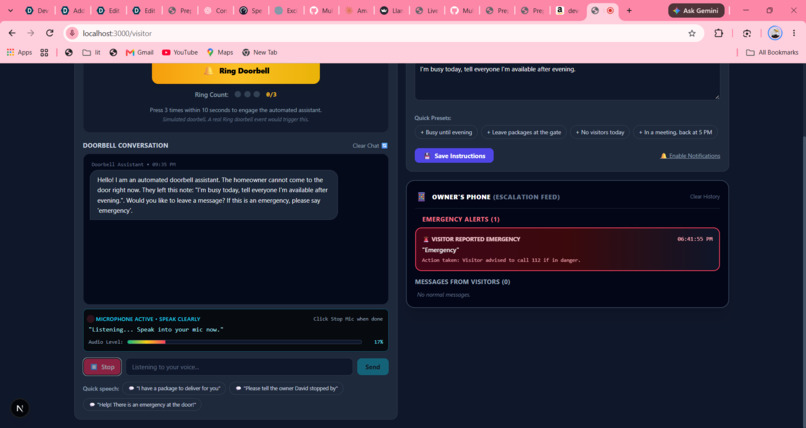
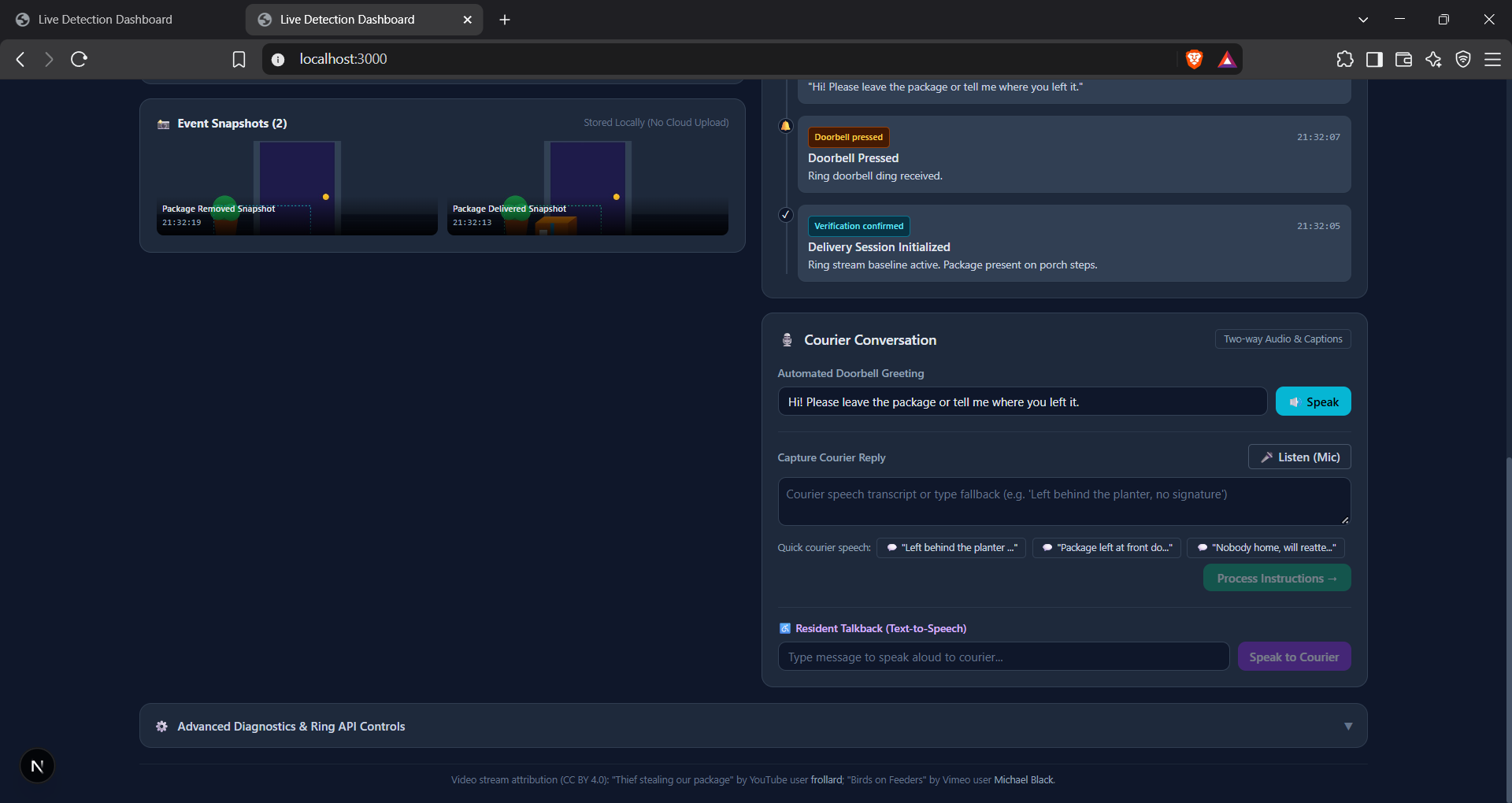
live conversation with visitor
-
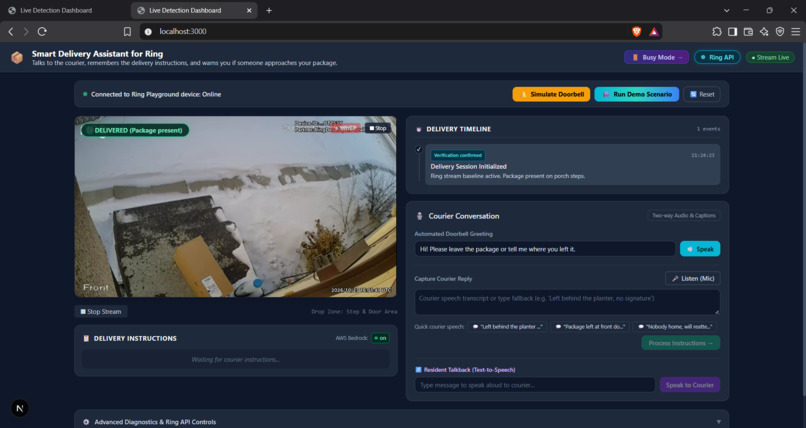
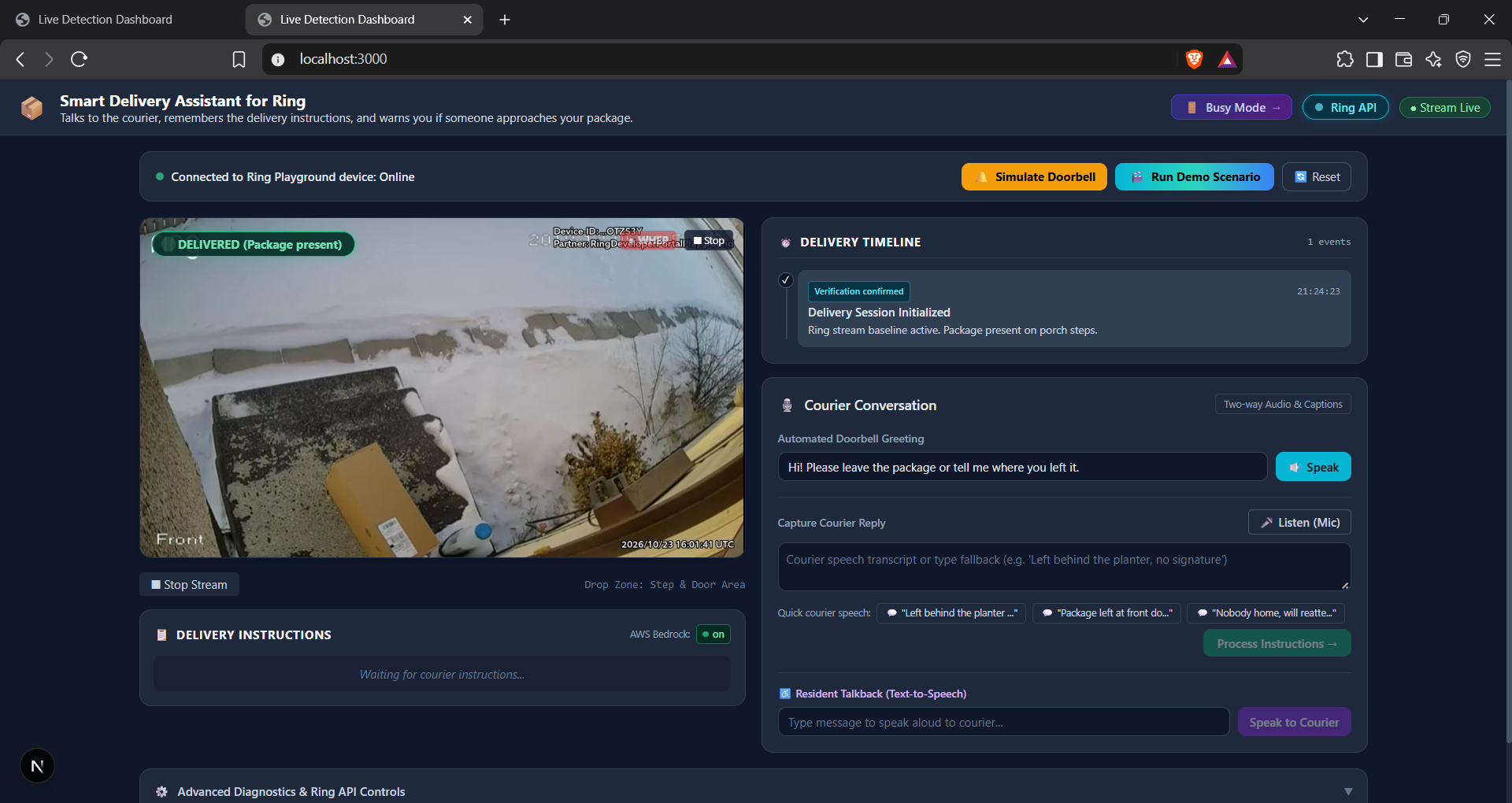
package tracking and watching
-
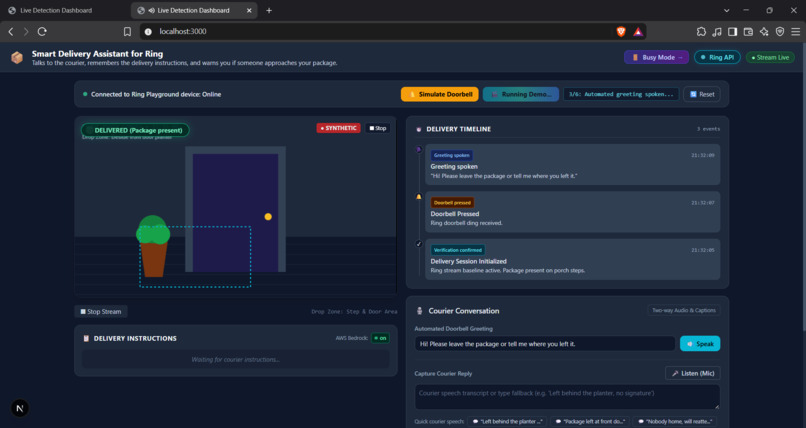
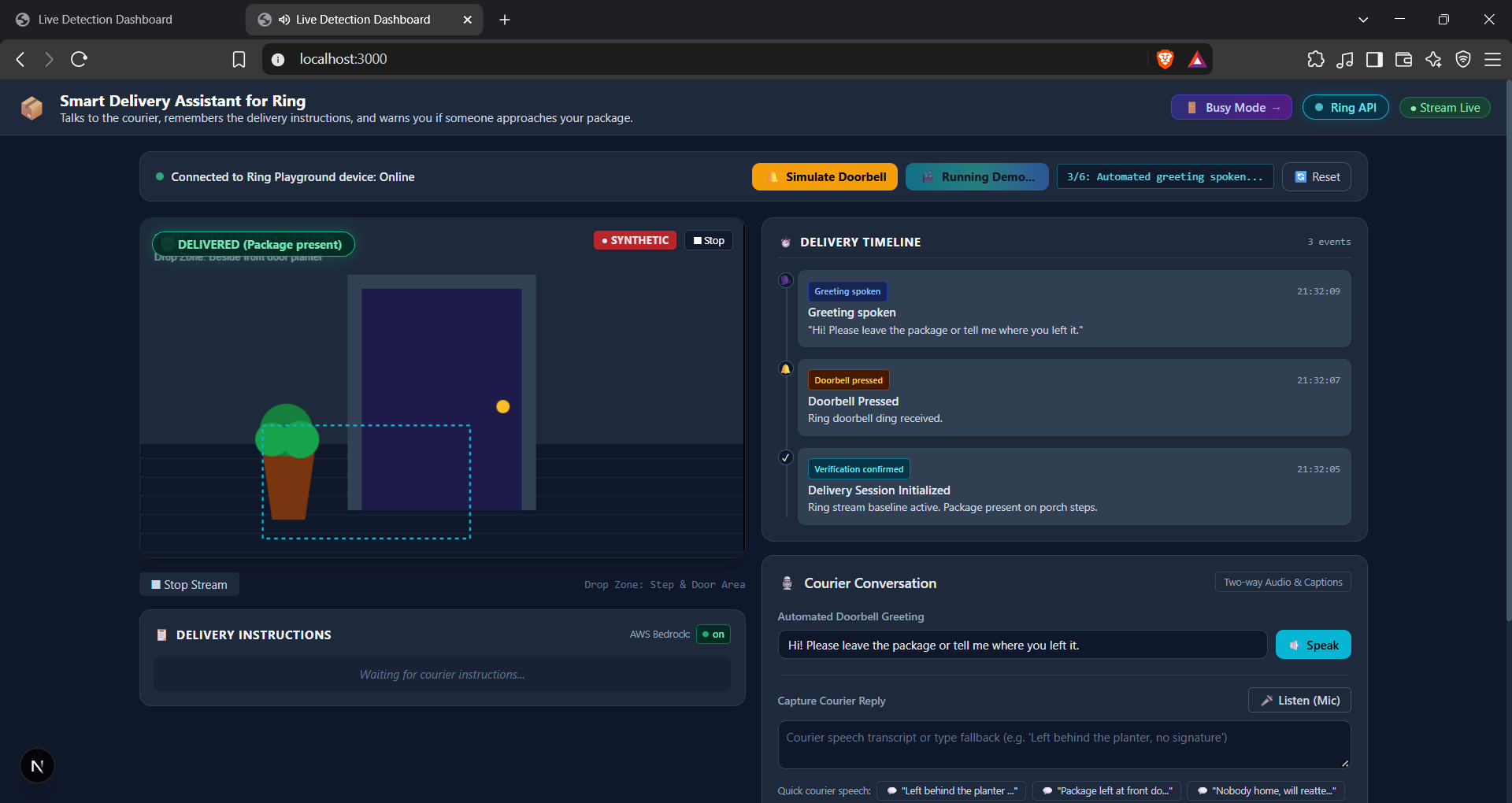
demo of how package
-
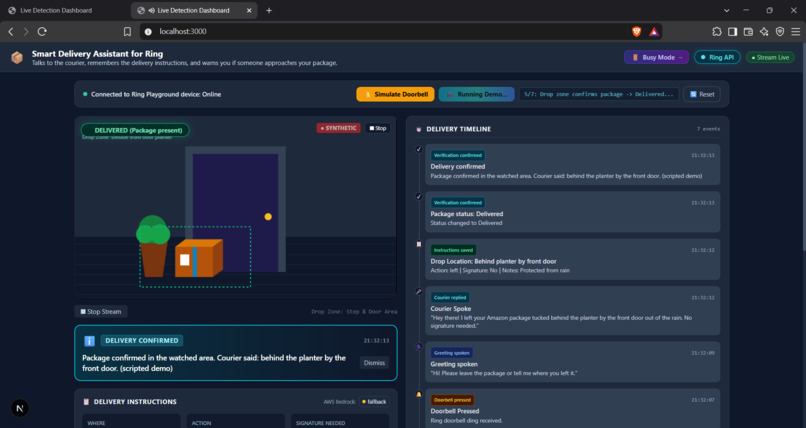
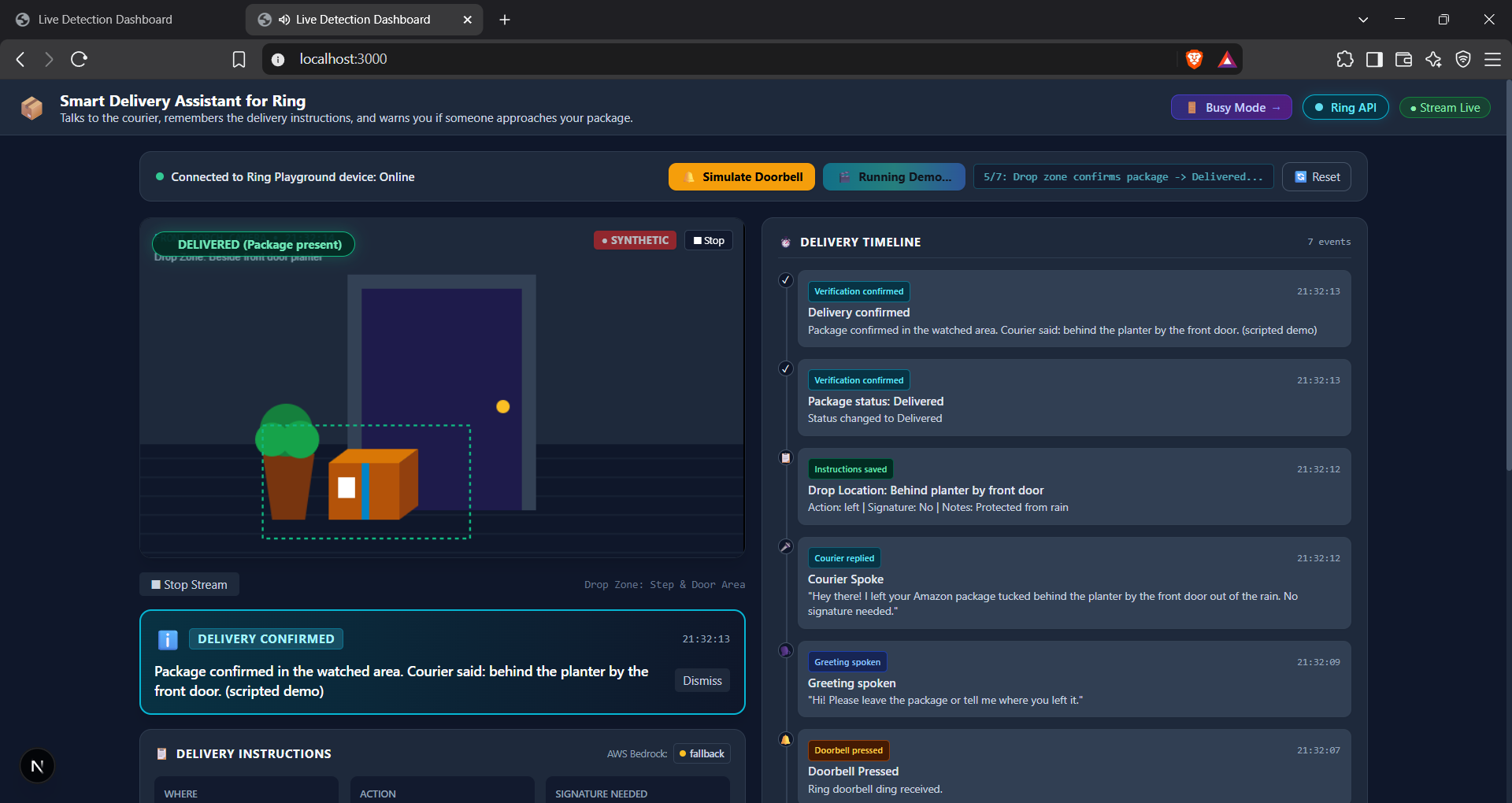
capturing the package place and saving
-
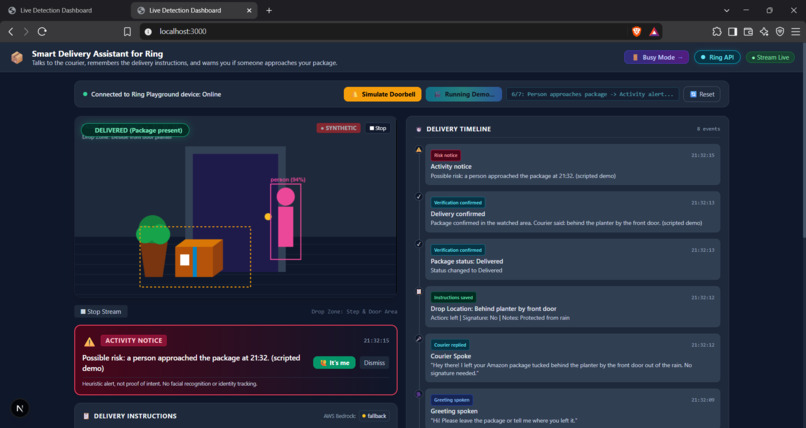
raising alert when some one approaches the parcel
-
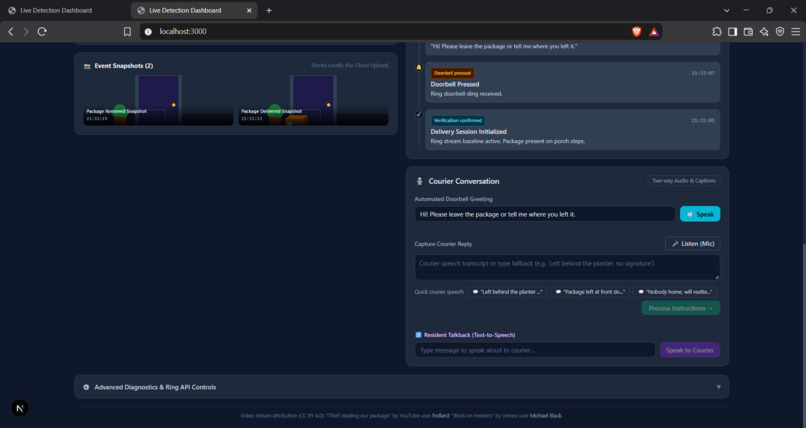
saved snapshot of parcel actions
Smart Delivery Assistant for Ring
Inspiration
Missed deliveries, misplaced parcels, and unanswered visitors are everyday problems for millions of households. For people who are hard of hearing, working from home in back-to-back meetings, or experiencing mobility challenges, reaching the door in time is not always possible.
Traditional smart doorbells are largely passive. They send notifications, but they rarely help when homeowners cannot respond immediately. As a result, delivery drivers may leave packages in unsuitable locations, visitors may leave without communicating their needs, and important situations can go unnoticed.
We wanted to transform a standard Ring doorbell into an active, autonomous doorstep concierge that can communicate with delivery drivers, monitor package activity, provide visitor assistance, and escalate emergencies while prioritizing household privacy.
Our vision was to combine voice AI, computer vision, and generative AI to make doorstep interactions smarter, safer, and more accessible.
What It Does
Smart Delivery Assistant for Ring is an edge-to-cloud intelligence platform that combines real-time communication, browser-based computer vision, and Amazon Bedrock to create an intelligent doorstep experience.
Key Features
Autonomous Delivery Assistant: Greets delivery drivers, captures their responses, and extracts delivery instructions such as package location, drop action, and signature requirements. Live captions and typed talkback allow homeowners to communicate with drivers remotely.
Drop-Zone Package Monitoring: Lets residents define a custom drop zone on the video stream and tracks package states through Expected, Delivered, and Removed / Resident Pickup.
Privacy-First Proximity Alerts: Detects activity around the delivery area after a package has been delivered and provides heuristic-based proximity warnings. The system does not use facial recognition or identity profiling.
Busy Mode AI Visitor Concierge: A dedicated
/visitorexperience activates after three rapid doorbell rings within 10 seconds. Powered by Amazon Bedrock, it communicates customized homeowner instructions, records visitor messages in a simulated homeowner interface, and escalates emergency-related messages through visual alerts, browser notifications, and Telegram.Native Audio Experience: Generates a dual-tone Westminster-style chime at 830 Hz and 622 Hz using the Web Audio API, alongside a live audio input-level meter.
Interactive End-to-End Demo: Provides a seven-stage simulated scenario that allows judges to explore the complete delivery workflow without requiring physical Ring hardware or account credentials.
How We Built It
We built the application using Next.js 14, TypeScript, and Tailwind CSS, extending the official ring-api-helloworld starter template.
The architecture combines three major components:
Device Integration: A device abstraction layer supports Ring API mode and simulator mode. Ring integration is designed around live WHEP WebRTC streams, device information, and event history, while the simulator enables repeatable testing without physical hardware.
Browser-Based Computer Vision: TensorFlow.js and COCO-SSD support person detection, while a frame-difference engine monitors changes within the resident-defined delivery zone. Video processing is performed in the browser so raw video frames do not need to be sent to the AI backend.
Generative AI: Amazon Bedrock's Converse API with Amazon Nova Micro processes courier transcripts into structured delivery information and supports the Busy Mode visitor concierge. A server-side integration keeps cloud AI requests separate from the browser interface.
We also integrated the Web Speech API for voice interaction, the Web Audio API for doorbell sounds and audio monitoring, and browser notifications for urgent events.
Computer Vision Approach
To monitor the delivery zone, we calculate the average pixel difference between the current video frame and a baseline frame:
$$ \Delta I = \frac{1}{N}\sum_{(x,y)\in\Omega}|I_t(x,y)-I_{\text{baseline}}(x,y)| $$
Here, (\Omega) represents the calibrated drop zone and (N) is the number of pixels in that region. When the difference exceeds a configured threshold, the system evaluates whether a package-related state change may have occurred, alongside person detection.
To reduce unnecessary proximity alerts, the system uses a 15-second grace period:
$$ t_{\text{alert}} = t_{\text{detected}} + 15\text{ seconds} $$
These visual signals are used as heuristic indicators rather than definitive proof of package identity or theft.
AI-Powered Understanding
Amazon Nova Micro is used for two primary tasks:
- Courier intent extraction: Converts speech transcripts into structured JSON with
location,action,needs_signature, andnotes. - Visitor intent classification: Categorizes visitor messages as
message,emergency, orotherand generates short spoken responses based on homeowner-provided instructions.
We also implemented a local regex-based fallback for essential keyword detection when the AI service is unavailable. This helps preserve core functionality during service interruptions.
Challenges We Faced
1. Static Ring Playground Streams
One of our biggest challenges was that simulated Ring Playground streams, including Package and Motion, contained static scenes rather than realistic movement. This made it difficult to validate package placement, removal, and proximity detection using those streams alone.
We addressed this by building a dual-mode device abstraction layer that separates device integration from the computer vision pipeline. This allows us to test the application using controlled dynamic footage while retaining a path for integration with Ring endpoints.
2. Boolean Parsing Errors in AI Responses
We encountered a subtle JavaScript issue when parsing AI-generated JSON. The expression Boolean("false") evaluates to true, which can incorrectly interpret a waived signature as a signature requirement.
We fixed this by implementing strict boolean normalization instead of relying on JavaScript truthiness:
const needsSignature =
  parsed === true ||
  String(parsed).toLowerCase() === "true";
This reinforced the importance of validating AI-generated structured data before using it in application logic.
3. Browser Audio Resource Conflicts
On Windows Chrome, using getUserMedia() for audio-level monitoring alongside the Web Speech API recognizer caused race conditions.
We addressed this by decoupling audio processing and using single-shot speech recognition with continuous: false. This improved the reliability of speech capture and reduced conflicts between browser audio features.
4. Balancing Privacy and Cloud Intelligence
Another challenge was deciding which operations should run locally and which should use cloud AI. Sending raw video frames to a remote service would introduce unnecessary privacy concerns.
We separated local video analysis from cloud-based language understanding. The browser handles video processing, while Amazon Bedrock receives textual information needed for semantic interpretation. This architecture reduces the need to transmit sensitive visual data for AI processing.
What We Learned
Privacy by Design: Processing video locally can reduce unnecessary exposure of sensitive household information while still enabling intelligent monitoring.
AI Needs Deterministic Safeguards: Generative AI is useful for understanding natural language, but structured outputs must be validated, and critical alerting should not depend exclusively on an LLM.
Reliable Fallbacks Matter: A useful AI-powered product must account for network failures, unavailable services, unexpected outputs, and browser limitations.
Computer Vision Requires Careful Interpretation: Pixel changes and person detection provide useful signals, but they cannot independently prove that a specific package was delivered or stolen. Combining multiple signals and communicating uncertainty is essential.
WebRTC Enables Responsive Experiences: Working with WHEP-based streaming helped us understand low-latency video delivery and the challenges of integrating real-time media into a modern Next.js application.
Simulation Accelerates Development: A reproducible demo environment makes it easier to test complex event sequences, validate state transitions, and demonstrate the application without relying on physical devices.
What's Next
Our next steps are to complete production-grade Ring OAuth 2.0 account linking and webhook subscriptions, expand monitoring across multiple cameras, and explore secure smart-lock integrations for authorized deliveries.
We also plan to improve package tracking accuracy, test the system against a wider range of real-world lighting and environmental conditions, and strengthen notification reliability.
Our long-term goal is to make smart doorbells more than notification devices: we want them to become accessible, privacy-conscious assistants that help households manage doorstep interactions intelligently.
Built With
Next.js 14, TypeScript, Tailwind CSS, Ring Partner API, WebRTC (WHEP), Amazon Bedrock, Amazon Nova Micro, TensorFlow.js, COCO-SSD, Web Speech API, Web Audio API, and browser notifications.
Built With
- amazon-bedrock
- amazon-nova
- amazon-web-services
- artificial-intelligence
- computer-vision
- edge-computing
- generative-ai
- iot
- next.js
- node.js
- privacy
- react
- ring-api
- security
- smart-home
- speech-synthesis
- tailwindcss
- telegram-api
- tensorflow.js
- typescript
- web-audio-api
- web-speech-api
- webrtc
- whep


Log in or sign up for Devpost to join the conversation.