-
-
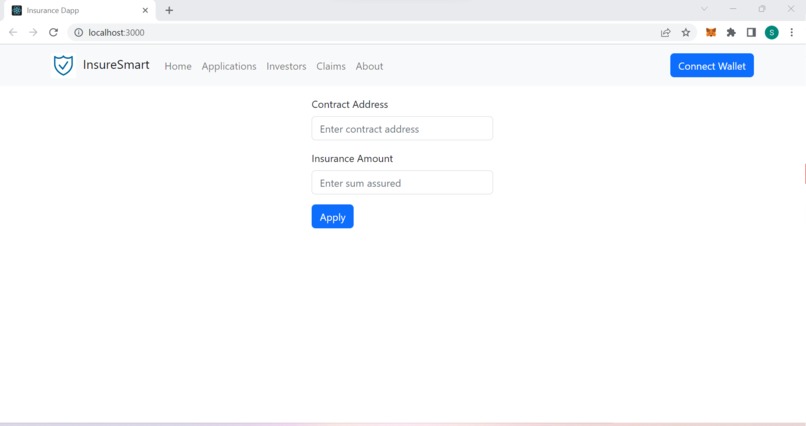
Dapp Home
-
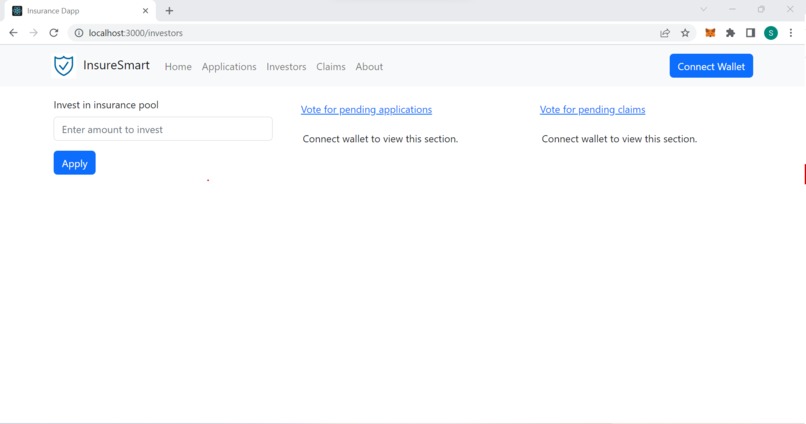
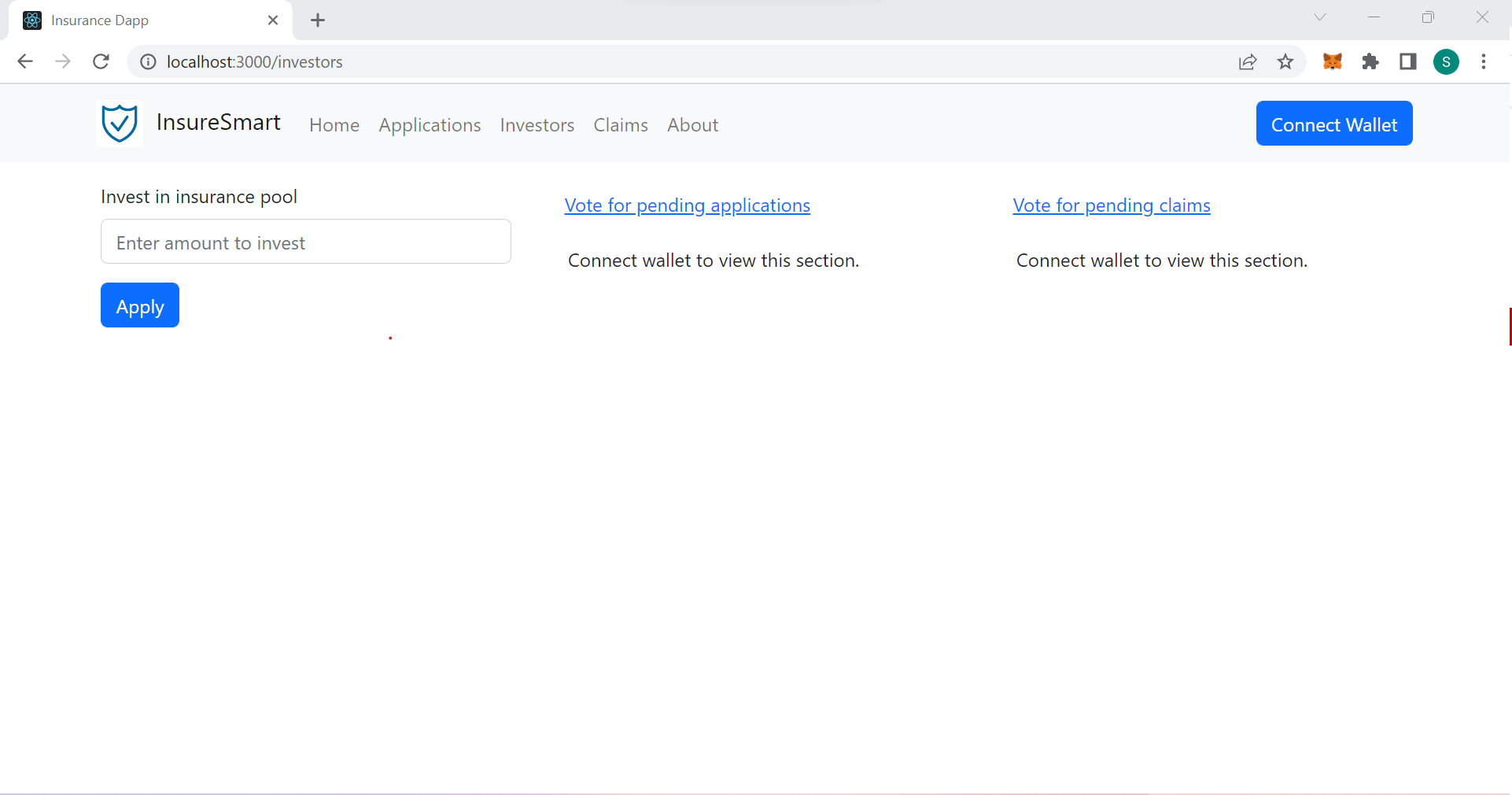
Investors section
-
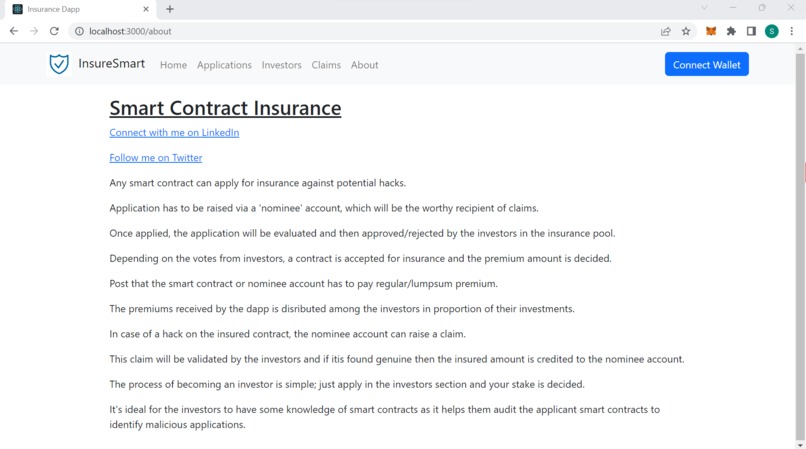
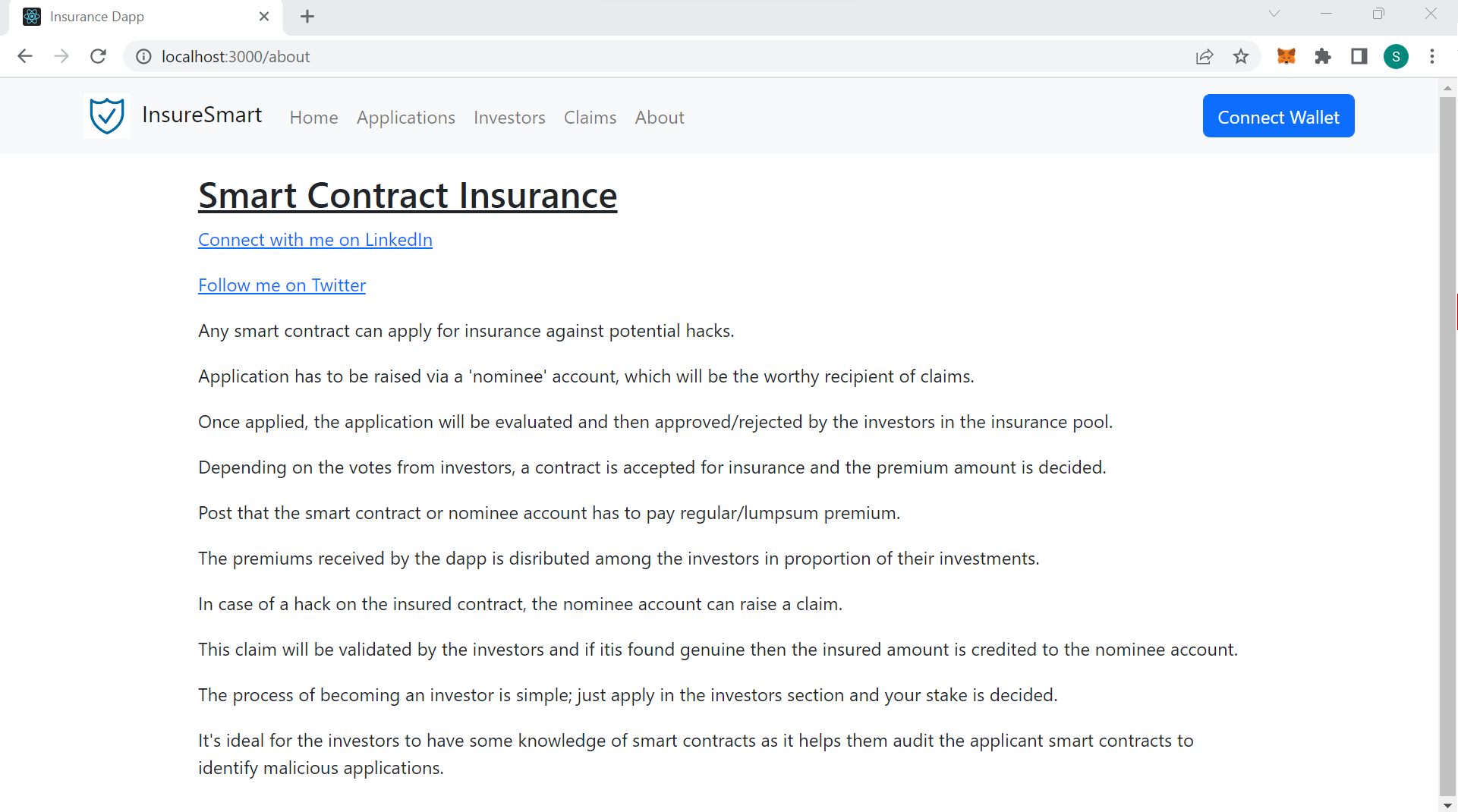
About
Inspiration
Attacks on smart contracts are very common and these are only going to increase with the mass adoption of web3. While safe programming principles help against such hacks, they still do not guarantee safety. Thus we wanted to build a Dapp which can act as a decentralized and community-driven insurance provider to insure against such unexpected attacks.
What it does
Individuals and communities can use this Dapp to buy insurance for their Dapps or smart contracts. When a smart contract applies for insurance, it passes through some automated checks for vulnerability and after that, a voting process takes place in the community to decide if it can be accepted for insurance. The community comprises all the investors in the insurance pool. Members in the community can also do some manual audits on the applicant contract before voting, in which case they get rewarded with an increase in their stake in the pool. When an insurance application gets accepted, the insured has to pay the premium decided by an algorithm that takes into account the vulnerability and the number of votes for the application, and the application gets registered. In case there are hacks on the insured contract, a claim can be raised which is validated by the community and the insured amount is credited to the nominee of the insured contract by deducting from the pool. Also, anyone can participate in the community by investing some ether/native token.
How we built it
We built it to work on all EVM-compatible chains. The backend was written in Solidity and the frontend in Javascript with React.js. We used the Hardhat framework for development and deployment.
Challenges we ran into
The main challenge was the planning phase. From ideas to a concrete implementation plan involved some work. The next challenge was to build the Dapp itself; I was a beginner in Solidity, Javascript, and blockchain technology. So building this Dapp was a challenge and it took some time.
Accomplishments that we're proud of
This was my first full-stack blockchain project and it makes me feel immensely proud that I could make it to a hackathon.
What we learned
This was a huge experience for learning blockchain development with Solidity, front end with React.js, and about Ethereum and EVM-related chains, and the web3 ecosystem in general.
What's next for Smart Contract Insurance
Currently, we are using it for insuring smart contracts. But this model, with some tweaks, can be applied to other types of insurance as well.
Built With
- evmos
- hardhat
- javascript
- react
- solidity

Log in or sign up for Devpost to join the conversation.