Inspiration
Manual attendance takes valuable classroom time and can become difficult to manage accurately as class sizes grow. We wanted to build a system that uses computer vision to automate attendance while also turning attendance records into useful information for teachers.
What it does
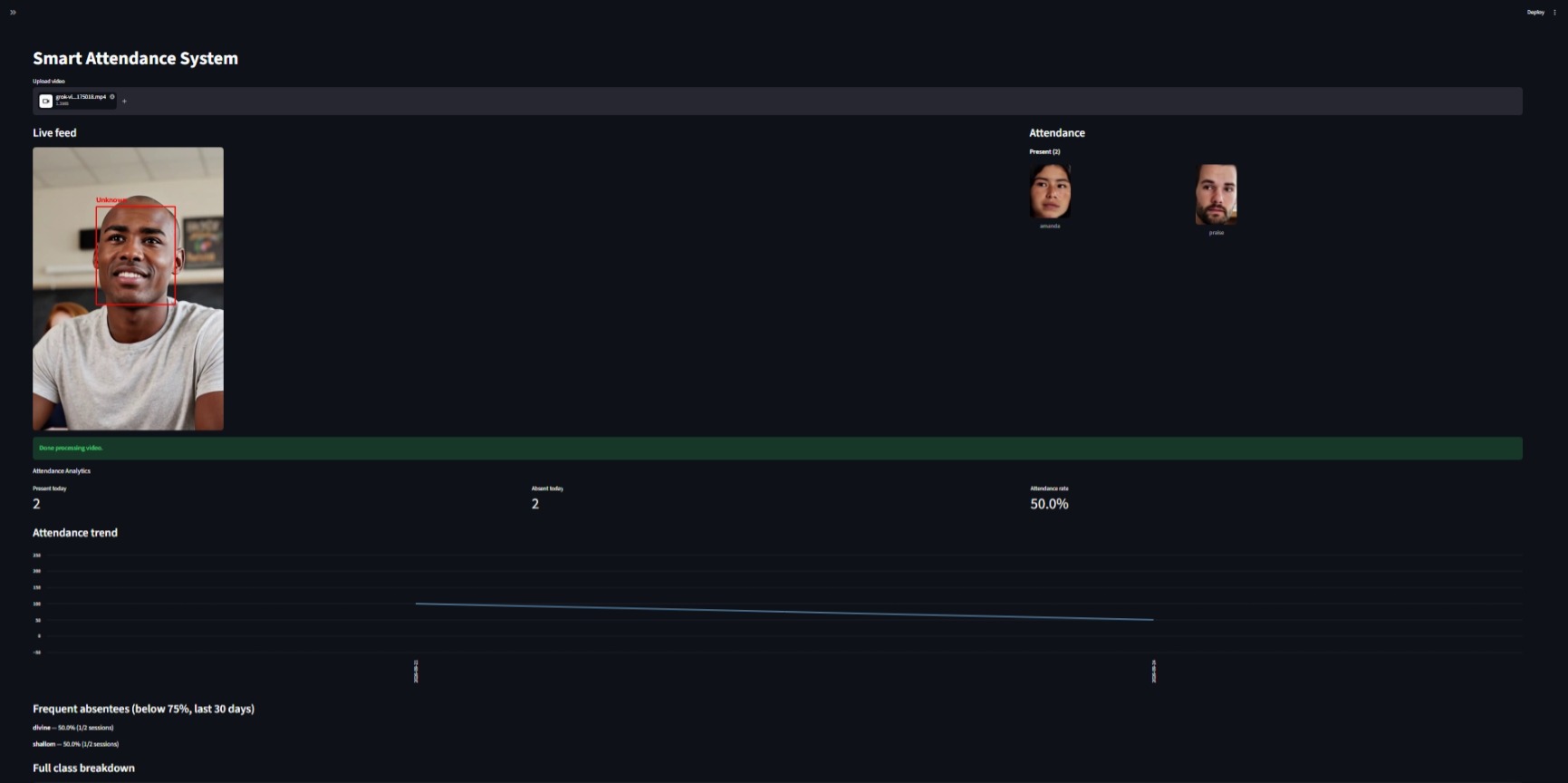
Smart Classroom Attendance System uses a camera and computer vision to identify registered students and record their attendance during an active classroom session. The system can: Detect and recognize registered students. Track students across video frames. Prevent duplicate attendance records. Record attendance timestamps.
How we built it
The system combines computer vision, backend services, and a database: Computer Vision InsightFace for face recognition and student identification. ByteTrack for tracking detected individuals across frames. OpenCV for camera and video processing.
Backend
FastAPI for the application API and video/attendance services. SQLite for storing students, attendance records, timestamps, and class information.
Dashboard A teacher-facing interface for starting attendance sessions, viewing attendance records, and analyzing attendance trends.
The overall pipeline is:
Camera ↓ InsightFace Recognition ↓ ByteTrack Tracking ↓ Attendance Logic ↓ SQLite Database ↓ Teacher Dashboard
i also designed the inference layer to support hardware-aware deployment, allowing models to run on available CPU/GPU resources where supported.
Challenges we ran into
Another challenge was preventing duplicate attendance when the same student appears across many video frames. Tracking and attendance-state logic are used to ensure that a student is not repeatedly recorded during the same session.
Finally, we had to balance recognition accuracy with inference speed so the system could operate close to real time.
Accomplishments that we're proud of
We are proud of building an end-to-end system that combines several areas of software and computer vision rather than creating only a face-recognition demo.
The project brings together:
Real-time computer vision. Face recognition. Object tracking. Attendance management. Database storage. A teacher-focused dashboard.
What we learned
We learned that building a computer-vision application involves much more than training or running a model. We had to consider the complete pipeline: image acquisition, detection, recognition, tracking, database design, inference performance, and user interaction.
What's next for Smart Classroom Attendance System
Scaling recognition accuracy to larger class sizes and less controlled lighting, adding the "late" status and multi-class support, and building out the analytics layer we scoped early on — letting a teacher ask natural-language questions like "who's had the lowest attendance this month?" and get an answer pulled straight from the logged data.


Log in or sign up for Devpost to join the conversation.