-
Smart City
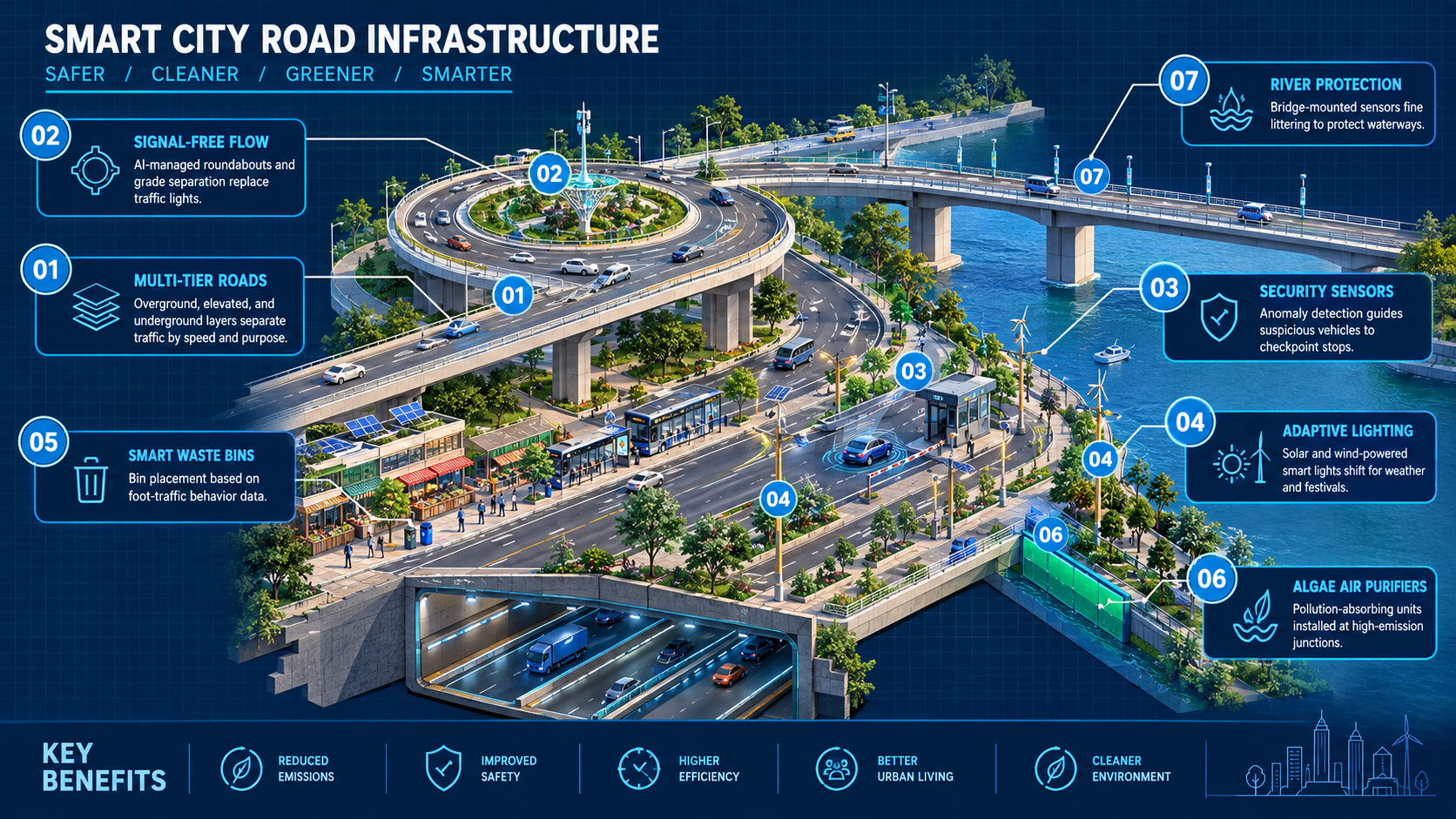
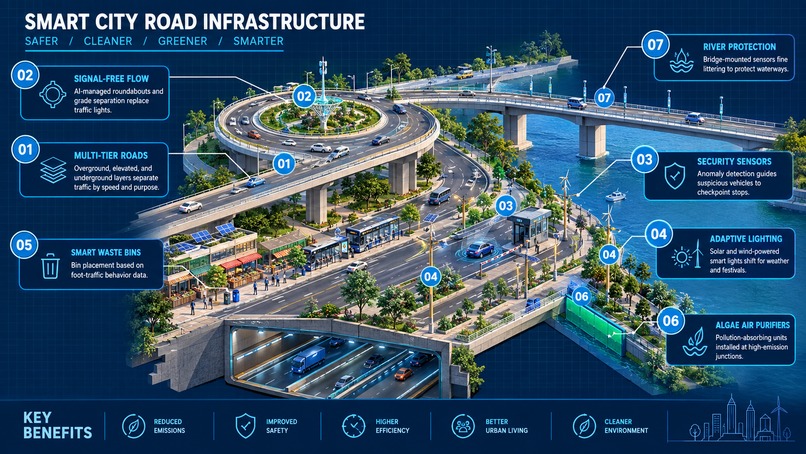
My idea reimagines Indian road and transportation infrastructure as a multi-layered, AI-governed system built directly in response to the specific failures of Indian roads today — chronic traffic congestion caused by outdated signal-based intersections that force vehicles to halt rather than flow, chaotic and unplanned junctions that lead to some of the highest accident rates in the world, poor or broken footpaths that push pedestrians onto vehicle lanes, absent or overflowing waste bins that turn markets and roadsides into dumping grounds, open or badly designed sewage systems that contaminate water and worsen road decay, and rivers turned into dumping sites because there is no real deterrent against civic waste disposal; it addresses each of these by proposing a three-tier road network — underground tunnels for heavy and express traffic, elevated flyovers for fast inter-zone movement, and surface roads for local and pedestrian use — connected through roundabouts and grade separation instead of traffic lights, following the proven signal-free model already working in Kota, Rajasthan, so that vehicles are guided through the city continuously instead of stopping at every junction; on top of this physical redesign sits an AI traffic-management layer that reroutes flow in real time, a sensor-based security system that can flag and safely intercept suspicious vehicles by guiding them toward a checkpoint rather than triggering a chase, adaptive AI-controlled street lighting powered by renewable sources like solar and wind (feeding a grid also supported by nuclear baseload power) that adjusts for weather, time of day, and festivals like Diwali or Holi, a behavior-data-driven placement of waste bins modeled on how Disney parks position them based on actual foot traffic rather than fixed intervals, algae-based air purifiers to counter vehicle pollution, proper footpaths and separated sewage systems similar to developed countries, and river-adjacent sensors that fine people caught throwing waste into water bodies — the underlying reasoning throughout is that India's road problems aren't just about adding more infrastructure, but about replacing reactive, stop-and-control systems (signals, manual policing, fixed-interval bins) with proactive, flow-based and data-driven ones that work with how people and vehicles actually move through a city rather than forcing them to constantly stop and restart.
Built With
- chatgpt
- claude

Log in or sign up for Devpost to join the conversation.