-
-
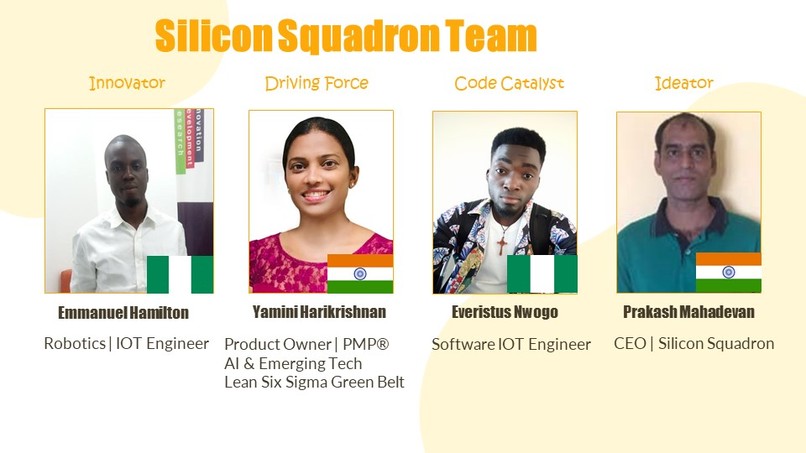
Team
Inspiration
PROJECT DESCRIPTION - SMART CANE
With a large number of people suffering from various levels of blindness such as cataracts, glaucoma, river blindness and total blind. It's very important that these demographic of persons are integrated into the full-scale of societal activities through inclusive design to aid enhanced mobility and advance social acceptance thereby stemming the roots of discrimination.
Problem Statement Blind people at all levels suffer stigmatization, difficulty in mobility, societal isolation, segregation in public gatherings and majorly unaware of their environment. Also with the aid of their cane they can only detect an obstacle but not the nature of the obstacles nor their sizes.
The blind may find it difficult to tell the difference between various locations with similar atmosphere such as restaurant, boutique, bar, saloon, sports arena, political rally, religious gathering, civil protest ground, parks, paved roads, tarred roads, agricultural estate and a lake side or beach.
A blind man mistakenly kicked me at the entrance to our Church, despite being aided by someone. If he had our Smart Cane, he would have known the proximity.
What it does
Solutions We crafted a solution that revolutionizes the mobility and social sense of belonging amongst blind people.
We deployed image analytics, RFID and ultrasound technologies to redefine the Cane used as aid by blind people.
Our solution helps blind people to be aware of their environment and know the exact kind of environment where they're, we also deployed computer vision to inform the blind of the various nature of road surface they're moving on.
The smart cane also helps the blind to detect the presence of fellow disabled persons within their proximity as well as the presence of verified community assistants who they can rely on when authenticated by the RFID module attached to their smart cane, this ensures that the blind person feels safe around who is helping them.
All notification to the blind are communicated through a haptic feedback motor which acts as a digital Braille system.
Now with our solution, blind people can now get help from verified community assistants whom they can be free with and the blind can not just only navigate their ways easily but they can also tell the nature of obstacles on their path as well as knowing the setting of their immediate environment.
We have integrated wireless Bluetooth technology to help the blind get audio instruction in real-time to aide navigation, a future enhancement of this attachment would see to how blind people can listen to internet radios while taking a walk through the neighborhood.
How we built it
Using IOT technology
Advance Social interaction value added feature :
RFID tags for verified community helper and fellow disabled people.
NFC Reader in the Smart Cane that detects authenticated community partners.
Vibrator to sense verified community helper so that blind person knows its a verified person and not a fraudster.
Increasing Mobility by Obstacle detection and description feature: Ultrasound sensors embedded in the Smart Cane to detect obstacles and integrated Bluetooth technology for auditory feedback on the path blind person can follow.
Challenges we ran into
Bringing in cost effective solution and value added features
Accomplishments that we're proud of
With Smart Cane we are bringing blind people close to the network of common people, so that they are not left alone and hence we can boost their moral capabilities to being strong
What we learned
Global statistics of people with disabilities, Companies that are making inclusive product designs to include the needs of disabled people for increased accessibility, inclusive design thinking
What's next for Smart Cane Project
1.Smart Cane aesthetic design
2.Battery power optimization and energy autonomy
3.Cloud Integration
4.Advanced Image Analytics
5.Online Radio
6..Cost optimization
7.Weight reduction of the devices


Log in or sign up for Devpost to join the conversation.