Inspiration
We wanted to build a friendly, interactive robot that feels alive—something small, smart, and approachable that can teach, assist, and entertain. Our goal was to merge fun design with practical electronics so anyone could experience AI in a physical form.
What it does
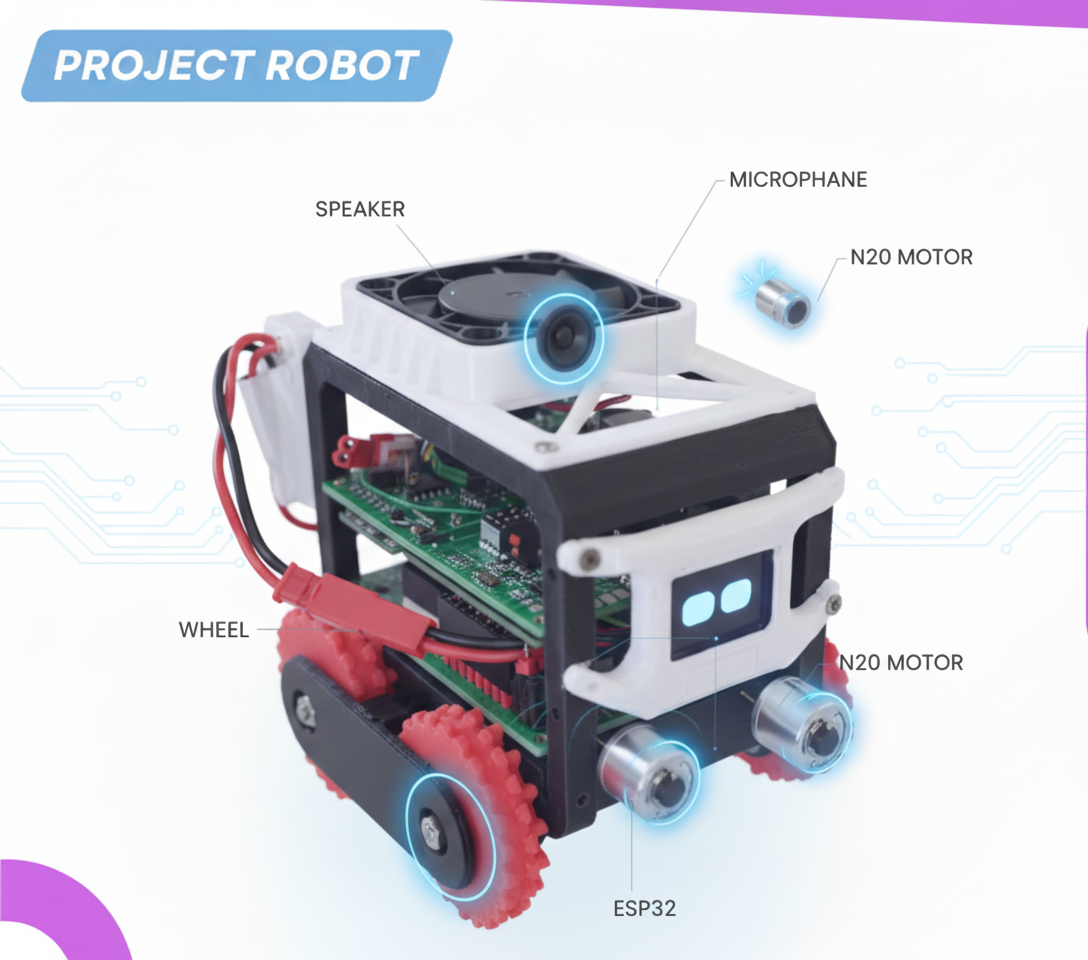
Smart Companion is a compact, wheeled robot that responds to voice commands, shows expressions on its LED face, and can communicate through a built-in speaker and microphone. It moves with precision using N20 motors, detects obstacles, and interacts with users in real time.
How we built it
We designed a lightweight 3D-printed chassis and assembled key components such as an ESP32 controller, N20 DC motors with encoders, a speaker, and a microphone module. We programmed the ESP32 to handle motor control, voice input, and wireless communication. The facial display is powered by a small OLED screen that renders animated eyes and expressions.
Challenges we ran into
Achieving smooth movement with small N20 motors while keeping power consumption low.
Tuning the microphone sensitivity to accurately detect commands in noisy environments.
Balancing a transparent/exploded design so internal components remain visible but protected.
Accomplishments that we're proud of
A fully functional robot that can hear, talk, and move in a compact, stylish form factor.
A transparent presentation model highlighting all key components for educational demos.
Successful integration of voice control with real-time motor response.
What we learned
Fine-tuning motor drivers and PID control for stability.
Designing 3D parts for easy assembly and visibility.
Handling real-world audio input on a microcontroller platform.
What's next for Smart Companion
We plan to add object recognition through a small camera, more expressive facial animations, and an app interface to expand the robot’s teaching and entertainment capabilities.
Built With
- api
- display
- esp32
- mic
- motor
- speaker


Log in or sign up for Devpost to join the conversation.