Inspiration
During medical emergencies, every second matters. Ambulances can lose valuable time at congested traffic junctions, especially when conventional traffic signals have no way of knowing that an emergency vehicle is approaching. This inspired us to develop AMBIDO, a Smart Ambulance Traffic Priority System that connects ambulances with traffic-signal controllers and a central control platform. The idea is to allow an authenticated ambulance to request priority at upcoming junctions and coordinate traffic signals to create a safer and faster passage. Our goal is to demonstrate how GPS, embedded systems, IoT communication, and web-based monitoring can work together to address a real-world emergency-response challenge.
What it does
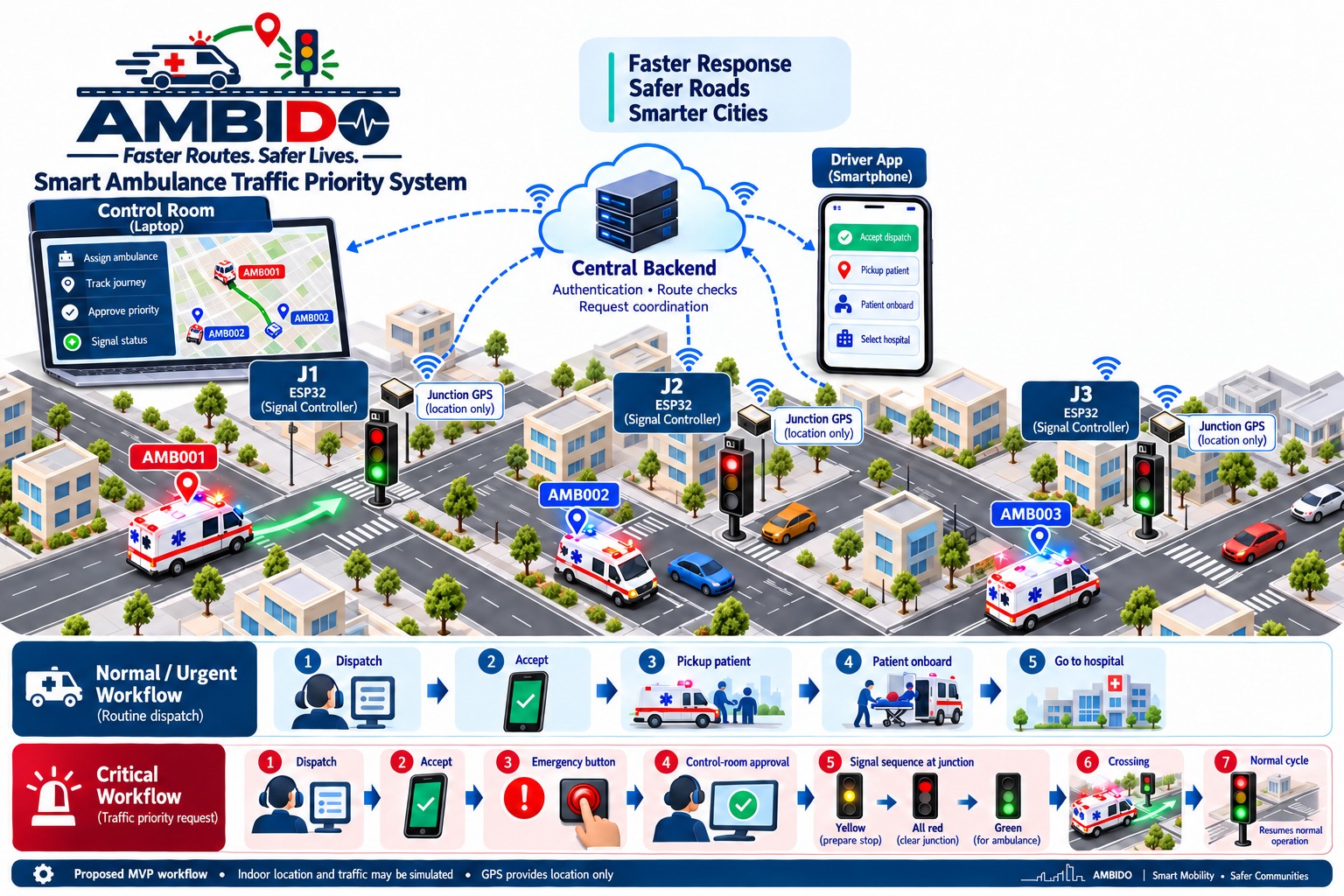
AMBIDO consists of three main components:
- Ambulance Unit
- Smart Traffic Signal Unit
- Web-based Driver & Control Room Platform
AMBIDO provides three primary operational modes: Normal Mode, Urgent Mode and Critical Mode.
Normal Mode & Urgent Mode
The process begins when a patient or caller contacts the Control Room. The operator reviews the patient's situation and location and checks the availability and locations of registered ambulances. The system identifies an appropriate nearby ambulance and sends a notification to the respective driver. Once the driver accepts the request, the Patient Pickup Journey begins. When the ambulance reaches the patient's pickup location, the journey automatically changes to Patient Onboard mode. The system then provides nearby hospitals based on the current location, while also allowing the driver to search for and select a specific hospital. The driver can then start the hospital journey through the system.
Critical Mode
For critical emergencies, the Control Room sends an emergency notification to the assigned ambulance. The driver accepts the request and begins the emergency journey using routing and ETA. If the ambulance encounters a highly congested traffic signal, the driver can press a dedicated Emergency Priority Button. This generates a priority request for the nearby traffic signal and simultaneously informs the Control Room. The Control Room can monitor the request and assess the traffic situation before authorising the required signal priority. Once authorised, the corresponding traffic signal provides a controlled green phase for the ambulance. After the ambulance passes the junction, the signal returns to its normal operating sequence. This approach combines rapid emergency response with human oversight, rather than giving unrestricted control of traffic signals to the ambulance driver.
How we built it
AMBIDO combines embedded hardware, GPS tracking, web technologies, wireless communication, and traffic-signal control.
Ambulance Unit
The ambulance prototype is built around an ESP32, which acts as the main controller. A NEO-6M GPS module provides the ambulance's location, while a physical emergency-priority button allows the driver to request traffic assistance when required. The prototype also includes a 7.4V battery, LM2596 buck converter, slide switch, and status indicators.
Traffic Signal Unit
Each traffic junction is controlled using an ESP32 with red, yellow, and green LEDs representing the traffic signals. The prototype contains three independently controlled traffic-signal units, allowing us to demonstrate priority coordination across multiple junctions.
Web Platform
We are developing a web-based platform using HTML5, CSS3, JavaScript, Node.js, Express.js, REST API, JSON, Leaflet.js, OpenStreetMap, OSRM, Nominatim, Geolocation API, Responsive Web Design.
The platform provides two primary interfaces:
Control Room
- Patient request management
- Ambulance availability and location
- Ambulance assignment
- Active journey monitoring
- Emergency notifications
- Traffic-priority requests
- Traffic-signal monitoring
Driver Interface
- Dispatch notifications
- Request acceptance
- Patient pickup navigation
- Patient Onboard status
- Nearby hospital suggestions
- Specific hospital search The web platform acts as the central coordination layer between the ambulance units, Control Room, and traffic-signal system.
Challenges we ran into
One of our main challenges was designing a complete emergency workflow rather than focusing only on traffic-signal automation. We needed to coordinate several stages of the journey, including patient requests, ambulance selection, driver acceptance, patient pickup, hospital selection, and emergency traffic management. Another important challenge was designing Critical Mode safely. We did not want a driver to independently control traffic signals whenever they encountered congestion. Therefore, the priority request is also communicated to the Control Room so that the situation can be monitored before traffic priority is provided.
We also had to consider:
- Matching the nearest available ambulance to the patient's location.
- Managing the transition from patient pickup to patient onboard.
- Providing flexible hospital selection.
- Identifying the appropriate nearby traffic signal.
- Coordinating multiple traffic signals.
- Returning signals to their normal sequence after an ambulance passes.
- Maintaining communication between the physical prototype and web platform.
Accomplishments that we're proud of
We developed AMBIDO as an integrated emergency-response and traffic-coordination system rather than a standalone traffic-light prototype.
Our key accomplishments include:
- Designed a complete patient-to-hospital emergency workflow.
- Developed a Control Room-based ambulance dispatch concept.
- Implemented location-based ambulance selection.
- Designed separate Normal and Critical operational modes.
- Created an automatic Patient Pickup → Patient Onboard transition.
- Added nearby hospital discovery and specific hospital search.
- Developed a GPS-enabled ESP32 ambulance prototype.
- Added a physical emergency-priority button.
- Designed Control Room monitoring for traffic-priority requests.
- Developed a React.js-based Driver and Control Room interface.
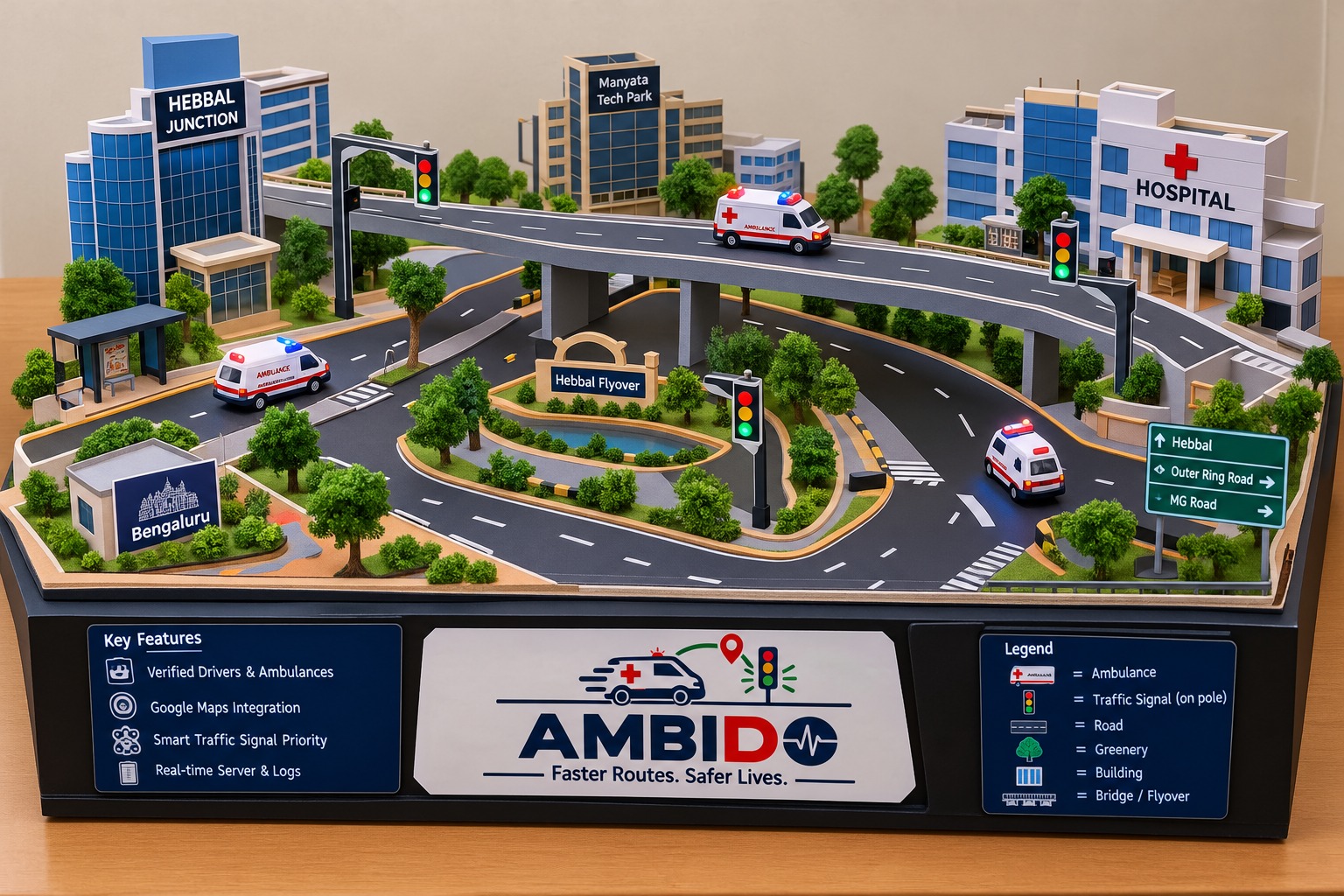
- Created a physical tabletop prototype representing a connected urban traffic network.
What we learned
Through AMBIDO, we learned how embedded systems, GPS, web applications, wireless communication, and real-time decision-making can be combined to address a real-world emergency-response problem. We gained practical experience in ESP32 development, GPS integration, traffic-signal control, React.js development, dashboard design, location-based logic, and hardware-software integration. More importantly, we learned that systems involving emergency vehicles and traffic infrastructure require careful consideration of authentication, human oversight, communication reliability, safety, and fail-safe operation.
What's next for AMBIDO- Smart Ambulance Traffic Priority System
Our next objective is to evolve AMBIDO from a prototype into a more comprehensive emergency-response platform.
Future development will focus on:
- Integration with authorised traffic-control infrastructure.
- Real-time ambulance-to-patient assignment using routing and ETA.
- Live traffic-density analysis.
- Intelligent traffic-signal prioritisation.
- Secure ambulance and driver authentication.
- Enhanced Control Room monitoring.
- Hospital availability and emergency-capacity information.
- Improved handling of GPS and network failures.
- Detailed journey and event logging.
- Controlled pilot testing in a simulated traffic environment.
Our Vision
AMBIDO aims to create a connected emergency-response ecosystem that coordinates patients, control rooms, ambulances, hospitals, and traffic infrastructure — helping ambulances reach patients efficiently and supporting safer, faster patient transport.
Built With
- automation
- embedded-systems
- emergency-response
- esp32
- gps-tracking
- healthcare-technology
- iot
- location-based
- react.js
- real-time-monitoring
- smart-city
- smart-transportation
- traffic-signal-control
- web-application
- wireless-communication


Log in or sign up for Devpost to join the conversation.