-
-
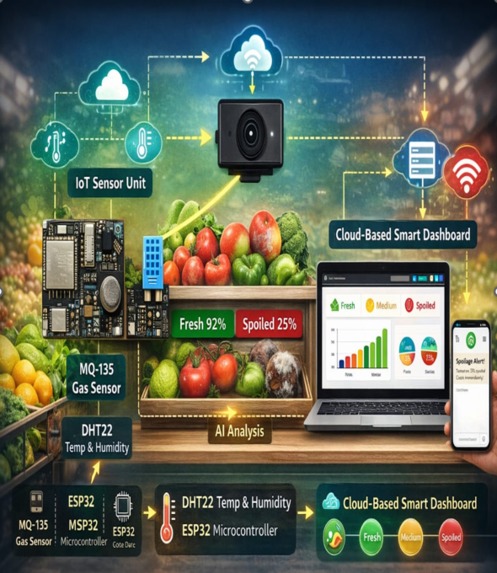
"AI-Driven IoT Food Freshness Monitoring System for Reducing Food Waste.”
Inspiration
Food waste is a serious problem around the world. Many shops, restaurants, and supermarkets throw away large amounts of food because spoilage is detected only after the food becomes unusable. Seeing this problem inspired us to develop a smart system that can monitor food storage conditions and predict spoilage early, helping businesses reduce waste and save resources.
What We Learned
Through this project, we learned how technologies like IoT sensors, RFID systems, and Artificial Intelligence can work together to solve real-world problems. We also gained knowledge about how environmental factors such as temperature, humidity, and gas levels affect food freshness. Additionally, we explored basic machine learning concepts and how AI can be used to predict spoilage patterns.
How We Built the Project
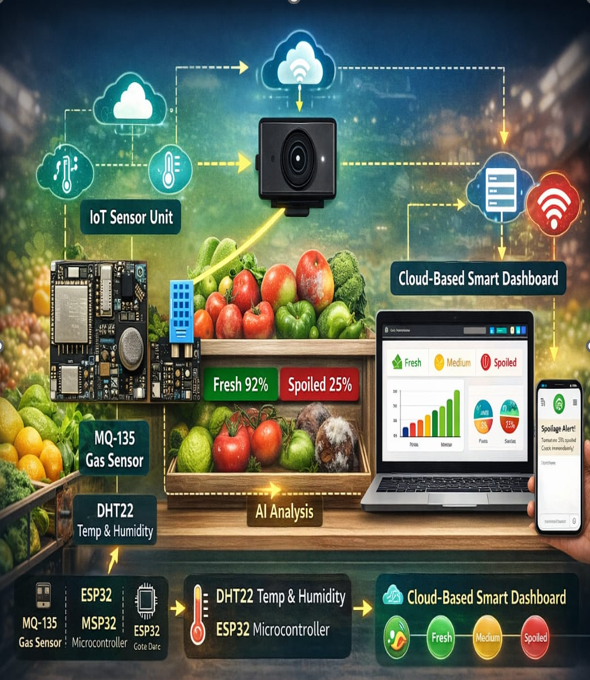
Our system uses RFID tags attached to food packets so each item can be identified. Sensors are placed in the storage area to measure temperature, humidity, and gases released during food spoilage. The data is collected using an ESP32 microcontroller, which then sends the information to an AI model that analyzes the data and predicts whether the food is fresh, spoiling soon, or spoiled. If the system detects a risk of spoilage, it sends an alert so that action can be taken quickly.
Challenges We Faced
One of the challenges we faced was understanding how to combine hardware components with AI-based prediction. It was also difficult to simulate real spoilage conditions and ensure the sensors respond correctly. However, working through these challenges helped us better understand how technology can be used to build practical solutions for reducing food waste. Accomplishments that we're proud of
We are proud that we were able to design a system that combines IoT sensors, RFID technology, and Artificial Intelligence to detect food spoilage early. We successfully created a working concept that monitors temperature, humidity, and gas levels and predicts the freshness of stored food. Our project shows how technology can help reduce food waste and improve food storage management, especially for small shops and supermarkets.
What we learned
Through this project, we learned how hardware and AI can work together to solve real-world problems. We gained knowledge about IoT sensors, microcontrollers like ESP32, and basic machine learning models used for prediction. We also learned the importance of teamwork, problem solving, and designing practical solutions that can make a positive impact on society.
What's next for Smart AI Food Spoilage Detection System
In the future, we plan to improve the system by adding a mobile application for real-time monitoring and alerts. We also aim to integrate AI cameras to detect visual spoilage such as color change or mold. Our goal is to develop the system further so that it can be used in supermarkets, warehouses, restaurants, and even smart homes to reduce food waste on a larger scale.
Built With
- ai-based
- arduino
- cnn
- dht22
- esp32
- iot-sensors
- machine-learning
- mq135
- random-forest
- rfid

Log in or sign up for Devpost to join the conversation.