-
Smart fall Detector
Inspiration
Falls are one of the leading causes of injury and hospitalization among elderly people, particularly those living alone. Delayed medical assistance can significantly increase the risk of severe complications. We were inspired to develop a smart, affordable, and reliable wearable device that detects falls automatically and immediately alerts caregivers, enabling faster emergency response and improving elderly safety.
What it does
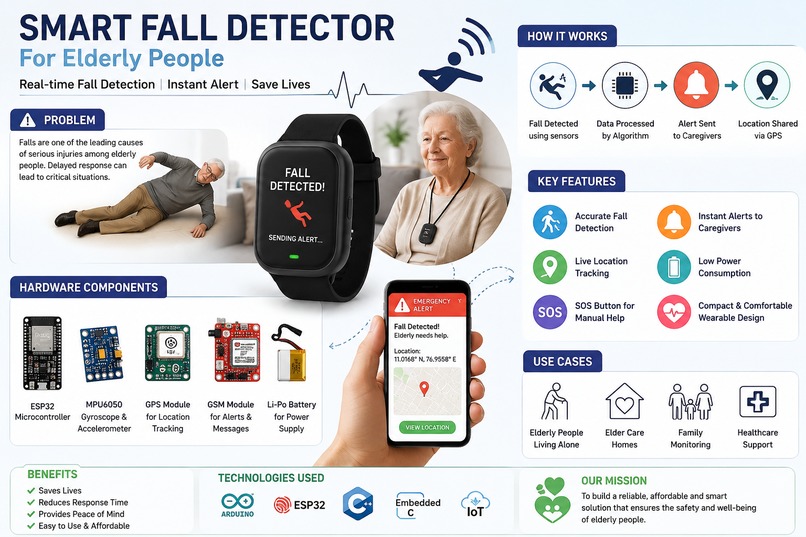
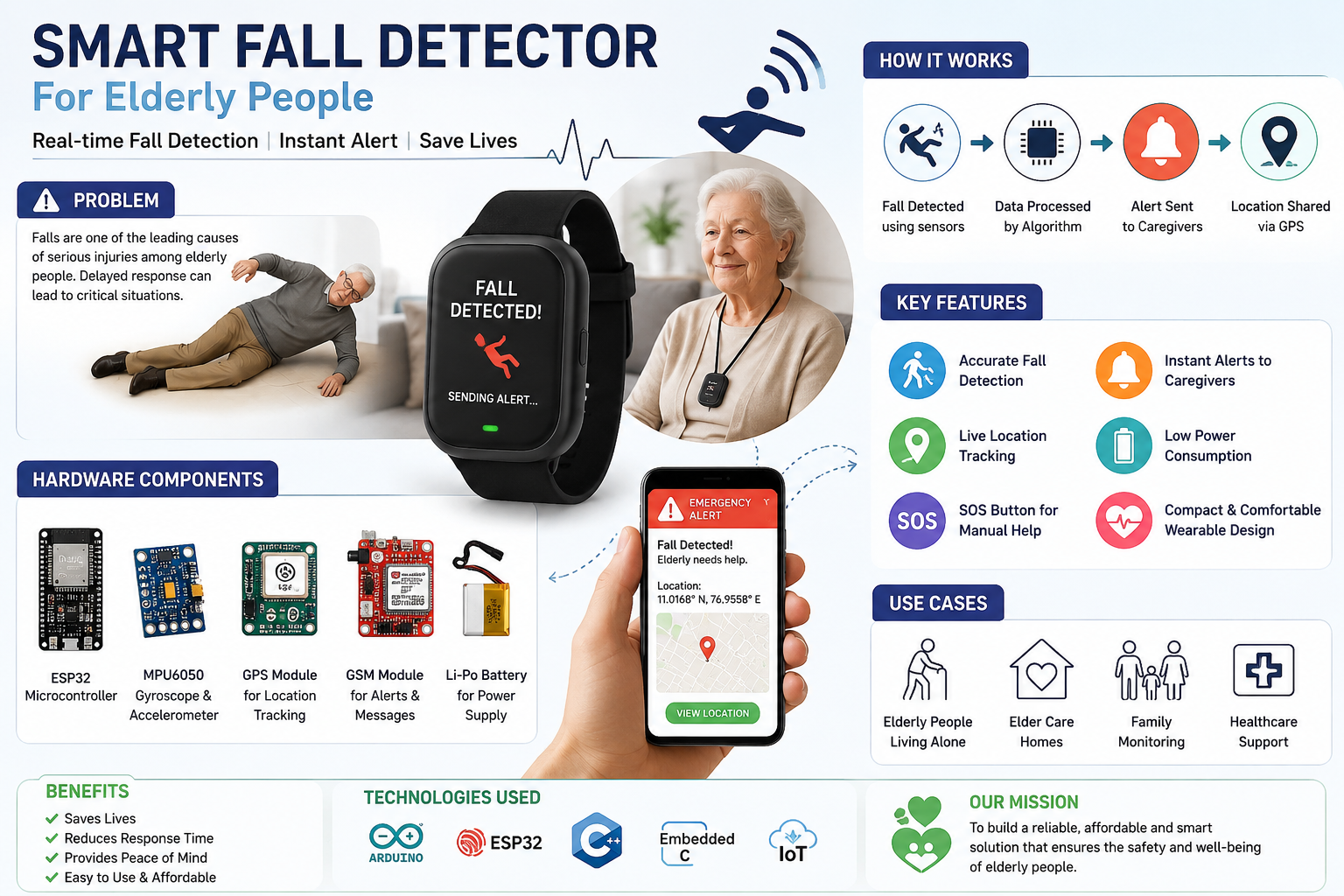
The Smart Fall Detector continuously monitors body movement using motion sensors. It analyzes acceleration and orientation data to accurately identify fall events while minimizing false alarms. Once a fall is confirmed, the device instantly sends an emergency alert along with the user's live GPS location to pre-registered caregivers or family members. It also features an SOS button for manual emergency assistance and a buzzer for local alerts.
How we built it
The prototype is built around an ESP32 microcontroller integrated with an MPU6050 accelerometer and gyroscope for motion sensing, a GPS module for location tracking, and a GSM/Wi-Fi module for transmitting emergency notifications. The fall detection algorithm analyzes sudden impacts followed by inactivity to determine whether a fall has occurred. The firmware was developed using the Arduino IDE, and all components were integrated into a compact wearable prototype.
Challenges we ran into
- Differentiating real falls from everyday activities such as sitting, bending, or lying down.
- Reducing false alarms while maintaining high detection accuracy.
- Optimizing power consumption for longer battery life.
- Achieving reliable GPS positioning in indoor environments.
- Designing a lightweight, comfortable, and wearable device.
Accomplishments that we're proud of
- Built a functional wearable prototype for real-time fall detection.
- Successfully implemented automatic emergency alerts with live location sharing.
- Improved detection reliability by reducing false positives.
- Developed a low-cost and accessible solution for elderly care.
- Designed an easy-to-use device suitable for everyday use.
What we learned
This project strengthened our knowledge of embedded systems, IoT, sensor fusion, wireless communication, and real-time data processing. We also gained valuable experience in designing user-centric healthcare technology and learned the importance of reliability, usability, and rapid emergency response in assistive devices.
What's next for Smart Fall Detector
Our future roadmap includes:
- Integrating AI and machine learning for more accurate fall detection.
- Developing a mobile application for caregivers with real-time monitoring and notifications.
- Adding health sensors such as heart rate, SpO₂, and body temperature monitoring.
- Enabling cloud storage for emergency records and health analytics.
- Introducing geofencing and voice assistant support for enhanced safety.
- Miniaturizing the hardware into a smartwatch or smart wearable band for everyday use.
- Exploring healthcare integration for hospitals, assisted living facilities, and telemedicine platforms.

Log in or sign up for Devpost to join the conversation.