Inspiration
Small businesses are affected by state laws governing wages, taxes, permits, safety requirements, and everyday operations. However, most owners do not have the time, policy expertise, or money to track legislation and speak directly with lawmakers.
Large companies solve this problem by hiring government-affairs teams and lobbyists. Independent businesses rarely have that option—even when they collectively employ thousands of people and power their local communities.
We asked: What if small businesses could share the cost of representation without giving up control of their individual voice?
That question inspired Small Business Advocacy Network.
What it does
Small Business Advocacy Network allows businesses in the same industry and region to form a coalition and pool resources to hire a shared lobbyist.
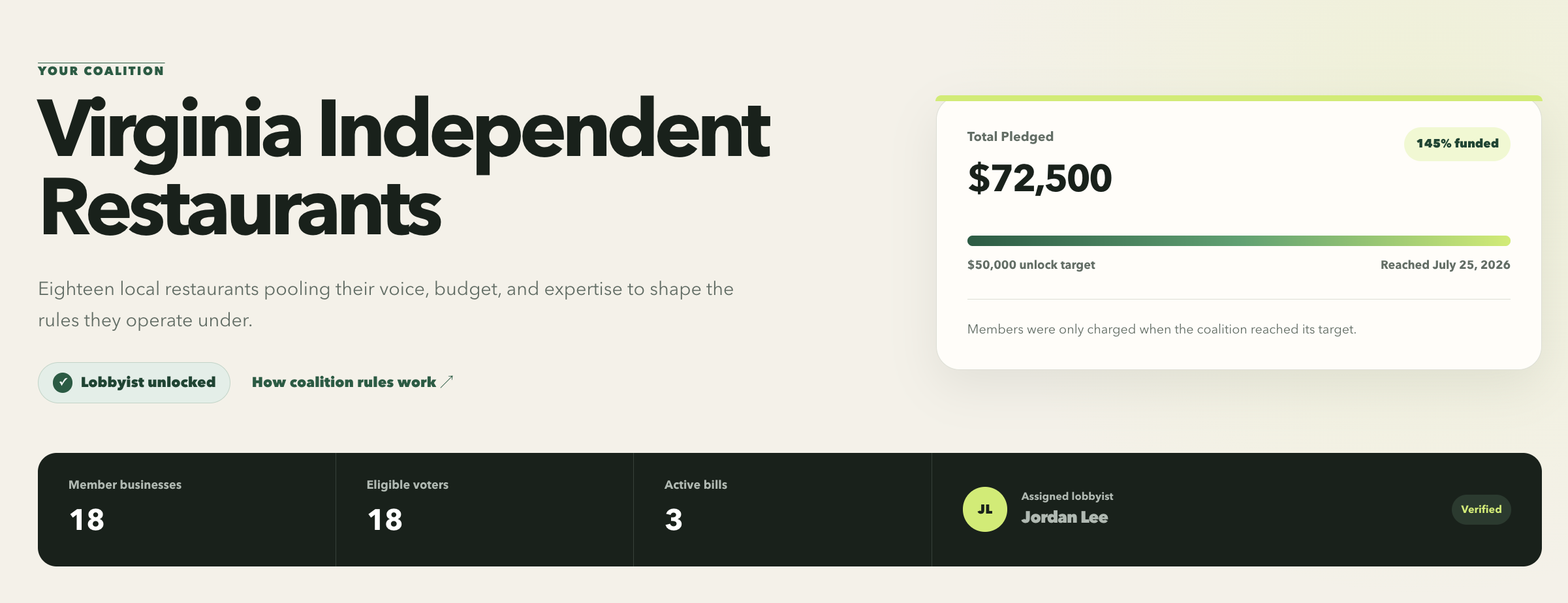
Each business pledges at least $2,500, but no business is charged unless the coalition reaches the $50,000 required to hire professional representation. Businesses may contribute more, but every participating business receives exactly one vote.
Once funded, the coalition’s lobbyist:
- Identifies legislation affecting the coalition
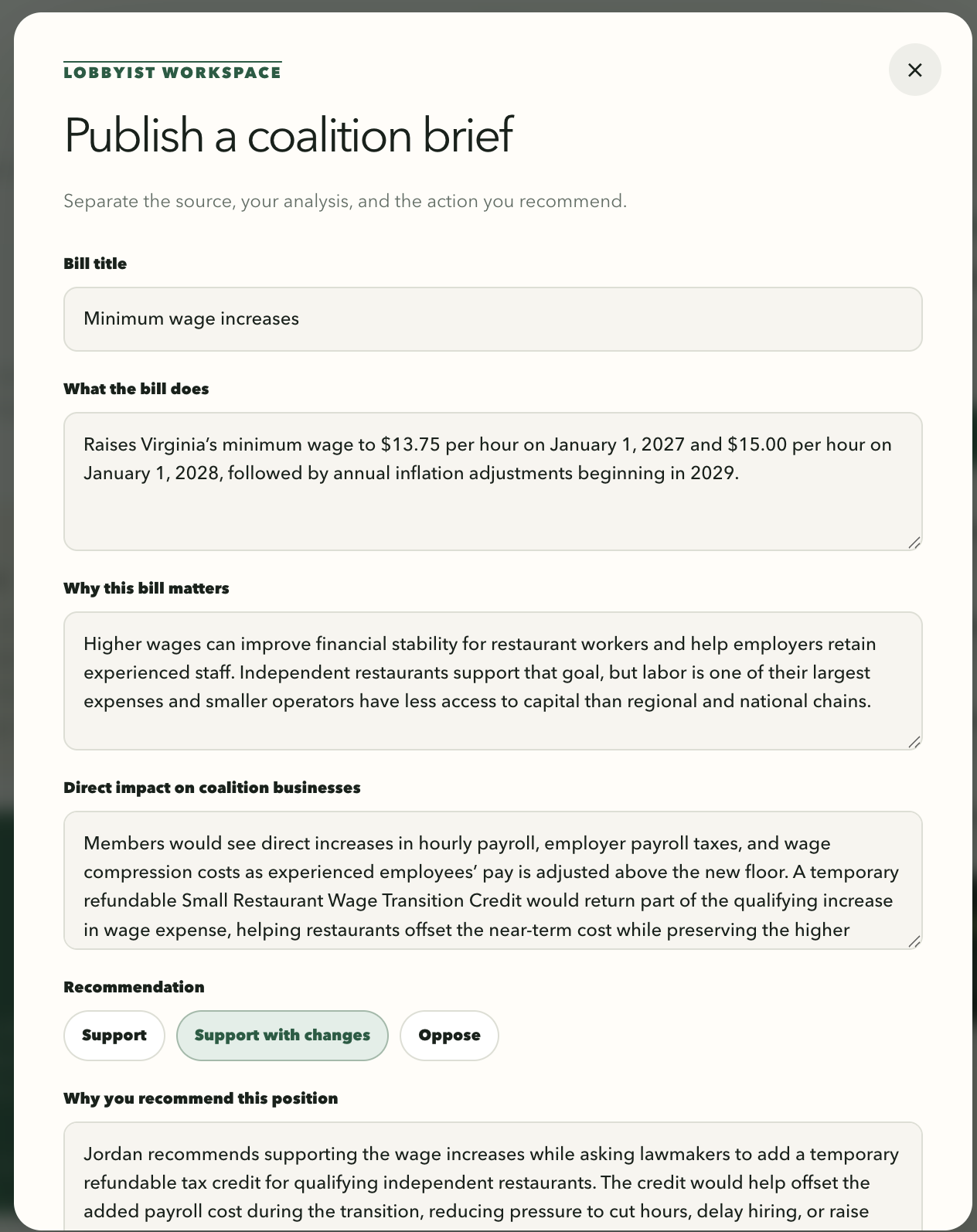
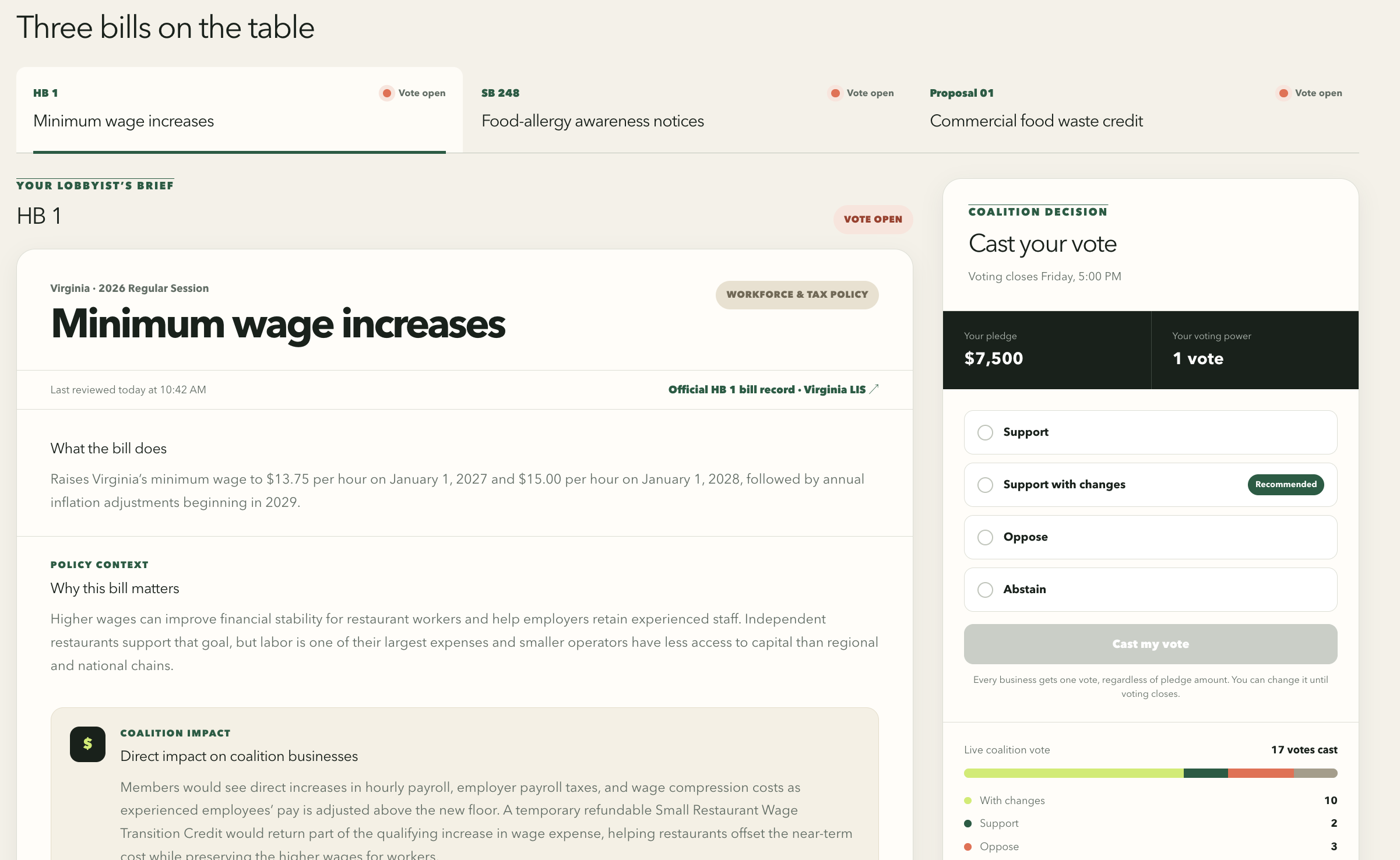
- Explains what each bill does in plain language
- Describes why it matters and how it could directly affect coalition members
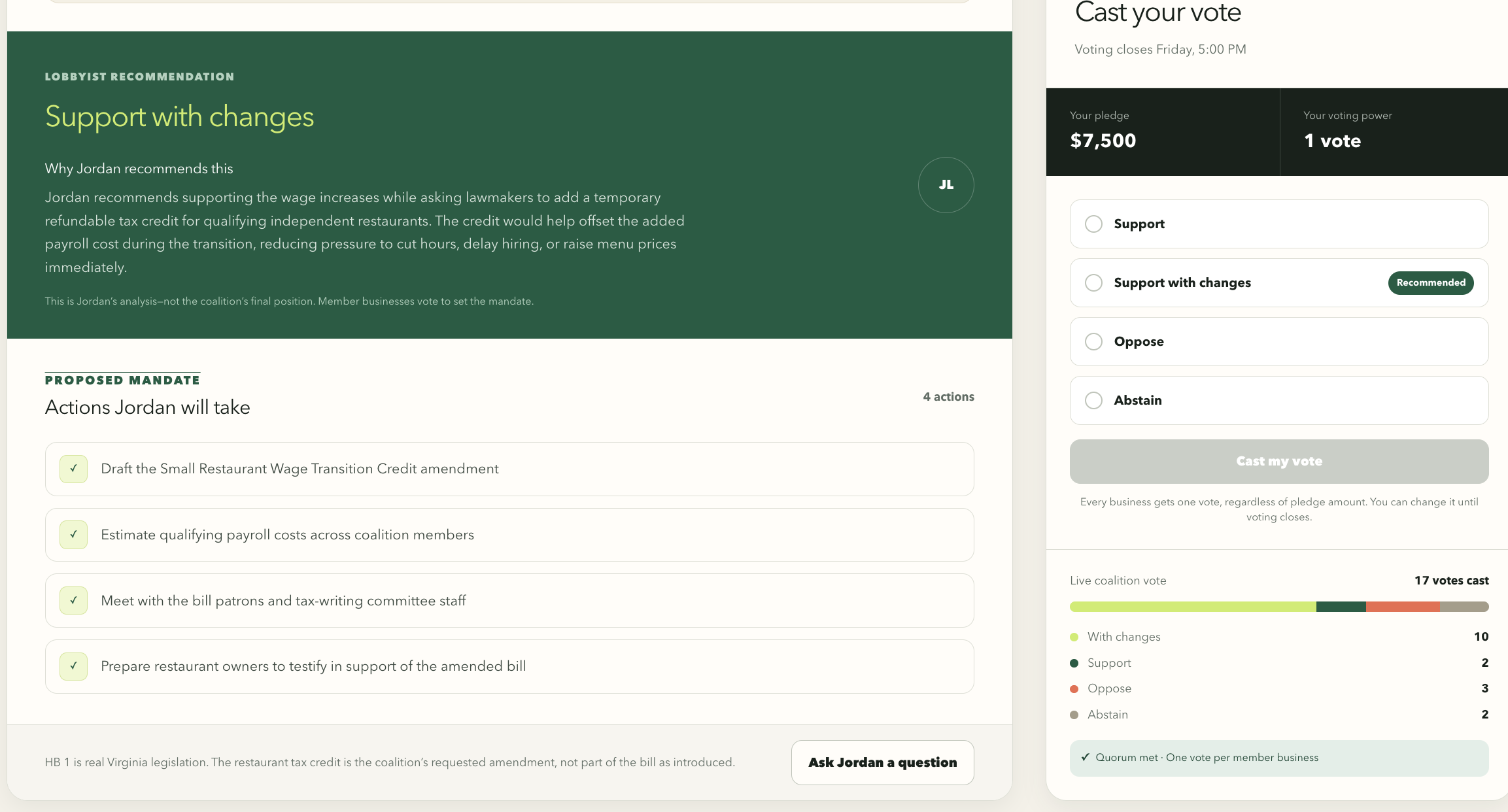
- Recommends actions tailored to the coalition’s needs
- Carries out the action selected by a majority vote
The prototype follows a coalition of Virginia independent restaurants. It includes briefings and votes for Virginia’s HB 1 minimum-wage legislation, SB 248 food-allergy awareness legislation, and a coalition-proposed commercial food-waste tax credit.
The product also separates legislative facts, business impact, lobbyist analysis, member votes, and completed actions so businesses can understand how every decision was made.
How we built it
We built the prototype from scratch during the hackathon using Next.js, React, TypeScript, and CSS.
The experience includes:
- A marketing homepage that explains the problem and business model
- Separate business and lobbyist views
- Interactive bill tabs and plain-language briefings
- Lobbyist-editable recommendations and action plans
- One-business-one-vote coalition decisions
- Funding and coalition information
- An activity log showing changes and actions
- Browser storage that preserves edits and votes when the page is refreshed
- A reset option that restores the original demonstration data
We used browser storage to create a functional prototype without introducing the complexity of accounts, payments, or a production database. The project is stored on GitHub and publicly hosted through ChatGPT Sites.
Challenges we ran into
One of our biggest challenges was designing a funding model that did not allow larger contributors to purchase more influence. We initially considered connecting voting power to contribution size, but realized that would reproduce the same imbalance we were trying to solve. We changed the model to one business, one vote, regardless of pledge amount.
Another challenge was presenting legislation without oversimplifying it or blurring the line between fact and opinion. We created distinct sections for what a bill does, why it matters, its direct business impact, the lobbyist’s recommendation, and the reasons behind that recommendation.
We also needed to clearly distinguish between existing legislation and actions proposed by the coalition. For example, HB 1 is real legislation, while the small-restaurant tax credit is a requested amendment. The commercial food-waste credit is coalition-proposed legislation that has not yet been introduced.
Finally, we needed lobbyist edits and business votes to survive a page refresh. Browser storage gave us enough persistence for the prototype while keeping development focused on the core experience.
Accomplishments that we're proud of
We are proud that we created more than a visual mockup. The prototype supports an understandable, end-to-end workflow: a lobbyist publishes a briefing, recommends coalition-specific actions, a business votes, the results update, and the changes persist.
We are also proud of the governance model. Conditional funding reduces financial risk, larger contributions do not purchase additional votes, and the lobbyist’s work remains visible to coalition members.
Most importantly, we turned a complicated topic—state-level lobbying—into an experience that a busy small-business owner can understand and use.
What we learned
We learned that the value of a lobbyist is not simply access to lawmakers. It is also the ability to monitor legislation, translate it into practical business consequences, recommend a strategy, and carry out the coalition’s decision.
We also learned that transparency requires more than displaying a vote total. Businesses need to see the difference between legislative facts, professional analysis, the coalition’s decision, and the actions taken afterward.
Finally, we learned that shared funding must be paired with fair governance. Pooling money makes representation affordable, but equal voting and a visible activity record make it trustworthy.
What's next for Small Business Advocacy Network
The next step is turning the browser-based prototype into a secure, shared platform with business accounts, verified coalition membership, lobbyist profiles, and a centralized database.
Future development would include:
- Conditional payment authorization when a coalition reaches its target
- Live legislative data and bill-status notifications
- Secure voting with a permanent audit trail
- Administrator tools for forming and approving coalitions
- Lobbyist assignment and co-lobbyist approval workflows
- Compliance support for lobbying disclosures and campaign-finance rules
- Pilots with independent restaurant owners and policy professionals
- Expansion into additional industries and communities across the DMV
Our long-term goal is to give small businesses a practical seat at the table before legislation becomes an unexpected cost or operational burden.

Log in or sign up for Devpost to join the conversation.