Inspiration
Many people in rural and low-literacy communities struggle to use digital services due to language barriers and complex interfaces. Tasks like filling government forms, understanding medical prescriptions, or accessing online services become difficult without proper guidance.
We were inspired to build a solution that makes technology simple, accessible, and inclusive — especially for people who are not comfortable with English or reading complex text.
What it does
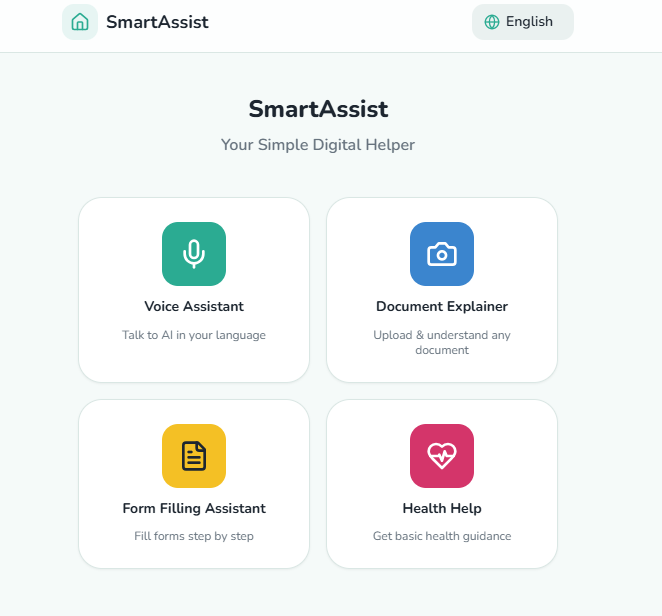
SMAI (Smart Assist AI) is an AI-powered web application that helps users interact with digital services using simple language and voice support. Key features: Voice Assistant: Users can speak, and the app responds in simple language (English/Tamil). Document Explainer: Upload documents (forms, prescriptions), and the app explains them in easy terms. Form Filling Assistant: Guides users step-by-step to fill forms correctly. Health Guidance: Provides basic health advice based on symptoms with safety disclaimers. Multi-language Support: Default English with option to switch to Tamil for better accessibility.
How we built it
We built SMAI using modern web and AI technologies:
Frontend: React (Next.js) with Tailwind CSS for a clean and responsive UI Backend: Firebase / Supabase for data handling AI Integration: OpenAI / Gemini API for generating intelligent responses Voice Features: Web Speech API for speech-to-text and text-to-speech Document Processing: OCR for extracting text from images
We designed the app with a user-first approach, focusing on simplicity, large buttons, and easy navigation.
Challenges we ran into
Handling accurate voice recognition for different accents and languages Simplifying complex documents into very basic language Ensuring safe health responses without giving harmful advice Managing multi-language switching dynamically Designing UI for low-literacy users while keeping it modern
Accomplishments that we're proud of
Built a fully functional AI assistant with real-world use cases Successfully implemented multi-language support (English + Tamil) Created a simple and accessible UI for first-time users Designed a solution with strong social impact Integrated multiple features (voice, OCR, AI) into one platform
What we learned
How to integrate AI APIs into real-world applications Importance of user-centered design, especially for accessibility Handling edge cases and errors in AI-based systems Working with speech recognition and text processing Building scalable and impactful solutions using modern tools
What's next for SMAI
We plan to enhance SMAI further by:
Adding more languages (Hindi, regional languages) Improving offline functionality for low-internet areas Integrating real government services and forms Improving AI accuracy with better prompt engineering Launching a mobile app version Partnering with NGOs and local communities for real-world deployment
Built With
- css
- html
- javascript
- lovable
- openai
- react
- supabase
- tailwind

Log in or sign up for Devpost to join the conversation.