-
-
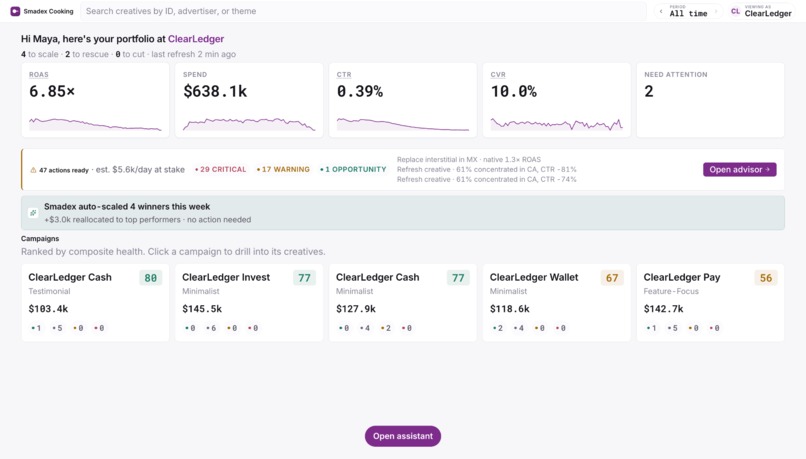
Advertiser Dashboard
-
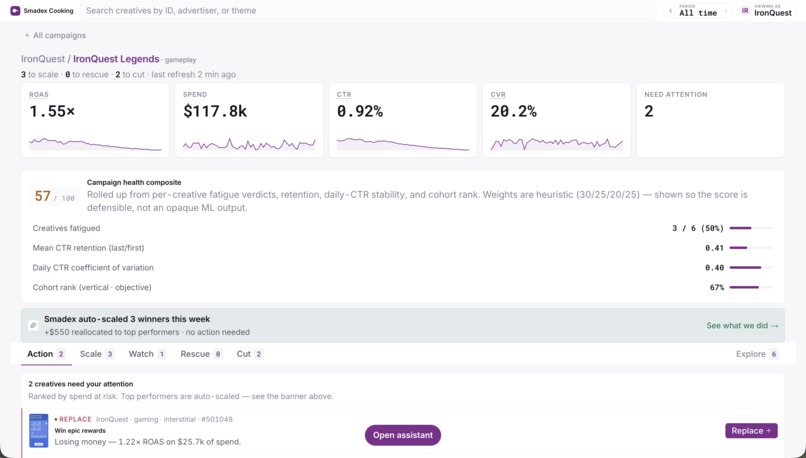
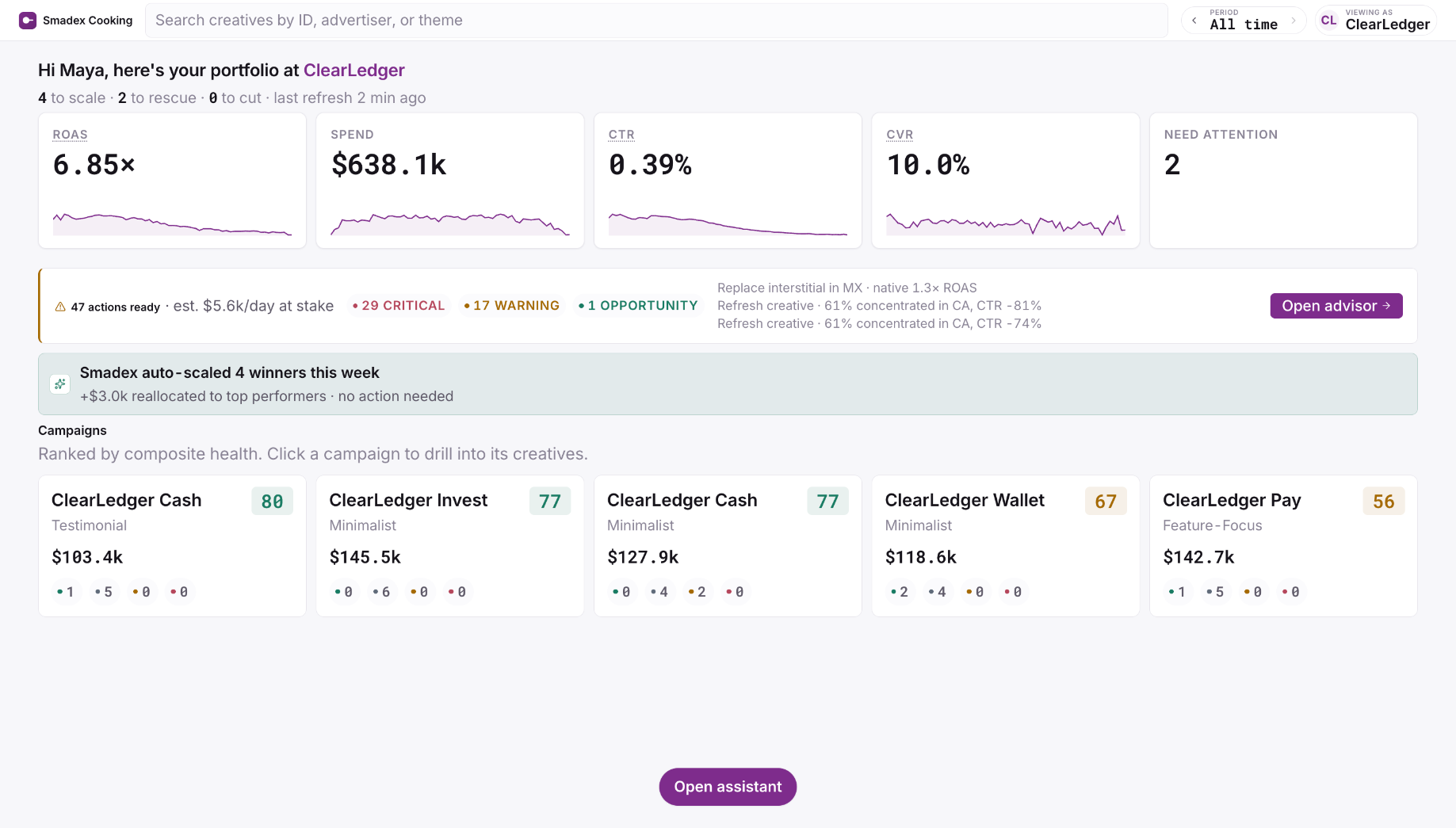
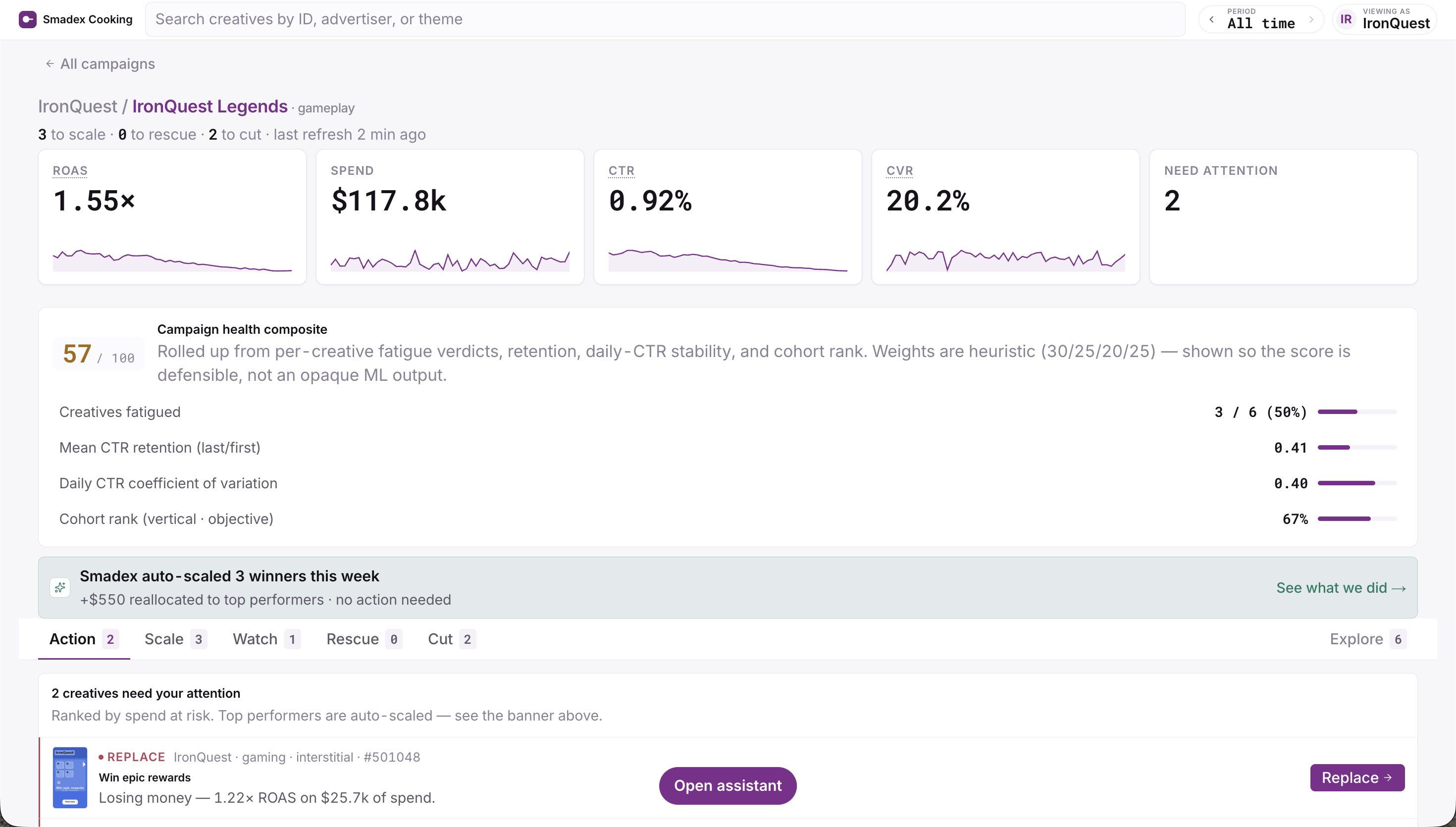
Campaign View
-
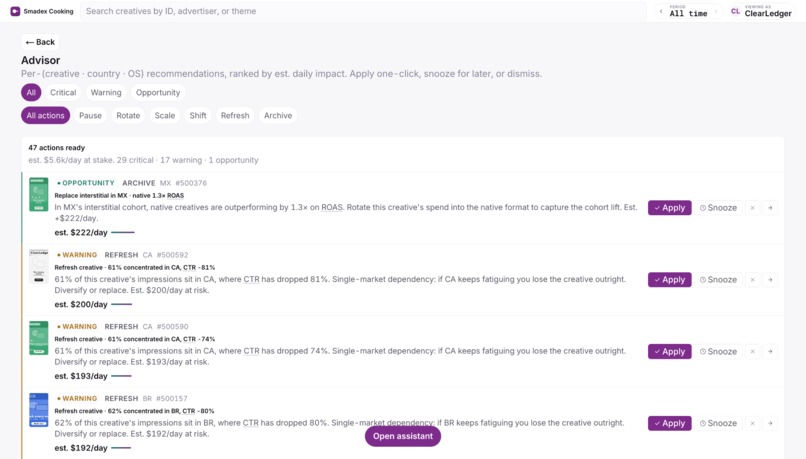
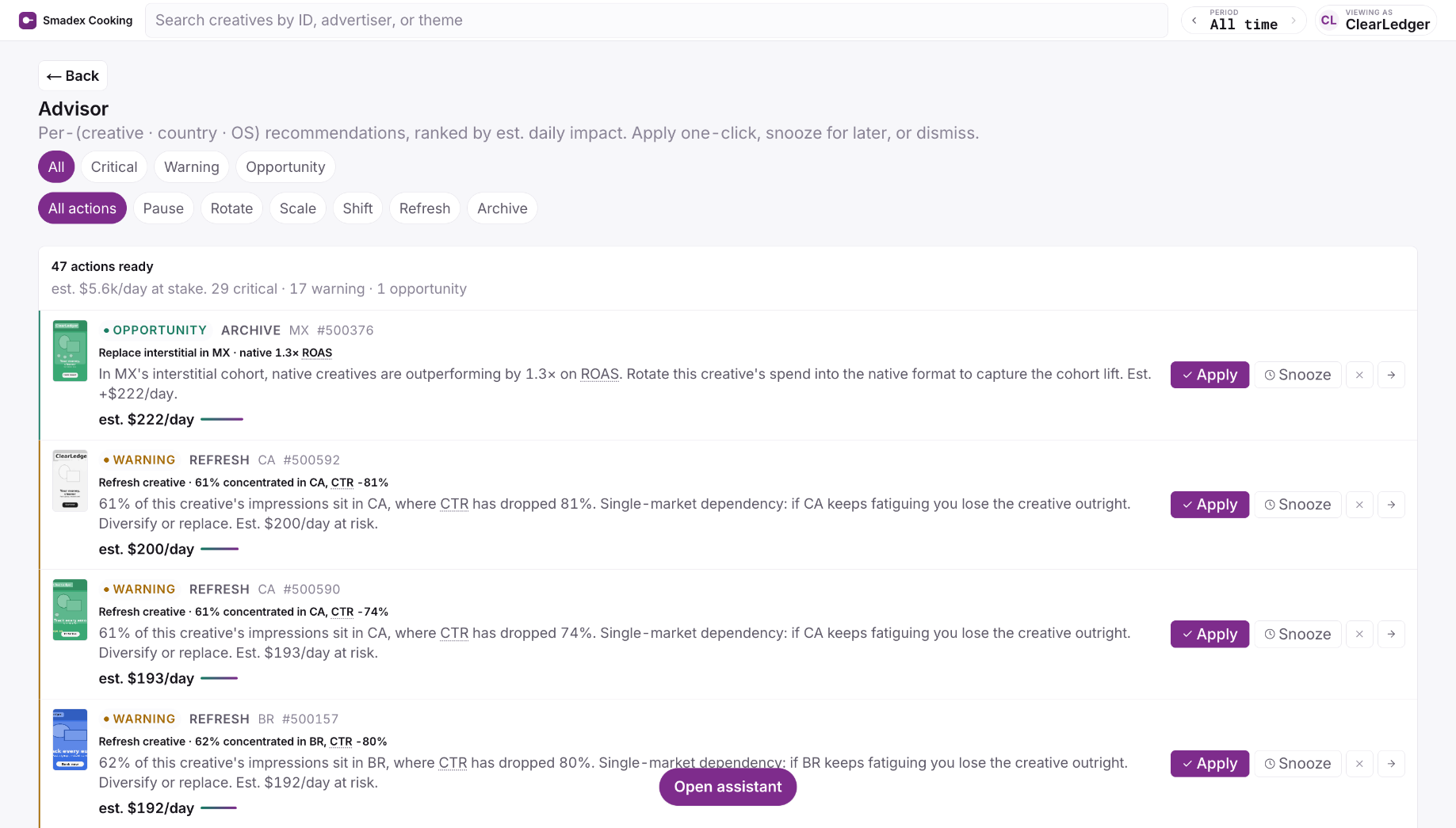
Action Items
-
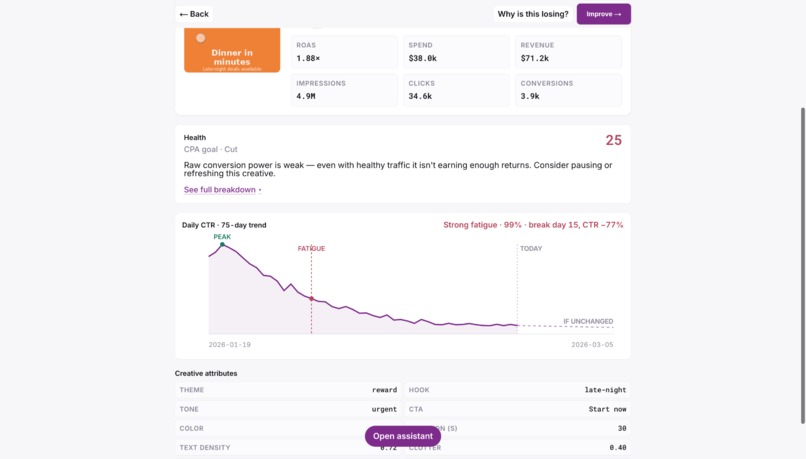
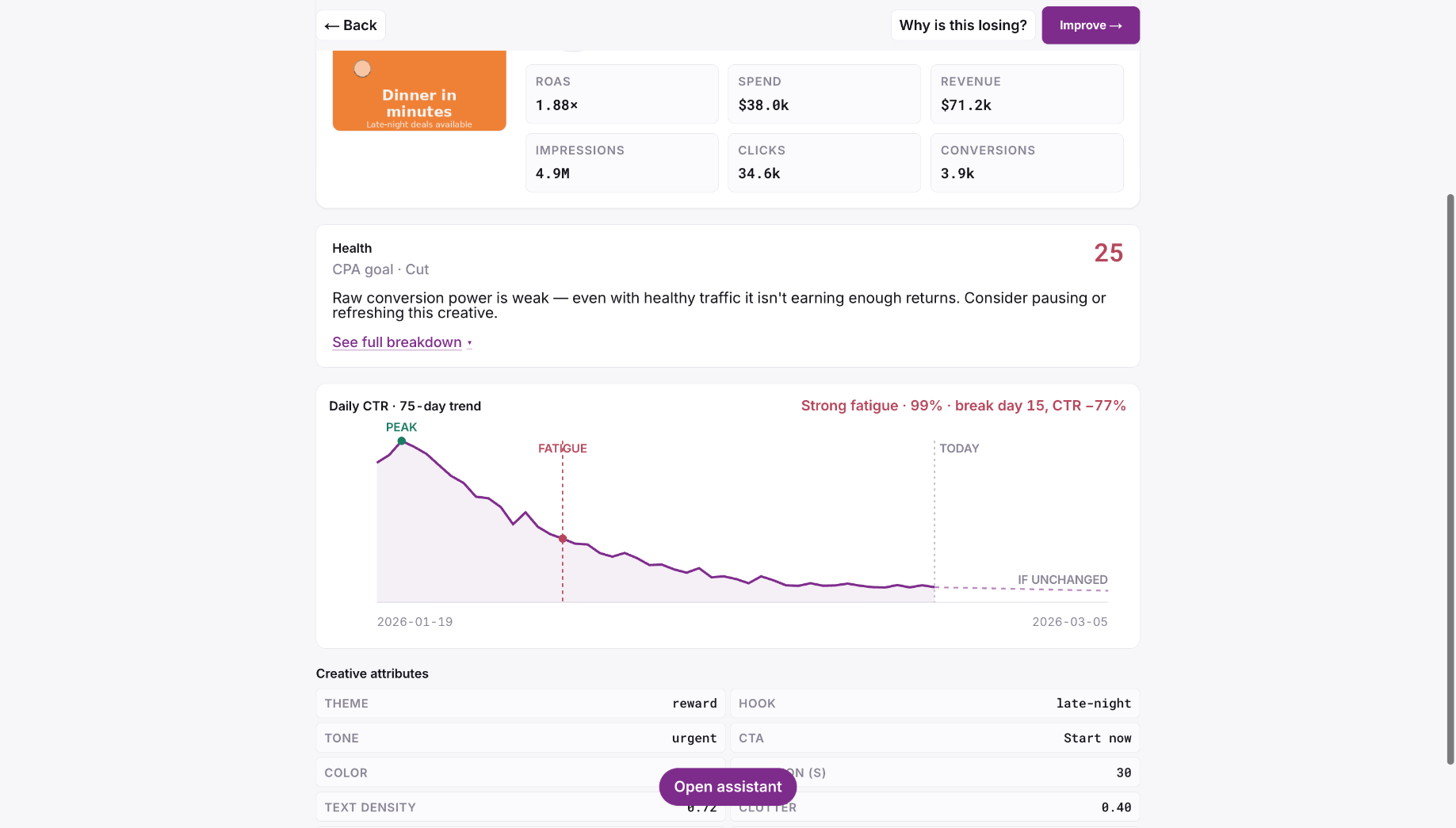
Fatiguing Creative Detection
-
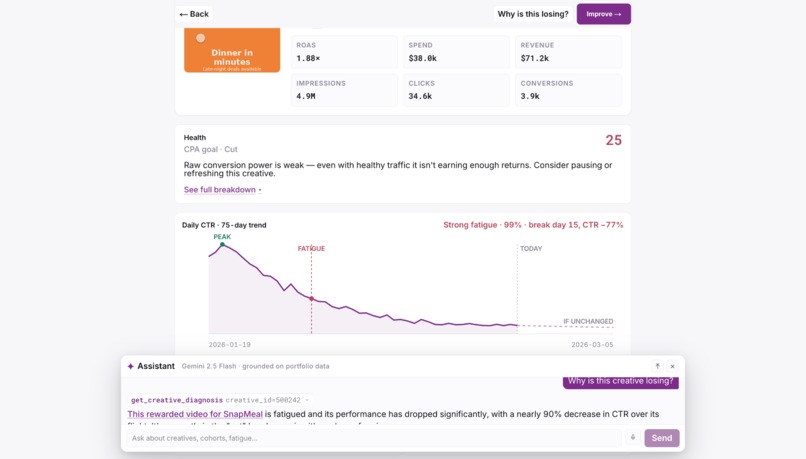
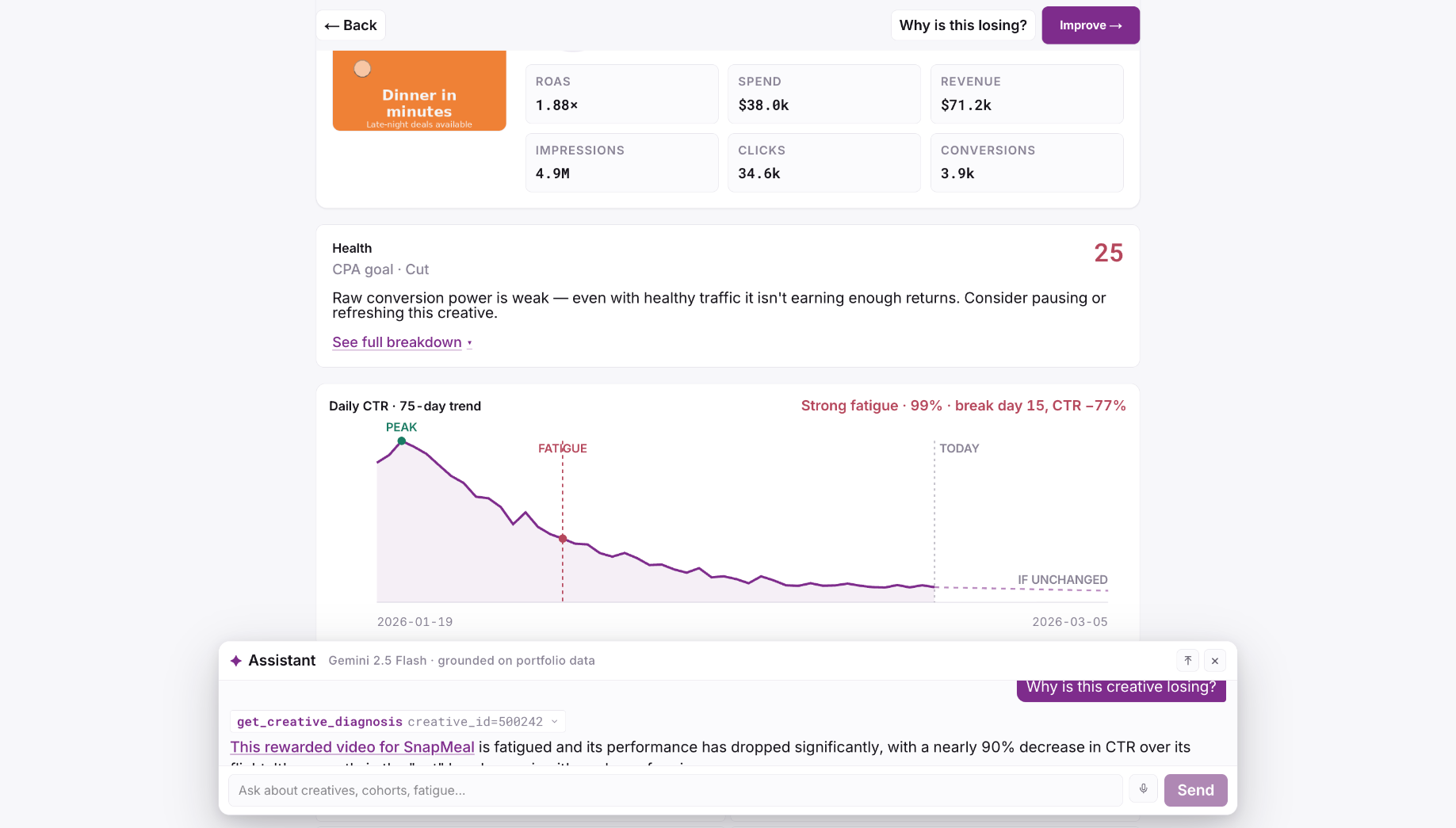
AI Explaination
-
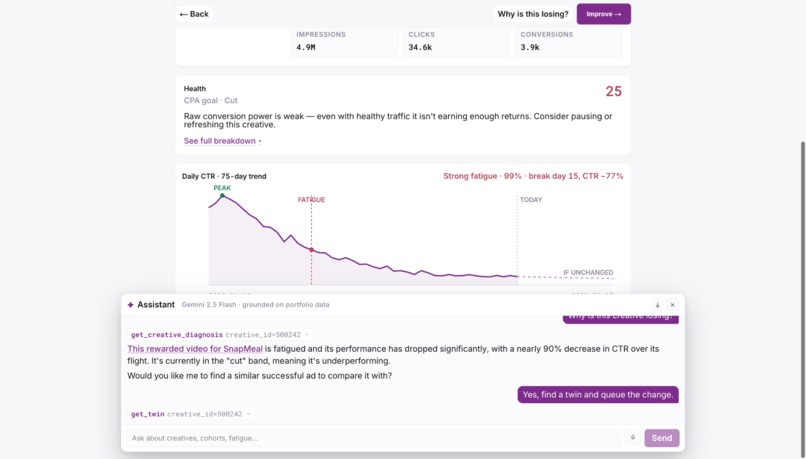
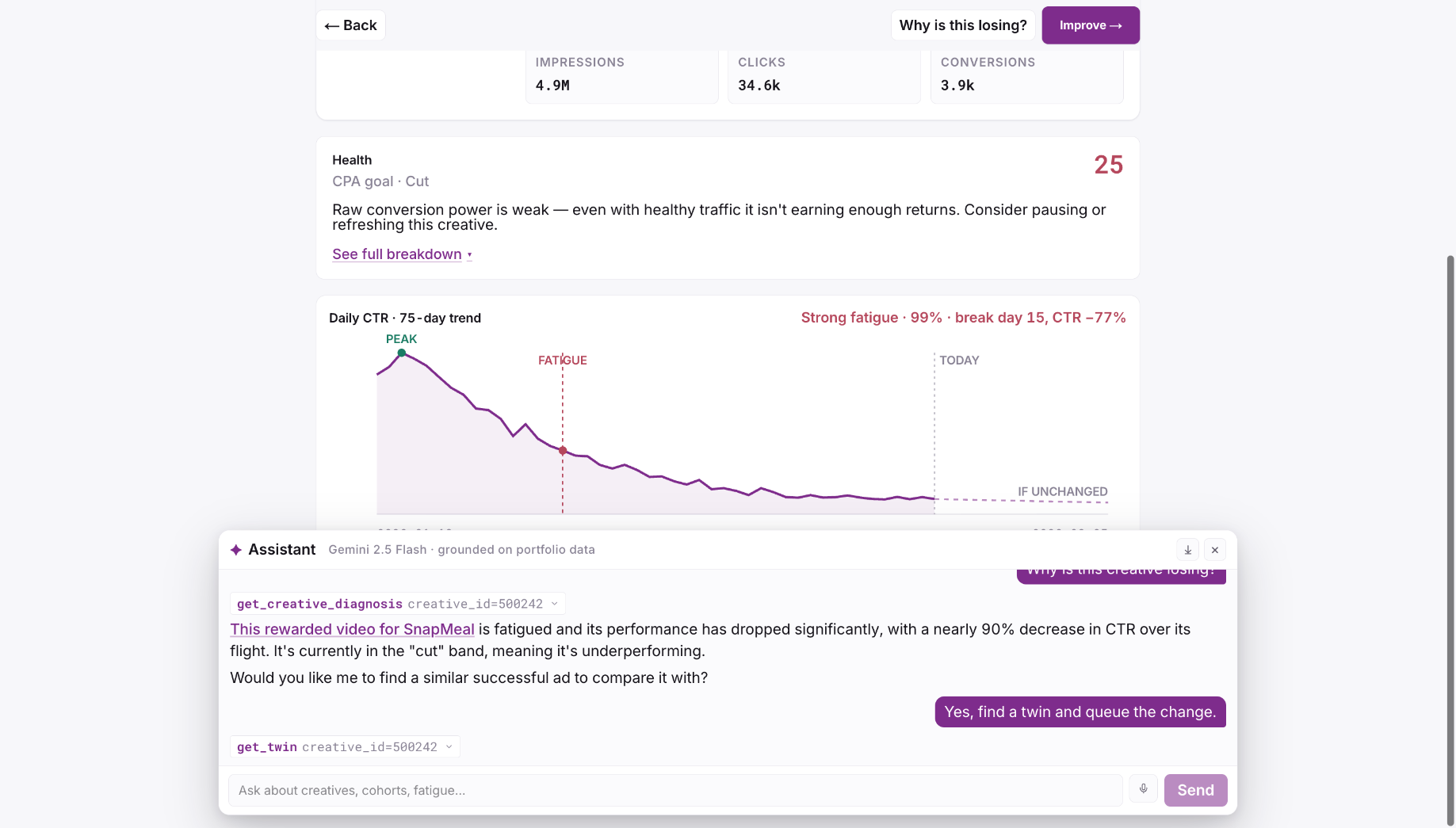
AI Action
-
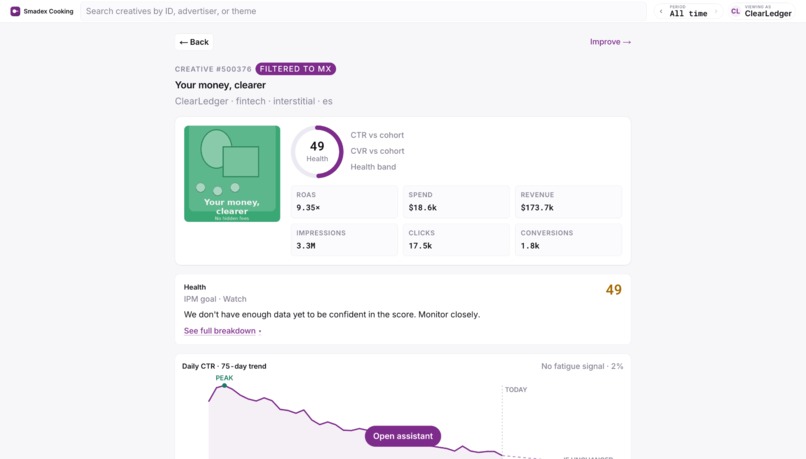
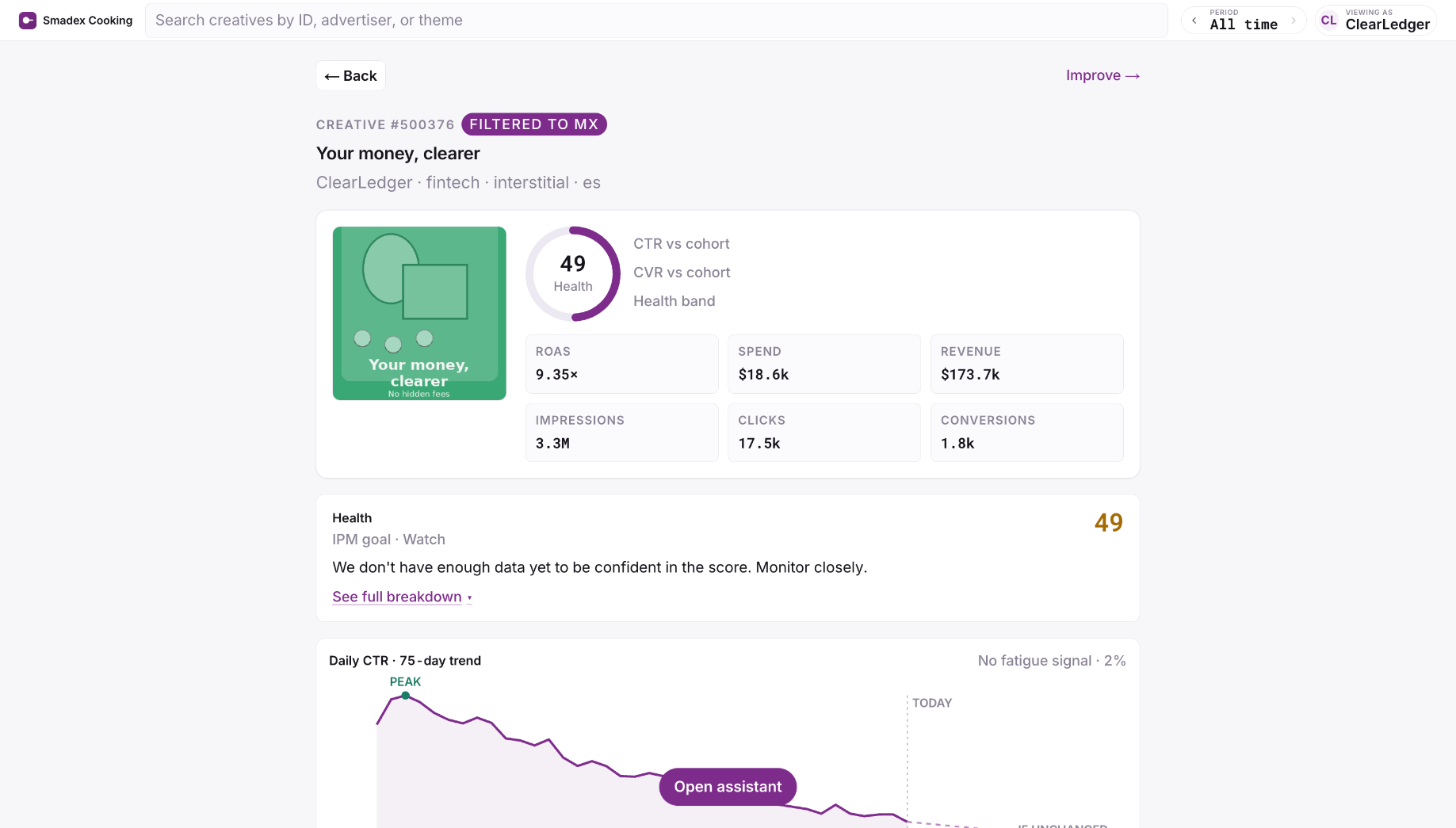
Non-fatiguing OK Performing Ad
-
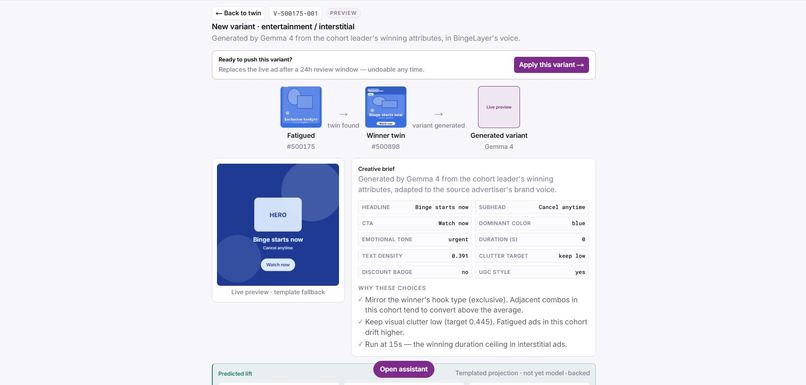
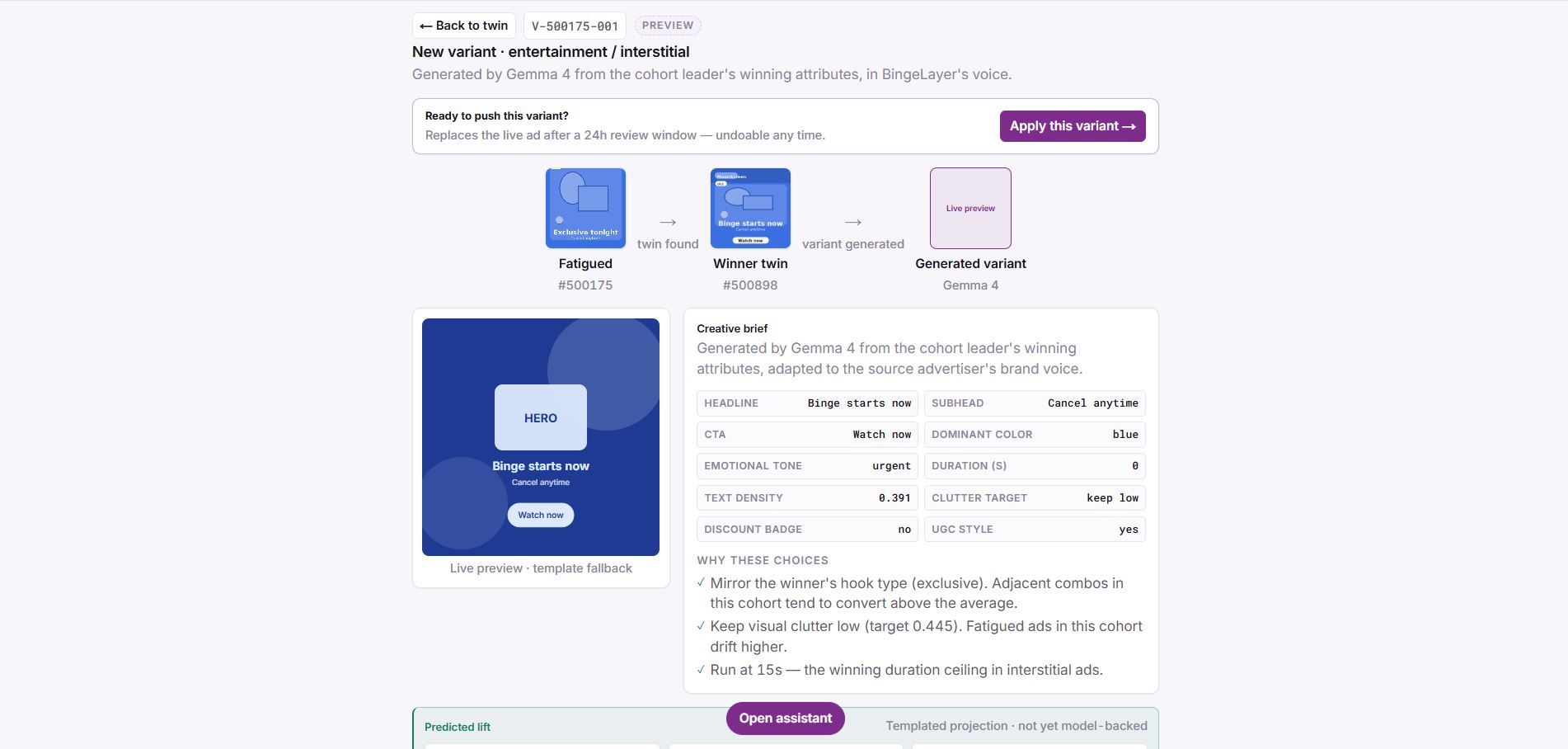
Digital Twin
-
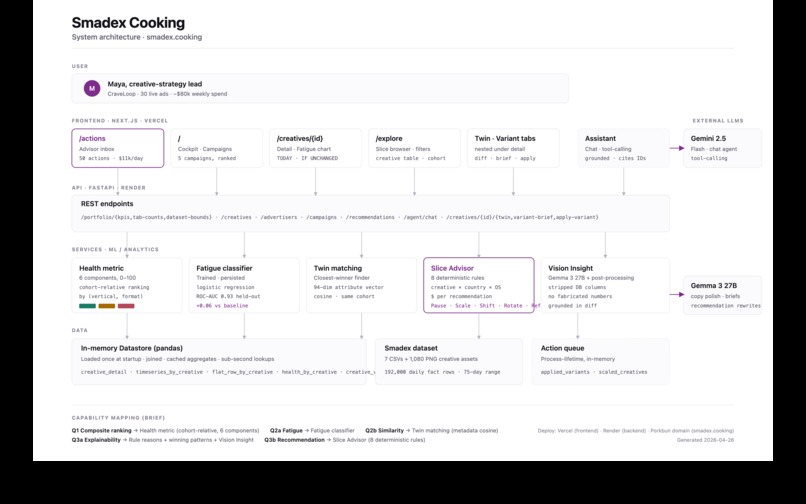
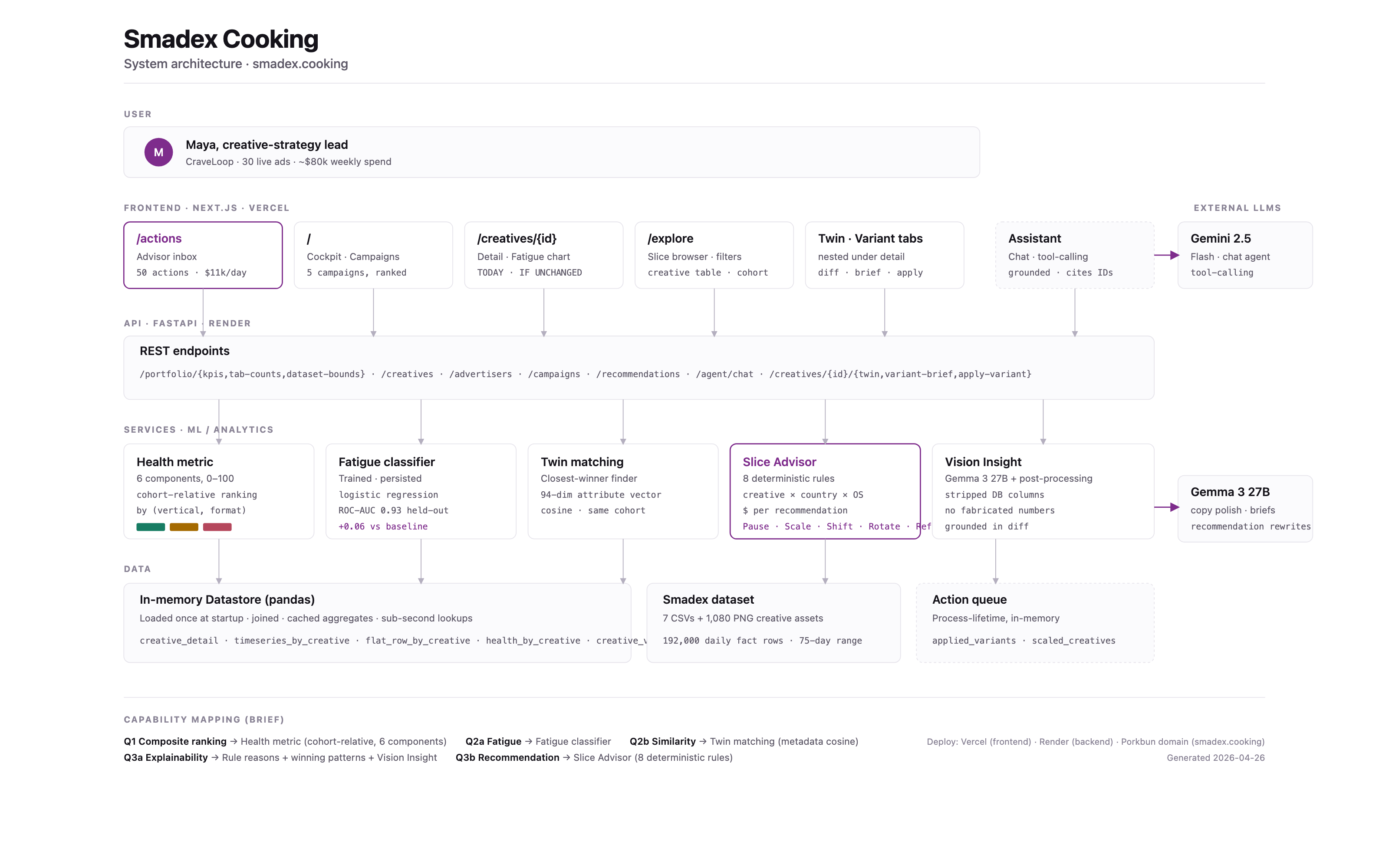
Architecture Diagram
Inspiration
Performance marketers spend their day buried in country-by-OS breakouts on ten different dashboards. They pause an ad in the global view, only to realise it was the only thing working in Mexico. They scale a winner everywhere, only to watch it tank in Brazil because Android users hate the music. The aggregate is a comfort blanket. The slice is the diagnosis.
Smadex Cooking is the kitchen. The dataset goes in raw, eight rules do the chopping, the AI plates it up as a daily action queue. You spend less time analysing and more time cooking. 🧑🍳
Try it live: smadex.cooking
What it does
Smadex Cooking is a cockpit for anyone running mobile ads. It does three things, all on the same dataset of 1,080 creatives across 36 advertisers and 75 days.
- Health KPI per creative. A composite 0 to 100 score that fuses ROAS, CTR, CVR, spend efficiency, fatigue verdict, and cohort-relative rank. Not one number that hides the diagnosis, but six dimensions surfaced side by side.
- Daily action queue at /actions. A ranked list of 1,800 country-by-OS recommendations, written in plain English. Each card has the change ("pause in Brazil on Android"), the reason ("CTR dropped 78% week over week, ROAS at 0.4x cohort median"), the projected daily impact in dollars, and one tap to apply, snooze, or dismiss.
- AI assistant. Ask "why is creative 500376 underperforming?" and Gemini calls our typed tools to pull the slice metrics, identify the country where CTR collapsed, surface peer benchmarks, and offer a one-click pause for that geo only. No hallucinated numbers; every digit comes from the datastore.
The eight rules behind the queue are: geographic prune, geographic scale, OS frequency cap, cross-market early warning, concentration risk, format-market mismatch, pattern transfer, and reallocation. They all run over the per-(creative, country, OS) slice of every ad, which is where the actual money lives.
How we built it
- Backend. Python 3.12 + FastAPI, dataset loaded once into memory at startup. A logistic regression classifier trained on hand-engineered changepoint features (drop ratio, peak-to-last drawdown, CTR coefficient of variation, pre and post-changepoint CTR deltas) decides the fatigue verdict. The eight action rules run over a precomputed (creative, country, OS) feature matrix with cohort baselines.
- Frontend. Next.js 16 with the App Router, deployed to Vercel at smadex.cooking. The layout is dense, neutral, and calm, modelled on real ad-tech tools like AppLovin MAX, Liftoff, and Moloco so anyone in the industry feels at home.
- AI. Google's Gemini 2.5 Flash for the chat assistant, with typed tool calls so every metric read goes through a Python function instead of a hallucinated guess. Gemma 3 27B rewrites our deterministic recommendation copy in marketer voice. We added a key-rotation pool with exponential-backoff retry so free-tier 429s don't crash the demo.
- Deploy. Frontend on Vercel, backend on Render, domain on Porkbun.
Challenges we ran into
The real signal was in the country and OS breakdown, and we found it late. Our first pass built recommendations at the creative level. Mid-build we realised the per-country, per-OS slice was where the genuinely actionable insight was hiding. The same creative could be a winner on iOS in the US and a dud on Android in Brazil. We had to shift the recommendation grain on the fly, and it was the difference between generic advice and something a marketer would actually act on.
Figuring out what "KPI" actually means in advertising. We started by treating fatigue as the headline metric, then briefly chased an LLM-generated synthetic score. Both were wrong. Performance is a basket of ROAS, CTR, CVR, spend efficiency, fatigue, and cohort-relative behaviour, and collapsing it into a single number throws away the diagnosis. We reworked the cockpit to surface those dimensions side by side instead of fusing them.
Splitting the dashboard cleanly across three of us. Carving the cockpit into ownable pieces and stitching them back together was harder than the code itself. Types drifted, naming diverged, the same concept appeared in three places. The lesson: front-load the task split, agree shared types and conventions before anyone writes a component, and treat integration as a first-class deliverable rather than a leftover.
Accomplishments that we're proud of
- The advisor analyses every (creative × country × OS) slice across all 1,080 creatives in the dataset and produces 1,800 ranked actions across all 36 advertisers. 86% of creatives surface at least one recommendation; the remaining 14% are clean and the system stays quiet.
- The fatigue classifier hits 0.93 ROC-AUC on a held-out, campaign-grouped test split. The dataset's own pre-computed
ctr_decay_pctbaseline scores 0.87 on the same evaluation. So the model beats the dataset's shipped signal by 6 points of AUC, with proper grouped cross-validation (no campaign appears in both train and test). - The chat assistant uses typed tool calls instead of prompt-stuffing. Every number it cites is the real number from the datastore, not something the model decided sounded plausible. It handles diagnose, recommend, confirm, and apply turns end to end.
- The interface looks and reads like a real ad-tech tool. Dense tables, Lucide icons only, a 6/8/10 px radius scale, accent colour reserved for the active state and the primary action. Marketers who've used MAX or Moloco recognise the layout instantly.
Submission Challenge
We are entering this for the Smadex Creative Intelligence for Mobile Advertising challenge. The brief asked for a tool that answers, for a marketer, (1) which creatives work best, (2) which are repetitive or tired, (3) what to test next, with explainability and recommendations. Smadex Cooking covers four of those bullets directly:
- Which work best: Health KPI composite + cohort-relative rank, surfaced in the cockpit and on every creative card.
- Which are tired: Fatigue classifier with a benchmark beat (0.93 vs 0.87 ROC-AUC).
- What to test next: The 8-rule action queue at /actions, ranked by projected daily impact in dollars.
- Recommendations with rationale: Each card explains why, in marketer voice, polished by Gemma.
We also opted into the MLH Gemma side-prize (Gemma 3 27B handles every natural-language polish step on recommendations and assistant replies; the deterministic templates are the floor it can't drop below).
What we learned
- Slices beat totals. A portfolio-average ROAS hides everything that matters. The same creative can be a 5x winner in the US and a 0.4x dud in Brazil at the same time. The aggregate is a comfort blanket; the slice is the diagnosis.
- Tools beat guessing. When we let the LLM read numbers off a prompt, it hallucinated confidently. When we forced it through typed tools that hit the real datastore, every digit was right. We didn't make the model smarter; we stopped asking it to memorise things it had no business knowing.
- Compute the numbers, let the AI pick the words. Deterministic Python decides the recommendation and the dollar impact. The LLM only writes the rationale around it. Numbers stay exact, copy stays warm, and nothing the marketer reads is something a language model decided was true.
What's next for Smadex Cooking
- Persist applied actions so a marketer can see "you applied 8 of 12 recommendations this week" and the system can score itself over time.
- Real causal lift estimates with proper geo experiments instead of projections, so the dollar impact line on each card stops being a hedged estimate.
- Plug the queue into Smadex's bid management API so one tap of "apply" hits a live campaign instead of an in-memory state. That is the bullet that turns Smadex Cooking from a tool next to Smadex into a feature inside Smadex.
- Bandit-driven exploration of the attribute cube (theme, hook, dominant colour, motion score, has-discount-badge) once enough applied-action history exists to update priors. Same idea, different stove.
A note on the dataset
The dataset's images are synthetically rendered from metadata, not real creative. We treat the visual layer as a placeholder. Production would consume real ad assets through Smadex's existing creative store. Everything else (CTR, CVR, ROAS, spend, conversions, fatigue labels, country mix, OS split) is real-shaped data, and that is what every model and rule in the cockpit operates on.
Built With
- fastapi
- gemini
- gemma
- httpx
- nextjs
- pandas
- porkbun
- pydantic
- python
- react
- scikit-learn
- tailwindcss
- typescript
- uvicorn
- vercel


Log in or sign up for Devpost to join the conversation.