-
-
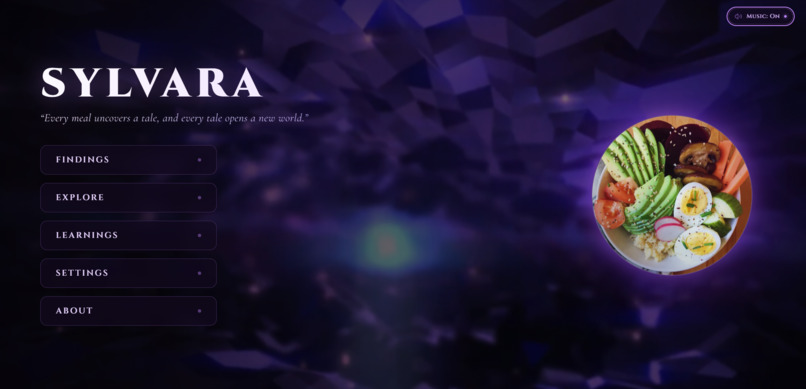
SLYVARA
-
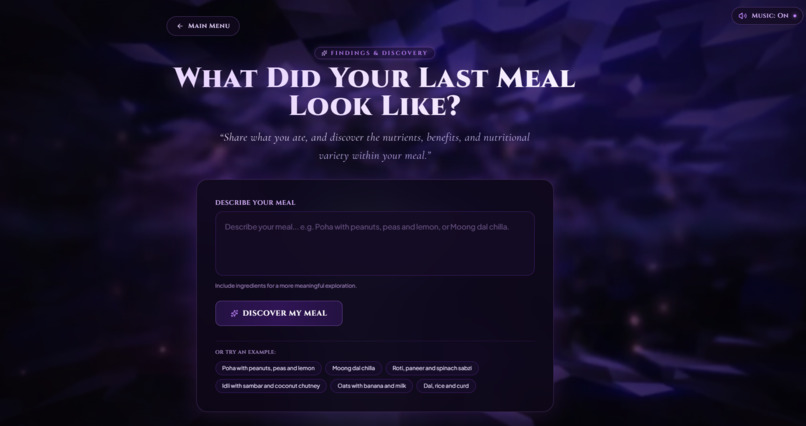
Findings
-
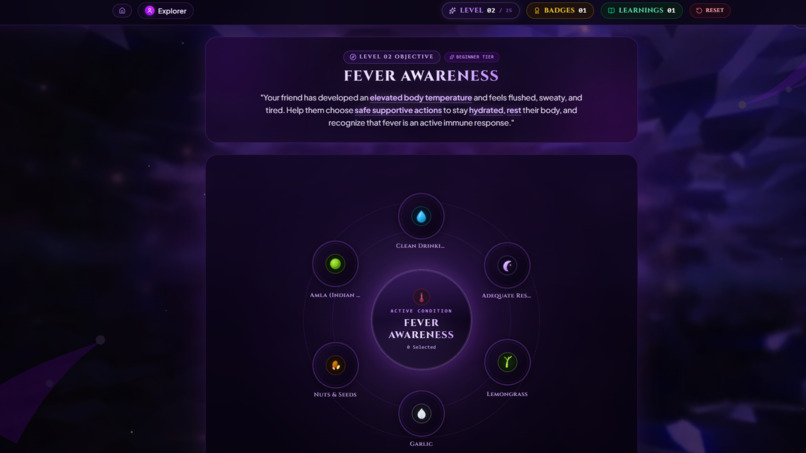
Explorer
-
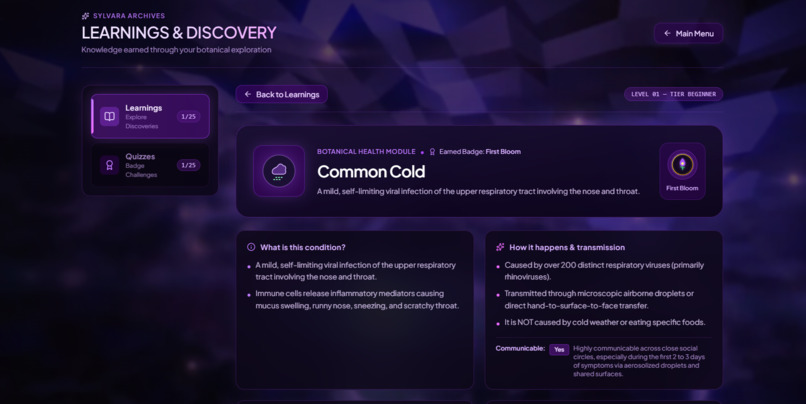
Learnings
-
Settings
-
About
SYLVARA
Every meal uncovers a tale, and every tale opens a new world.
Domain: Interactive Gamified Nutrition & Botanical Education / Digital Health Awareness
Project Type: Frontend-Only, Offline-First Educational Web Application
Project Description
SYLVARA is an interactive, gamified educational web application designed to transform how people explore food, essential nutrients, botanical knowledge, and public health awareness.
Instead of treating nutrition as an exercise in calorie counting, numerical targets, or restrictive diets, SYLVARA reframes food as cultural heritage, cellular nourishment, and an opportunity for discovery.
Through an illustrated 2D garden and interactive learning experiences, users can explore everyday meals and their nutritional synergies, solve 25 progressive botanical and health-awareness scenarios, unlock structured educational lessons, and test their understanding through badge-linked quizzes.
Combining an immersive visual environment, interactive discovery tools, and game-based learning, SYLVARA makes complex topics more approachable, engaging, and memorable.
Important: SYLVARA is an educational awareness platform. It does not provide medical diagnoses, treatment plans, clinical prescriptions, or personalised medical nutrition advice.
Inspiration
The idea behind SYLVARA started with a simple observation: food is much more than calories, and learning about nutrition should be about understanding what we eat rather than constantly measuring it.
Many digital nutrition platforms concentrate on calorie counting, macronutrient ratios, and numerical targets. Meanwhile, information about vitamins, minerals, phytochemicals, medicinal plants, and their biological functions is often buried in complex scientific terminology.
There is also a growing disconnect between everyday food, the plants it comes from, and the science behind its nutritional value. Traditional botanical knowledge is frequently misunderstood, while unverified health trends and unsafe self-medication can create confusion.
I wanted to bring these disconnected subjects together in a way that feels less like studying a textbook and more like discovering an interconnected world.
That idea became SYLVARA: a digital garden where meals tell stories, plants reveal their science, and every interaction creates an opportunity to learn.
What it does
SYLVARA brings together six interconnected sections:
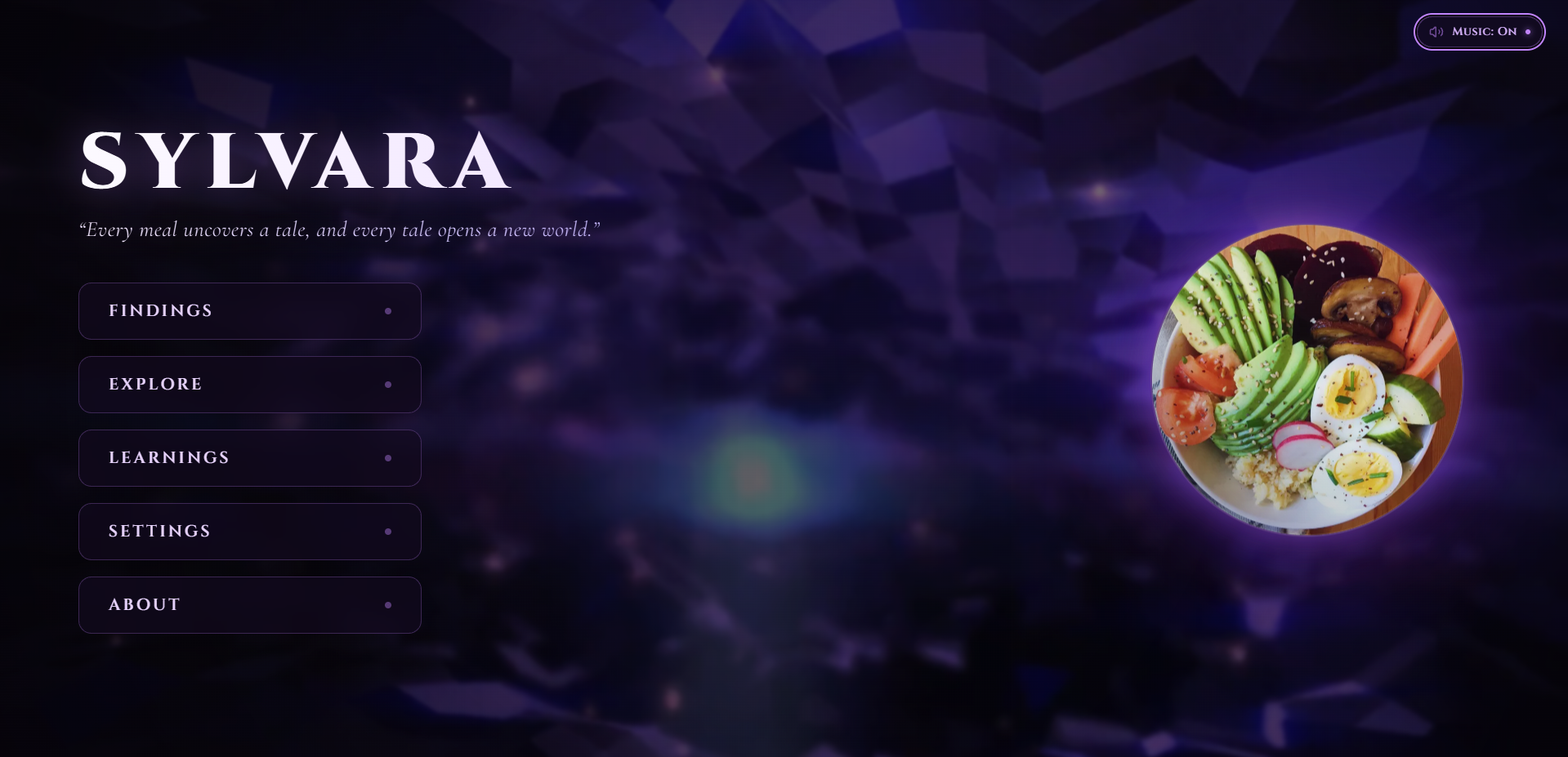
1. Main Menu
An immersive gateway into the SYLVARA experience, featuring a cinematic atmosphere, garden-inspired visuals, ambient audio, and navigation to the application's learning experiences.
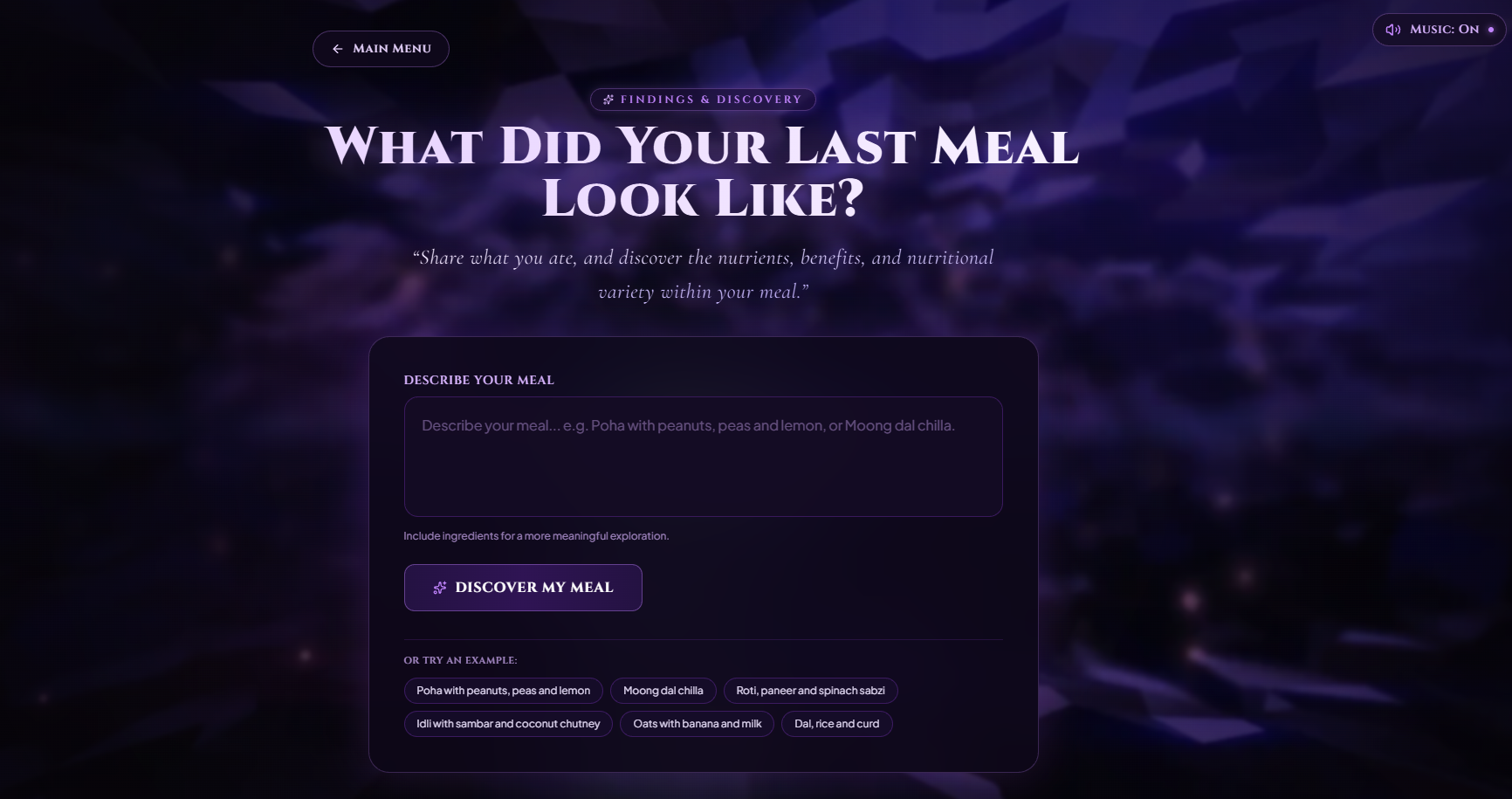
2. Findings — Meal & Nutrient Discovery
Users can enter everyday meals such as Poha, Dal Tadka with Roti, or Palak Paneer and explore their nutritional components through an interactive circular nutrient wheel.
They can discover:
- Vitamins, minerals, macronutrients, and phytochemicals.
- The biological functions of different nutrients.
- Complementary food combinations and nutrient synergies.
- Potentially underrepresented nutritional components.
- A qualitative nutritional profile of their meal.
Rather than focusing on calorie counts or restrictive numerical targets, Findings encourages a more meaningful understanding of food composition and dietary balance.
3. Explore — 25-Level Radial Garden Game
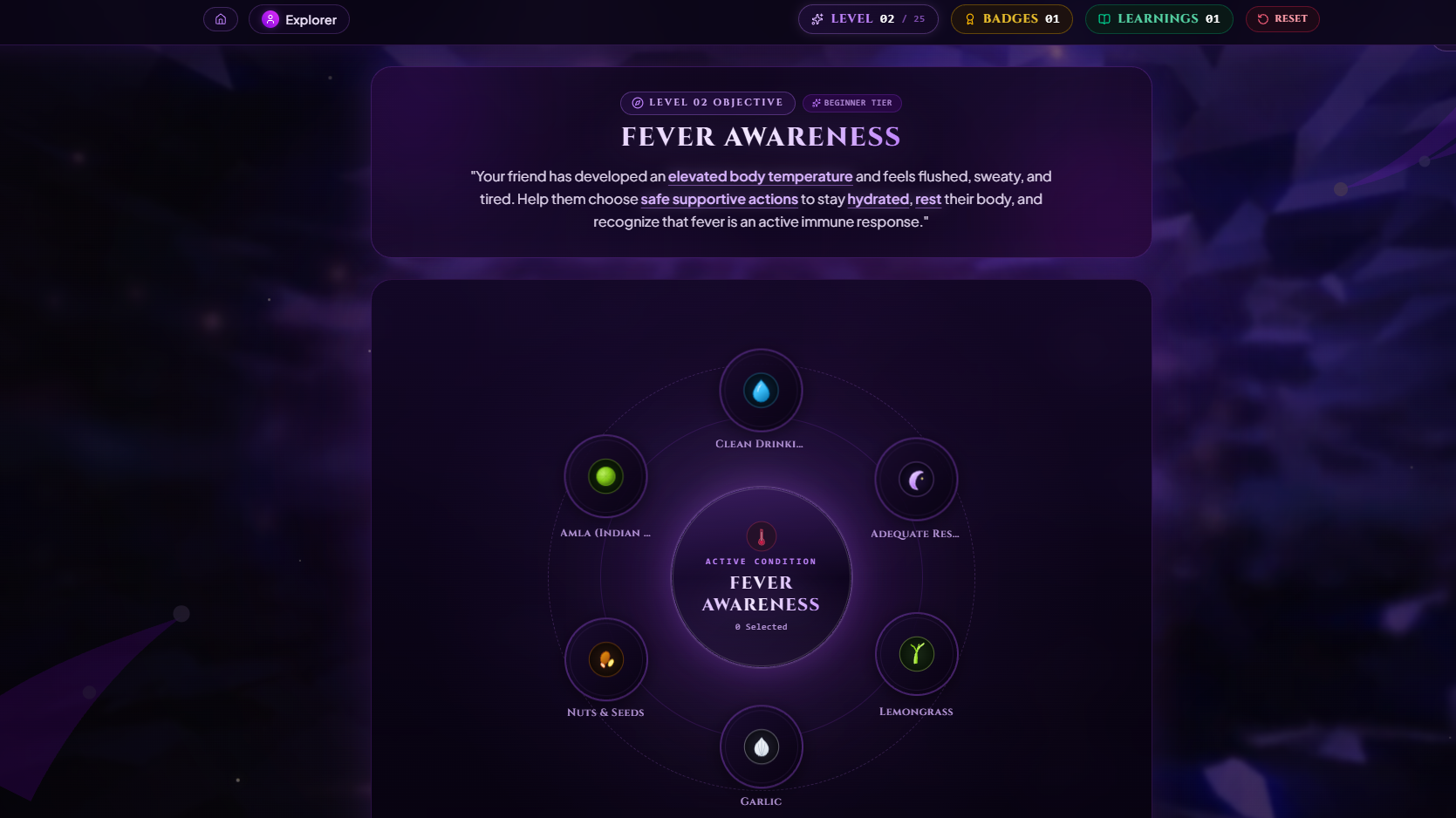
Explore transforms educational concepts into an interactive, scenario-based botanical puzzle game.
Users progress through 25 levels featuring health-awareness and botanical scenarios. They investigate plants and food-related elements arranged in a radial garden, make selections, solve challenges, and unlock new levels.
Successful completion rewards users with thematic badges and educational learning cards.
4. Learnings & Quizzes
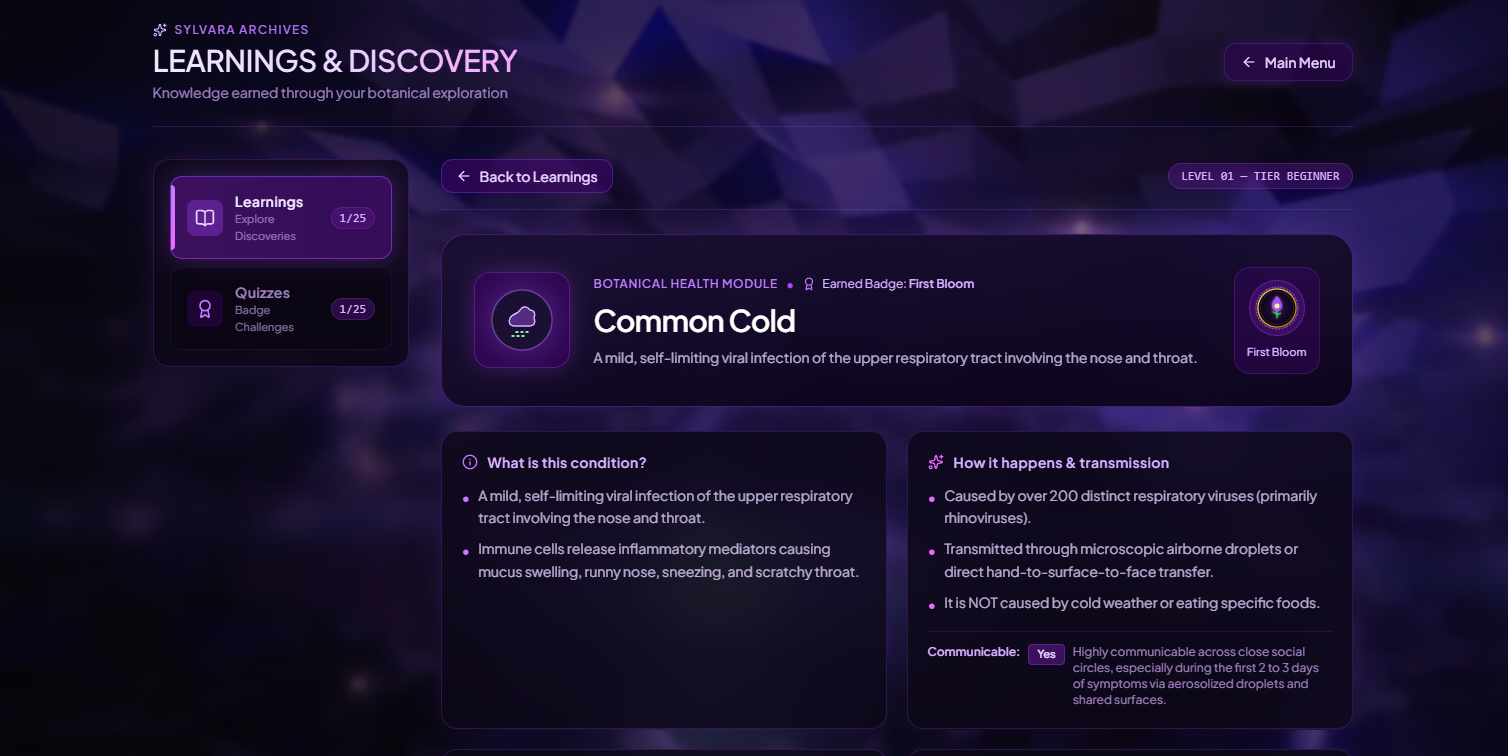
Learning cards earned through Explore become part of a dedicated educational repository.
Each lesson covers relevant topics such as contributing factors, nutrients, botanical compounds, evidence-based information, supportive care, and when professional medical attention is necessary.
Corresponding quizzes unlock through earned badges. Each quiz contains three questions, follows a single-attempt rule, and provides explanations and a permanent score summary.
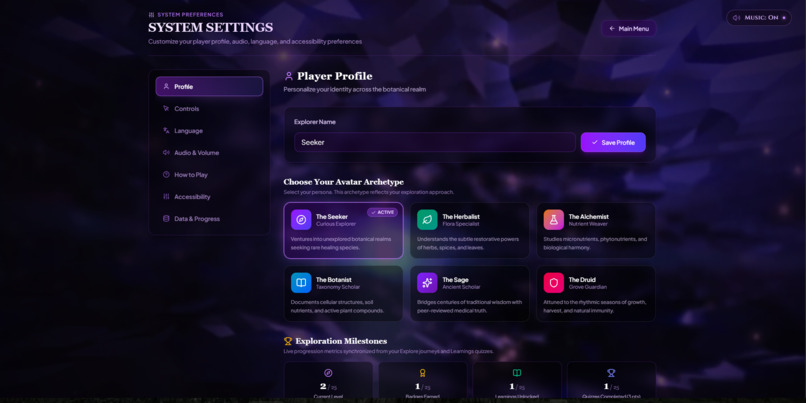
5. Settings
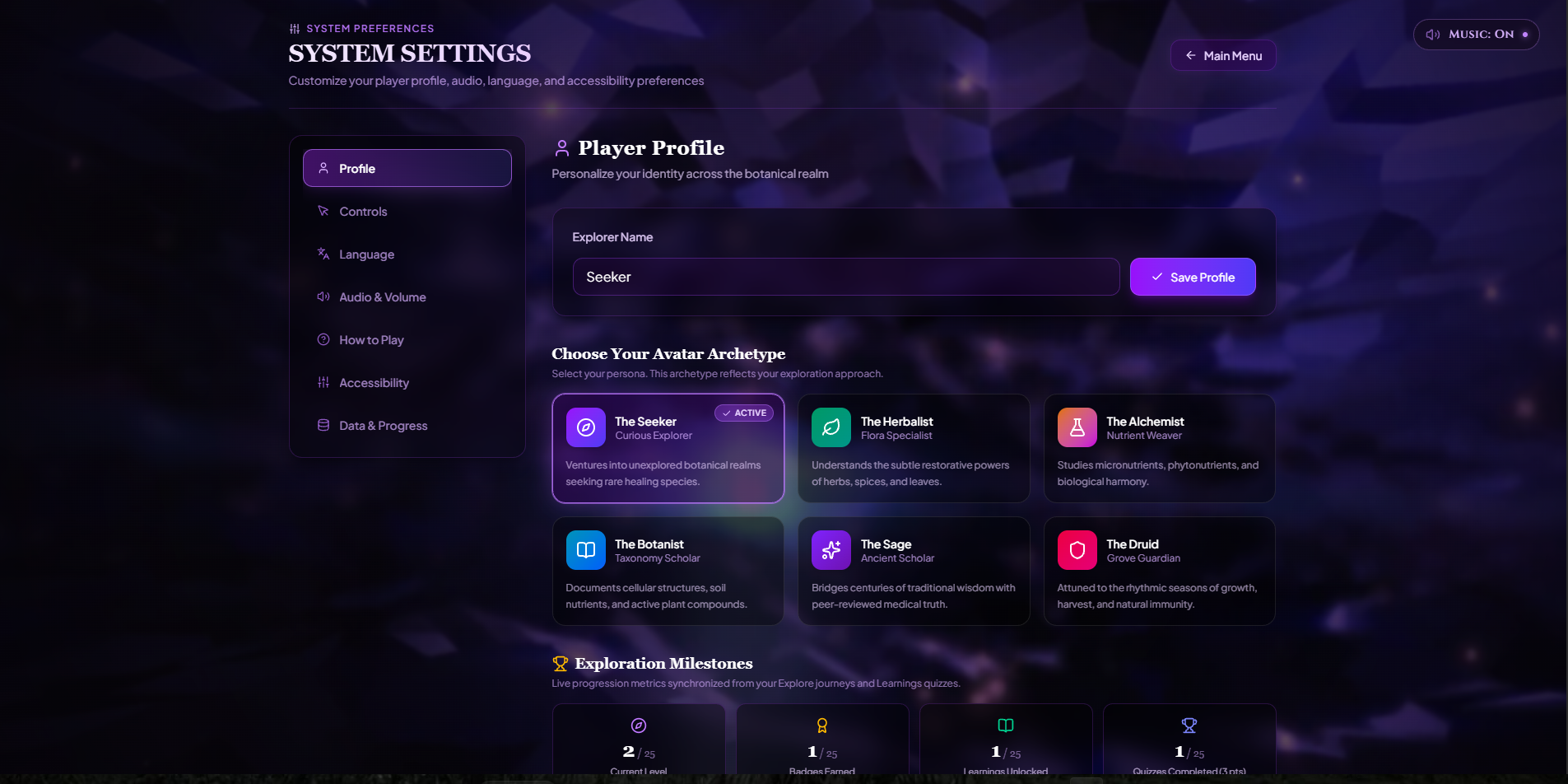
A unified settings dashboard provides:
- Customisable player profiles and avatars.
- Language selection across English, Hindi, Japanese, and Simplified Chinese.
- Independent background music and sound-effect controls.
- Accessibility options, including reduced motion, text scaling, and high contrast.
- Progress and local data management.
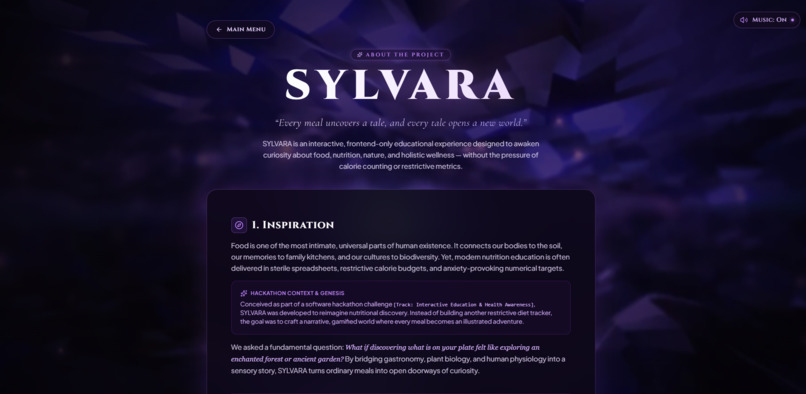
6. About
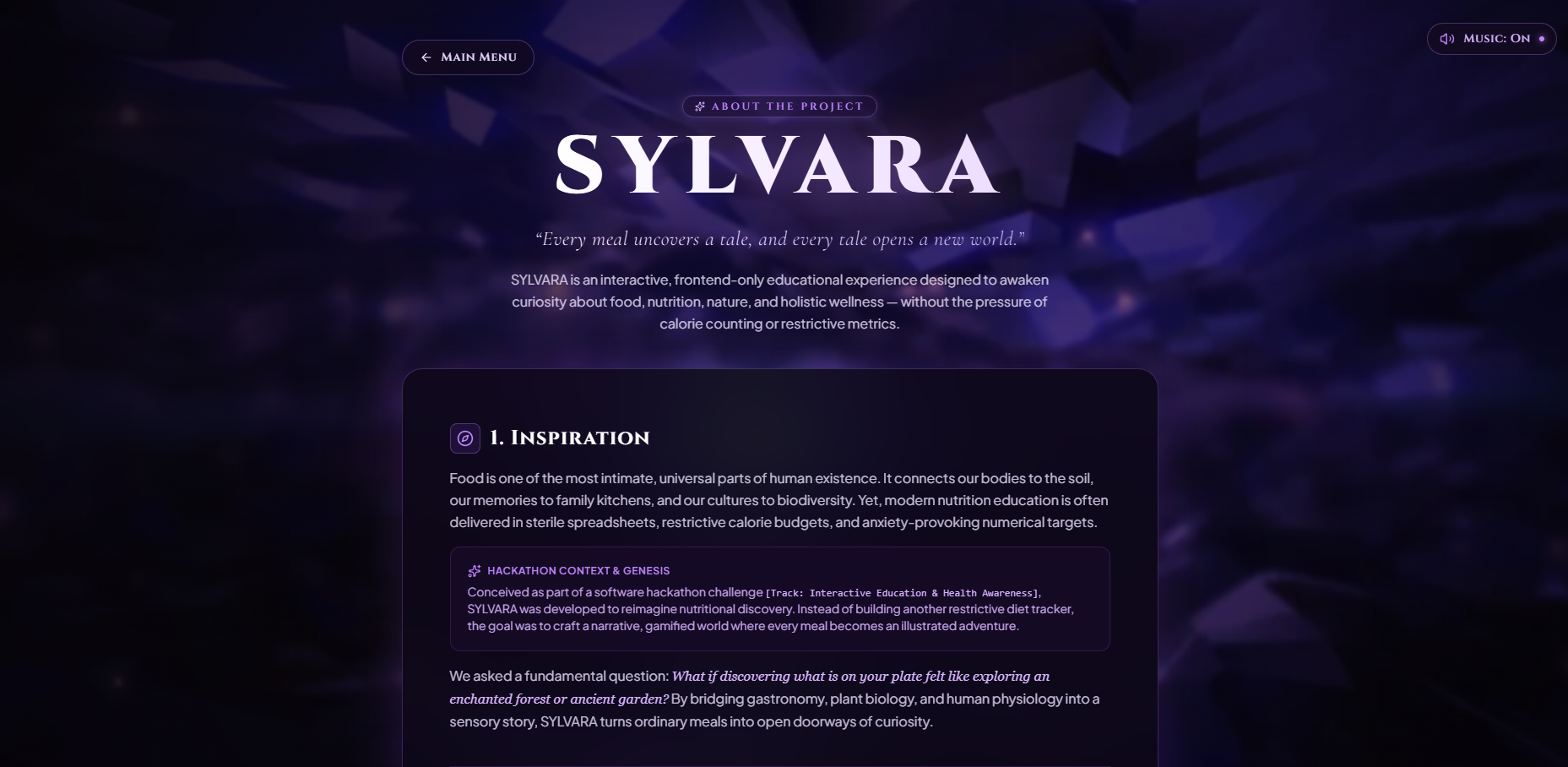
A dedicated space explaining the project's inspiration, educational philosophy, architecture, accomplishments, development challenges, and future direction.
Together, these sections create a connected learning experience in which discovering information leads to exploration, exploration unlocks lessons, and lessons are reinforced through quizzes.
How I built it
We built SYLVARA as a 100% frontend-only, offline-first modular monolith. The architecture is organised around independent feature modules that share structured educational content, state management, and browser-based persistence.
Technology Stack
- React 19 — Component-based user interface.
- TypeScript — Type-safe application logic and data structures.
- Vite — Development environment and production bundling.
- Tailwind CSS — Responsive styling and visual design.
- React Router 7 — Client-side navigation and lazy-loaded pages.
- Zustand — Feature-specific state management.
- Dexie + IndexedDB — Persistent storage for game progress, badges, and quiz records.
- LocalStorage — Player preferences and settings.
- Zod — Runtime data validation.
- i18next + react-i18next — Multilingual interface.
- Motion for React — Animations and interface transitions.
- Lucide React — Interface iconography.
- Vitest, React Testing Library, and Playwright — Testing and verification.
- ESLint and Prettier — Code quality and formatting.
Application Architecture
The application follows a feature-oriented modular architecture:
src/app/— Application shell and routing.src/features/main-menu/— Landing experience and shared audio.src/features/findings/— Meal analysis and nutrient visualisation.src/features/explore/— 25-level garden game and progression logic.src/features/learnings/— Educational lessons and quiz engine.src/features/settings/— Preferences, accessibility, and progress management.src/features/about/— Project information and documentation.src/content/— Structured food, meal, and nutrient datasets.src/database/— IndexedDB database configuration.src/i18n/— Translation resources and internationalisation.
Connected Learning Progression
One of the central architectural decisions was connecting gameplay with educational outcomes.
The progression works as follows:
- A user completes an Explore level.
- The corresponding learning card and badge are unlocked.
- The earned badge unlocks its associated quiz.
- The user completes a three-question quiz.
- The result and learning progress are stored locally.
This creates a connected progression system rather than treating the game, lessons, and quizzes as separate features.
The application does not require a backend server, cloud database, or server-side authentication. Game records are stored through IndexedDB using Dexie, while player preferences are stored in LocalStorage.
Challenges I ran into
Building SYLVARA involved more than creating individual pages. The biggest challenge was making several interactive learning systems function together while maintaining a completely frontend-only architecture.
1. Connecting the learning progression
Explore, Learnings, and Quizzes needed to share a consistent progression system. We had to ensure that completing a level unlocked the correct lesson and badge, and that quizzes remained inaccessible until their corresponding badge was earned.
2. Managing persistent browser data
Game progress, quiz attempts, and player preferences needed separate storage and reset behaviour. We designed the persistence architecture so resetting Explore would clear dependent learning and quiz records without affecting personal preferences or accessibility settings.
3. Building interactive radial experiences
Creating a responsive radial garden and nutrient wheel required careful attention to layout geometry, hover interactions, selection mechanics, tooltips, and information panels across different viewport sizes.
4. Making complex educational information approachable
Nutrition, biochemistry, botanical compounds, and public health topics can become difficult to understand when presented with excessive scientific terminology. We had to organise information into smaller, structured learning experiences.
5. Balancing traditional knowledge and scientific responsibility
Presenting botanical knowledge required particular care. We needed to distinguish traditional uses from evidence-based medical information and avoid suggesting that foods or plants replace prescribed treatment.
6. Maintaining a consistent experience
The visual atmosphere, animations, audio, language settings, accessibility controls, and navigation needed to work consistently across all six sections.
These challenges pushed us to think about SYLVARA as one connected product rather than a collection of independent interfaces.
Accomplishments that I'm proud of
We are proud of turning an educational concept into a complete, interconnected application with multiple learning experiences.
Some of our key accomplishments include:
- Building six interconnected application sections.
- Developing a 25-level scenario-based radial garden game.
- Creating a structured educational repository with 25 learning topics.
- Implementing 25 badge-linked quizzes with exactly three questions and a single-attempt rule.
- Connecting level completion, badges, lessons, and quiz progression.
- Building an interactive meal and nutrient discovery experience.
- Designing a multilingual architecture supporting four languages.
- Implementing browser-based offline persistence using IndexedDB and LocalStorage.
- Introducing independent audio controls and accessibility settings.
- Creating a consistent visual identity using dark-lavender gradients, glassmorphism, atmospheric backgrounds, and subtle animations.
Most importantly, we are proud that the different parts of SYLVARA contribute to one larger purpose: making everyday food, botanical knowledge, and responsible health awareness easier to explore and understand.
What I learned
Developing SYLVARA helped us understand that educational technology is not simply about presenting accurate information. It is also about how people interact with that information, connect concepts, and retain what they learn.
From the technical side, we gained experience in modular React architecture, TypeScript, state management, browser storage, data-driven gameplay, responsive visualisation, internationalisation, and testing.
We also learned how important it is to separate application preferences from learning records, design predictable progression systems, and maintain consistency across multiple interconnected features.
Beyond development, the project strengthened our understanding of nutrition literacy, botanical science, food chemistry, and responsible public health communication.
One of our biggest takeaways was that gamification becomes more meaningful when rewards are connected to actual learning outcomes rather than being purely decorative.
What's next for SYLVARA
SYLVARA is designed with room to grow into a broader educational ecosystem.
Our future roadmap includes:
1. Expanding Food and Ingredient Knowledge
Adding more regional ingredients, culinary traditions, and food combinations, including African, East Asian, and Indigenous South American food traditions.
2. Interactive Garden Simulation
Developing richer garden interactions with seasonal visual cycles, companion planting concepts, and culinary balance simulations.
3. Expanded Educational Curriculum
Introducing more in-depth modules on edible plants and toxic look-alikes, antibiotic resistance, food safety, botanical identification, and responsible health decisions.
4. Spoken Learning Experiences
Exploring audio narration and additional interactive educational formats to make learning more accessible.
5. User Data Portability
Introducing encrypted, user-controlled JSON export and import so learners can manually transfer their progress between devices without depending on cloud accounts.
Our long-term vision is to create a growing digital learning environment where food, nature, science, and interactive exploration come together.
We want SYLVARA to encourage people to look beyond what is on their plate, understand the science behind it, appreciate the natural world, and make more informed decisions.
Because every meal uncovers a tale, and every tale opens a new world.
Built With
- css
- dexie.js
- eslint
- framer-motion
- html
- i18next
- indexeddb
- javascript
- localstorage
- lucide-react
- motion
- playwright
- prettier
- react
- react-i18next
- react-router
- react-testing-library
- tailwind-css
- typescript
- vite
- vitest
- zod
- zustand

