The final product was never the goal
When you journal, write a letter or work through an idea, what matters is the thinking that happens along the way. You replay a moment, question what you believe, and come out the other side with a new perspective. The words on the page are only the result of that thinking.
That same thinking is what makes someone feel cared for when you write to them. The care isn't in the final words. It's in the time you took to figure out what you really wanted to say.
But more and more of our writing gets finished for us. Autocomplete and AI can hand you the final product in seconds and skip the part that actually changes you. And when only the output gets seen, the pauses, rewrites and changes of heart that show you really thought about it leave no trace. A letter you rewrote ten times arrives looking exactly like a quick text.
Slow Bloom is for people who write to think and feel, like journalers, letter writers and students working through ideas. It's for anyone who wants one place where the writing is truly theirs, even when AI could finish it for them.
That led us to one question: how might we encourage people to think more deeply as they write, and let the people they write to see that care, by making the journey visible, rewarding and worth keeping?
The Journey Matters
In Slow Bloom, the final text is just the result. The bouquet grows only from your process, and every part of it is designed to encourage you to keep writing and keep thinking.
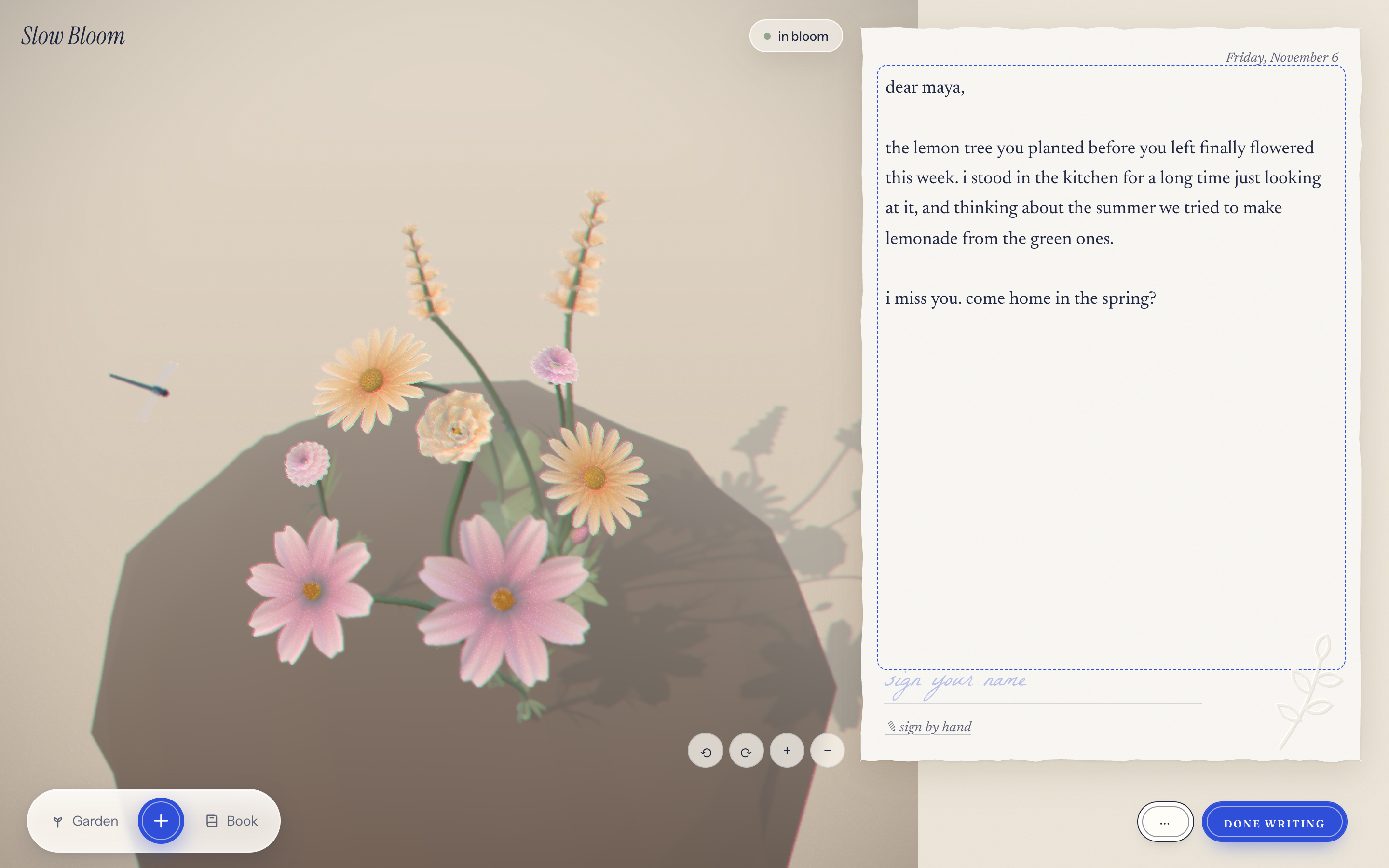
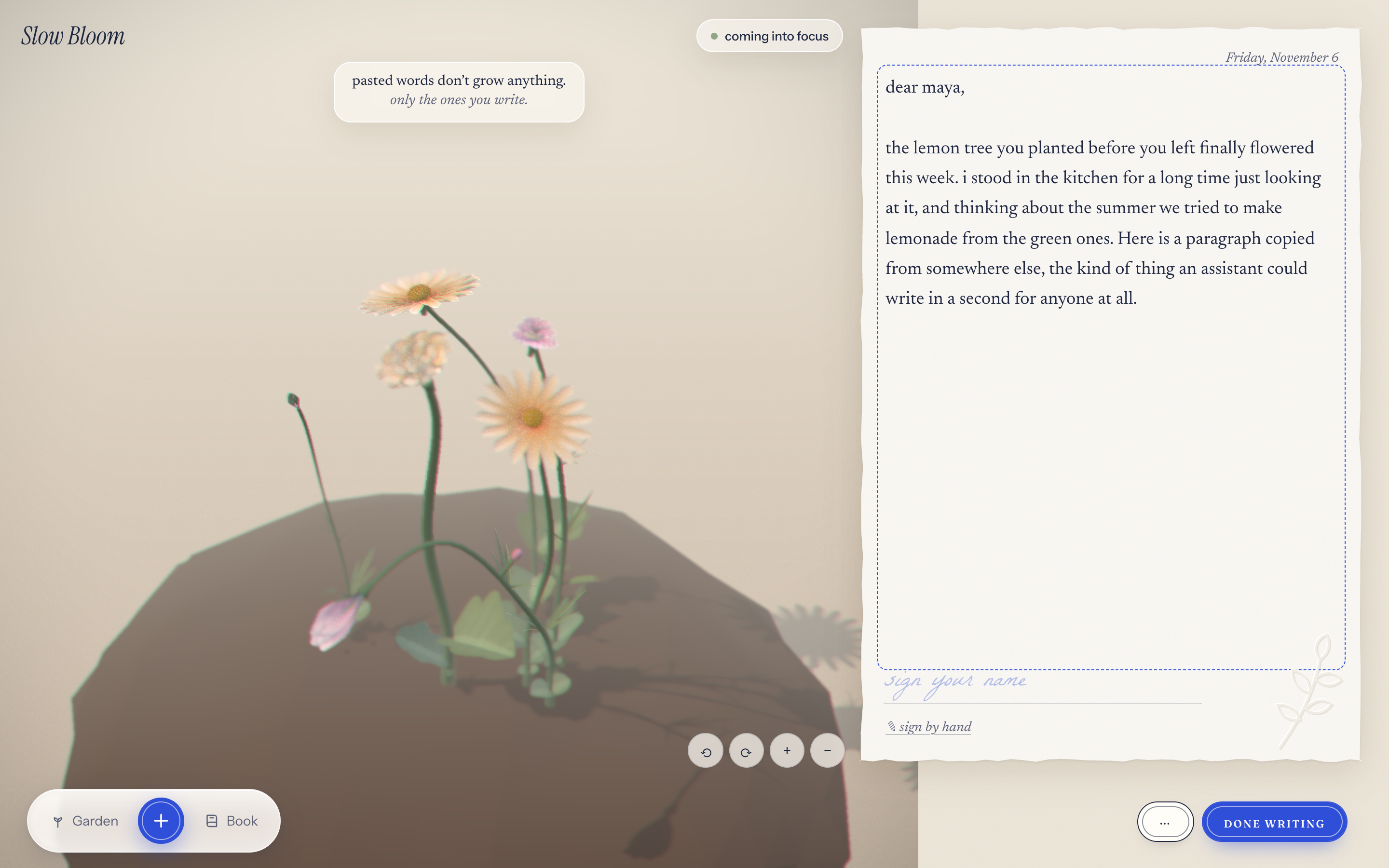
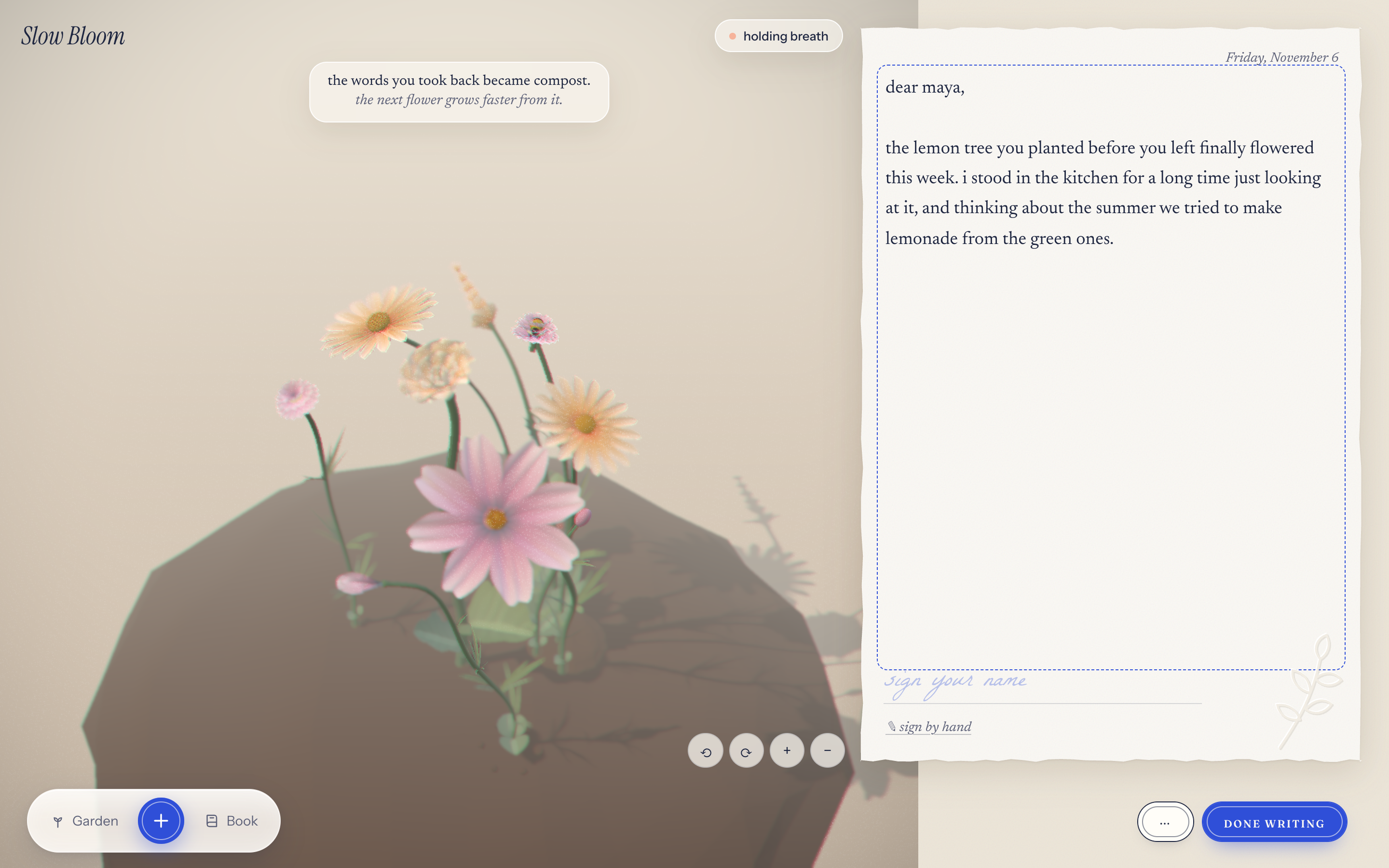
When you keep writing, new seeds sprout. When you pause to think, the bouquet keeps growing, because thinking is progress too. When you take words back, they wither into compost, and the next flower grows faster from it, because the ideas you let go of feed better ones. When you paste a paragraph in, nothing grows at all, because you can't skip the thinking.
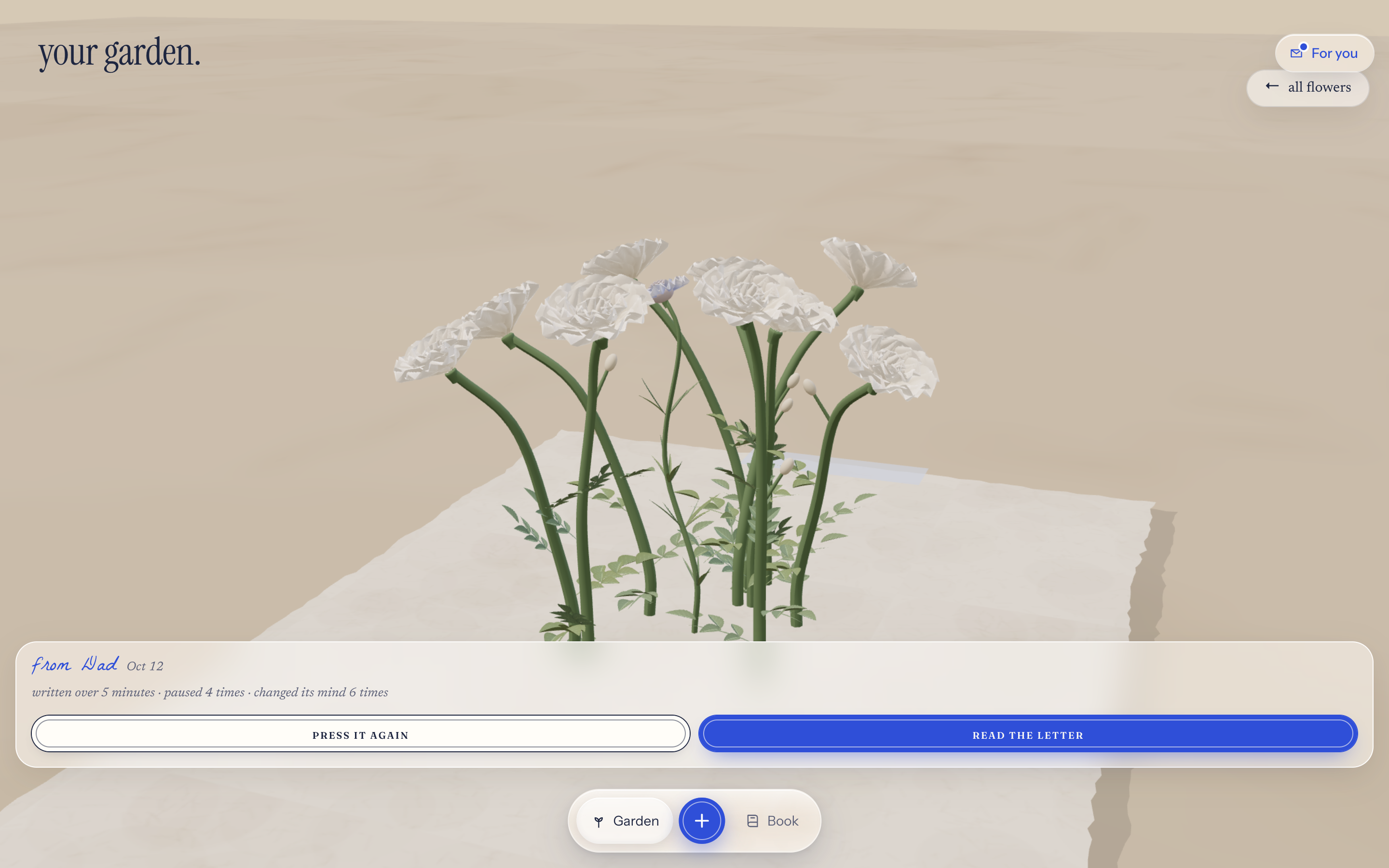
The bloom is an invitation, not a score. There are no word counts, streaks or ratings, and Slow Bloom never reads what you wrote. When you finish, your letter is pressed into your garden with a journey receipt like "written over 5 minutes · paused 4 times · changed its mind 6 times." It's a record of how you got there. Tap it later and it grows again, inviting you back into that thinking. And when you send a letter, the person you wrote to watches the bouquet grow again in your rhythm before they read a word, so they can see the care it took to get there.
The prompt's example, Slow Mail, slows down the delivery. Slow Bloom slows down the writing itself, because that's where the journey really happens.
How it works
Slow Bloom is a writing space where your letter grows a bouquet while you think it through. We kept the flow simple on purpose, so nothing gets between you and your thinking.
You start by writing a letter or a journal entry, and a 3D bouquet grows beside it as you go. A new seed drops in every 40 characters you type, the bouquet keeps growing through your thinking pauses, and the words you take back turn into compost for the next flower. Walking away doesn't count, so the bouquet only grows while you are actually with your writing.
When you're done, you can make it yours by drawing on the page, pressing a flower from your garden into it or choosing the paper. This step is only decoration, because the bouquet has already grown from how you wrote.
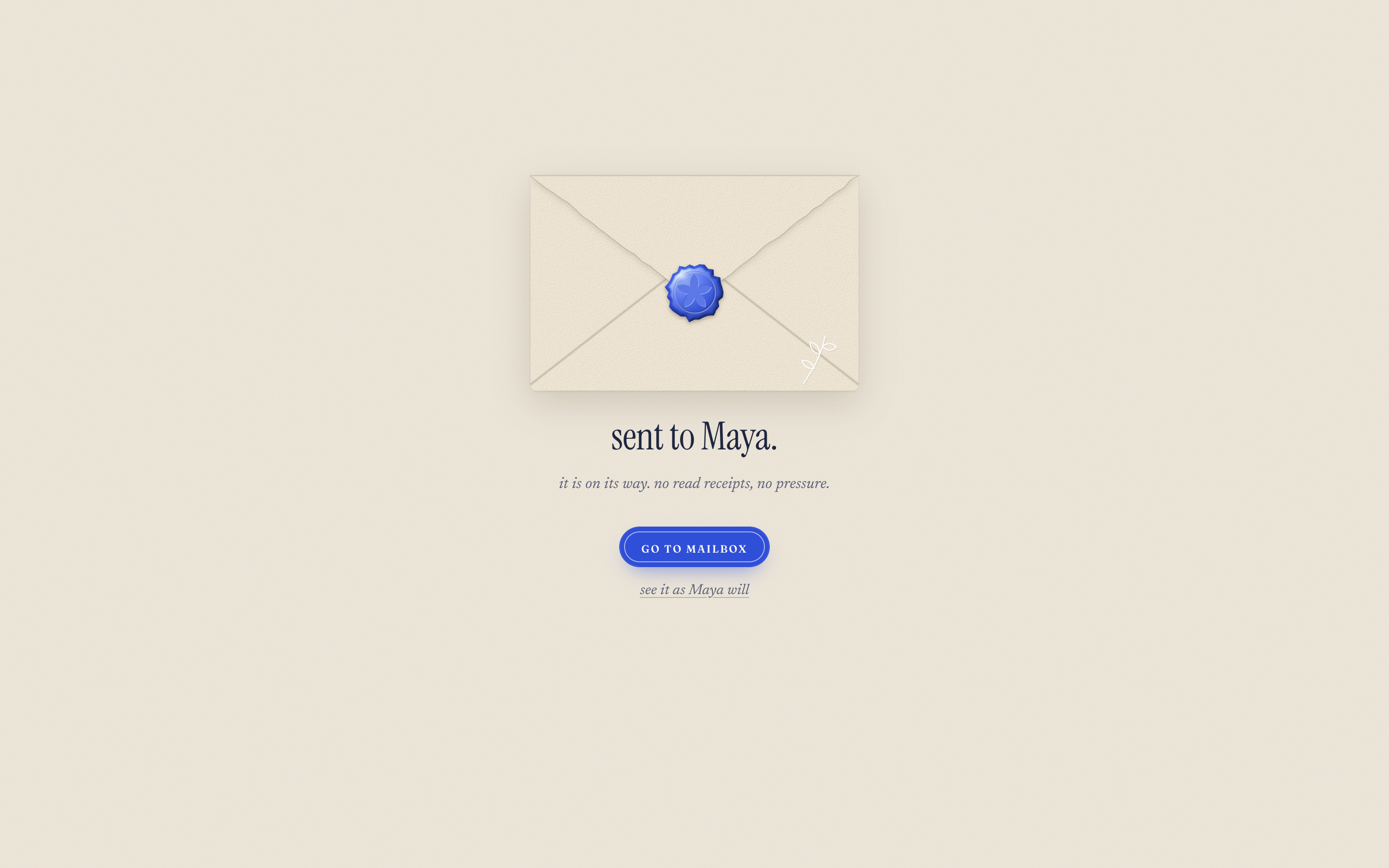
Only then do you decide who it's for. We put this choice at the end on purpose, so you can write freely first without worrying about an audience. You can keep it in your book, where you can tear the page out and send it whenever you're ready, or you can seal it with wax and send it to one person. When they open it, they watch the bouquet grow again in your rhythm before they read your words, and then they can plant it in their own garden.
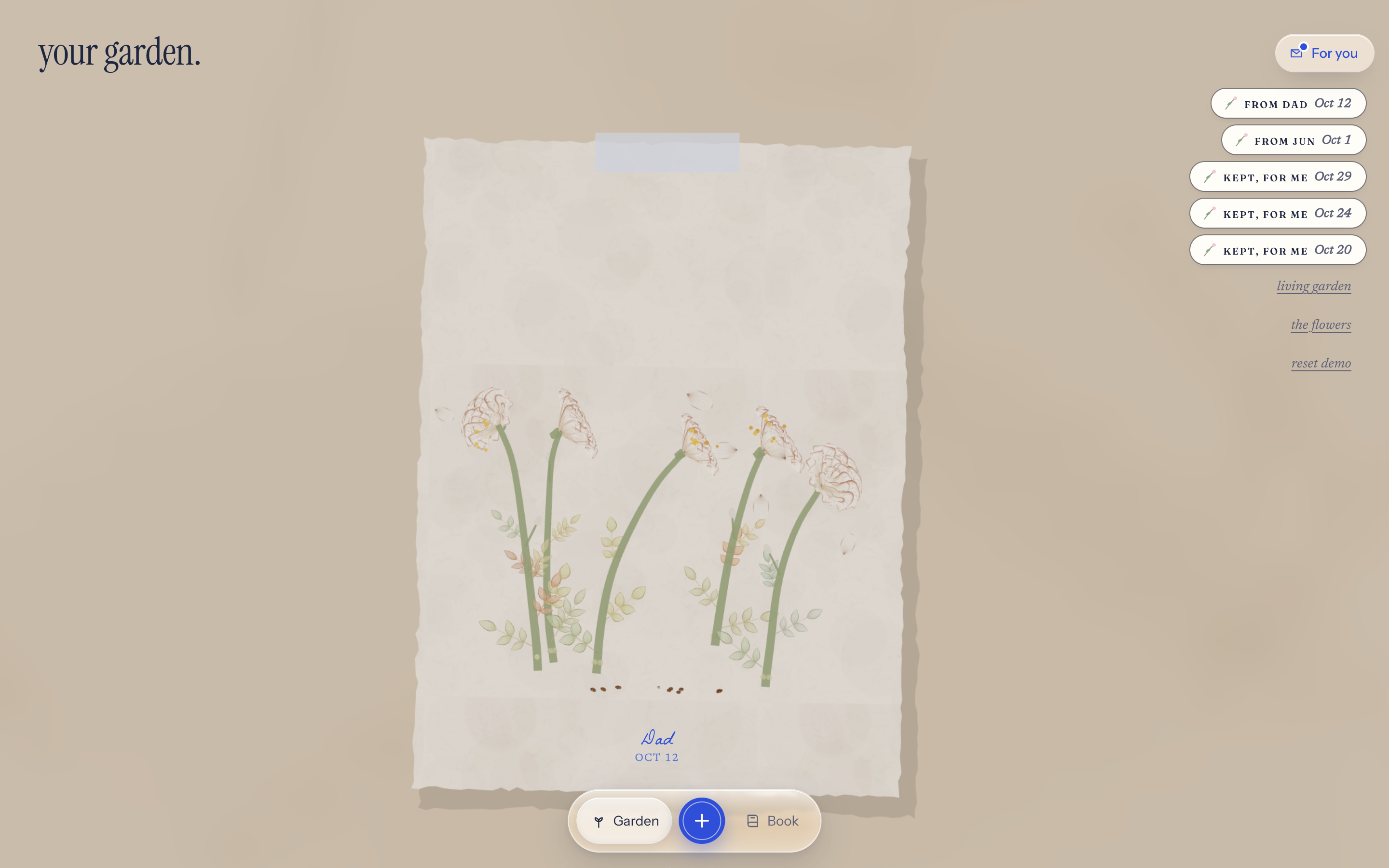
Every letter you keep or receive is pressed like a flower onto a herbarium sheet in your garden. Tap one and it grows again with its journey receipt, so you can look back on how you got to what you wrote, not just what you wrote.
The prototype works on phone and laptop at https://slow-bloom.vercel.app. Sending uses mock data for now, and every letter is stored only in your browser.
How we built it
Slow Bloom started with Braxton's belief that when you write a message, journal or work through an idea, the final product is never the goal. The goal is to write something meaningful that you truly believe in, and to come out of it with a new perspective. Lucy led the research, UX, visual design and the prototype.
We began with a Pinterest moodboard of pressed flowers, herbarium sheets and cyanotype prints, because care feels physical, imperfect and slow. From there we mapped the writing, keeping, sending and revisiting flows in FigJam, and set the visual direction in Figma around the idea of a letter coming into focus as you write.
Instead of stopping at static screens, we built a real 3D web app so we could feel how the growth worked, not just describe it. We then iterated on it every day, refining the growth rules across 23 flower species, the button system and the pressed garden.
A few decisions shaped everything. We grow flowers from effort and never from the words, so nothing judges what you feel, and we rejected flowers based on sentiment or keywords. Pasting grows nothing, because the thinking can't be copied. Deleting feeds compost instead of acting like a plain undo, because rewriting is part of the journey. You choose who it's for at the end, so you can write freely first. And there are no scores or streaks, because they would turn reflection into a contest. The journey receipt only records how you got there.
Testing on real phones changed the design too. The keyboard hid the bouquet, so we added a split view that lets you switch between more flower and more letter. Early testers also found the app slow and glitchy, so we rebuilt how scenes load, pressing sheets into the garden one at a time and skipping the heaviest effects on phones.
Visual design and accessibility
Slow Bloom is designed to feel like stationery, a field notebook and a botanist's specimen board, because writing slowly should feel like something you hold onto. The ground is beige paper with navy ink and one cobalt accent, used sparingly to show what's selected or in focus, like focus rings and selected chips. The flowers feel like real plants across 23 species, and when a letter is finished they press flat onto herbarium sheets with torn edges and washi tape. Headings are set in Instrument Serif, the letter is set in Newsreader, and every button is the same specimen label in Fraunces small caps. The words on screen are gentle and lowercase, and they never comment on what you wrote. Motion is slow and soft, with no bounce or spin, so the interface never rushes you.
We wanted a slow, gentle experience to work for everyone. You can write, seal and send using only a keyboard, with a visible focus ring showing where you are. Every drag or pinch on the bouquet also has a button, so you can turn and zoom it without a gesture. Screen readers hear the bouquet and the garden described in words, and status changes like the paste note are announced. If you turn on reduced motion, growth jumps to its finished state and transitions are removed. We also checked contrast, and navy ink on beige reads at 11.9:1 while white on cobalt reads at 6.1:1.
Privacy matters just as much, because people only write honestly when they feel safe. Your words stay in your browser, and only the timing of your writing shapes what grows.
Built With
- react
- react-three-fiber
- three.js
- typescript
- vercel
- vite

