-
-
Solventuri
Inspiration
Everyday health questions are surprisingly difficult to navigate.
Someone might wonder, "What should I eat for better nutrition?", "Why is my hair changing?", or "Am I doing this exercise correctly?" — but finding useful information often means switching between different apps, websites, and sources.
We wanted to build a simpler starting point.
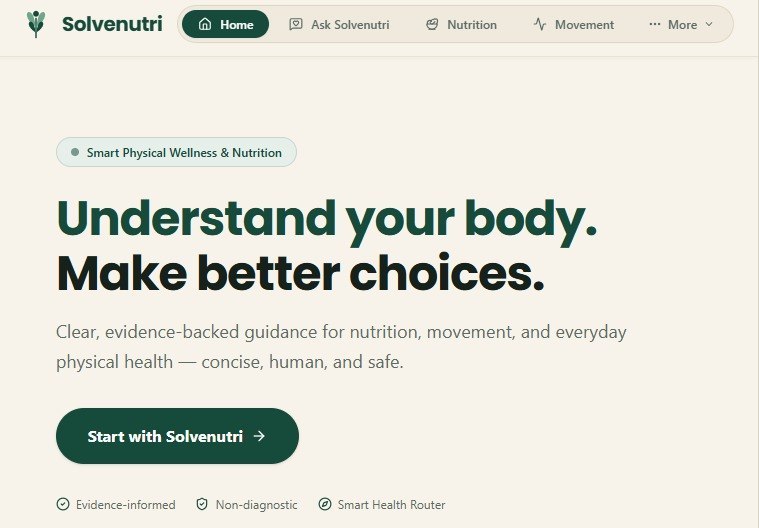
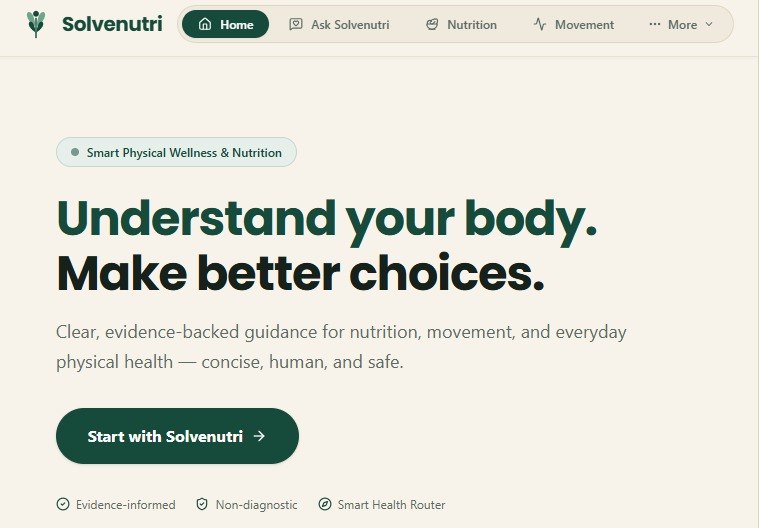
That idea became Solvenutri — an AI-powered physical wellness platform designed to help people understand everyday health and wellness concerns, discover relevant nutrition guidance, and improve their movement and fitness habits.
Our goal wasn't to build an "AI doctor." Instead, we wanted to create an intelligent wellness companion that could understand → explain → guide, while being transparent about its limitations.
What We Built
Solvenutri brings several capabilities into one experience:
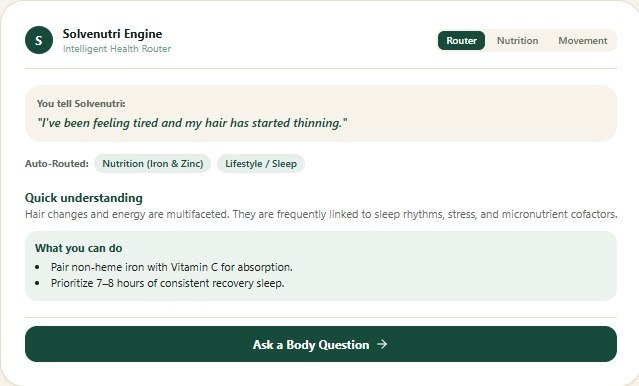
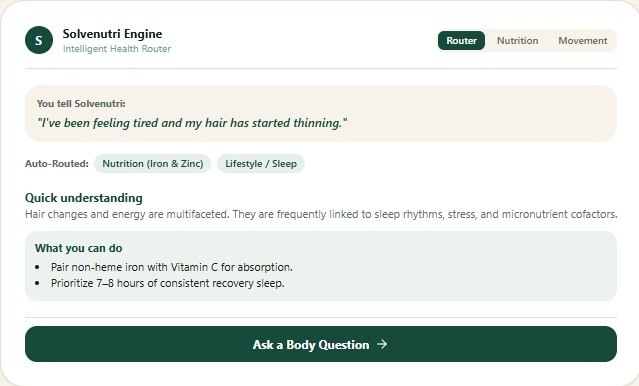
- AI Health Guide — users can describe a concern naturally instead of figuring out which category it belongs to.
- Nutrition Intelligence — connects relevant nutritional factors with practical food sources and dietary preferences.
- Movement Coach — uses computer vision to analyze exercise movement and provide basic form feedback.
- Skin & Hair Guidance — provides educational observations from uploaded images without claiming to diagnose conditions.
- Safety Layer — keeps health responses focused on education and encourages professional evaluation when appropriate.
We deliberately kept the interface simple. Instead of showing every feature immediately, users start with what they actually want to accomplish and discover additional capabilities when relevant.
How We Built It
Solvenutri is built as a Next.js and TypeScript web application with a clean, modular structure.
We use the Gemini API for conversational and multimodal AI capabilities, while browser-based computer vision is used for the movement-analysis experience.
The core flow is:
User concern
     ↓
Smart routing
     ↓
Relevant AI capability
     ↓
Safety check
     ↓
Concise, actionable guidance
For nutrition-related questions, we designed the experience around the idea of connecting a concern with relevant nutrients and food sources rather than simply asking an LLM to generate a list of foods.
For movement analysis, the application can use body landmarks to provide simple observations about exercise form.
Challenges
One of our biggest challenges was deciding how much to build.
Our initial idea had many different features, but we realized that adding more features would make the product harder to understand and less useful. We eventually focused on a few core experiences and used UX principles such as Hick's Law, Jakob's Law, and progressive disclosure to reduce unnecessary choices.
Another major challenge was working with AI in a health-related context.
It is easy to make an AI generate confident-sounding medical answers. It is much harder to design an experience that recognizes uncertainty and avoids pretending to diagnose someone. This forced us to think carefully about prompts, response structure, safety checks, and how information is presented.
The movement-analysis feature was another challenge because it required us to think beyond text-based AI and work with computer vision, camera permissions, body landmarks, and real-time feedback.
What We Learned
This project taught us that building a good AI application isn't just about connecting an API to a chatbot.
We learned about:
- Designing AI around a real user problem
- Building multimodal experiences
- Working with computer vision
- Structuring AI responses
- Designing safety boundaries for health-related AI
- Using UX principles to reduce cognitive load
- Building a clean Next.js application
- Balancing technical ambition with what can actually be made reliable
Most importantly, we learned that a smaller number of well-executed features can create a much stronger product than a huge collection of unfinished ones.
What's Next
Solvenutri is only the beginning.
We want to make the nutrition engine more evidence-backed, improve movement analysis, expand personalization, and continue improving how the system communicates uncertainty and directs users toward professional care when necessary.
Our long-term vision is simple:
Make understanding your everyday health a little easier.
Built With
- googleaistudio
- next.js


Log in or sign up for Devpost to join the conversation.