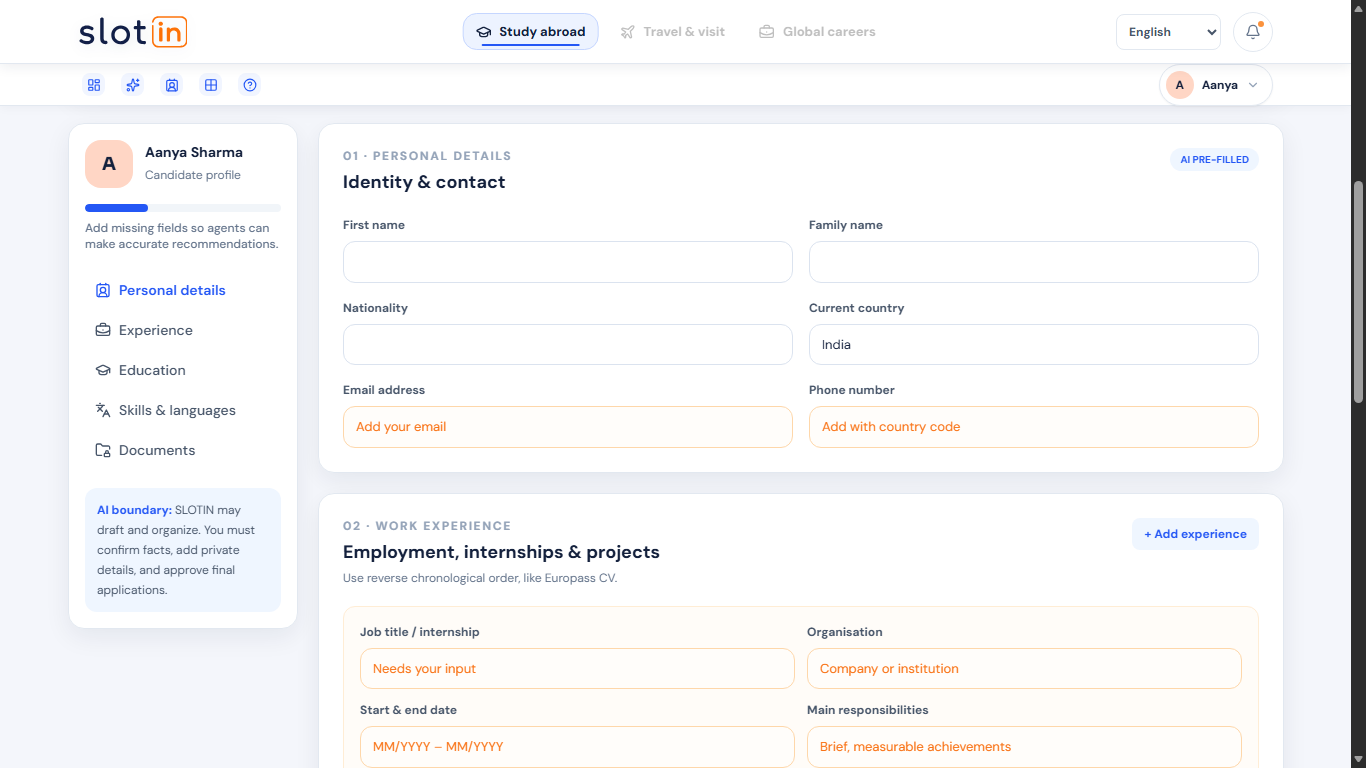
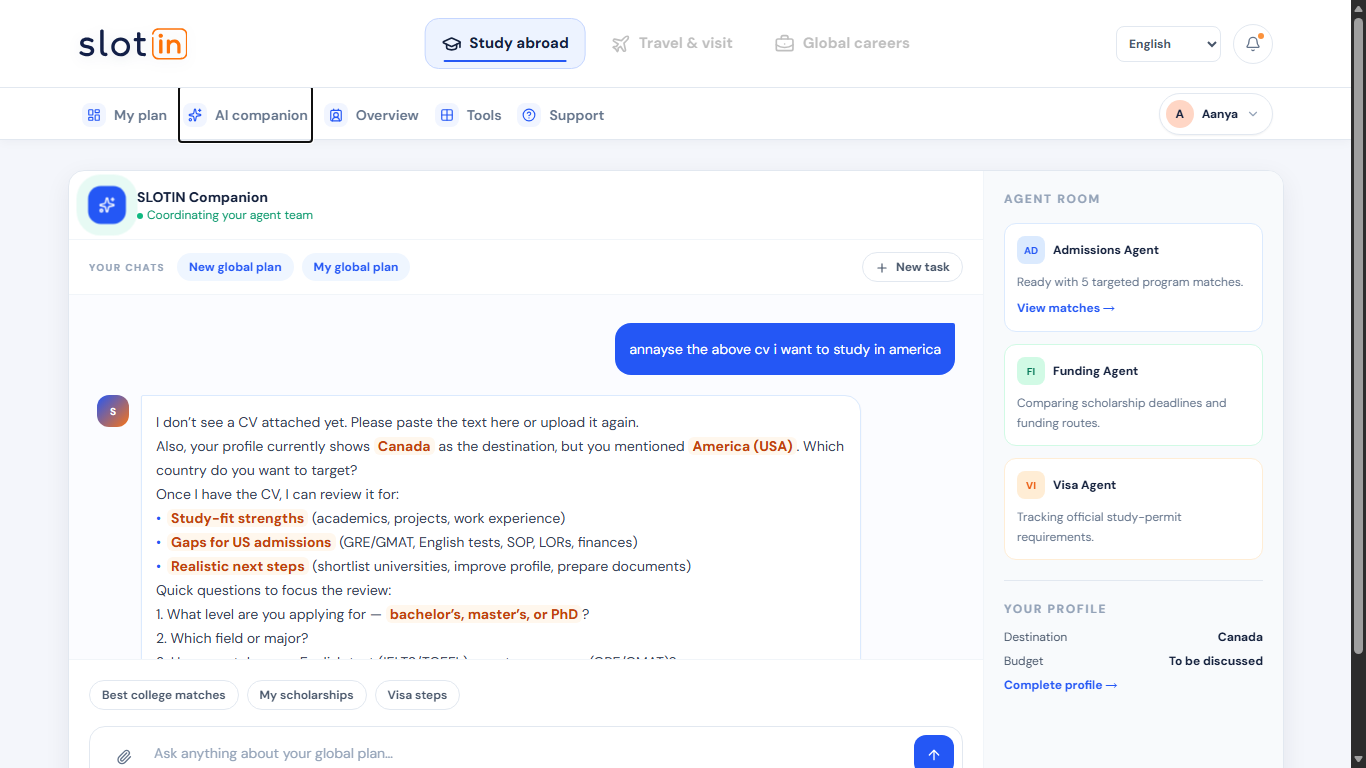
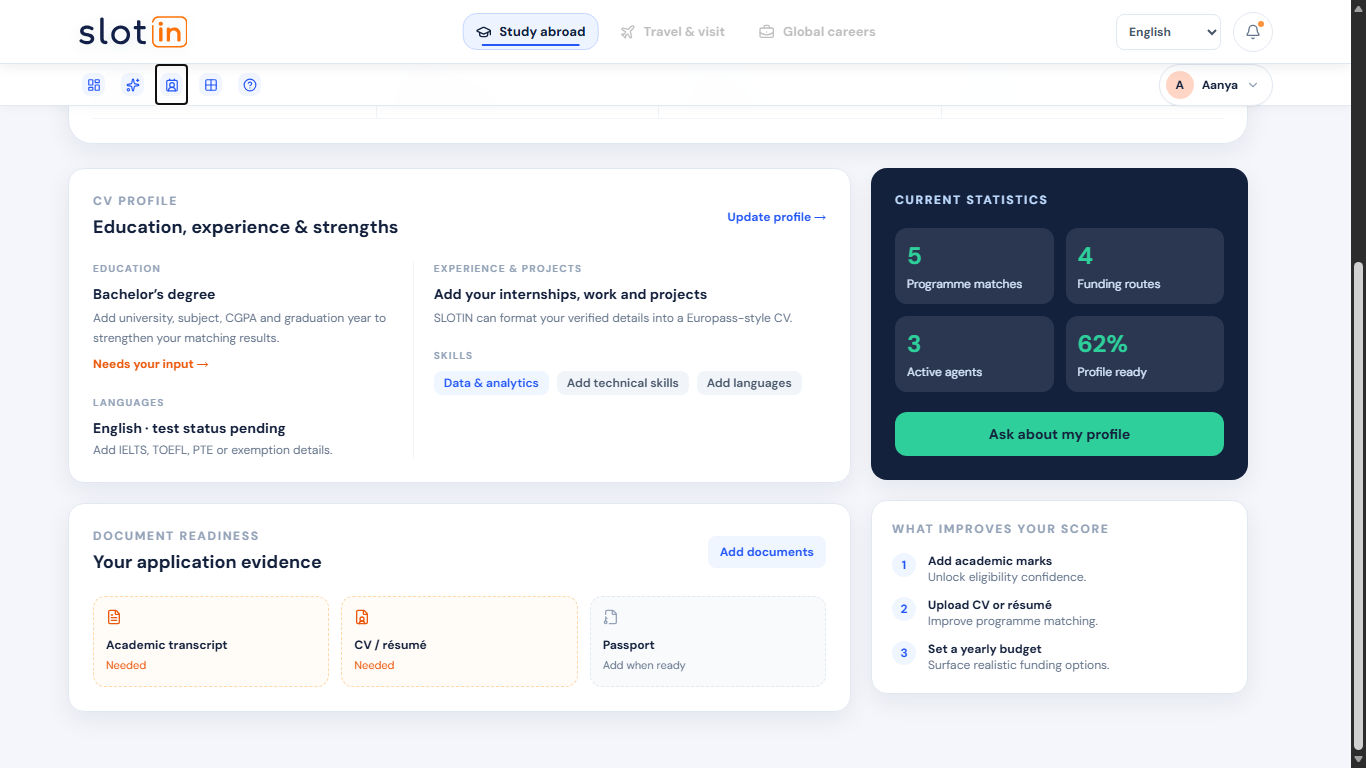
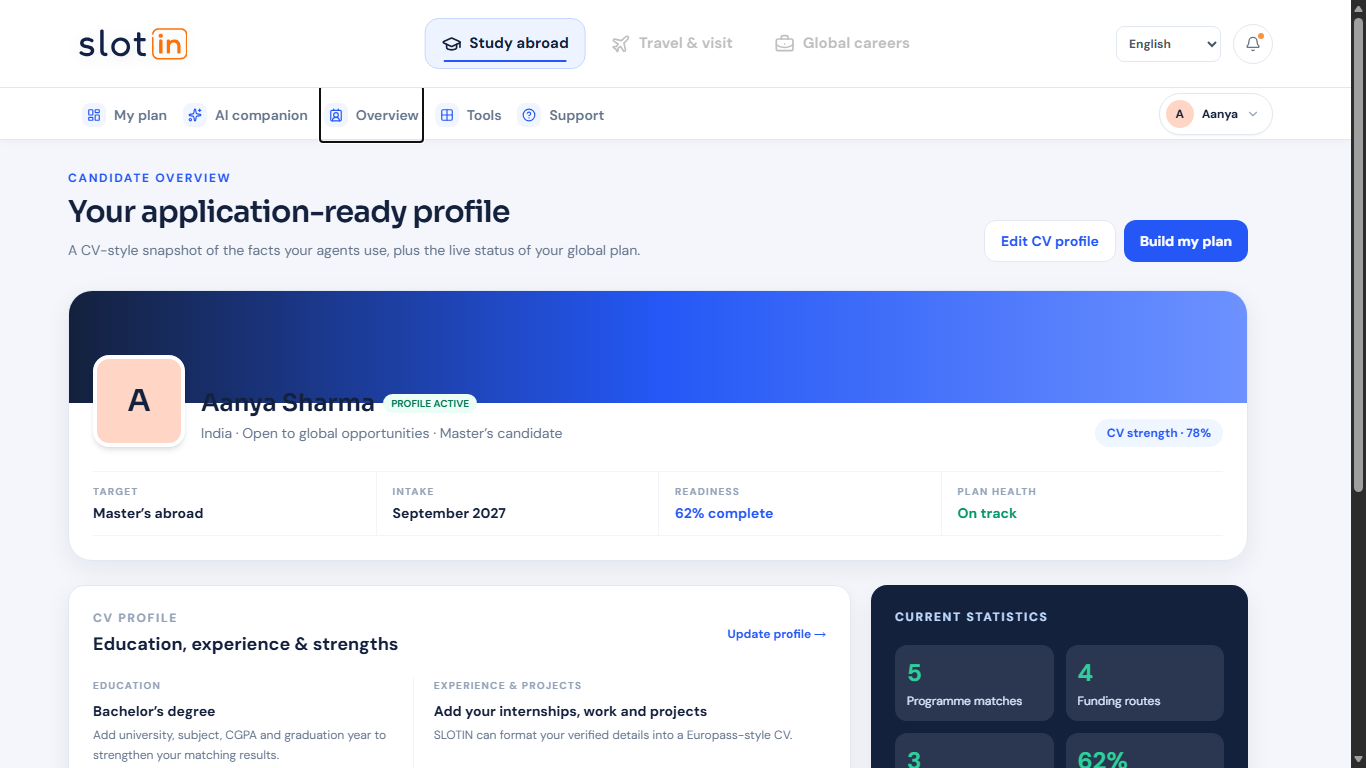
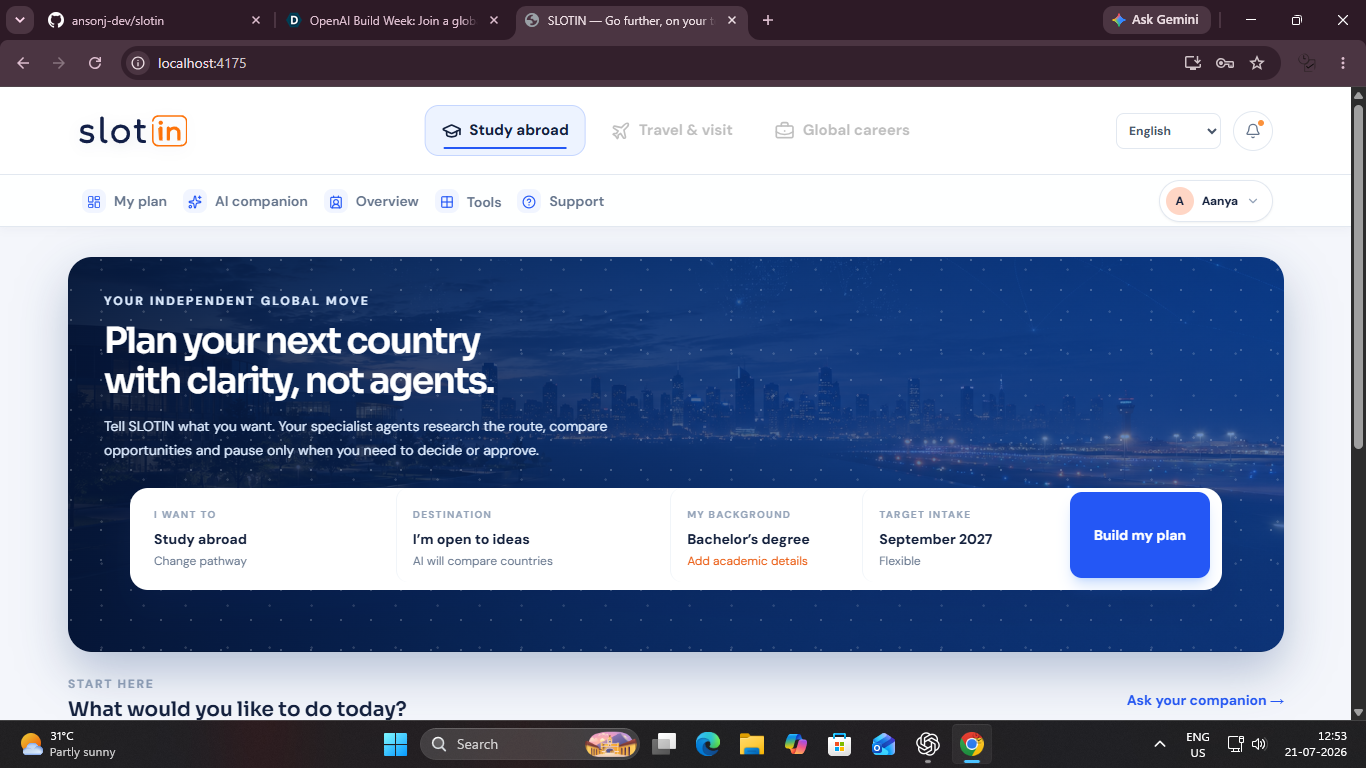
SLOTIN - AI Companion for Global Mobility
Inspiration
honestly, the idea came when my friend was trying to study abroad and got completely lost in all the paperwork and requirements. she paid like $3000 to some agency who basically just sent her list of universities from google search. i thought "there has to be better way" you know? so many people dream of studying or working abroad but the whole process is so confusing and expensive with agencies taking advantage. i wanted to build something that could actually help people do this themselves without getting ripped off or missing important steps.
What it does
SLOTIN is basically your AI buddy that helps you plan moving abroad - whether its for studying, traveling or finding a job. instead of paying thousands to agencies or spending weeks googling stuff, you just chat with it like talking to a friend who actually knows what theyre doing.
you tell it what you want - like "i want to study computer science in europe but dont know where to start" and it will:
- figure out which countries and universities fit your profile
- find scholarships you might qualify for (cause studying abroad is expensive!)
- tell you what documents you need
- help prepare your visa application
- even check if someones trying to scam you
the cool part is most of this happens automatically in the background. you dont have to learn how to use bunch of complicated tools, the AI agents just do the research while you focus on making the actual decisions. and it always links you to official government and university pages so you know the info is legit.
How we built it
ok so the tech stack is pretty interesting. i went with simple but powerful approach:
Frontend: just one HTML file with Tailwind CSS from CDN. no fancy react or anything, wanted it to load super fast and work on any device. added PWA support so people can install it on their phones like real app.
Backend: built a custom Node.js server from scratch (no express or anything). it uses Server-Sent Events for real-time updates which is perfect for showing agent progress as it happens.
AI Brain: this is where it gets interesting - im using GPT 5.6 Terra at high for the main AI reasoning. it handles the complex decision making and planning. also integrated Fireworks API as the primary inference engine with automatic fallback to MiniMax M3 and Qwen 3.7 Plus if theres rate limiting or issues. used Kimi K2.7 Code model through Fireworks for code-heavy tasks.
Database: started with local JSON file for development but then migrated to Amazon Aurora PostgreSQL Serverless v2 on AWS. it scales automatically and i dont have to manage servers. used JSONB columns for flexible data storage which was perfect for the agent workflows.
Authentication: set up Amazon Cognito user pool for signup/login with email verification. also integrated Google OAuth through Cognito managed domain for easy sign-in. used AWS CDK to define all the infrastructure as code.
Autonomous Agents: built 7 different specialized agents (Profile, Eligibility, Admissions, Funding, Visa, Career, Arrival) that work in background after each message. they dont need user to click buttons or manage tasks manually.
the whole infrastructure is deployed on AWS - Cognito for auth, Aurora for database, S3 for file storage (though still working on that part), all orchestrated with CDK.
Challenges we ran into
oh man, where do i start lol
Real-time updates: getting the Server-Sent Events to work reliably was pain. had issues with connections timing out and browser compatibility. spent like 2 days debugging why Chrome was closing connections but Firefox worked fine.
Database migration: moving from JSON file to Aurora was harder than expected. had to figure out IAM authentication for Aurora Express, SSL/TLS certificates, connection pooling. the RDS Signer for getting temporary auth tokens was tricky to implement correctly.
AI model reliability: at first i was just using one model but then fireworks would hit rate limits or timeout randomly. had to build entire fallback system with multiple providers. also managing API keys securely without exposing them to frontend took some thinking.
Agent orchestration: making the autonomous agents work together without conflicts was challenging. like if Profile Agent updates something while Visa Agent is running, things could get messy. ended up using atomic JSONB updates in postgres to avoid race conditions.
Authentication flow: Cognito has so many moving parts - user pools, identity pools, OAuth flows, callback URLs. getting Google sign-in to work required setting up proper redirect URIs and keeping secrets secure. also had to handle email verification codes and password resets properly.
Making it feel human: biggest challenge was making AI responses feel helpful and natural instead of robotic. spent lot of time on prompting and adding personality without making it annoying.
Accomplishments that we're proud of
honestly pretty pumped about few things:
Zero-dependency frontend - the whole UI is one HTML file that loads instantly. no npm install, no build step, no webpack config hell. just works.
Smart fallback system - the AI keeps working even if primary model is down. automatically switches to backup models and candidate never loses their data or workflow.
Real autonomous agents - this was the vision from start. users dont manage tasks or click through workflows, they just chat and agents handle the complexity. seeing it actually work is super satisfying.
Source-linked everything - never gives recommendations without linking to official sources. theres too much misinformation about studying abroad so this was important to get right.
Aurora integration - went from local JSON to production-ready cloud database with IAM auth and automatic scaling. learned ton about AWS in the process.
GPT 5.6 Terra integration - getting access to and working with the latest GPT model was amazing. the reasoning capabilities are insane compared to older models.
PWA support - people can install it on their phone and use it like native app. works offline for viewing existing plans too.
What we learned
so much stuff honestly:
AWS is powerful but complex - Cognito, Aurora, IAM, CDK... theres a learning curve but once you get it, you can build production-ready systems. IAM policies still confuse me sometimes tho.
Fireworks API is great - their inference platform made it easy to try different models and switch between them. the latency is really good too.
Server-Sent Events > WebSockets for this use case - simpler to implement, auto-reconnects, works better with HTTP infrastructure. dont always need full duplex communication.
LLM fallbacks are essential - cant rely on single AI provider in production. rate limits, outages, model updates happen. always have backup plan.
Simple beats fancy - almost used Next.js and bunch of frameworks but sticking with vanilla JS made everything faster and easier to debug. not every project needs the latest tech stack.
Users want control not automation everything - learned that people want AI to do research and prep work, but they want to make final decisions themselves. especially for important stuff like choosing universities or submitting applications.
Infrastructure as Code is worth it - using CDK to define Cognito setup means i can reproduce the exact setup anywhere. also makes it easy to see what resources exist.
What's next for Slotin
theres still lot to do to make this production ready:
Short term:
- finish S3 integration for secure document storage
- add document OCR to extract info from transcripts and certificates automatically
- implement RDS Proxy for better connection pooling
- add proper rate limiting and monitoring
- audit logs for compliance
Medium term:
- integrate real university databases and APIs (not just starter dataset)
- scholarship database with eligibility matching
- visa requirement checker that updates with latest rules
- document checklist generator based on specific country/university
- SOP and recommendation letter drafters (with human review)
Long term:
- partner with universities for verified data feeds
- integrate with official government visa portals where APIs exist
- add career pathway matching with sponsorship info
- build marketplace where verified consultants can help with specific steps (but transparent pricing, no agency BS)
- mobile apps for iOS and Android
- support for more languages beyond English
- AI that learns from successful applications to give better recommendations
Technical debt:
- move uploaded files to S3 with presigned URLs
- add virus scanning for uploads
- implement proper RBAC (role based access control)
- set up monitoring with CloudWatch
- add automated tests (i know i know, should have done this earlier)
- improve error handling and user feedback
the vision is to make global mobility accessible to everyone regardless of their background or budget. too many people miss opportunities because they dont have money for agencies or dont know how to navigate the system. if SLOTIN can help even few people achieve their dreams of studying or working abroad, that would be pretty cool.
also want to make sure it stays ethical - no hidden fees, no commission-based recommendations, always transparent about what its doing and where info comes from. the candidate should always be in control.
Built with: GPT 5.6 Terra, Fireworks AI API, AWS (Cognito, Aurora PostgreSQL, CDK), Node.js, Tailwind CSS
Built With
- amazon-web-services
- artificial-intelligence
- aurora
- cloud
- cognito
- css
- fireworks-ai
- gpt-5
- html5
- javascript
- machine-learning
- node.js
- openai
- postgresql
- progressive-web-app
- pwa
- server-sent-events
- serverless
- tailwind

Log in or sign up for Devpost to join the conversation.