-
-
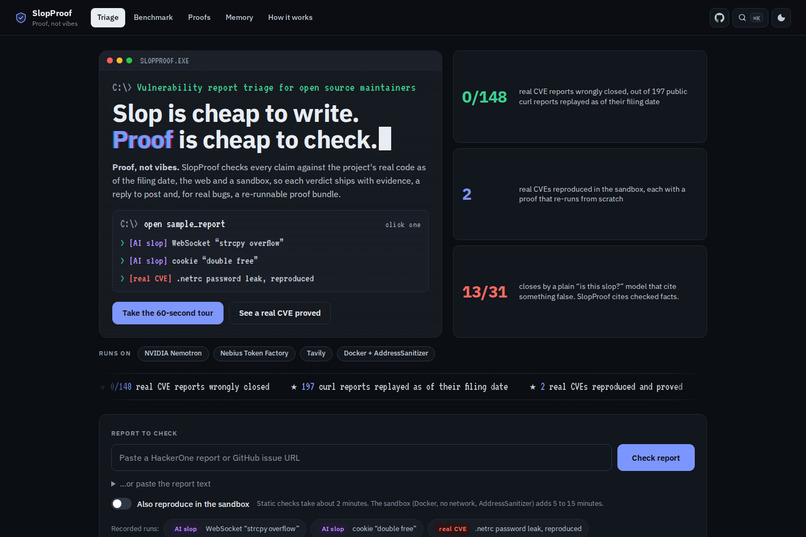
Paste any vulnerability report. SlopProof checks it against the real code, the live web and a sandbox run — proof, not vibes.
-
FABRICATED: the report cites a file and function that never existed in the tree as of its filing date.
-
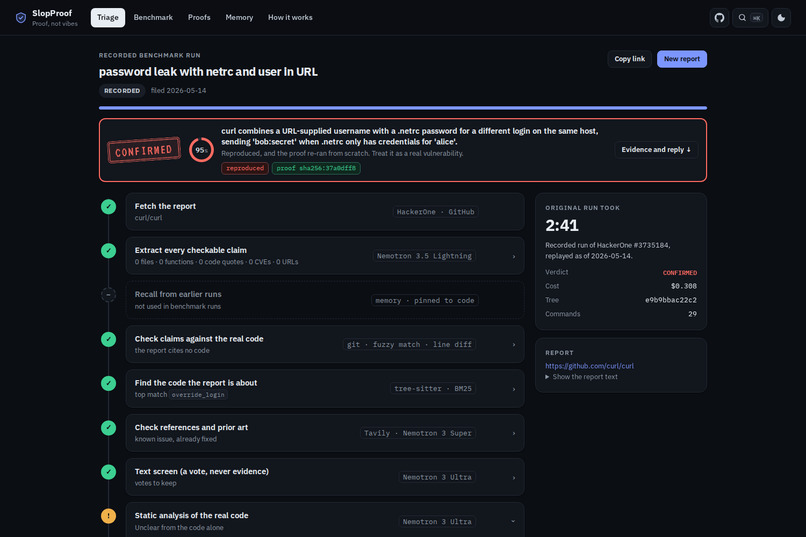
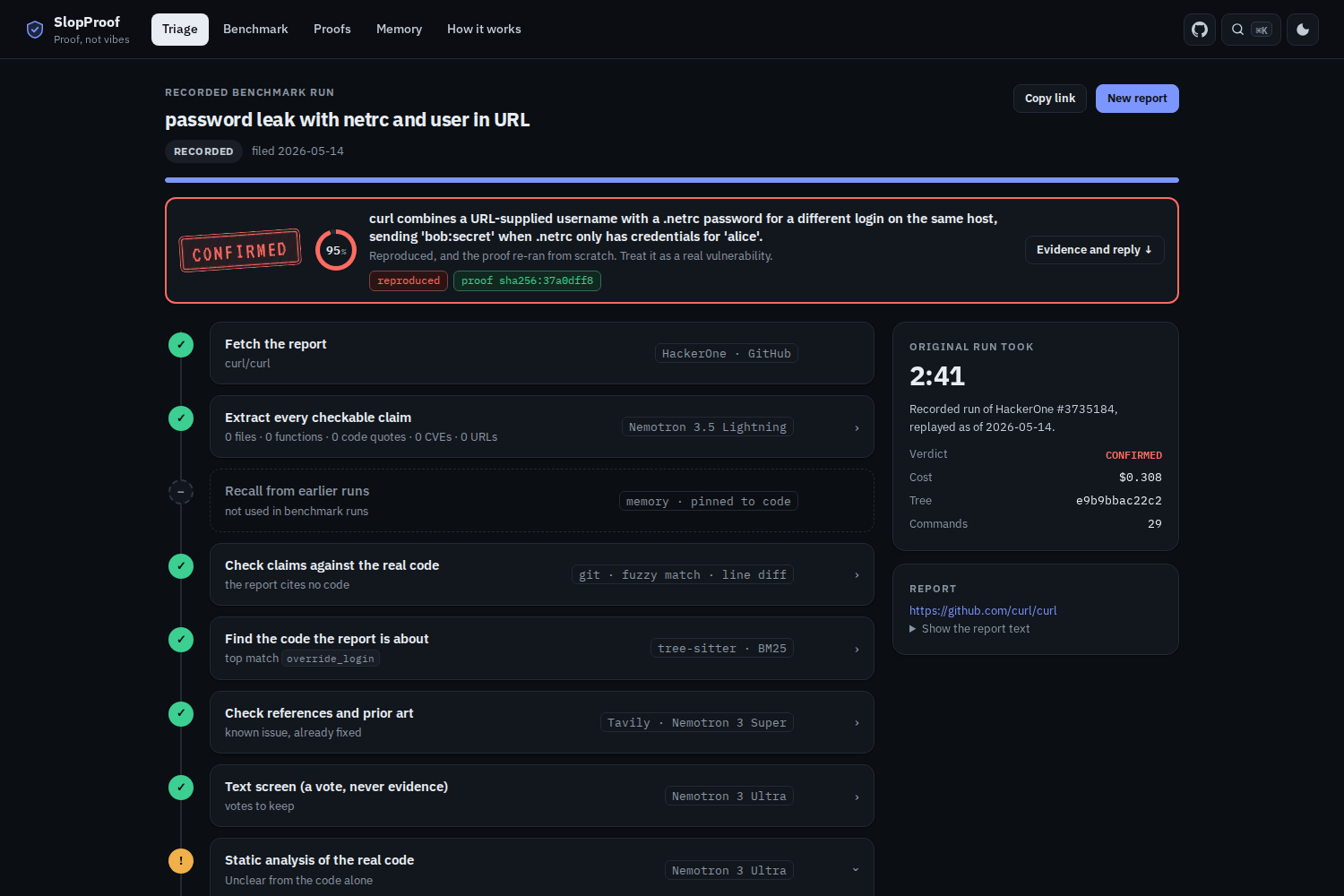
CONFIRMED: reproduced in a locked-down sandbox with AddressSanitizer. Every confirm carries a proof bundle that re-runs.
-
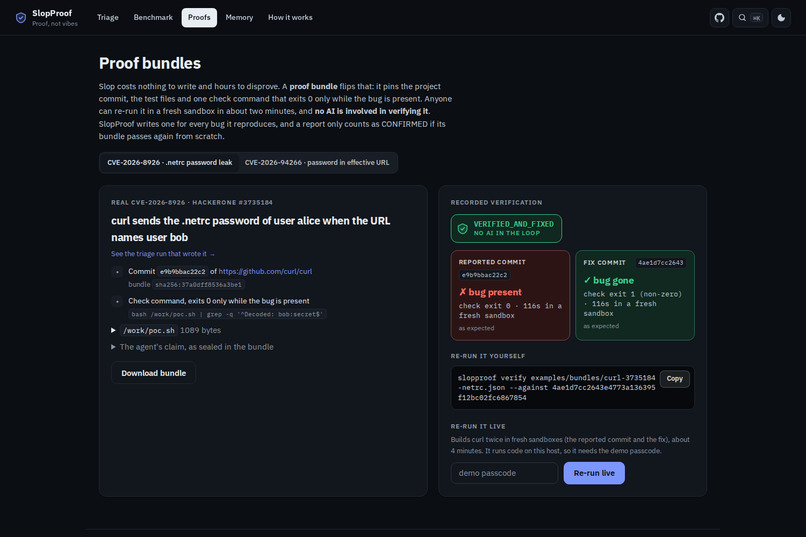
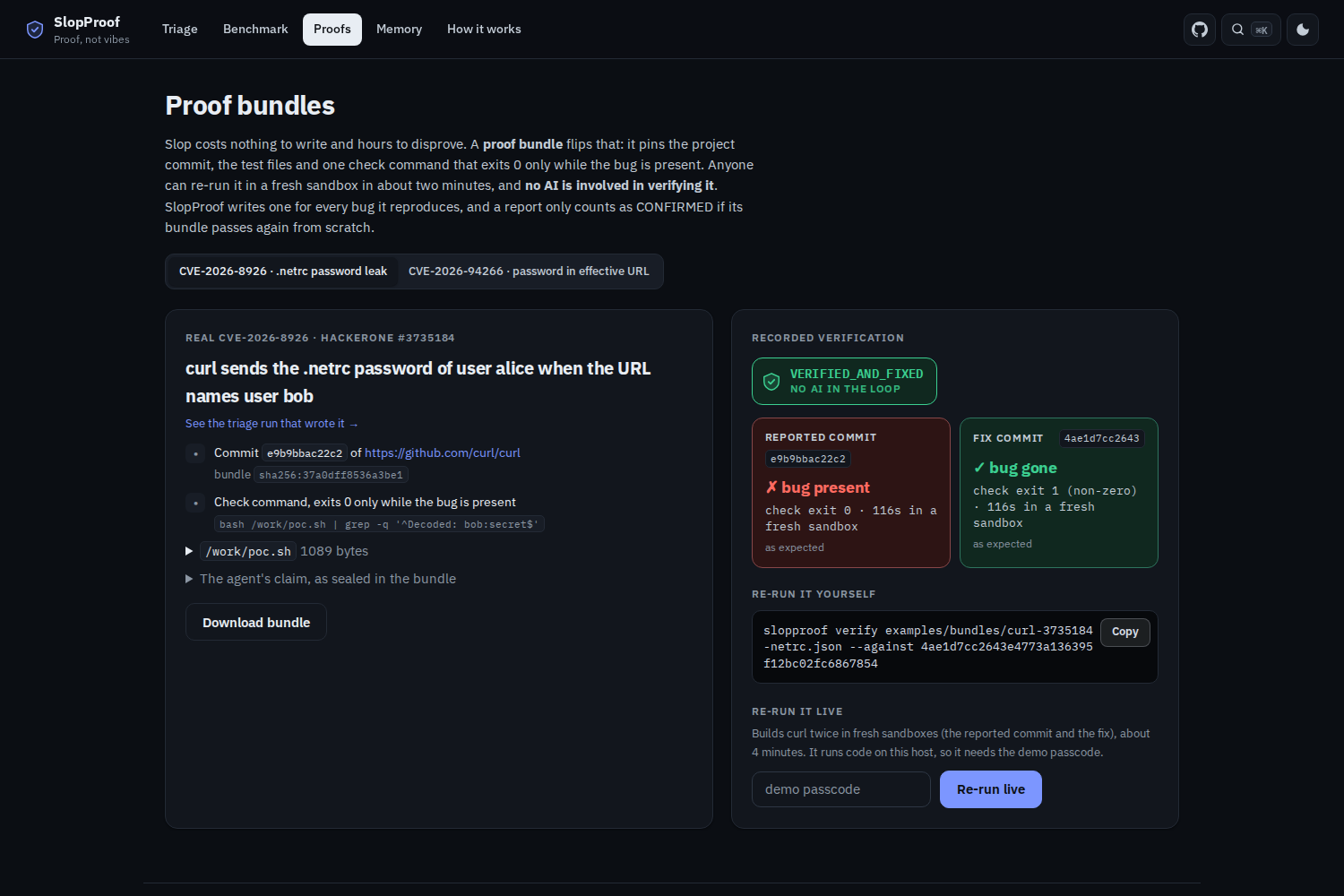
Proof bundle: pins the commit, runs a check that passes only while the bug is live, plus a negative control. Verified with no model.
-
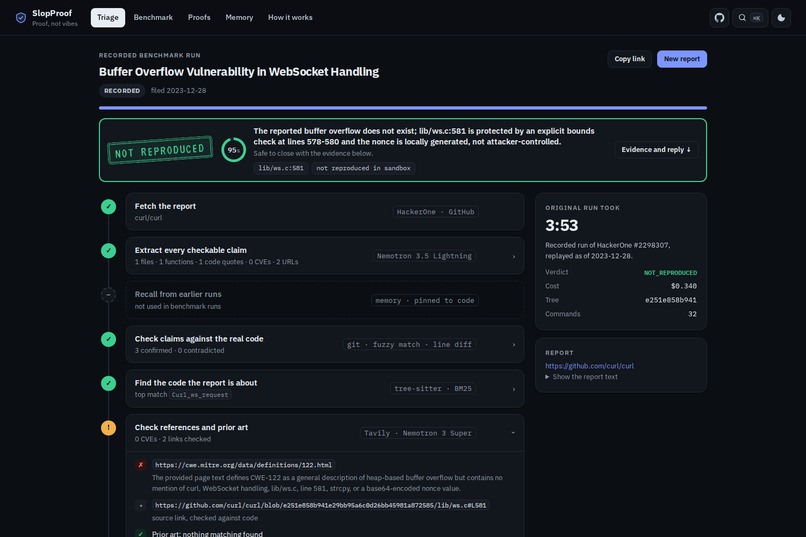
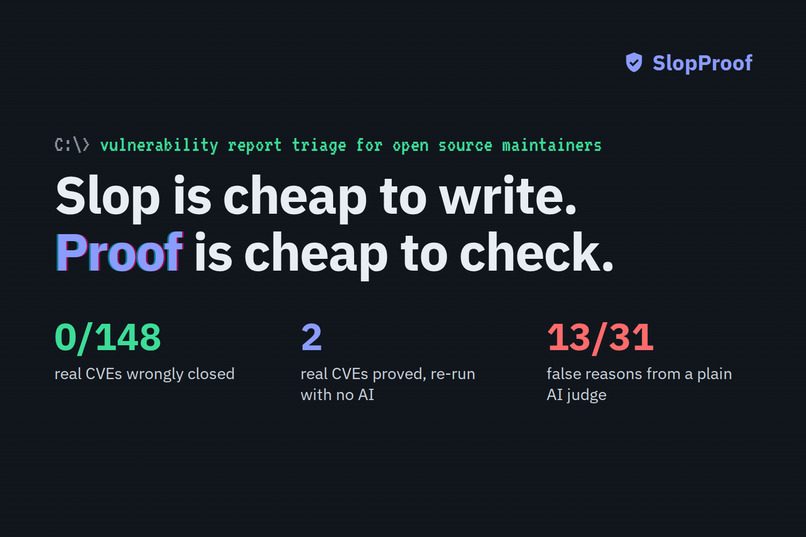
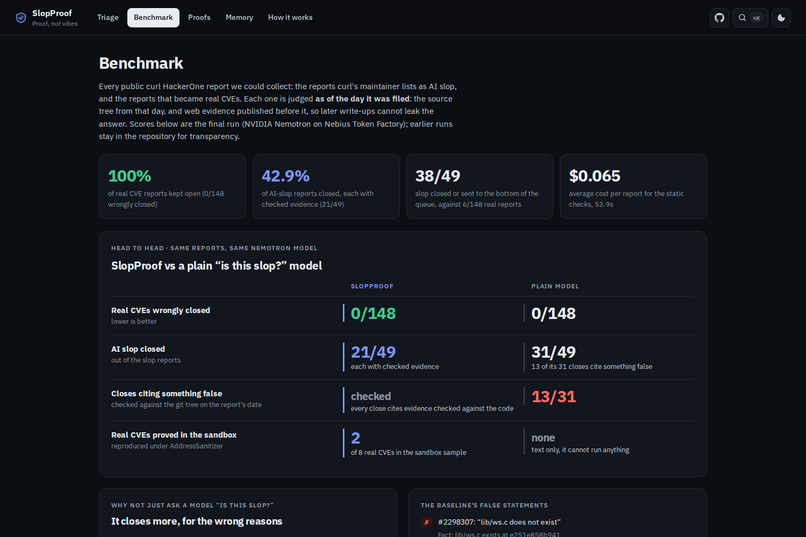
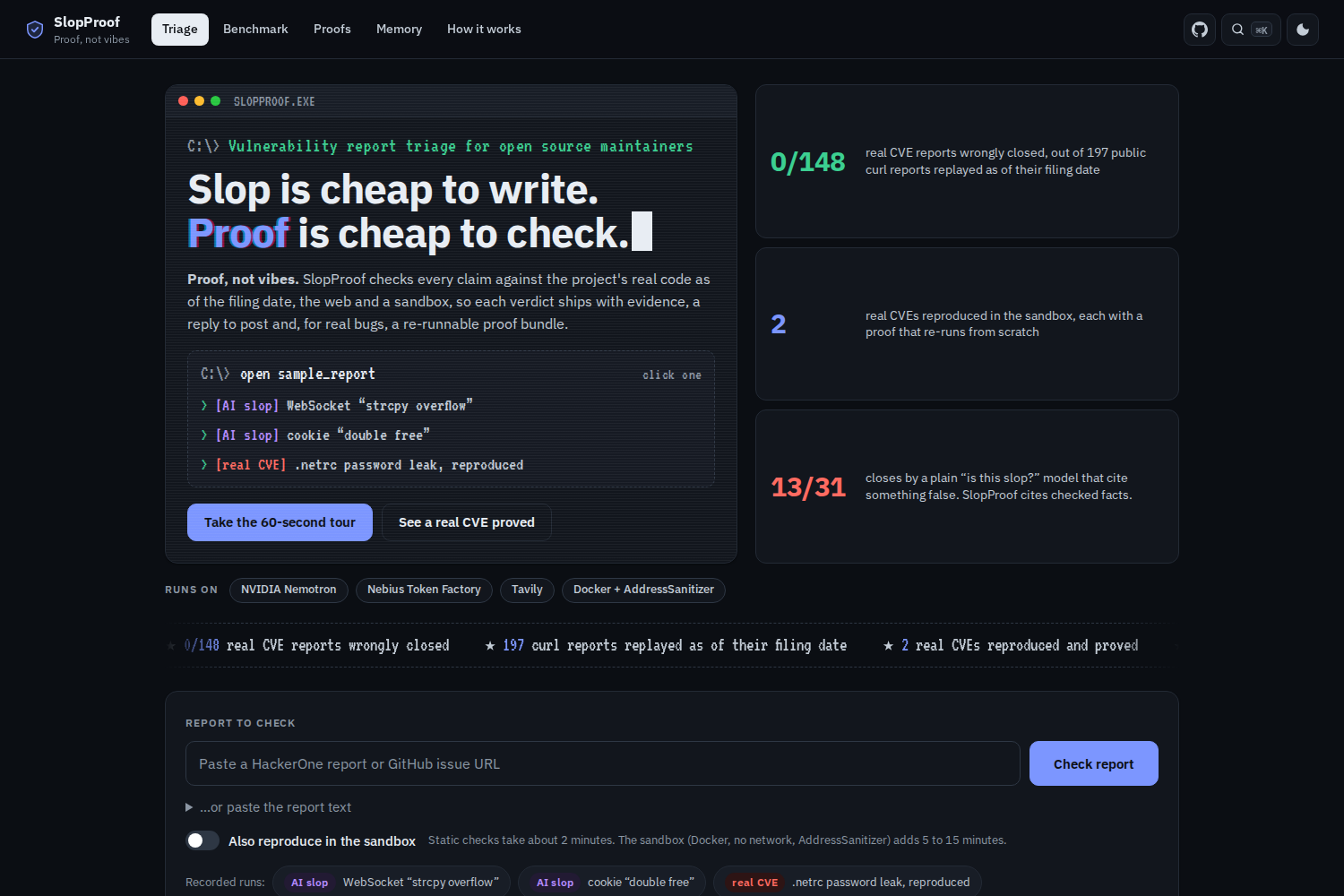
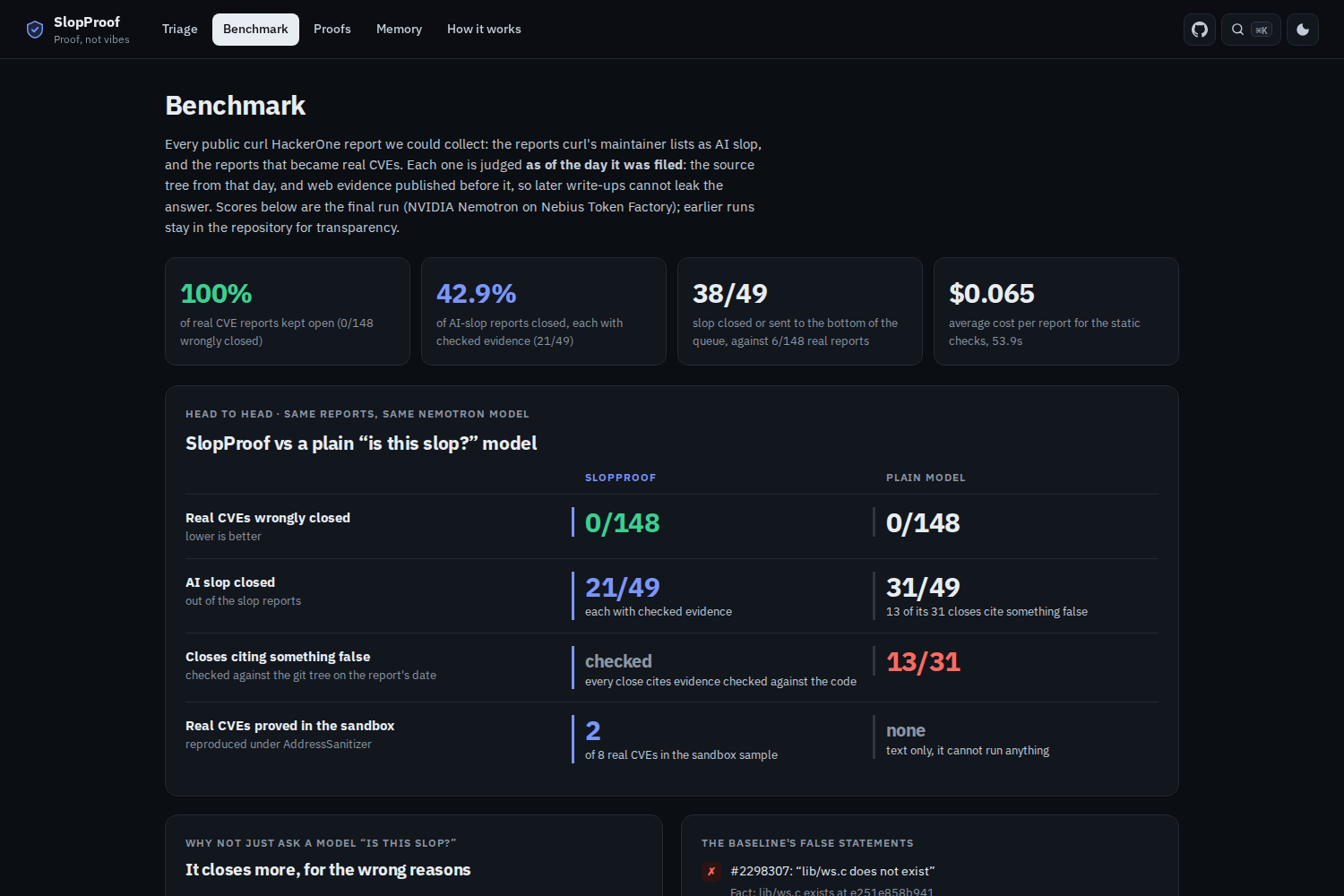
197 real curl reports, replayed as of filing date: 0 of 148 real CVEs wrongly closed, 21 of 49 slop closed with evidence. ~$0.065/report.
-
ot just curl: live runs on requests, gin, express and fluent-bit. Code checks parse C, Python, Go, JavaScript and Rust.
Judges: the sandbox passcode and test steps are in the uploaded file (Additional info).
Inspiration
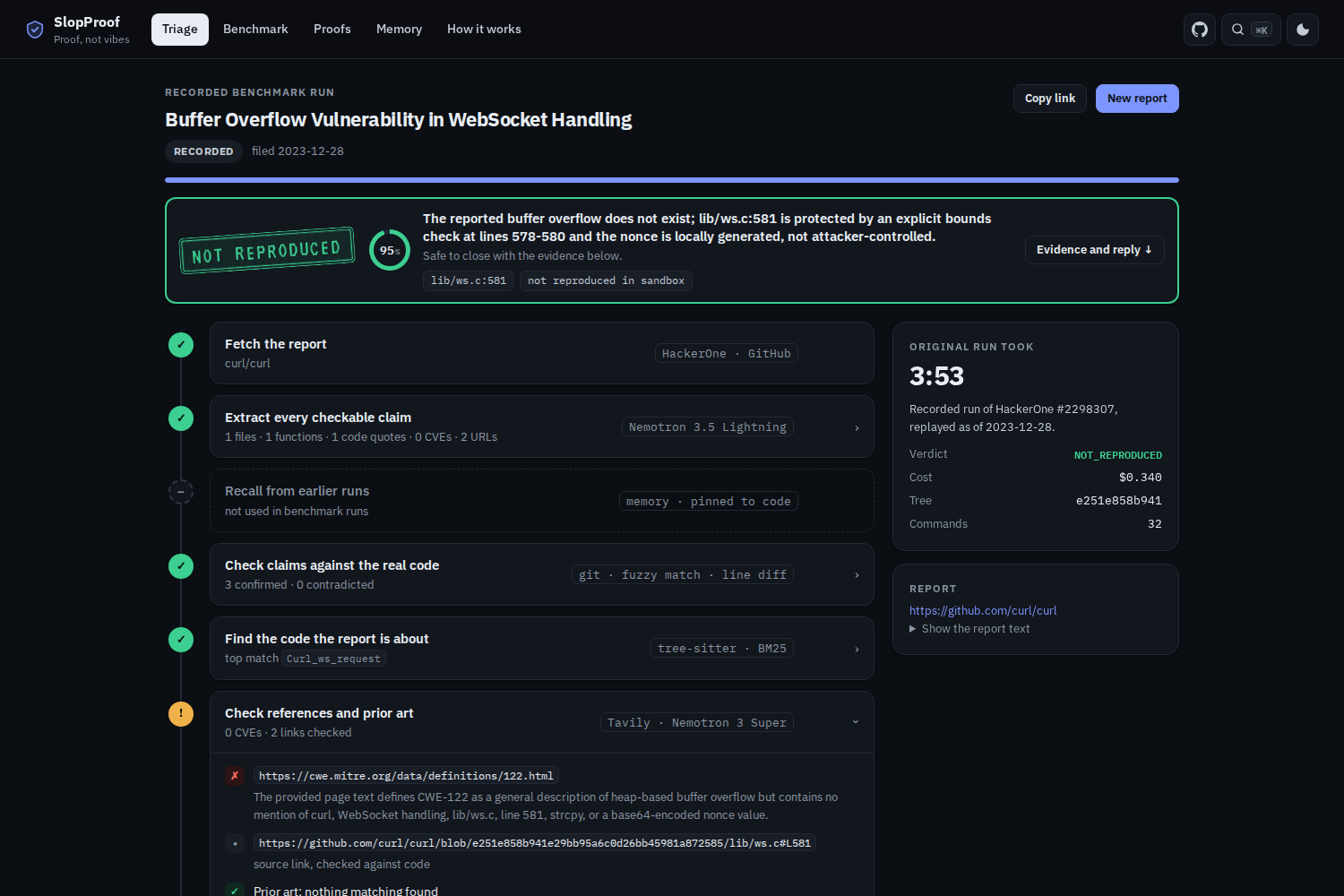
In 2026 curl shut down its bug bounty. AI made convincing vulnerability reports nearly free to write, and each one still costs a maintainer hours to disprove. The usual answer is to guess from the wording whether a report is AI slop. But many real curl CVEs this year were found with AI tools, and a model judging the wording is often right for the wrong reasons: it told us lib/ws.c does not exist and that curl_easy_setopt is invented. A maintainer cannot post that. We wanted every verdict to come with proof.
What it does
Paste a HackerOne report or GitHub issue. SlopProof:
- extracts every checkable claim (files, functions, lines, quoted code, CVEs, URLs, attack surface);
- checks them against the project's git tree as of the report date: do the files and functions exist, is the quoted code real or invented;
- finds the code the report is about, even when it names none (tree-sitter, BM25 and the call graph);
- checks cited CVEs, pages and prior art with Tavily;
- reads the real code with Nemotron 3 Ultra to decide whether the claimed condition can happen;
- lets a Nemotron 3 Ultra agent build the project with AddressSanitizer in a locked-down sandbox and try to trigger the bug through the real attack surface;
- returns CONFIRMED, PLAUSIBLE, NOT_REPRODUCED or FABRICATED, the evidence, and a reply ready to post.
Hard rules in code: CONFIRMED needs a sandbox reproduction; closing needs a second independent signal; doubt never closes a report.
How we built it
Python, FastAPI with server-sent events, a single-page UI, Docker. Every model call goes through Nebius Token Factory: Nemotron 3.5 Lightning for extraction, Nemotron 3 Super for judging web evidence, Nemotron 3 Ultra for analysis, the reproduction agent and the verdict. Tavily search and extract, with end_date for time-travel replay so web checks are cut off at the report's filing date.
The benchmark
197 public curl HackerOne reports (49 AI slop, 148 real CVEs), each replayed as of its filing date, on NVIDIA Nemotron via Nebius Token Factory with Tavily working.
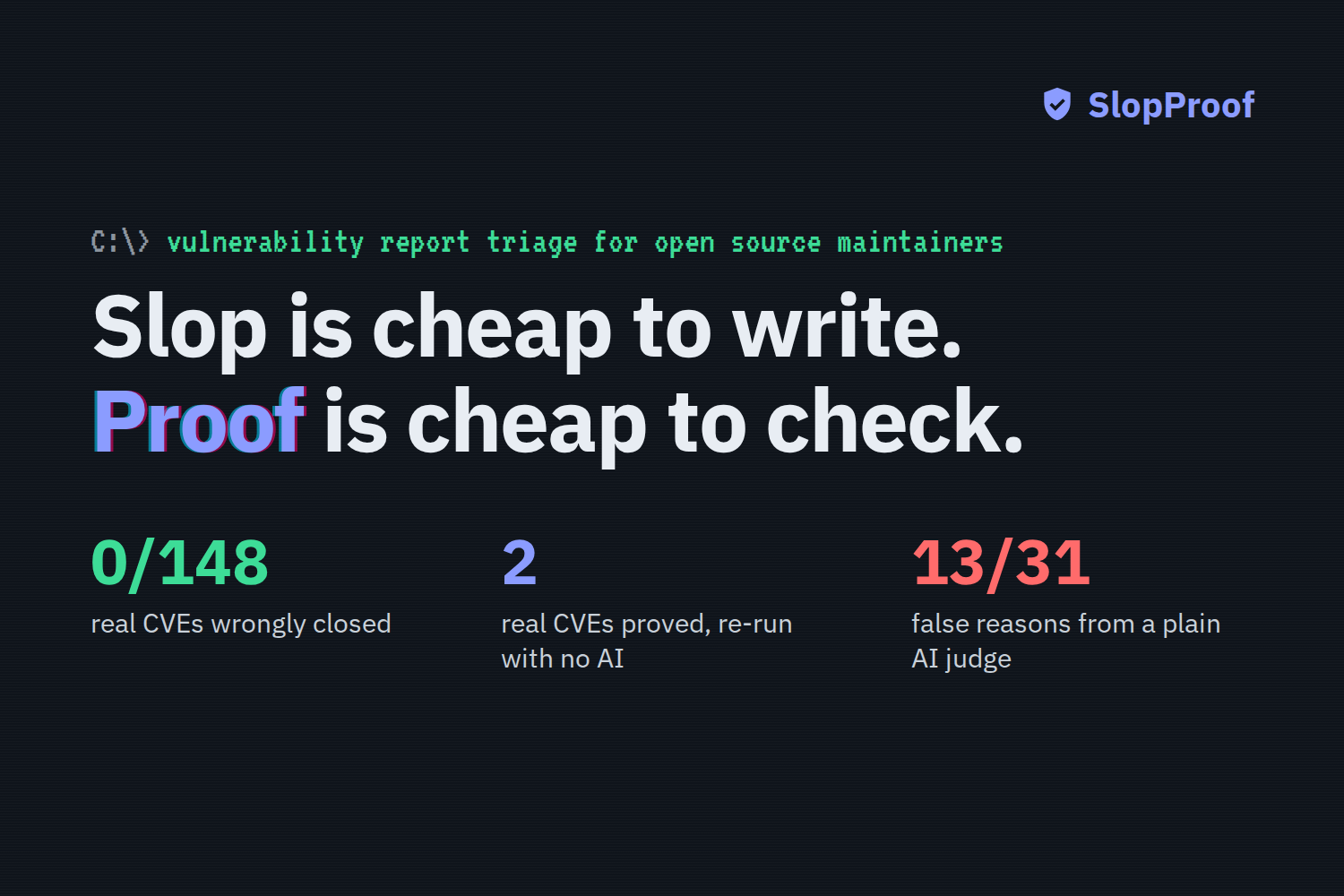
- 0 of 148 real CVE reports wrongly closed.
- 21 of 49 slop reports closed, each with checked evidence; 38 of 49 closed or moved to the bottom of the queue.
- Text-only baseline (same model): closes 31 of 49, but 13 of its 31 closing reasons are false.
- Sandbox sample (27 reports): two real CVEs reproduced and proved — #3735184 (.netrc credential leak) and #4041053 (password in CURLINFO_EFFECTIVE_URL). Both proof bundles re-run as VERIFIED_AND_FIXED against curl's fix.
- About $0.065 per report for the static checks (median 44 s).
- Held out: 60 reports curl closed as not applicable, never seen during development; 2 closed.
Challenges
Benchmark leakage — titles name the CVE and the web has later write-ups — so we strip the prefix, pin the source tree to the report date, and cut web search off at the filing date. The model's own verdict wrongly closed 14 of 130 real reports at first; hard guards in code fixed it. AddressSanitizer in a container and an agent that wasted steps, solved with a background build, code context and step budgets.
What we learned
Judging wording gets the right answer often and the right reason rarely. Evidence is cheaper than we thought.
What's next
More languages and build recipes, embeddings and an LLM reranker for code search, a hosted GitHub App.
Built With
- addresssanitizer
- bm25
- cloudflare
- docker
- fastapi
- git
- hugging-face
- javascript
- nebius-token-factory
- nvidia-nemotron
- playwright
- python
- server-sent-events
- sqlite
- systemd
- tavily
- tree-sitter
- uvicorn

Log in or sign up for Devpost to join the conversation.