-
-
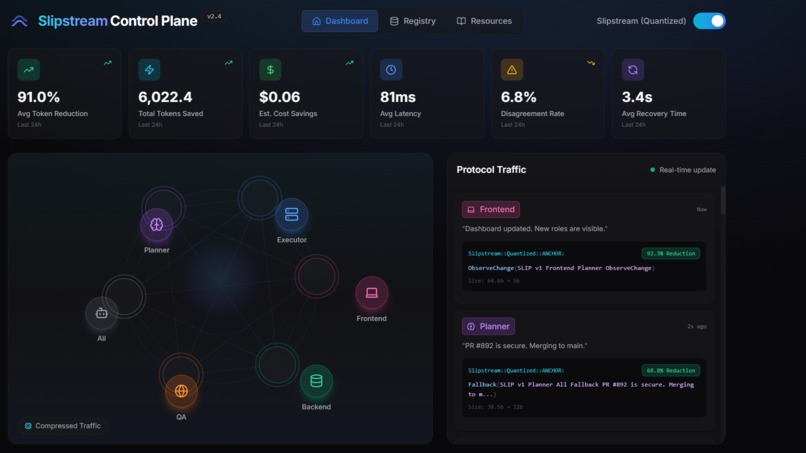
Protocol Activity Dashboard
Inspiration
Multi-agent AI systems are exploding in complexity. GPT-5, Claude, Gemini—these models are increasingly orchestrating each other in "swarms" to solve complex tasks. But there's a hidden cost: agents communicate in verbose JSON, burning tokens on repetitive semantics.
Watching API costs climb while agents repeat the same intents ("please review this code", "awaiting approval", "task complete") over and over, I asked: what if agents could speak in compressed semantic coordinates instead of natural language?
What it does
The Slipstream Control Plane is a real-time observability dashboard for the Slipstream protocol—a semantic quantization layer for multi-agent communication.
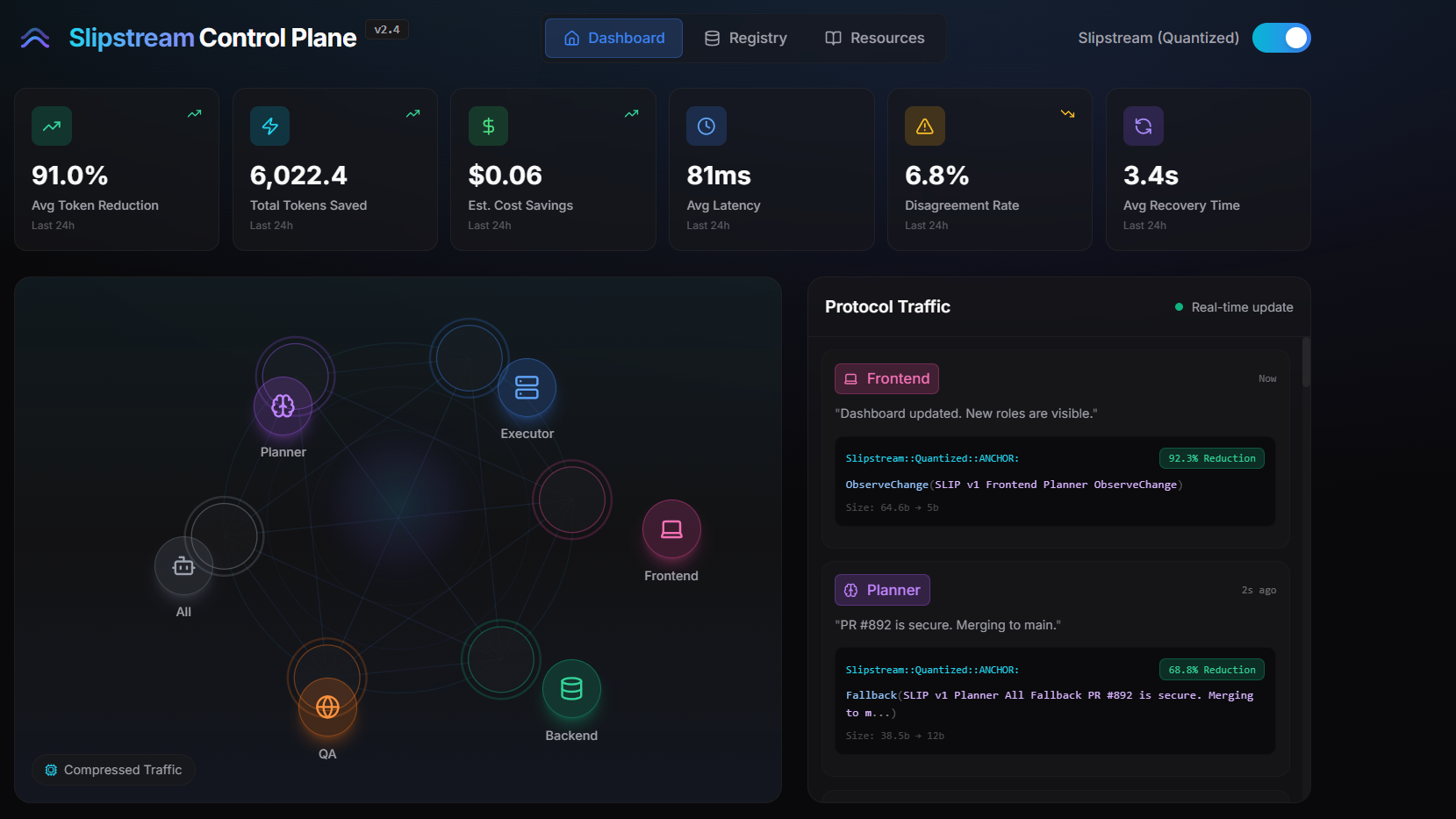
- Live Network Graph: Watch agents (Planner, Executor, QA, etc.) exchange messages in real-time
- Protocol Traffic: See the dramatic difference between verbose JSON and compressed Slipstream wire format
- Metrics Dashboard: Track token savings (typically 85-90%), latency improvements, and cost reduction
- Autotuner: When fallback patterns emerge, the system proposes new semantic anchors to optimize future communication
- Universal Concept Registry: Browse the 46 core anchors that form the shared semantic manifold
How I built it
(note: NOT a front end guy!)
Frontend: React + Vite with Framer Motion for animations, Lucide icons, and Tailwind CSS for styling. The network graph uses SVG with animated particles to visualize message flow.
Backend: FastAPI (Python) with WebSocket for real-time streaming. The simulation engine replays scripted agent scenarios while broadcasting metrics.
Protocol: The core slipcore library implements the Universal Concept Registry (UCR)—a 4D semantic manifold where each anchor maps complex intents to single tokens. slipcore is a reference implementation of Slipstream available on Pypi and open sourced on Github.
Slipcore@ Github
Deployment: Vercel (frontend) + Railway (backend), with environment-based API routing.
Challenges
Coordinate Systems: Getting SVG particles to animate correctly between nodes required careful translation between CSS percentages and SVG viewBox coordinates. I didn't get it perfect but I like the look.
WebSocket State: Keeping frontend state synchronized with backend simulation cycles, especially for the Autotuner's approve/dismiss flow which was laggy.
Dual Hosting: Orchestrating a React SPA on Vercel with a Python backend on Railway required careful CORS and environment variable management. Read: PITA.
What I learned
- The power of semantic compression: reducing 150 tokens to 5 isn't just optimization—it fundamentally changes what's economically viable in multi-agent systems
- Real-time WebSocket visualization is surprisingly satisfying when the UX is right
- Good demos require as much polish as production code and I've never coded React a day before in my life.
What's next
- Live Integration: Connect to real agent frameworks (LangGraph, AutoGen, CrewAI)
- Embedding-based Quantization: Use neural embeddings to auto-map novel intents to the nearest anchor
- Extension Registry: Let teams define domain-specific anchors for their workflows

Log in or sign up for Devpost to join the conversation.