Inspiration
Today’s social platforms are built for attention, not understanding. We scroll endlessly through disconnected posts, guided by opaque algorithms that prioritize virality over relevance. As builders and researchers, we wanted a better way to explore ideas — something that mirrors how knowledge actually works: as a network of connected concepts, not a chaotic feed.
Slift was inspired by a simple question. What if discovering information online felt like exploring a map instead of falling into a feed?
What it does
Slift is a knowledge-driven content discovery platform that transforms social media posts into a navigable knowledge graph.
Instead of scrolling through an endless timeline, users:
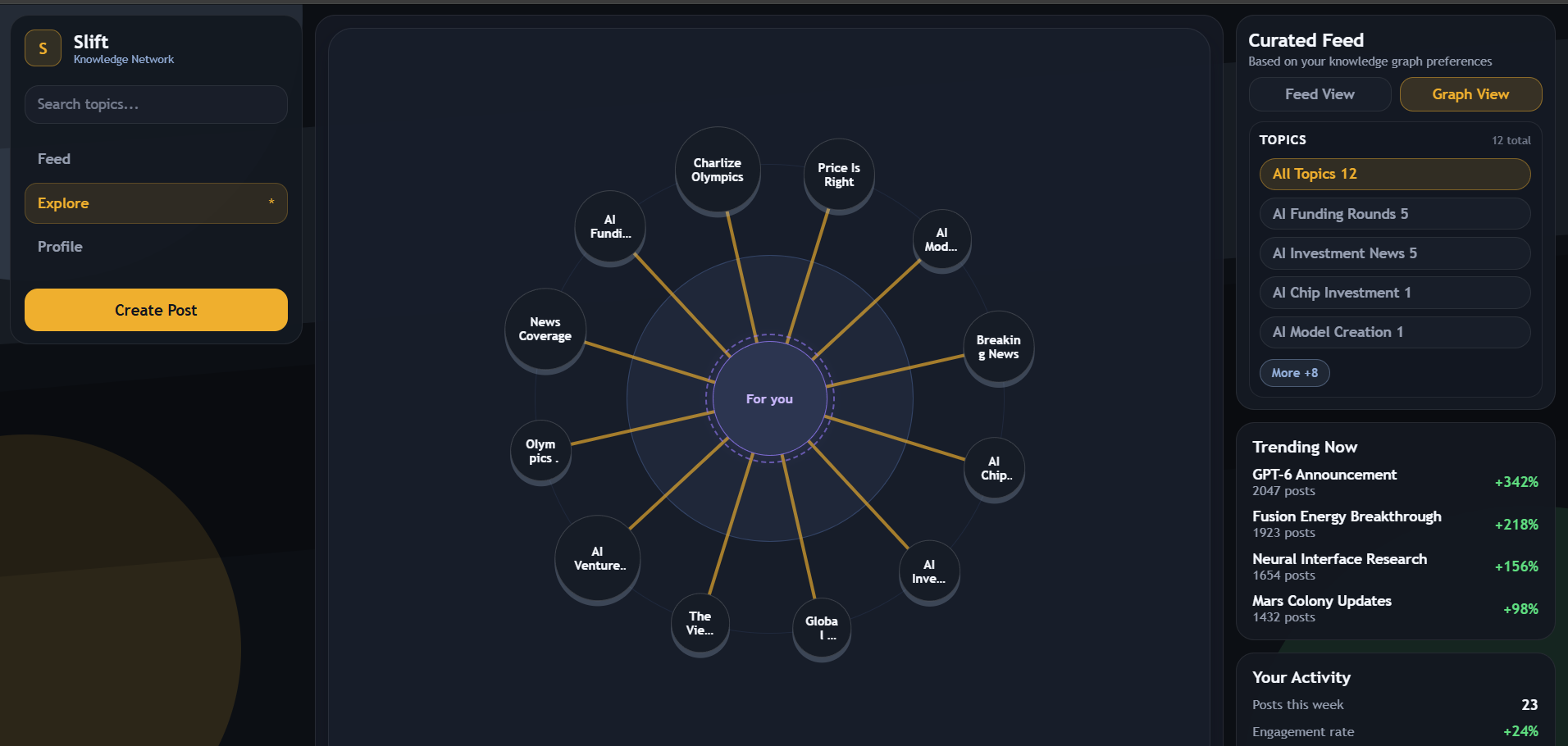
Explore topics visually through an interactive knowledge graph
Click on nodes (like AI Funding, Startups, Venture Capital) to see only posts related to that topic
Personalize their experience by liking or disliking posts, which dynamically updates their context graph behind the scenes
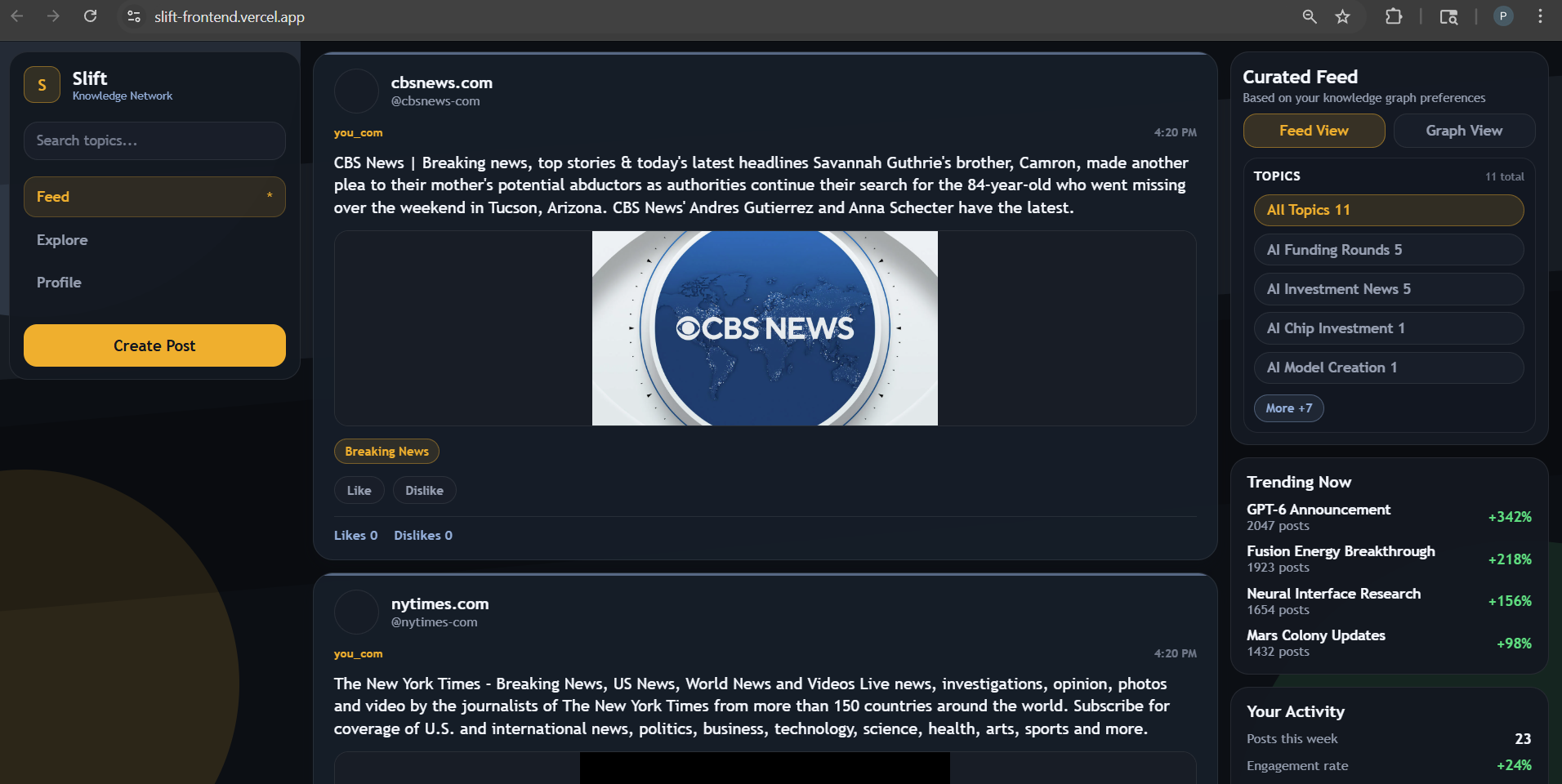
Slift pulls content from platforms like Twitter and You.com and organizes it around ideas, not just people — turning fragmented information into structured exploration.
How we built it
We combined content aggregation, graph modeling, and personalization systems to power Slift:
Content Ingestion: We pull posts from multiple platforms and process them using NLP techniques to extract key topics and entities.
Knowledge Graph: Extracted topics are structured into a graph database where nodes represent concepts and edges represent relationships.
Topic Filtering: When a user clicks a node, we query the graph to surface only posts strongly associated with that topic.
Personalization Engine: Likes and dislikes update a user-specific context graph, which reweights topic relevance and refines future recommendations.
Frontend Experience: A visual graph interface allows users to explore their interests intuitively, making discovery feel interactive rather than algorithmically imposed.
We use composio for twitter auth and access, akash networks for neo4js graph db, supabase for postgres db, and you.com for search/content/news.
Challenges we ran into
Balancing exploration vs. relevance. We had to ensure users could discover new topics without losing personalization.
Explaining the product simply.“Knowledge graph for social content” is powerful, but not immediately intuitive.
Accomplishments that we're proud of
Building a fully interactive knowledge graph UI that feels intuitive, not academic
What we learned
Building context graphs are hard.
What's next for Slift
Stay tuned!


Log in or sign up for Devpost to join the conversation.