-
-
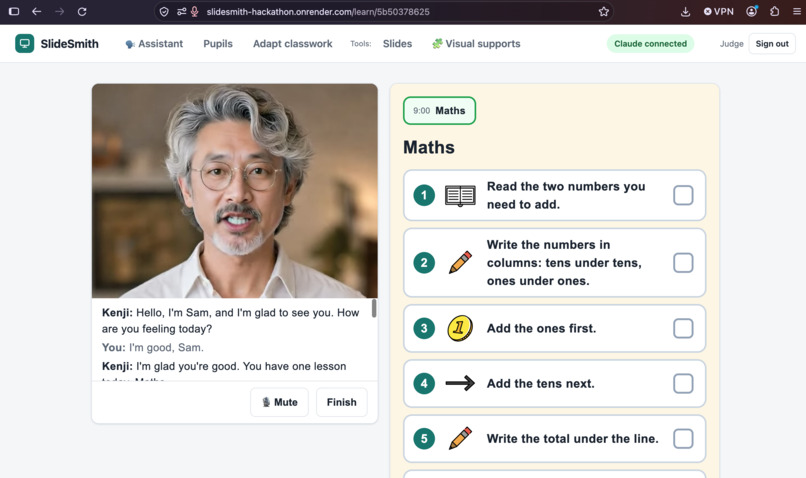
avatar having a conversation with a SEN student
Inspiration
I'm a teaching assistant. Every lesson I see pupils with special educational needs (SEN) waiting for an adult to tell them what to do next, because one teacher can't sit with every child. In England 1.32 million pupils are on SEN support, and fewer than half of new EHC plans arrive within the 20-week legal limit (46.1% in 2025). We wanted every one of those pupils to have help the moment they need it.
What it does
For pupils: "My day". The pupil opens their laptop and Sam, a friendly live avatar, greets them, tells them what they'll learn in each period and shows each lesson as simple numbered steps with pictures they can tick off. When they're stuck, Sam gives a hint or a smaller step, not the answer, shows the teacher's video if there is one, and calls the teacher when they need a grown-up.
For teachers and TAs. They set each period in minutes by typing what the pupil will learn or uploading the slides, and the AI turns it into the visual steps. Help requests appear on their screen. They can also adapt any worksheet for a specific need, grounded in the school's provision map and the SEND Code of Practice with sources, and talk to a staff assistant: "What's worked for this pupil?", "Adapt tomorrow's lesson", or a one-minute debrief that becomes an assess-plan-do-review record to approve.
Safe for children by design
Sam only talks about the teacher's plan: no web search, no videos the teacher didn't add, no personal questions. Anything that sounds like a pupil is unsafe goes straight to the teacher, caught by a rule in code. Pupils are stored by code only, and names and contact details never reach the AI.
How we built it
Angular 21 frontend; FastAPI and SQLite backend. Claude with strict tool calls, so every answer is validated JSON. Synthesia interactive avatars on LiveKit, with Cartesia speech and Claude as the brain; each avatar is an agent with tools (show the lesson, show the video, call the teacher). OpenMoji symbols matched deterministically, so the same word always gets the same picture. RAG over the SEND Code of Practice and the school's documents with citations. 112 tests; hosted on Render.
Challenges
Making a pupil-facing AI safe: grounding it in the teacher's plan, giving hints instead of answers, and putting the safety checks that matter in code rather than in a prompt.
Accomplishments
A teacher types a few lines per lesson, and seconds later a pupil has a picture-supported plan for the whole day and a friendly face to talk them through it.
What we learned
For SEN, consistency and small steps matter more than clever answers.
What's next
A pilot with a school SEN team, teachers setting the day by voice, and further education colleges, where 100,800 young people with EHC plans study.
Built With
- angular.js
- anthropic
- cartesia
- claude
- docker
- fastapi
- livekit
- openmoji
- python
- python-pptx
- render
- sqlite
- synthesia
- typescript
