-
-
Slice app settings
-
Email Builder Agent
-
Page Builder Agent
-
Concierge Dashboard
-
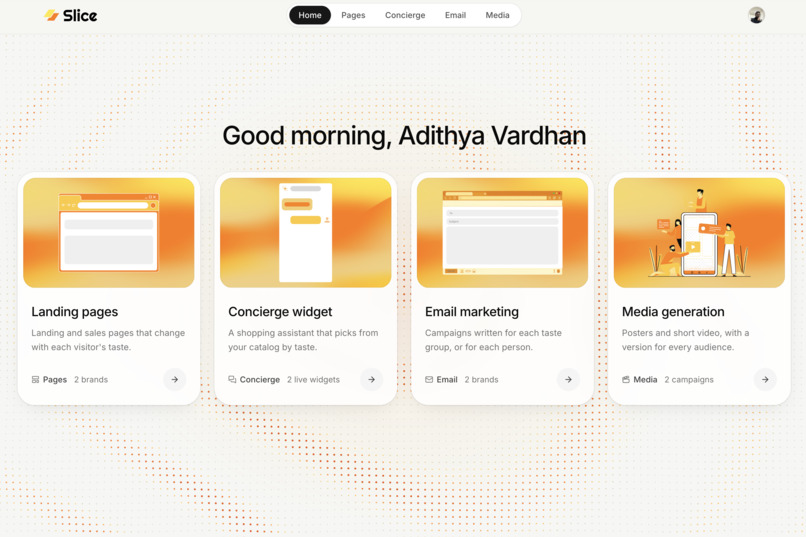
Dashboard
-
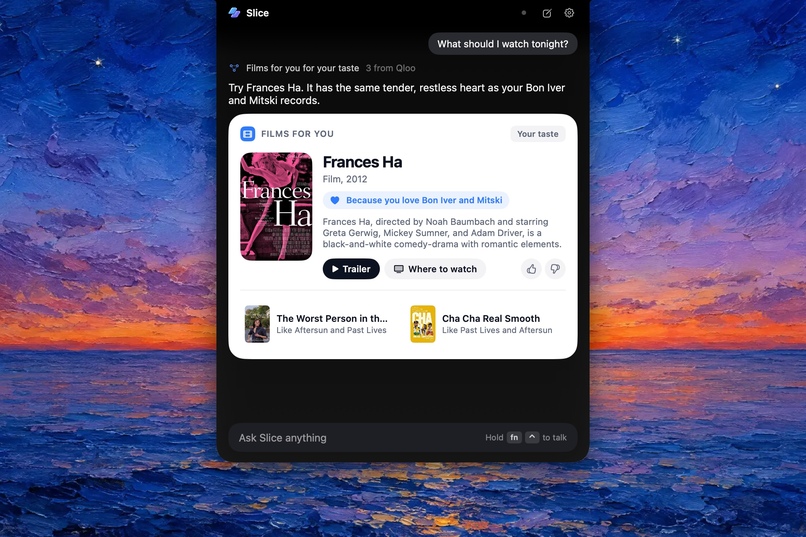
Slice mac app
-
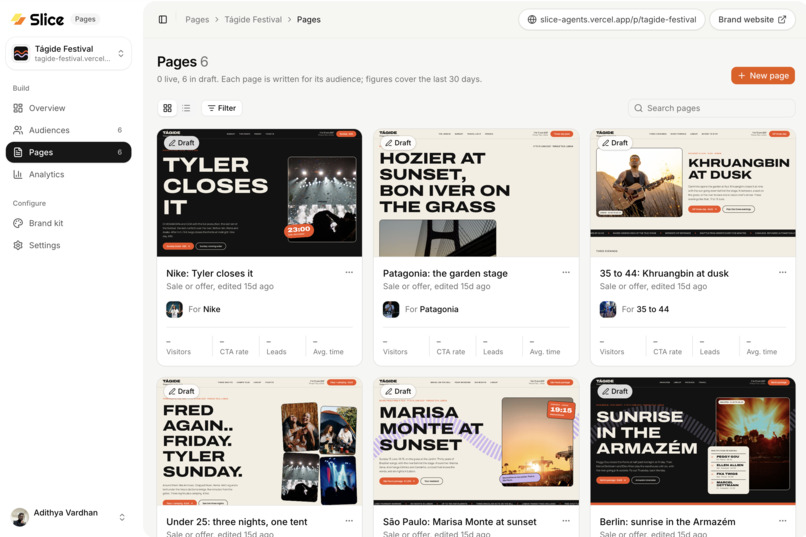
Slice Pages
-
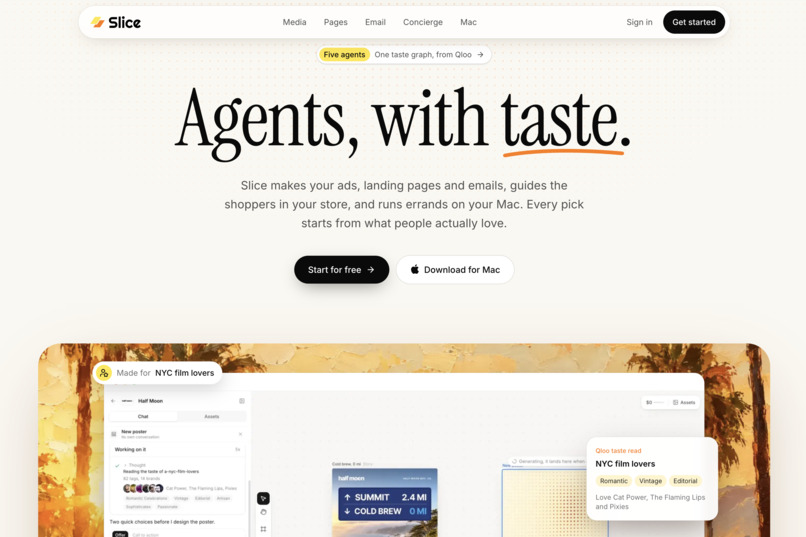
Landing page
-
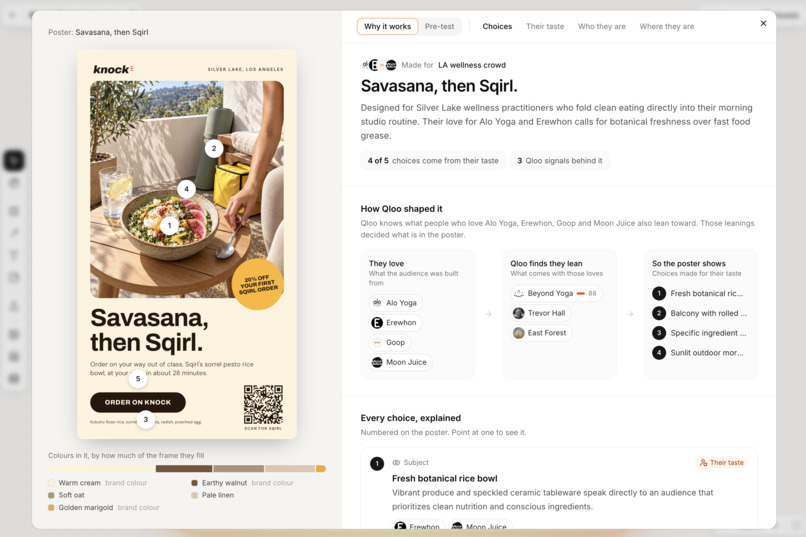
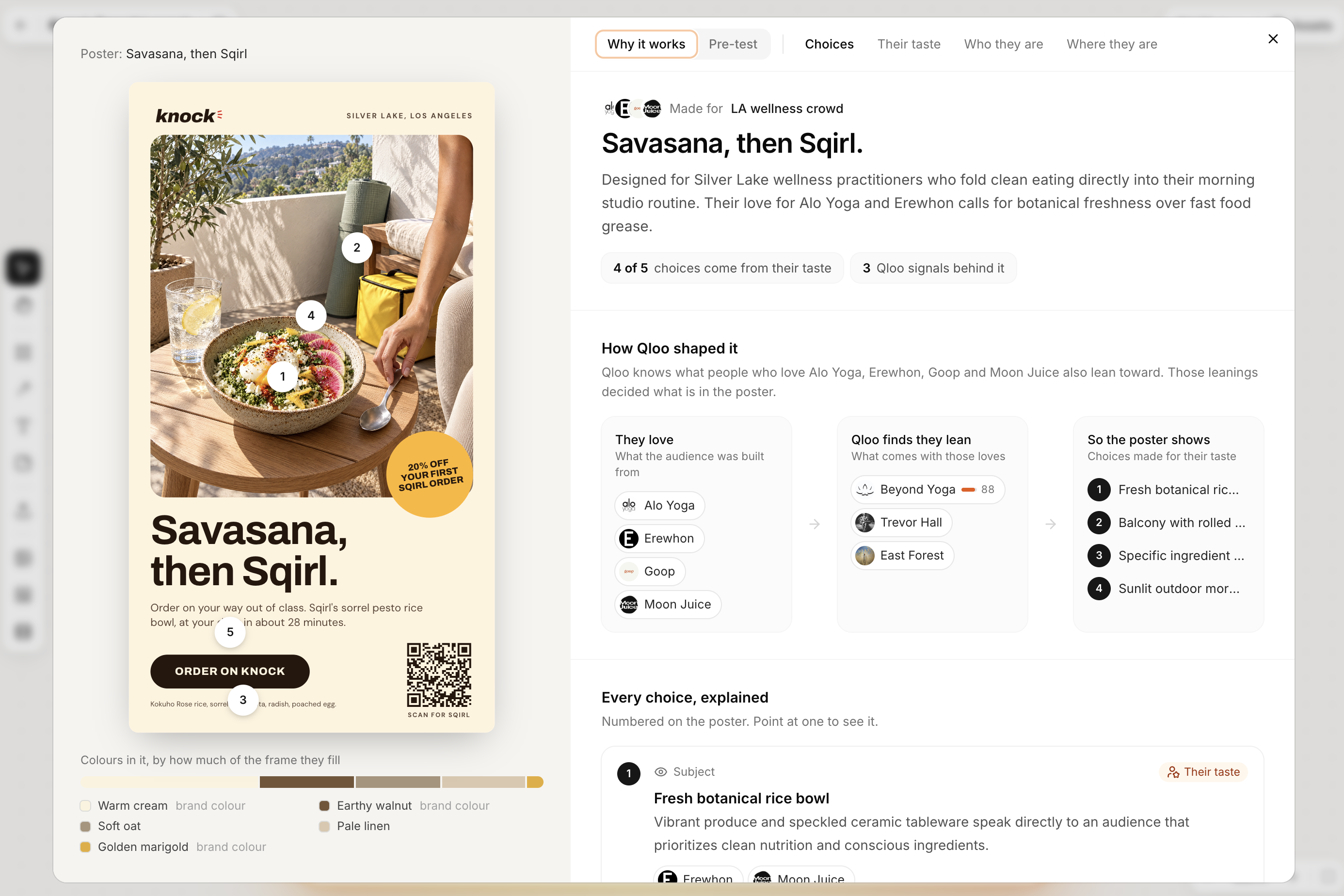
Why it works
-
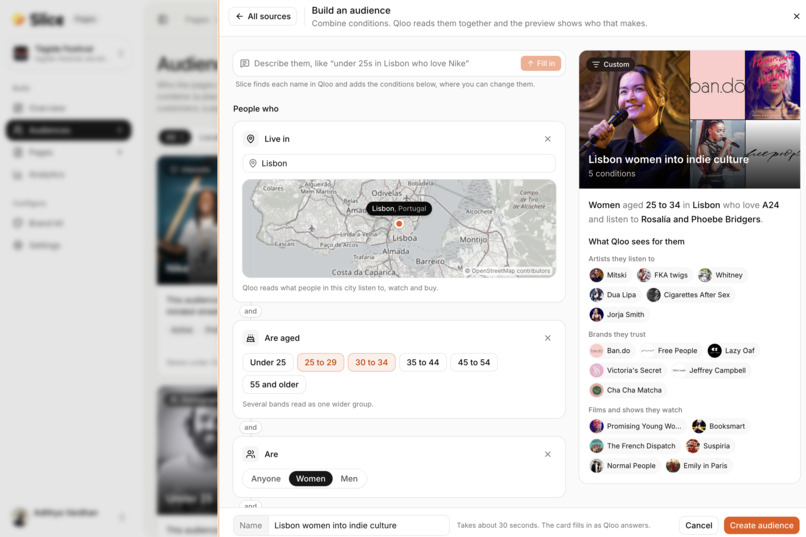
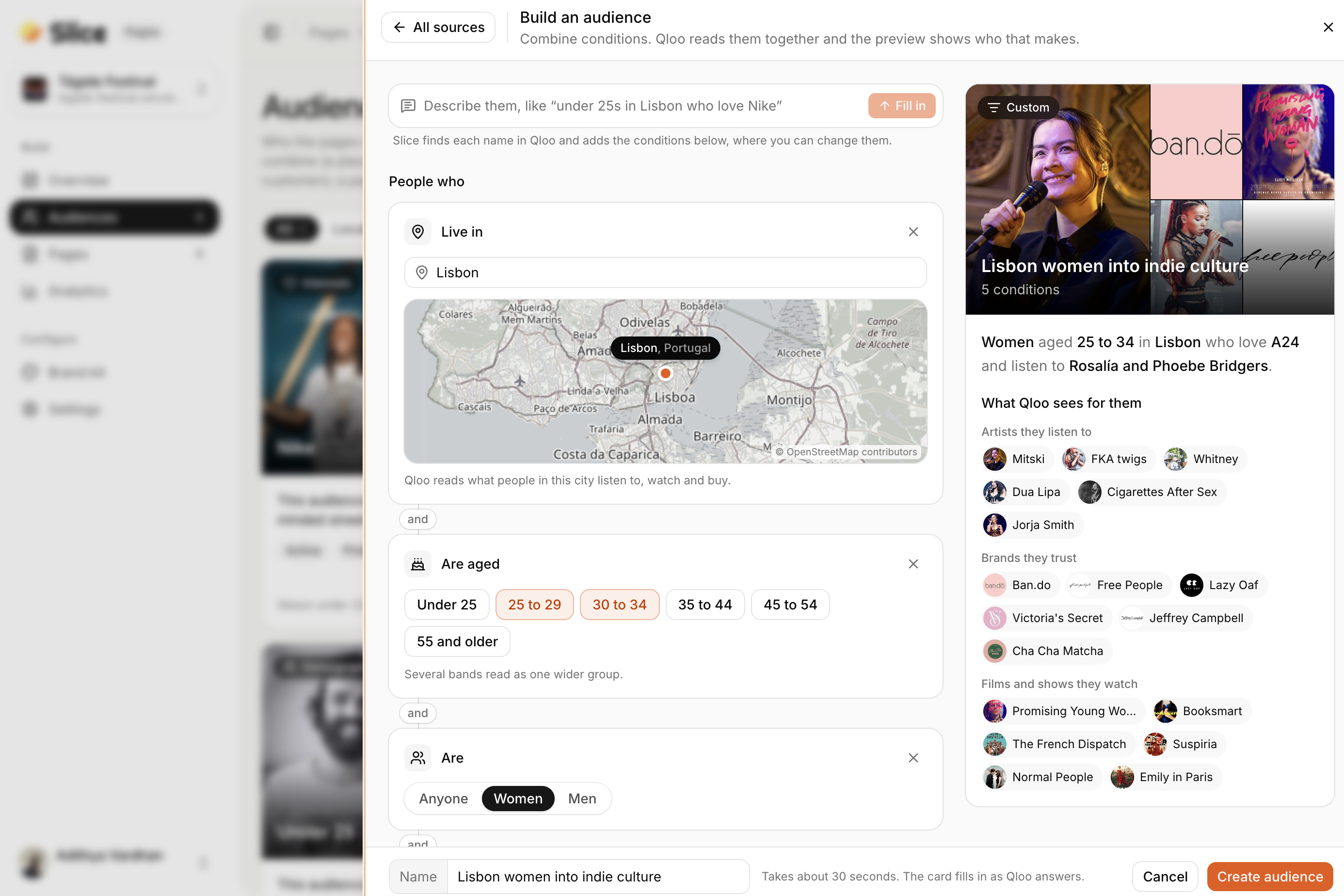
Audience builder
-
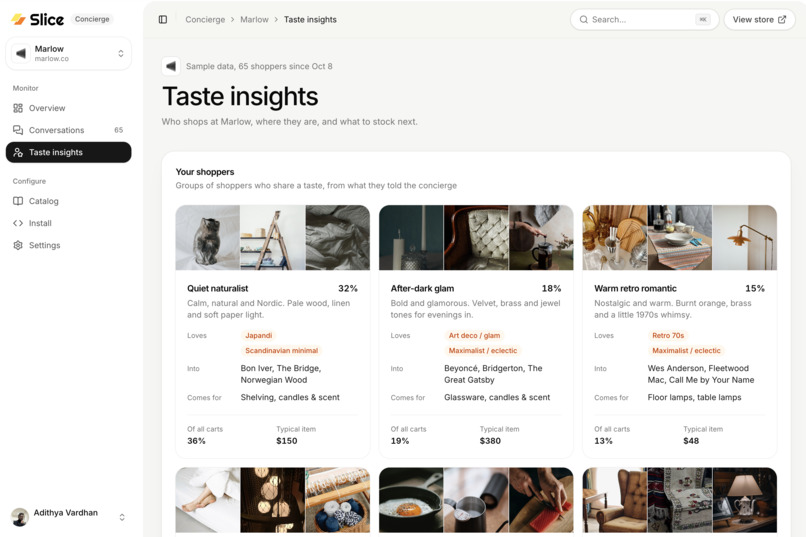
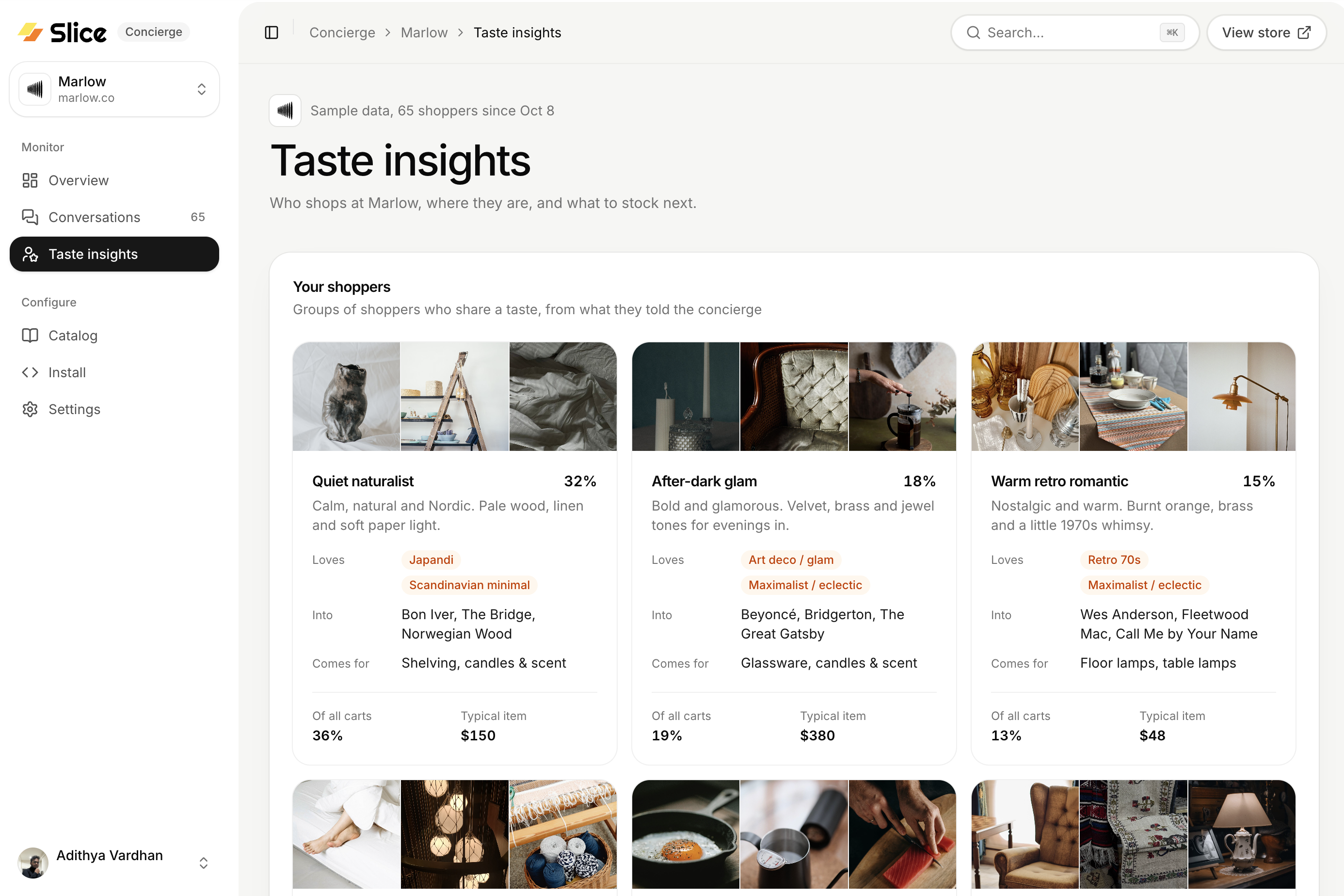
Insights
-
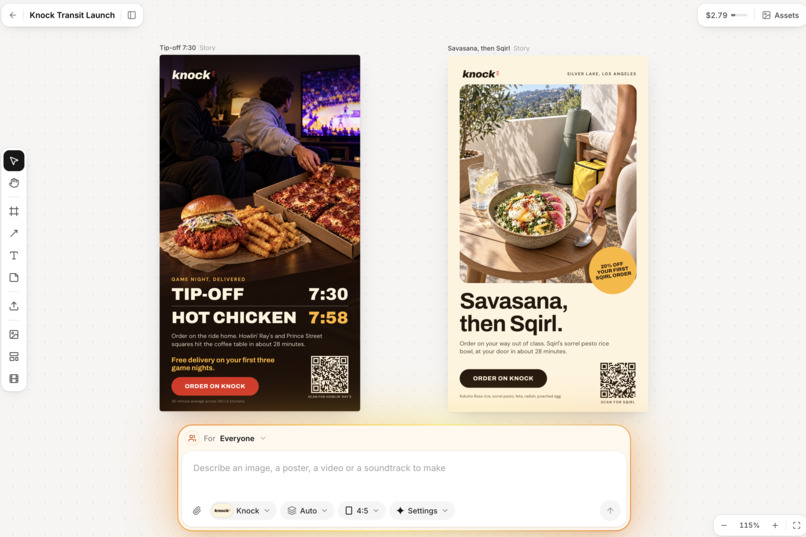
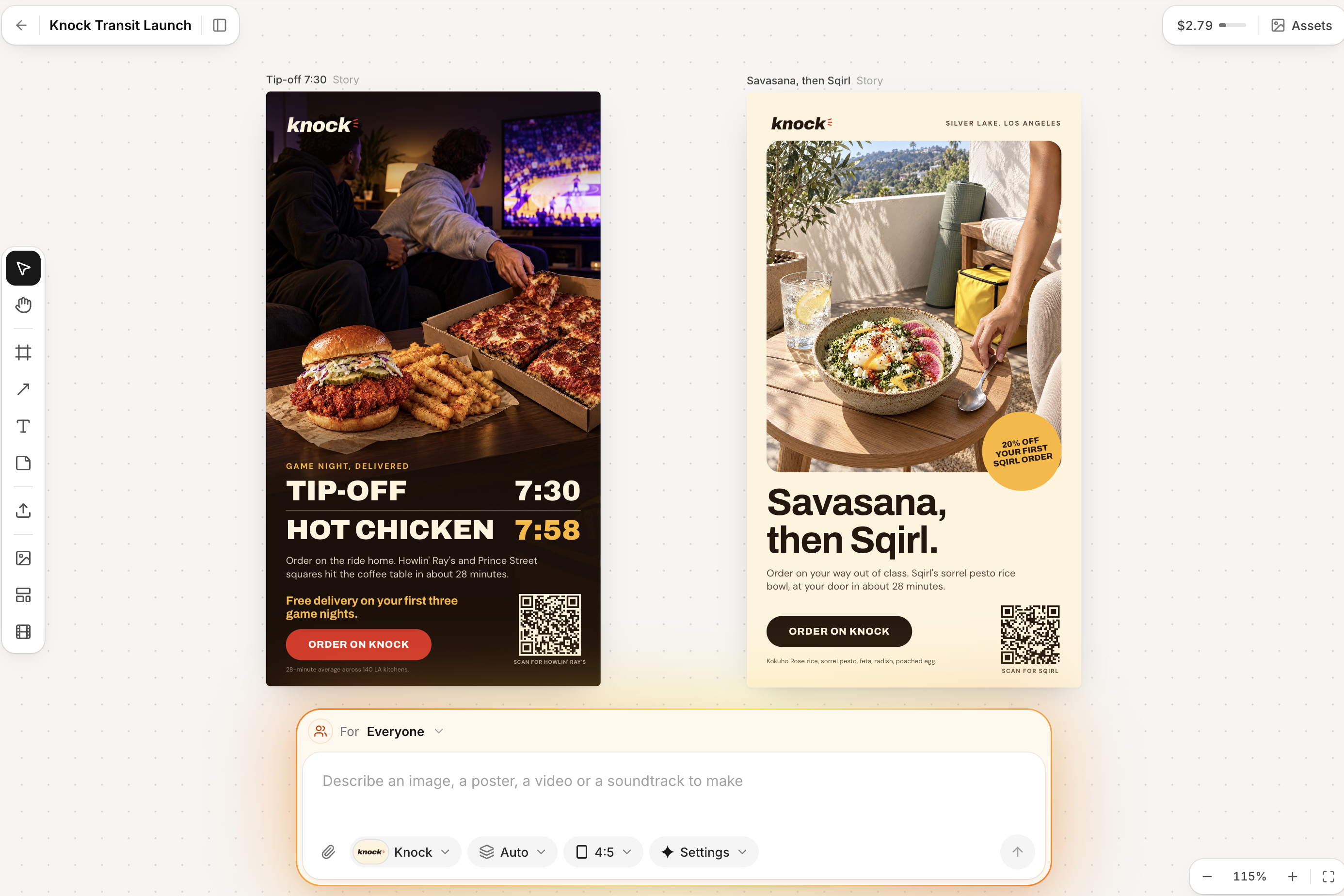
Slice media canvas

Inspiration
Agents can plan, write and act. Ask one what people would actually like and it guesses. It reaches for whatever is popular, which is the one thing a business cannot win on.
We wanted to build agents that pick the way a friend with great taste does. Not "the bestseller", but "this one, because you love Bon Iver and Patagonia". Qloo's taste graph made that possible: it connects what someone loves across music, film, dining, fashion, travel and brands, without knowing who they are.
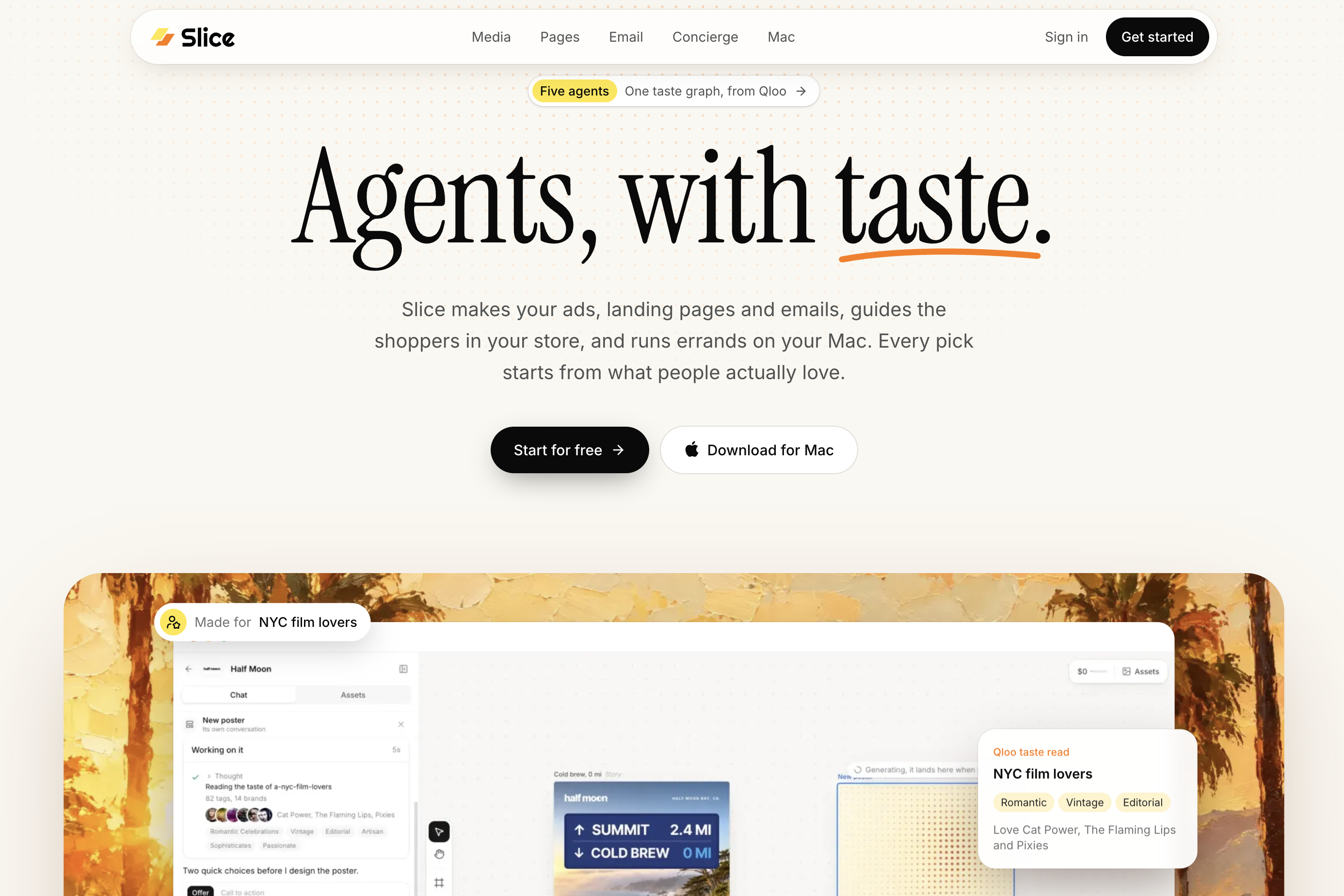
So we built Slice: five agents that share one habit. Every pick they make runs through Qloo first.
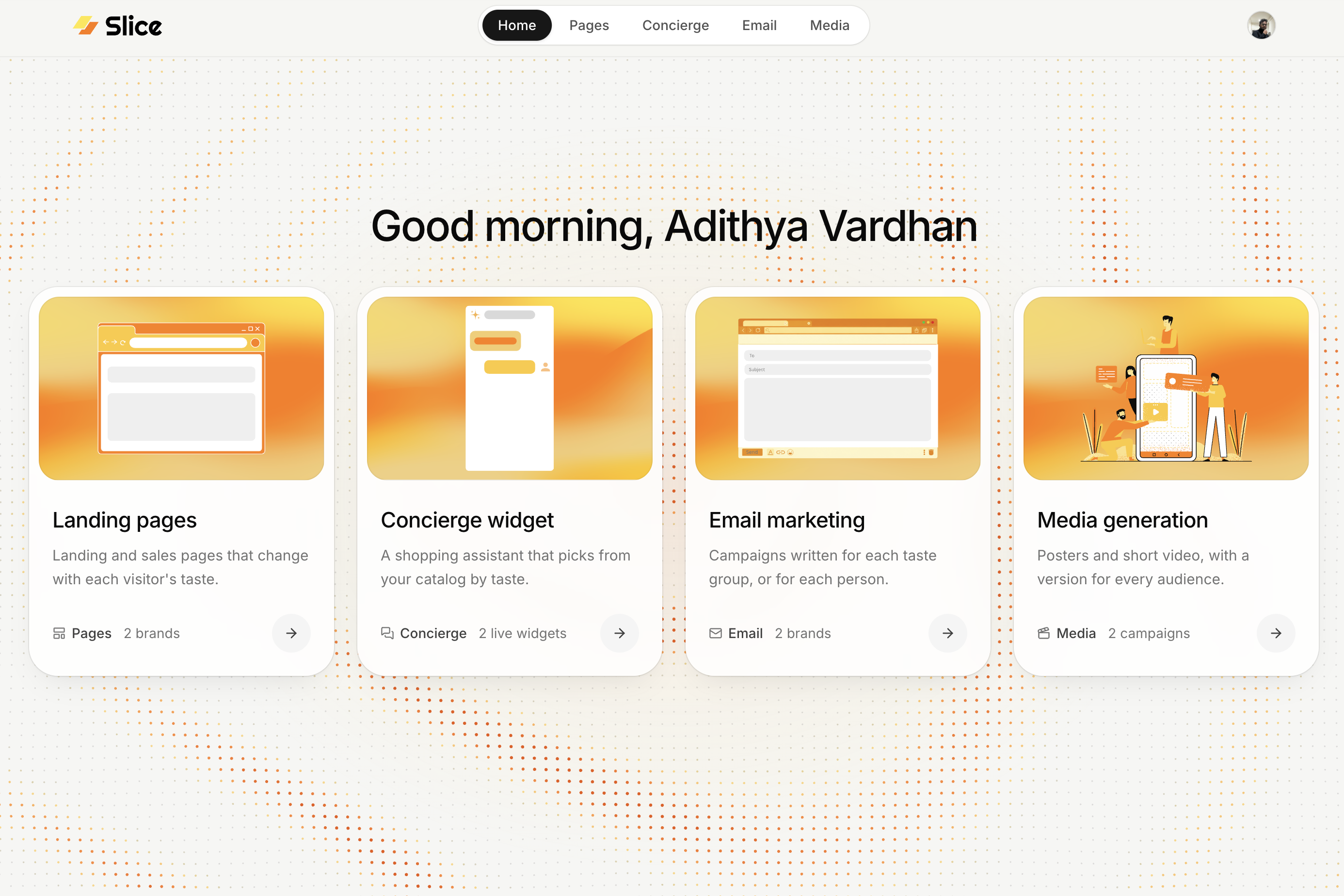
Four of them work for businesses, and each one owns a job a small team never has time to do well: a poster or video ad for every crowd, a landing page for every audience, an email written for every reader, and a concierge that guides every shopper in the store. The fifth, Slice for Mac, is a personal agent that lives in the Mac's notch and brings the same taste to everyday life.
What it does
How the agents use Qloo
Three things are the same in every Slice agent.
Taste is the context it starts with. Before an agent does anything, it gets a brief about who it is working for: a Qloo read of the audience, the shopper, or you. Whatever the input was (a city, an age band, a few artists or brands, a CSV of customers, five answers in a widget, the music on your own Mac), it is turned into Qloo entities and Qloo's cross-domain view comes back: the style and mood tags that cluster around that taste, the brands and places it leans to, the demographic skew. The agent reads that the way a good creative reads a brief.
Qloo is a tool it reaches for while it works. The brief is a starting point, not a script. As it designs, writes, ranks or plans, the agent calls Qloo whenever it decides it needs to know more: re-rank the festival's 57 acts for fans from Berlin, check which coffee brands the trail crowd already drinks before choosing which coffee leads, find the tasting menus within walking distance of Olivia's door, pull a heat map of where an audience leans in Los Angeles, compare a dad's taste with his friend's before picking the restaurant. Each agent has its own set of Qloo tools, and the traces show which ones it used and why.
It shows its evidence. Every result carries the signals behind it: a Why report on every creative, a "why this version" on every page, a reason on every email pick, a flip card on every product, a "because you love" under every pick on the Mac.
One rule never bends: the agents rank by taste, not by rating, sales rank or "trending". Take Qloo out and they have nothing to rank by. That was the design rule from day one.
Slice Media: an ad for every crowd
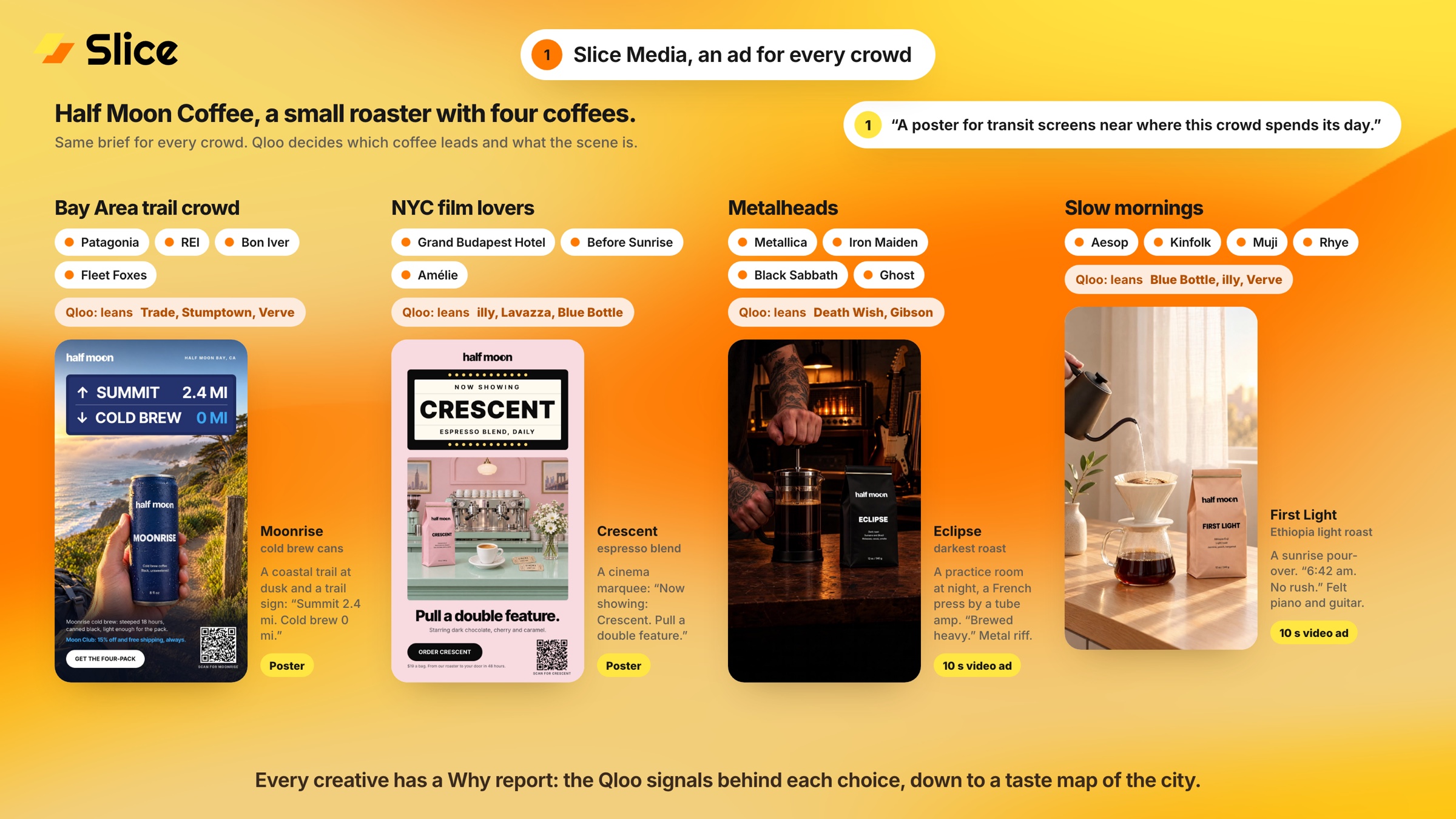
Slice Media is an infinite canvas where a brand's agent designs posters and short video ads, one per audience. You describe the campaign once, pick an audience, and the agent asks a couple of clarifying questions (music, voiceover, offer) before it works. Images come from Nano Banana Pro, video from Veo 3.1, music from Lyria 3. A brand check keeps every creative on brand, and a Why report explains each choice with the Qloo signals behind it, down to a taste map of the city.
Our two demo brands are the kind of business that would actually buy this:
- Knock, a food delivery app in Los Angeles with 15 real LA restaurants. Four audiences, four creatives. For Lakers game night the poster is a box score that reads "Tip-off 7:30, hot chicken 7:58". For the LA wellness crowd it is a Silver Lake balcony and a Sqirl sorrel bowl. The video ads target Anime night (Tsujita tsukemen, "order at the opening") and Música Mexicana fans (birria dipped in consomé, "¿Y la birria?").
- Half Moon Coffee, a small roaster in Half Moon Bay with four coffees. Here the agent asks Qloo which coffee brands each crowd already drinks before choosing which coffee leads. The Bay Area trail crowd (Patagonia, REI, Bon Iver) leans toward Trade and Stumptown, so it gives them the cold brew cans on a coastal trail: "Summit 2.4 mi, cold brew 0 mi". NYC film lovers (Grand Budapest Hotel, Before Sunrise) lean toward illy and Lavazza, so it gives them the espresso blend on a cinema marquee. Metalheads get the darkest roast, "Brewed heavy". Slow mornings get a sunrise pour-over, "No rush".
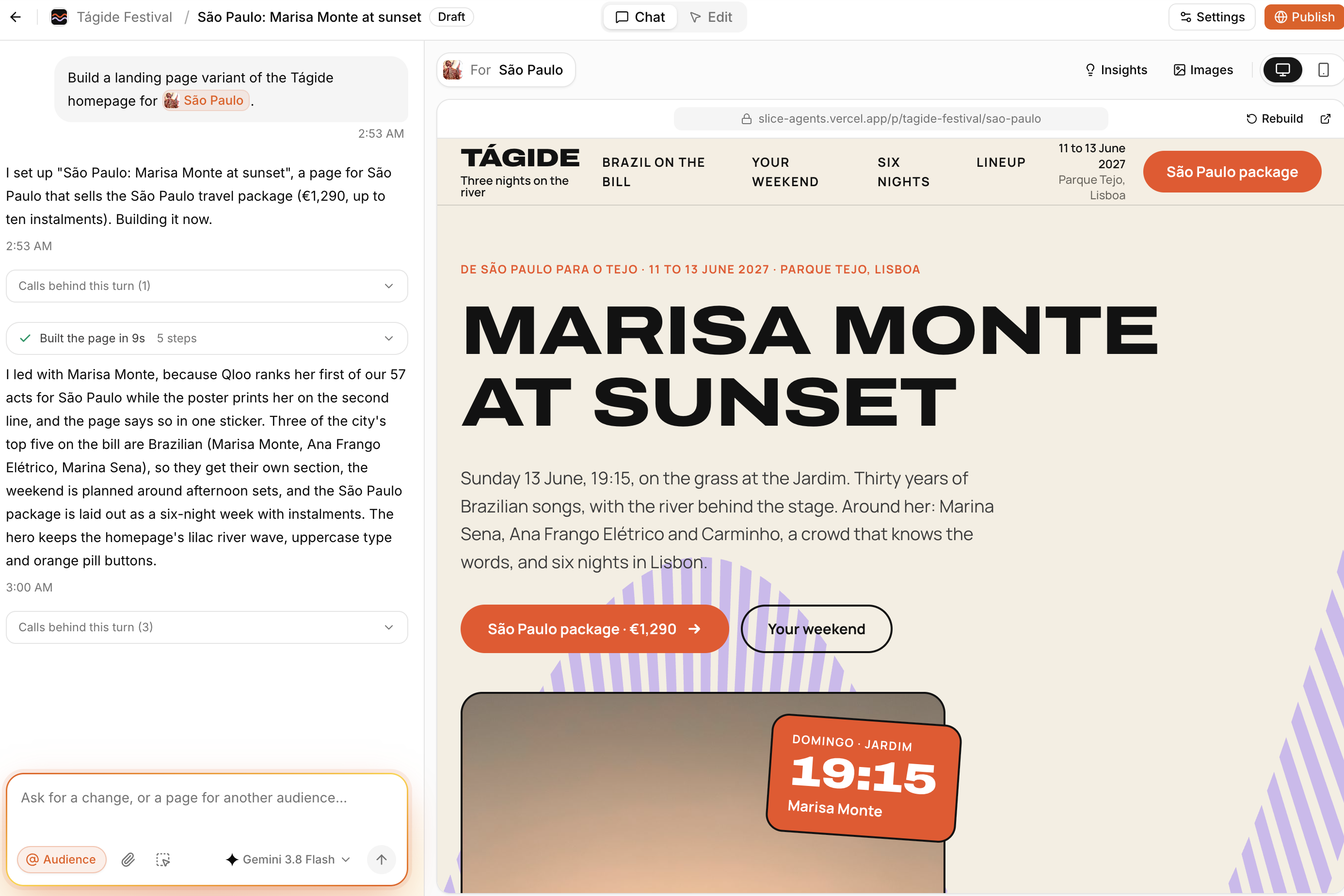
Slice Pages: a page for every audience
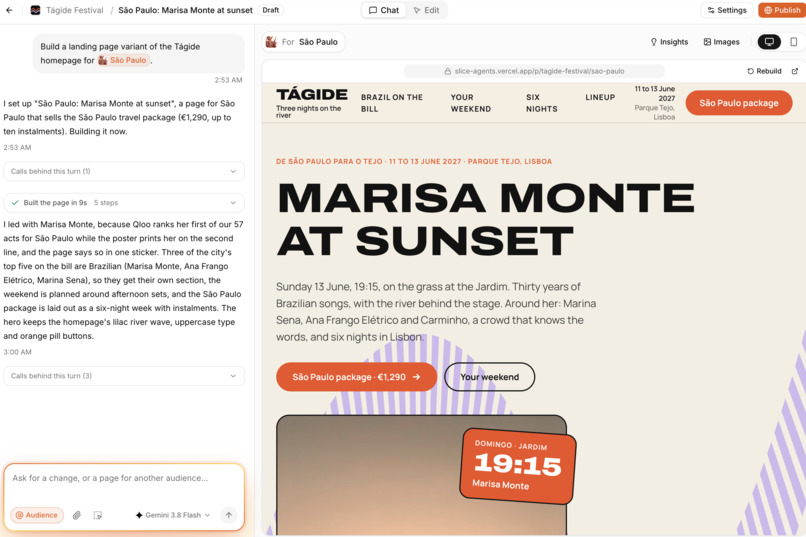
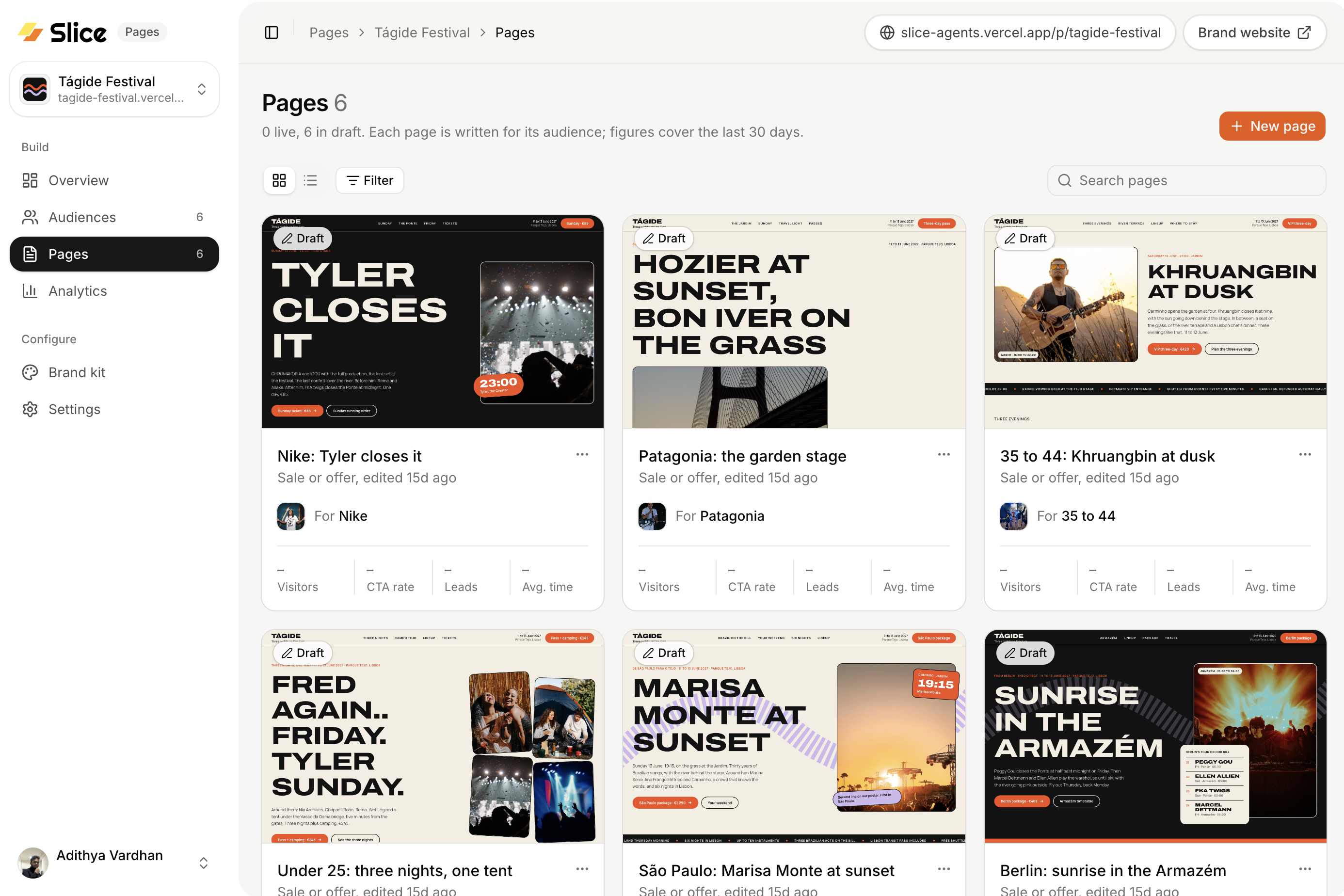
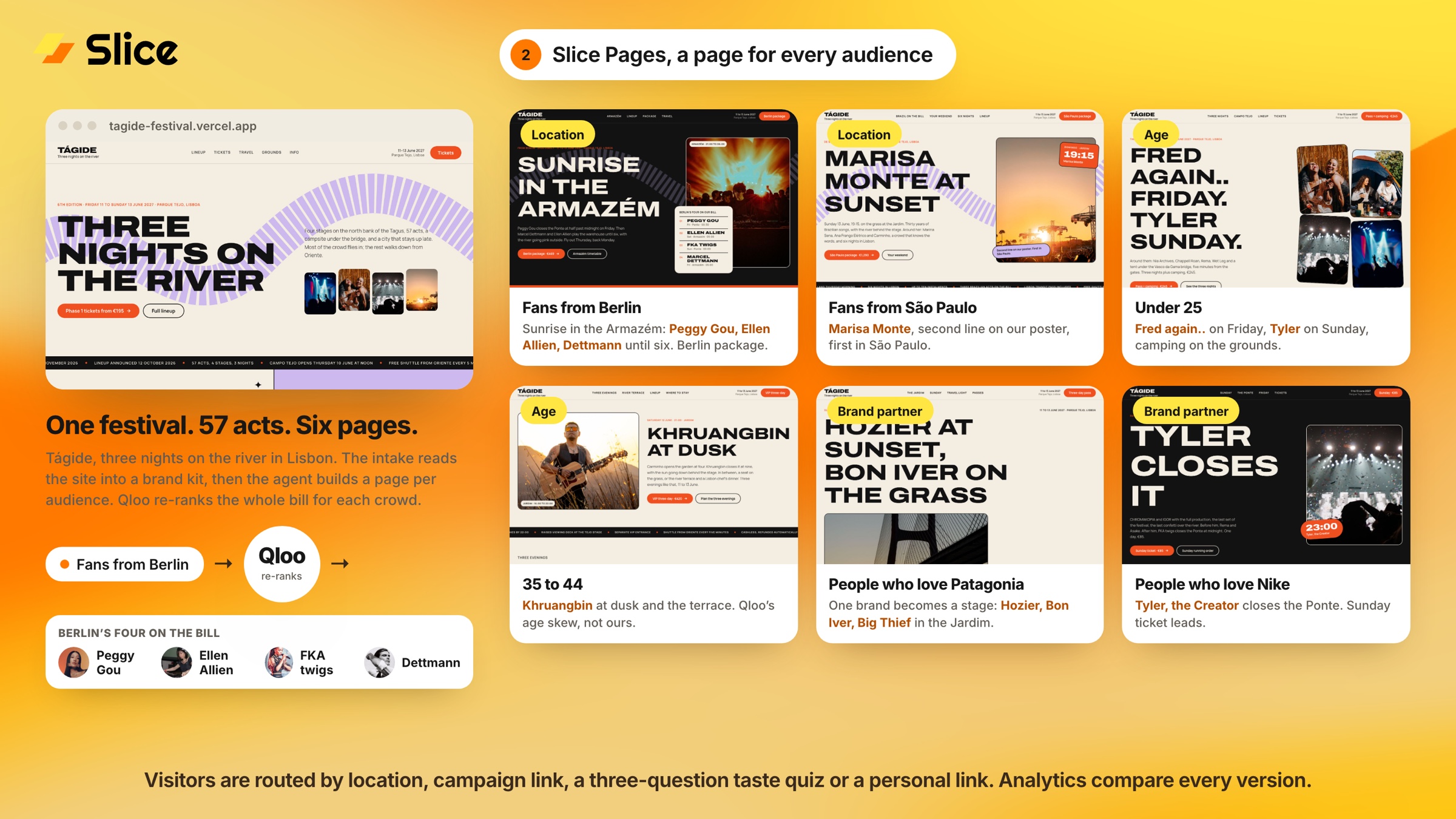
Slice Pages builds landing, sales and funnel pages with an agent, one version per audience. You paste a brand's URL and the intake reads the site into a brand kit (logo, colours, type, voice, products) and asks Qloo what it knows about the brand. Then you define audiences: a city, an age band, a set of interests or brands, a Qloo lifestyle segment, a cluster of your own customers from a CSV, a CRM list, or one person. The agent builds a page for each, and the published URL routes visitors to the right version by location, campaign link, a three-question taste quiz, or a personal link. Analytics compare every version with lift against the default, a click heat map over the page, and a section funnel.
- Tágide Festival, a three-night music festival in Lisbon with 57 real acts. One festival, six pages. For each crowd the agent has Qloo re-rank the whole bill and builds the page around what comes back: fans from Berlin see Peggy Gou, Ellen Allien and Marcel Dettmann in the warehouse until six; São Paulo sees Marisa Monte first; under 25s get Fred again.. and camping; 35 to 44 get Khruangbin at dusk and the terrace. Two pages are built for brand partners alone. From the single signal Patagonia, the agent finds Hozier, Bon Iver and Big Thief and leads with the garden stage; from Nike, Tyler, the Creator closing the bridge stage.
- Gwen, a premium credit card whose perks span dining, tickets, streaming, hotels and shops. Food lovers in Chicago see a page that leads with tasting menus and Chef's Table; newly engaged couples in Austin see hotel stays and getaways. Then five existing customers from a realistic bank CSV (name, city, merchants, subscriptions, flights) each get their own page: Maya in Brooklyn, Jake in Denver, Daniela in Miami, Ethan in Seattle and Linda in Chicago. The agent reads their taste through Qloo from the merchants alone, and the page never shows a single statement line.
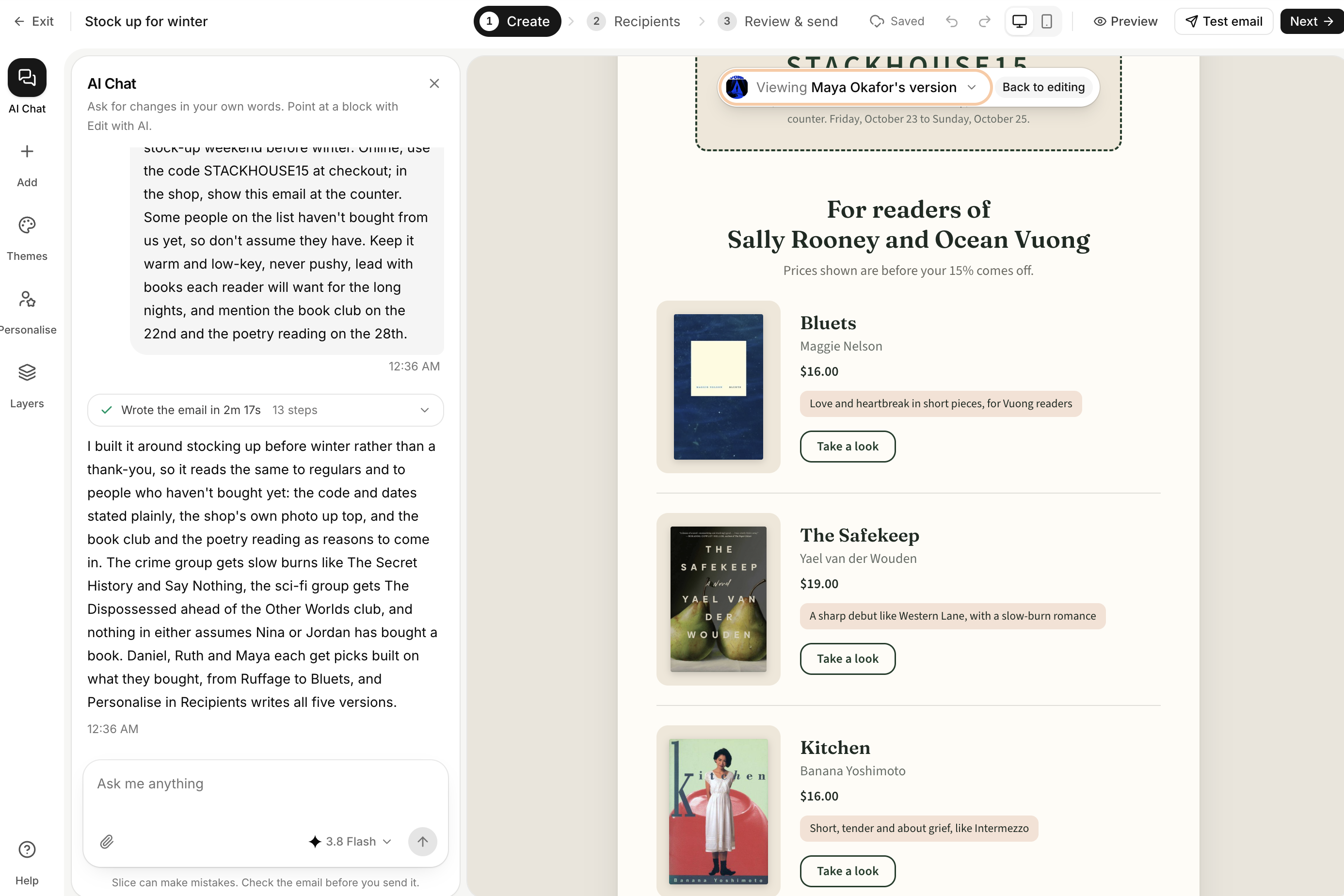
Slice Email: a letter to every reader
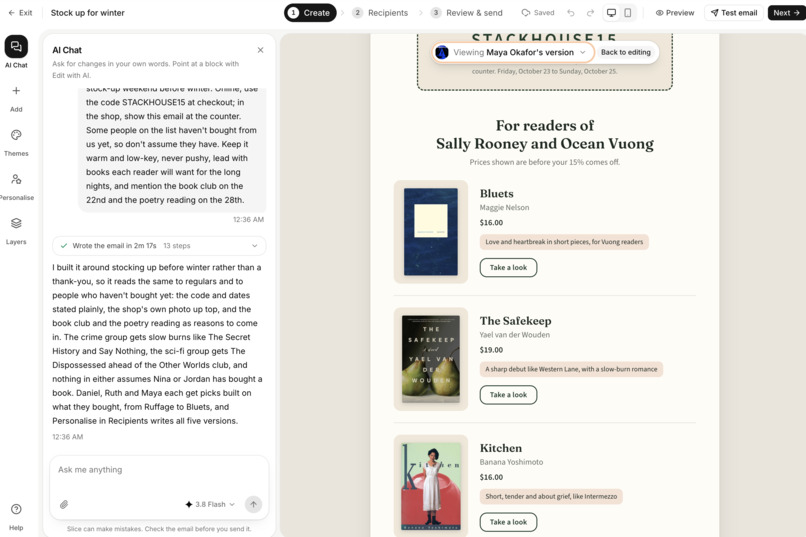
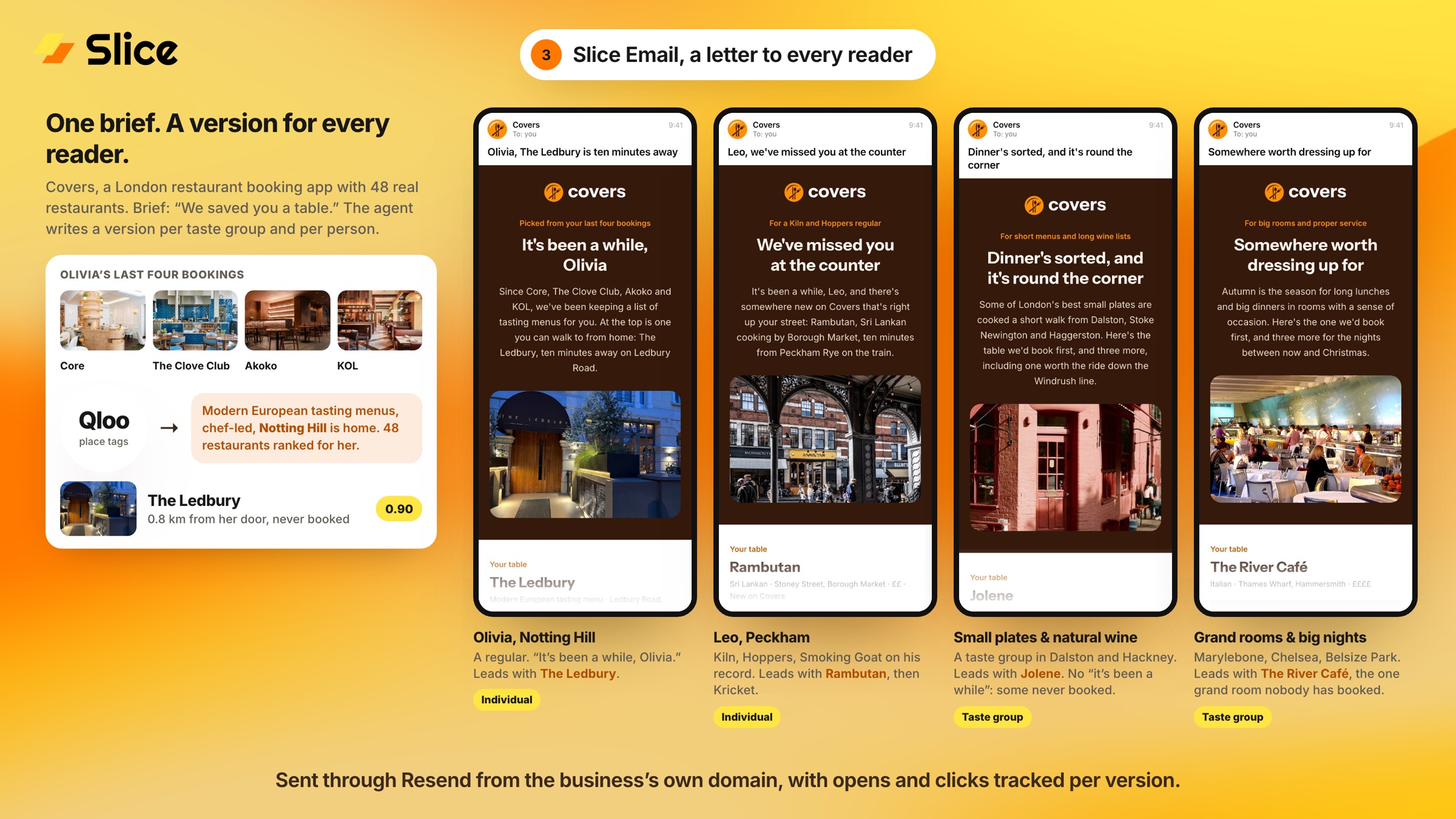
Slice Email is a Wix-style email builder with an agent in the sidebar. A business sets up its brand from its homepage, imports contacts with their purchase history, and Slice groups them into taste groups (clusters that share a Qloo profile) or keeps them one by one. A campaign is one brief. The agent writes a version for every group and every individual you tick, and personalises the blocks that should differ: the hero, the picks, the reason. Sending goes through Resend from the business's own domain, with open and click tracking built in.
- Stackhouse Books, an independent bookshop in Brooklyn. One sale brief, "Stock up for winter", becomes five emails: one for the Crime & suspense group, one for Sci-fi & fantasy, and one each for Daniel, Ruth and Maya, with picks ranked from their own shelves.
- Covers, a London restaurant booking app with 48 real restaurants. The win-back campaign "We saved you a table" turns Olivia's four bookings (Core, The Clove Club, Akoko, KOL) into The Ledbury, ten minutes from her door, with three more tasting menus for her list. Leo in Peckham gets Rambutan and Kricket. The Small plates & natural wine group gets Jolene, the Grand rooms group gets The River Café. The agent never assumes a purchase that did not happen: new sign-ups get copy about the kind of evening, not "it's been a while".
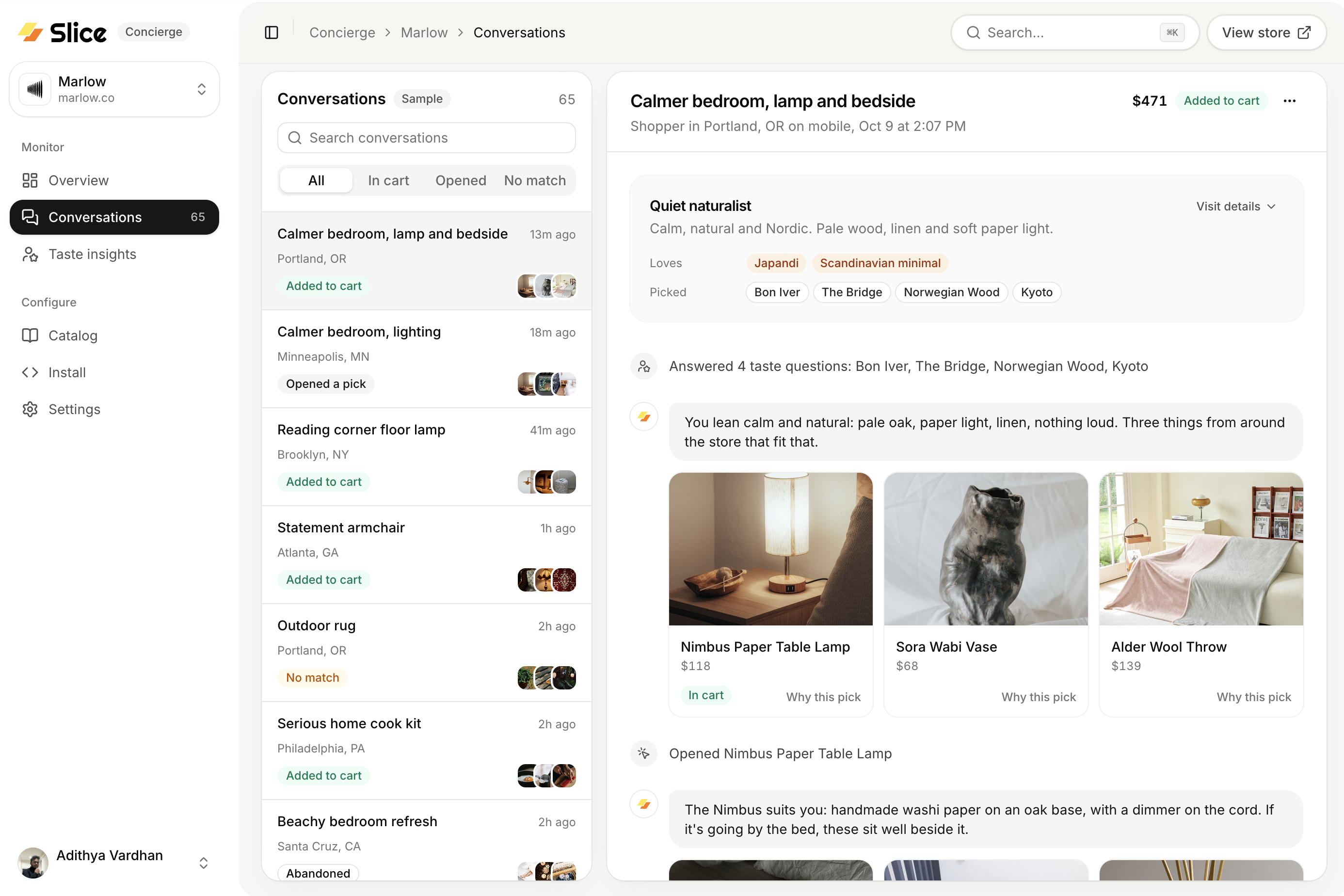
Slice Concierge: a guide for every shopper
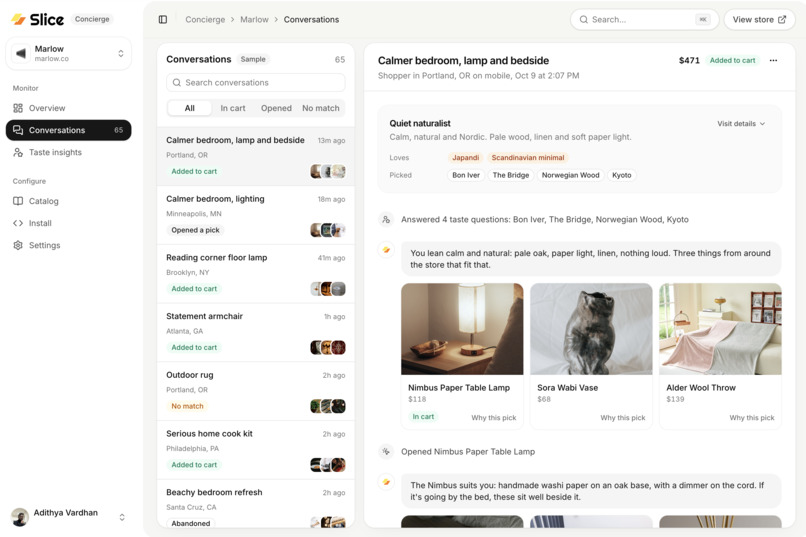
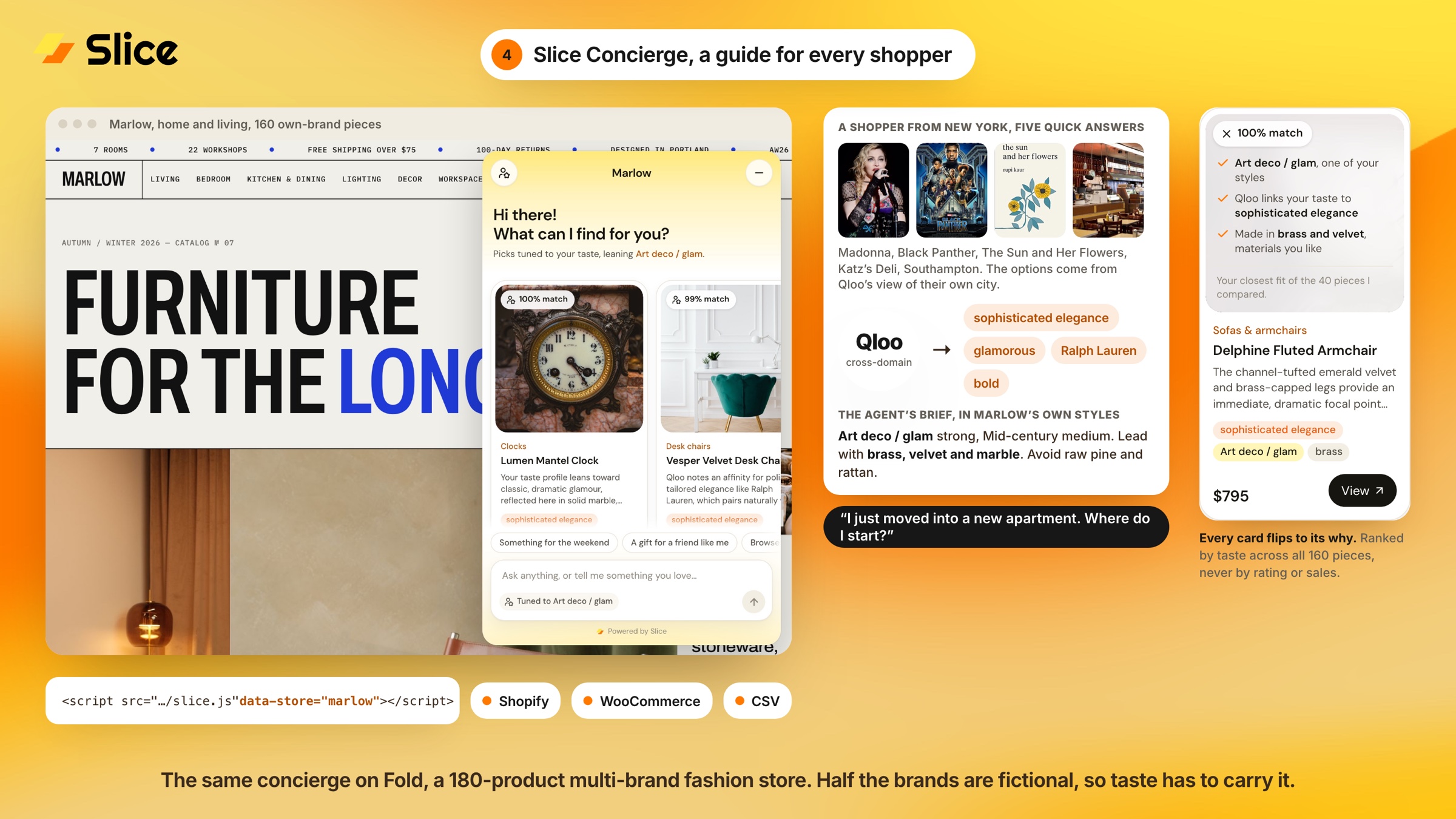
Slice Concierge is a shopping agent any store adds with one line of script. It connects to the catalog (Shopify, WooCommerce, a CSV or a product feed), tags every product in Qloo's vocabulary, and then meets each shopper with five quick questions whose options come from Qloo's view of their own city: artists, films, books and places people there love. Those answers become a Qloo taste profile, the agent writes a brief in the store's own style language, and from then on it ranks every recommendation by taste, never by rating or sales, searching the catalog and the profile as the conversation goes. Each card can flip to show exactly why it was chosen. The merchant console shows conversations, the taste groups walking through the store, and a map of where they come from.
- Marlow, a home and living store with 160 own-brand pieces, so nothing can be matched by brand name. A shopper from New York who loves Madonna, Black Panther and Katz's asks "I just moved into a new apartment. Where do I start?" and gets an art deco answer: the Delphine fluted armchair, a brass side table and a fan mirror, each with its reason.
- Fold, a multi-brand fashion store with 180 products across 24 brands, half of them fictional, so brand affinity alone cannot carry the result. "Something for a weekend hike upstate" lands on the right jacket for that shopper's taste.
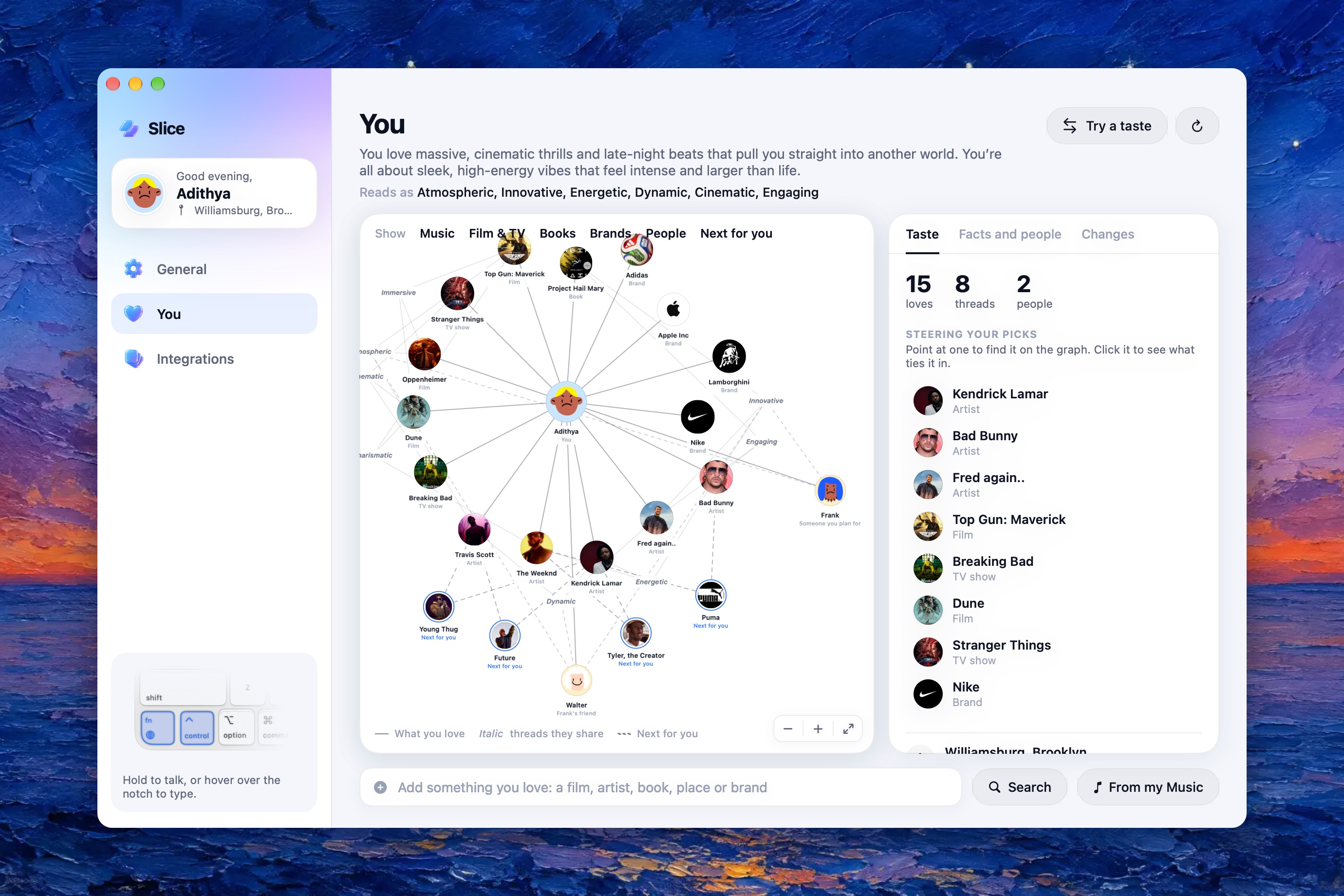
Slice for Mac: a personal agent in your notch
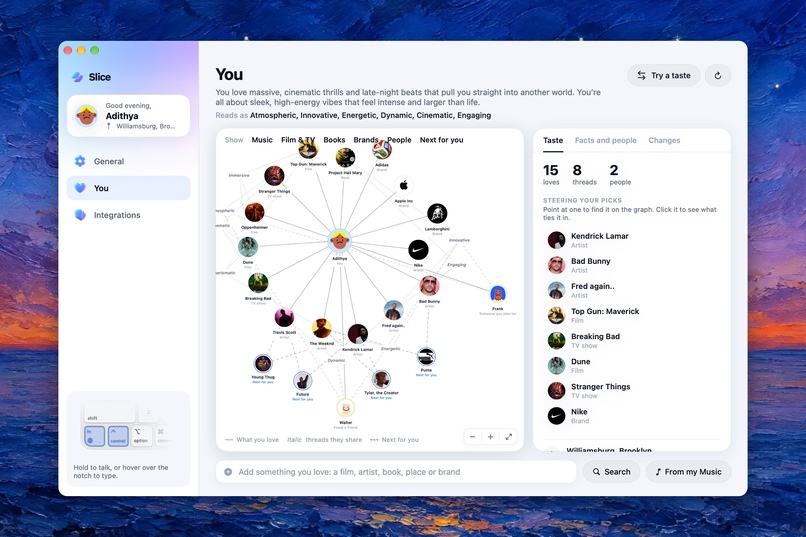
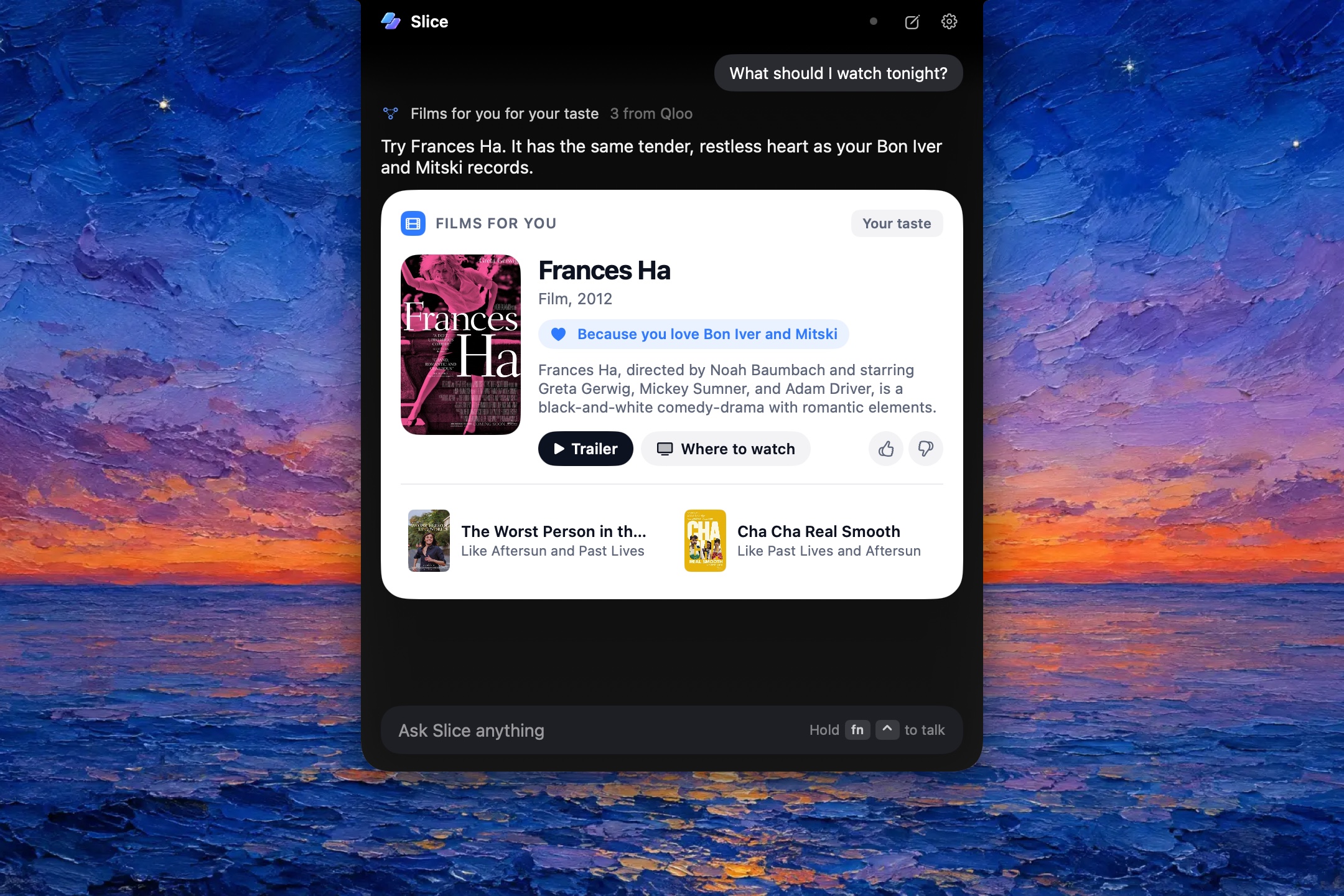
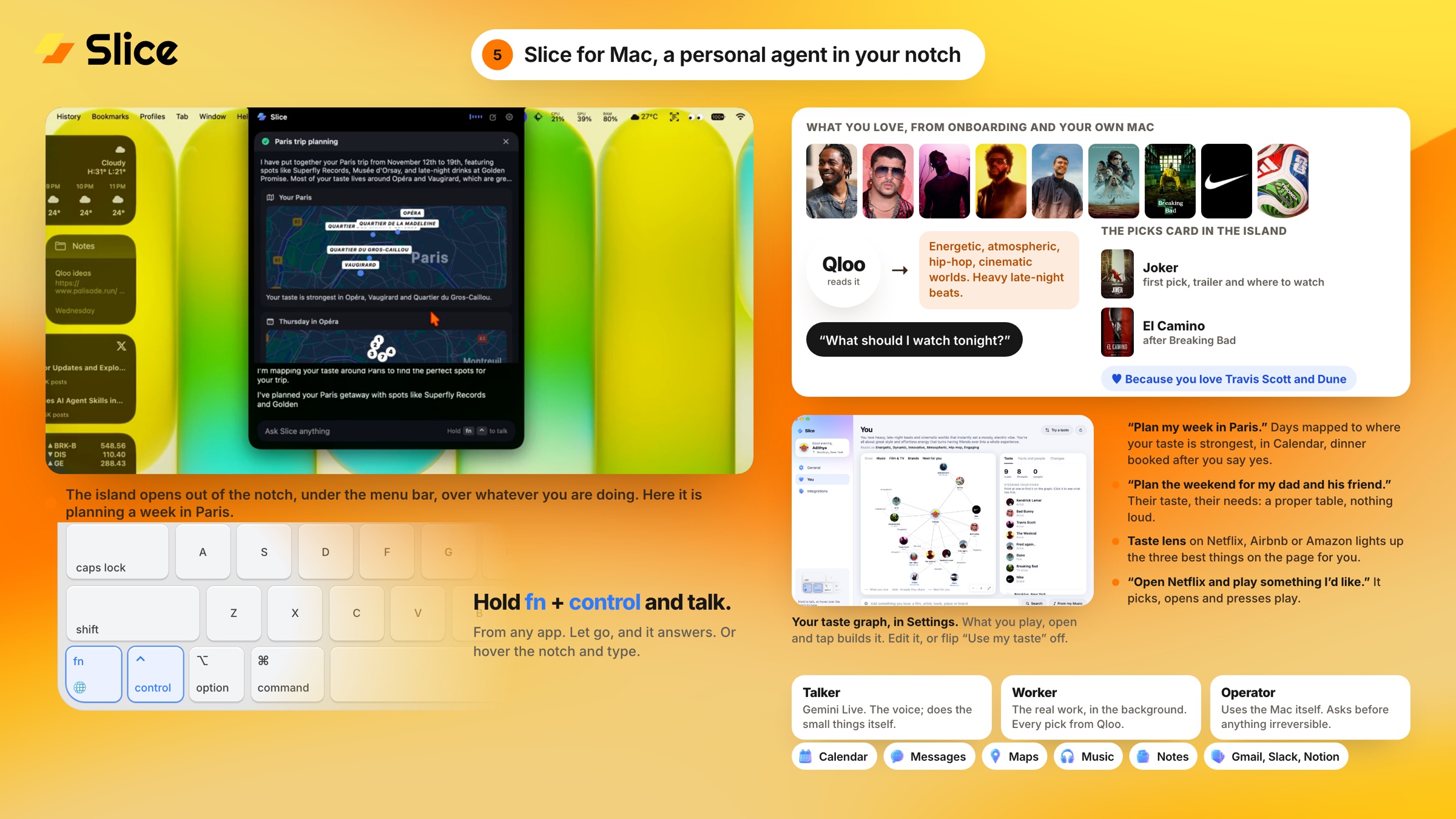
Slice for Mac is a native app. Hover the notch to type, or hold fn + control anywhere and talk. It knows your taste from a short onboarding (your music, your screen, your everyday brands, pulled from Qloo's picks for your city and from the library on your Mac), and it learns as you go: what you play, open and tap builds a taste graph you can see and edit in Settings.
It is three agents in one. A fast talker (Gemini Live) keeps the conversation going, a worker does the real work in the background, and an operator uses the Mac itself when there is no API for the job. Every recommendation comes from Qloo, never from the model's memory.
- "I'm going to Paris for a week, plan my itinerary" becomes a day-by-day plan mapped to the neighbourhoods where your taste is strongest, written to a document, added to Calendar, with dinner booked on the restaurant's own site after you say yes.
- "Plan the weekend for my dad and his friend" uses their taste, not yours, plus the needs you mention: a proper table, nothing loud, short walks.
- "What should I watch tonight?" opens a picks card in the island, with "because you love Bon Iver and Mitski" under it. Say "play the first one" and it does.
- On Netflix, Airbnb or Amazon, the taste lens dims the page and lights up the three best things on it for you.
- It connects to Gmail, Google Calendar, Slack, Notion, Ticketmaster and more, and to Calendar, Contacts, Reminders and Notes on the Mac. A Use my taste switch turns the taste layer off whenever you want plain answers.
How we built it
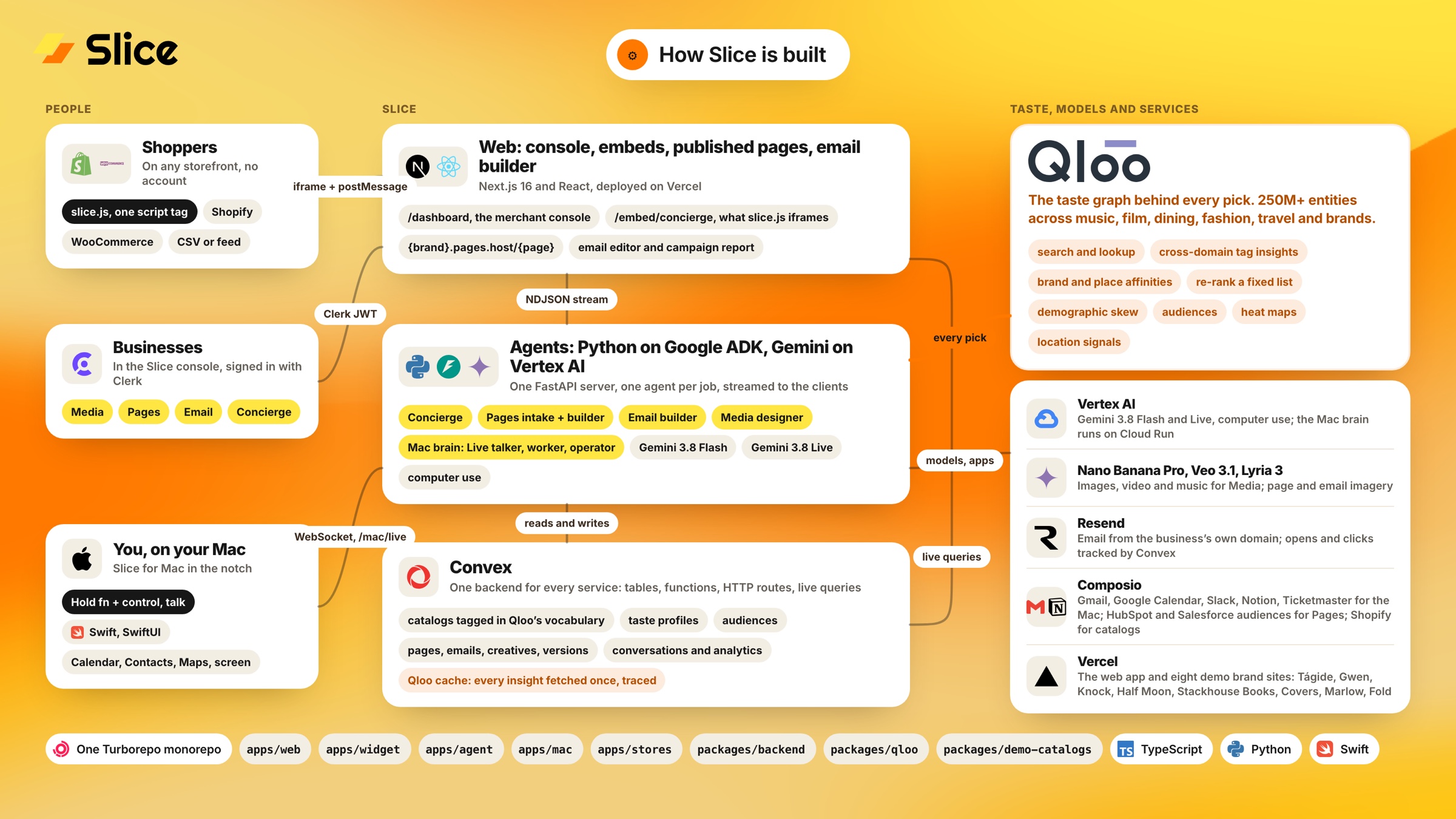
Slice is a Turborepo monorepo. Each service is independent, with its own clients and data, so a business can subscribe to one without the others.
- Agents: Python, Google's Agent Development Kit (ADK) and Gemini on Vertex AI. One FastAPI server hosts the concierge, the Pages intake and builder, the email builder, the Media designer and the Mac brain. The Mac brain uses Gemini Live for the voice and background ADK sessions for work and computer use.
- Qloo: a typed client with every call going through one cached proxy in Convex, so each insight is fetched once and traced. We use search and entity lookup, cross-domain tag insights (style, lifestyle, mood, values), brand and place affinities, re-ranking a fixed list of entities for a signal, demographic skew, location signals, Qloo audiences and heat maps.
- Web: Next.js 16 for the merchant console, the embedded concierge, the published pages and the email builder. Clerk for auth. The widget is one small script that mounts a launcher and talks to the embed over postMessage.
- Data: Convex for everything: catalogs, taste profiles, audiences, pages, campaigns, creatives, analytics and the Qloo cache.
- Mac: Swift and SwiftUI, with EventKit, Contacts, MapKit, ScreenCaptureKit and Accessibility for the hands and eyes, talking to the brain over a WebSocket. Integrations through Composio.
- Generation: Nano Banana Pro for images, Veo 3.1 for video, Lyria 3 for music, Resend for email.
- Demo brands: eight brand sites built and deployed on Vercel so every agent has a real thing to read: Tágide, Gwen, Knock, Half Moon, Stackhouse Books, Covers, Marlow and Fold.
Accomplishments that we're proud of
- Five working agents, each a complete product with its own console, not five demos of one trick.
- Qloo is load-bearing in all of them. Remove it and nothing ranks.
- The "why" is everywhere: a Why report on every creative, a "why this version" on every page, a reason on every email pick, a flip card on every product, a "because you love" under every pick on the Mac.
- Eight demo brands with real catalogs, real restaurants and real lineups, so judges can click through the whole story end to end.
- A native Mac agent that talks, sees your screen, and acts, with taste behind every suggestion and a switch to turn it off.
What we learned
Taste is a layer, not a feature. Once the agents had it as context and as a tool, the same approach worked for a poster, a landing page, an email, a shelf and a weekend. The hard part was never the model. It was turning what people love into something a business's own catalog can be ranked by, and then showing the evidence plainly enough that a shopkeeper trusts it.
We also learned how much better recommendations get when the input is specific. "Under 25 in Lisbon who are into Nike and Tyler" beats "young people" every time, and Qloo rewards that specificity across every domain at once.
What's next for Slice
- Concierge walks into the physical store. A QR code at the door or on a shelf opens a concierge on your phone that is yours alone. It knows the store's stock by taste and tells you which shelf to walk to, so a boutique gets the same help its website has.
- Pages that find the audience you missed. Today the merchant picks who a page is for. Next, the agent watches who actually lands, notices a crowd nobody built a page for, reads its taste through Qloo and drafts that page on its own for the merchant to approve.
- Media picks the creator, not just the creative. Qloo already knows which podcasts, YouTubers and artists an audience follows. The agent shortlists the creators a crowd already trusts and writes each one a brief in their own voice, so a brand can partner instead of only buying ads.
- Slice for Mac speaks first, Proactive. Instead of waiting to be asked, it notices the band you love is playing on your free Friday, or that your friend's birthday is next week and you still have no gift idea. Next it comes to iPhone, so your taste goes where you go.
Built With
- adk
- clerk
- composio
- convex
- fastapi
- gcp
- gemini-live
- nextjs
- python
- qloo
- react
- resend
- swift
- turbo
- typescript

Log in or sign up for Devpost to join the conversation.