-
-
Sleyrius the African and Traditional Astronomer
SLEYRIUS The African Traditional Astronomer – Cultural & Scientific AI By Indye 'Z Corporation
❤️I created Sleyrius as a tribute to my daughter, Dyasley , who has a deep passion for stargazing whenever she can. I wanted to give her this tool as a gift for her Master’s degree, to congratulate her on successfully completing these 5 years with brilliance and grace!
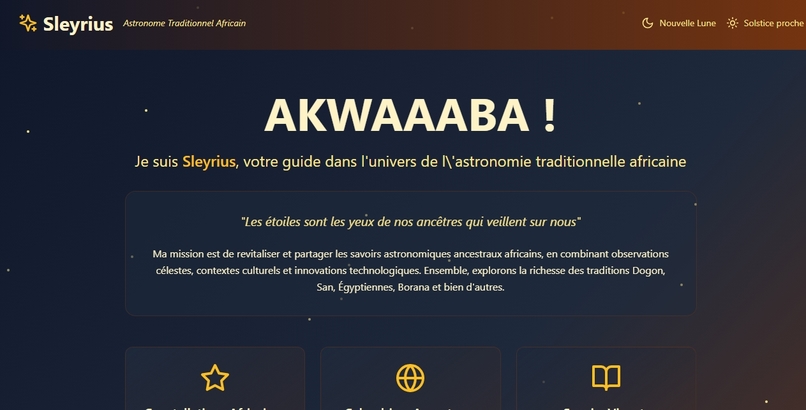
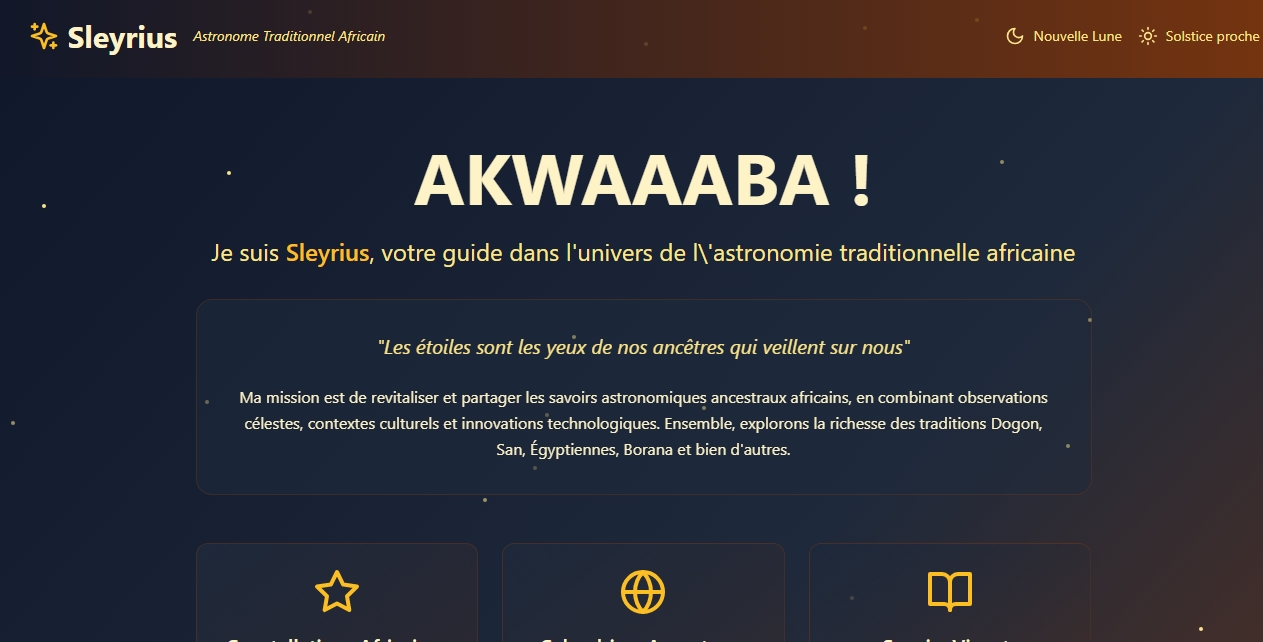
"The stars are the eyes of our ancestors watching over us." AKWAAABA ! Welcome under the stars. 🔭
1 Project Description
Sleyrius is an immersive and interactive platform dedicated to revitalizing and sharing ancestral African astronomical knowledge long neglected in global scientific narratives. By combining traditional observational techniques with modern technologies, this project celebrates and preserves the celestial systems developed by African civilizations over millennia.
It allows users to explore:
Constellations through the lens of Dogon, San, Borana, Yoruba, Egyptian, and other traditions. Traditional calendars based on stellar, lunar, and solar cycles. Ancestral star-based navigation techniques. Historical astronomical instruments (Merkhet, Sudanese Astrolabe, Gnomon). And much more through interactive resources: 3D models, educational quizzes, explanatory videos.
2 Main Features
Celestial Map Interactive exploration of the African night sky, customizable by location (Egypt, Mali, Ethiopia, South Africa) and historical era. Ancestral Calendars Discovery of timekeeping systems based on stars, moon, and sun (Dogon, Borana, Yoruba). Virtual Observatory 3D reconstructions of sites like Nabta Playa, Great Zimbabwe, Sine Ngayène. Stellar Navigation Techniques for maritime, desert, and river navigation based on the stars. Historical Instruments Interactive 3D models and tutorials for building ancient observation tools. Modern Science Bridge Validation of traditional knowledge against modern astronomy and its contemporary impact. Interactive Resources Educational quizzes, video tutorials, 3D visualizations.
3 Tech Stack
Frontend : React + TypeScript Build Tool : Vite Styling : Tailwind CSS 3D Visualization : React Three Fiber, Drei, Three.js Videos : React Player Icons : Lucide React Deployment : Netlify
4 Project Structure
1src/ ├── components/ # Reusable Components │ ├── Header.tsx # Main Navigation │ ├── Hero.tsx # Homepage Banner │ ├── StellarMap.tsx # Celestial Mapping │ ├── CalendarSection.tsx# Ancestral Calendars │ ├── Observatory.tsx # Virtual Observatory │ ├── NavigationTools.tsx# Star Navigation │ ├── Instruments.tsx # Historical Tools │ ├── ModernBridge.tsx # Modern Science │ ├── InteractiveResources.tsx # Interactive Hub │ ├── ModelViewer.tsx # 3D Viewer │ ├── QuizComponent.tsx # Thematic Quizzes │ ├── VideoTutorial.tsx # Video Player │ └── Footer.tsx # Footer ├── App.tsx # Root Component └── main.tsx # Entry Point
5 Installation
Clone the project bash git clone https://github.com/yourname/sleyrius.git Install dependencies npm install Start development server npm run dev Build for production npm run build
6 Design System
Color palette inspired by the African night sky: deep blue, ochre, black. Intuitive and immersive interface. Responsive design for all devices. Subtle, context-aware animations.
7 Included Educational Resources
3D Models : Merkhet, Sudanese Astrolabe, Gnomon. Thematic Quizzes : Constellations, Calendars, Navigation. Embedded YouTube Videos : The Mystery of Sirius B Nabta Playa Star Navigation
8 Cultural & Educational Impact
Sleyrius brings back a forgotten heritage, reconnecting younger generations with their scientific and cultural roots. It aims to:
9 Highlight African contributions to the history of astronomy.
Inspire intercultural learning. Promote preservation of intangible cultural heritage. 🏁 Deployment The site is deployed on Netlify: 🔗 https://sleyrius.netlify.app
10 Contributions
Contributions are welcome! You can contribute to: ai.afrocentree@gmail.com
11 Documentation
Integration of new cultures and languages Development of new interactive modules Translation of content into other African languages To contribute, open a PR or contact me via GitHub.
12 Associated PDF Guide
📥 Download the full guide: PDF Guide: African Astronomical Instruments and Technologies
13 🧗♀️ Challenges We Faced
Incomplete Data : Much traditional knowledge is oral or fragmented. Cultural Translation : Adapting concepts without altering symbolic or sacred meanings. Accessible Technology : Making the experience work on basic devices and offline. Scientific Accuracy vs Cultural Interpretation : Balancing rigor with respect for beliefs.
14🏅 Accomplishments We're Proud Of
Interactive 3D models of traditional astronomical instruments (Merkhet, Bay…) Contextual Q&A system that answers culture-specific astronomy questions Dynamic visualizations of lunar and solar cycles across traditions Documentation of lesser-known sites like Sine Ngayène and Great Zimbabwe Validation of traditional systems against modern astronomy (e.g., Dogon Sirius B cycle)
15🧠 What We Learned
African civilizations developed highly precise astronomical systems , often better suited to their environment than Western models. Technology can serve cultural preservation , not just innovation. There’s strong global interest in rediscovering Africa’s scientific roots . Combining AI with ancestral wisdom creates powerful, transformative educational tools.
16 🚀 What’s Next for Sleyrius
Upcoming Steps: Mobile First : Offline mobile app for rural areas AR/VR Experience : Explore constellations in augmented or virtual reality Education Kits : Teaching materials for primary and secondary schools in Africa Citizen Science Platform : Collaborative documentation of living astronomical traditions Digital Museums : Partnerships to digitize and display historical instruments
17 ✨ Conclusion
Sleyrius is more than an app or tech project — it’s a renaissance . A reconnection with our celestial past, a bridge between stars and roots. It’s an educational, cultural, spiritual, and scientific tool that places Africa at the heart of the history of astronomy.
18 📣 Call to Action
Join us on this cosmic journey! Support the preservation of ancestral knowledge. Share this vision. Together, let’s rediscover the sky through the eyes of our African ancestors.
19 Inspirational Quote
"The stars are the eyes of our ancestors watching over us." — Sleyrius
Thank You Thank you to the African community and researchers around the world for preserving ancestral knowledge. Special thanks to BOLT and DevPost for this space of creation and sharing.
🚀contact : ai.afrocentree@gmail.com https://vimeo.com/1097355525
🙌 AKWAAABA ! 🌟 (Welcome under the stars.)
Indye Gyal
IN FRENCH"*
🌟 SLEYRIUS L'Astronome Traditionnel Africain – IA Culturelle & Scientifique
1 💡 Inspiration
Sleyrius naît d’un besoin urgent : redonner vie aux connaissances astronomiques africaines ancestrales, longtemps ignorées ou minimisées dans le récit scientifique mondial. En s’appuyant sur les systèmes complexes mis en place par les Dogon, les Égyptiens, les Borana, les San et bien d’autres, Sleyrius propose une fenêtre immersive vers le ciel tel que nos ancêtres l’observaient, le comprenaient et l’utilisaient.
2 🔭 Ce qu’il fait
Sleyrius est une Intelligence Artificielle culturelle et astronomique conçue pour :
Cartographier le ciel nocturne à travers la vision des cultures africaines. Reconstituer et expliquer les constellations locales (Dogon, Borana, San, etc.). Simuler les calendriers traditionnels basés sur les étoiles, la lune et le soleil. Recréer virtuellement des sites astronomiques historiques (Nabta Playa, Great Zimbabwe, etc.). Apprendre et enseigner les techniques de navigation stellaire et les instruments anciens (merkhet, bay, gnomon…). Offrir un simulateur interactif pour construire, tester et utiliser ces instruments. Faire le lien entre traditions ancestrales et science moderne via des validations scientifiques.
3 ⚙️ Comment on l’a construit
Technologies Utilisées : Frontend : React + Three.js pour les visualisations 3D du ciel Backend : Python + bibliothèques astronomiques (Astropy) IA : Modèle de langage spécialisé entraîné sur un corpus de données ethnographiques, archéoastronomiques et mythologiques africaines Base de Données : MongoDB pour stocker les relations complexes entre mythes, étoiles, pratiques et lieux Architecture : Interface inspirée de l'art rupestre africain Sonorités immersives (musique, voix, ambiances) Multilinguisme intégré (français, anglais, swahili, yoruba, bambara, etc.) Mode hors ligne prévu pour les zones rurales
4 🧗♀️ Défis Rencontrés
Données incomplètes : Beaucoup de savoirs astronomiques sont oraux ou fragmentaires. Traduction culturelle : Adapter les concepts sans altérer leur sens symbolique ou sacré. Technologie accessible : Rendre l’expérience possible même sur appareils simples ou sans connexion internet. Précision scientifique vs interprétation culturelle : Maintenir un équilibre entre rigueur et respect des croyances.
5 🏅 Réalisations dont nous sommes fiers
Création de modèles 3D interactifs d’instruments astronomiques traditionnels (Merkhet, Bay…) Mise en place d’un système de dialogue contextuel capable de répondre à des questions précises liées à la culture et à l’astronomie locale Intégration de visualisations dynamiques des cycles lunaires et solaires selon diverses traditions Documentation de sites méconnus comme Sine Ngayène et Great Zimbabwe Validation de certains systèmes traditionnels contre l’astronomie moderne (ex: cycle de Sirius B chez les Dogon)
6 🧠 Ce que nous avons appris
Les civilisations africaines ont développé des systèmes astronomiques extrêmement précis , souvent plus adaptés à leur environnement local que les modèles occidentaux. La technologie peut être au service de la préservation culturelle , pas seulement de l’innovation pure. Il existe une forte demande mondiale de redécouverte des racines scientifiques africaines . Le mélange d'IA et de savoir ancestral peut créer des outils éducatifs puissants et transformateurs.
7 🚀 Perspectives futures pour Sleyrius
Prochaines étapes : Mobile First : Application mobile disponible offline pour les zones rurales Expérience AR/VR : Explorer les constellations en réalité augmentée ou virtuelle Éducation : Développement de kits pédagogiques pour les écoles primaires et secondaires africaines Science Citoyenne : Plateforme collaborative pour documenter et cartographier les pratiques astronomiques vivantes Musées Numériques : Partenariats avec des institutions pour numériser et exposer des instruments historiques
8 Conclusion
Sleyrius n’est pas simplement une application ou un projet technologique — c’est une renaissance. Une reconnexion avec notre passé céleste, un pont entre les étoiles et nos racines. C’est un outil éducatif, culturel, spirituel et scientifique, qui remet l’Afrique au cœur de l’histoire de l’astronomie.
9 📣 Appel à l'action
Rejoignez-nous dans cette aventure cosmique ! Soutenez la préservation des savoirs ancestraux. Partagez cette vision. Et ensemble, redécouvrons le ciel à travers les yeux de nos ancêtres africains.
AKWAAABA ! 🌟 (Bienvenue sous les étoiles.)
Built With
- react
- tailwind
- typescript
- vite

Log in or sign up for Devpost to join the conversation.