-
-
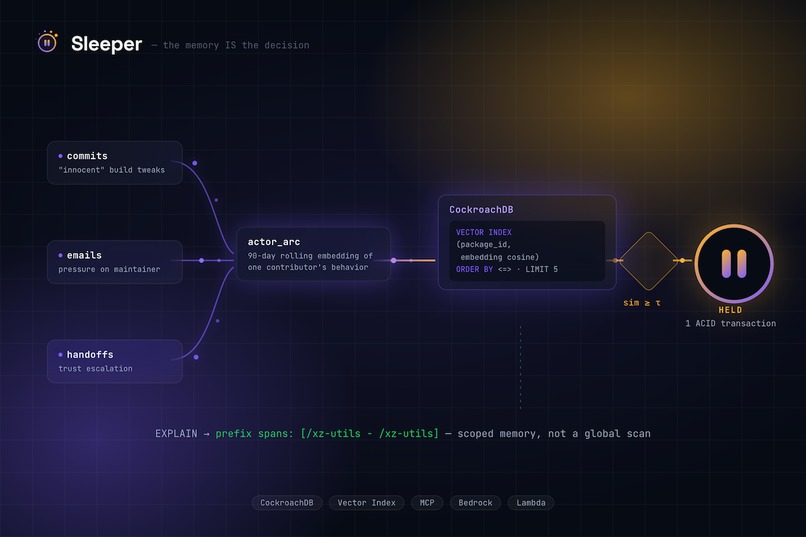
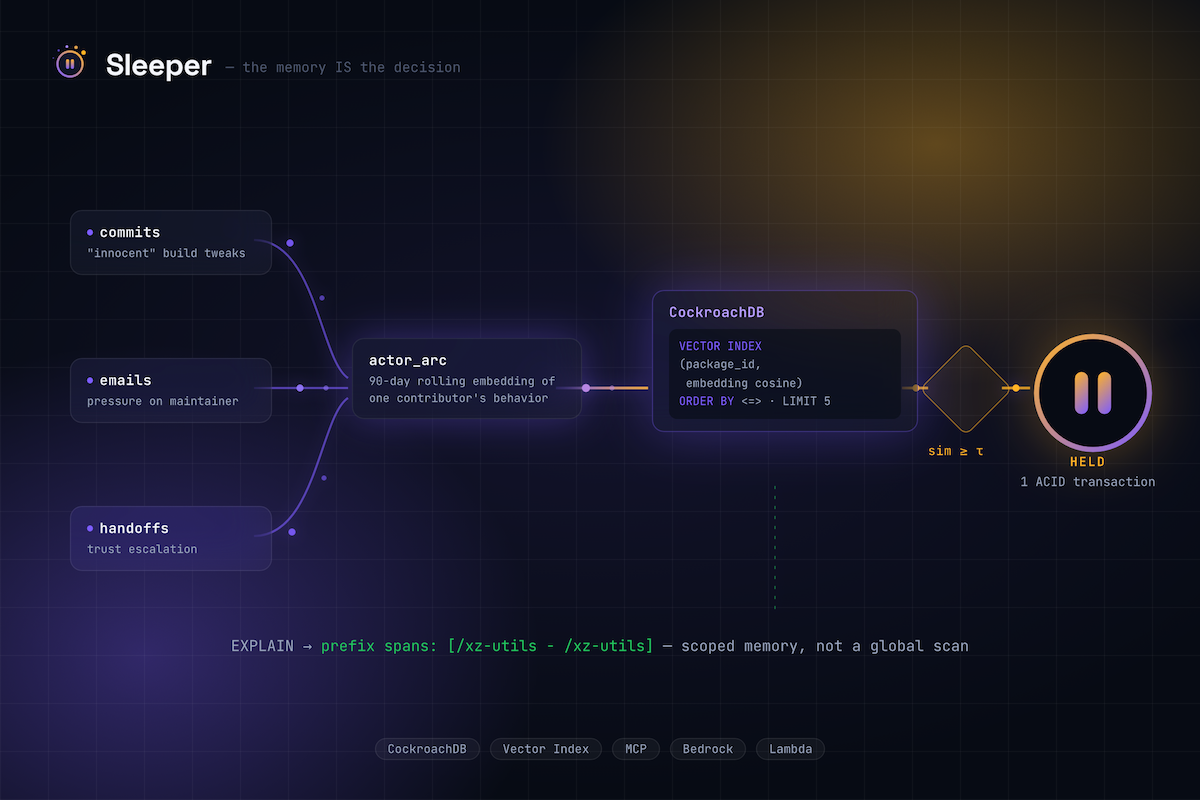
Commits, emails and handoffs become one actor arc, searched by CockroachDB's vector index. Match a takeover shape and the release is HELD.
-
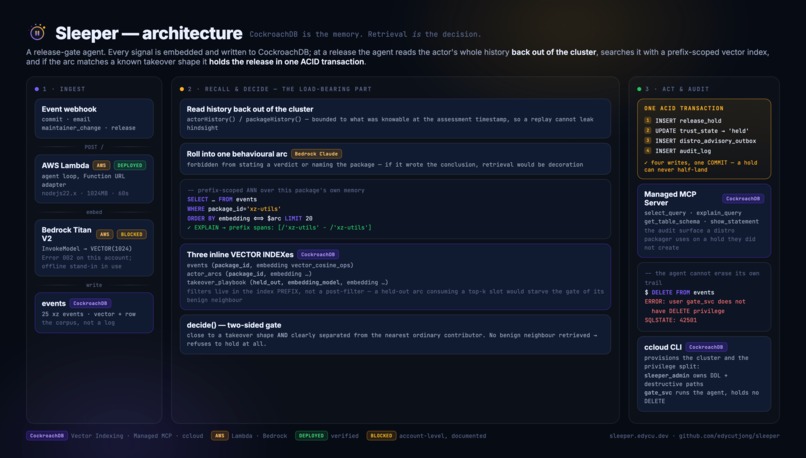
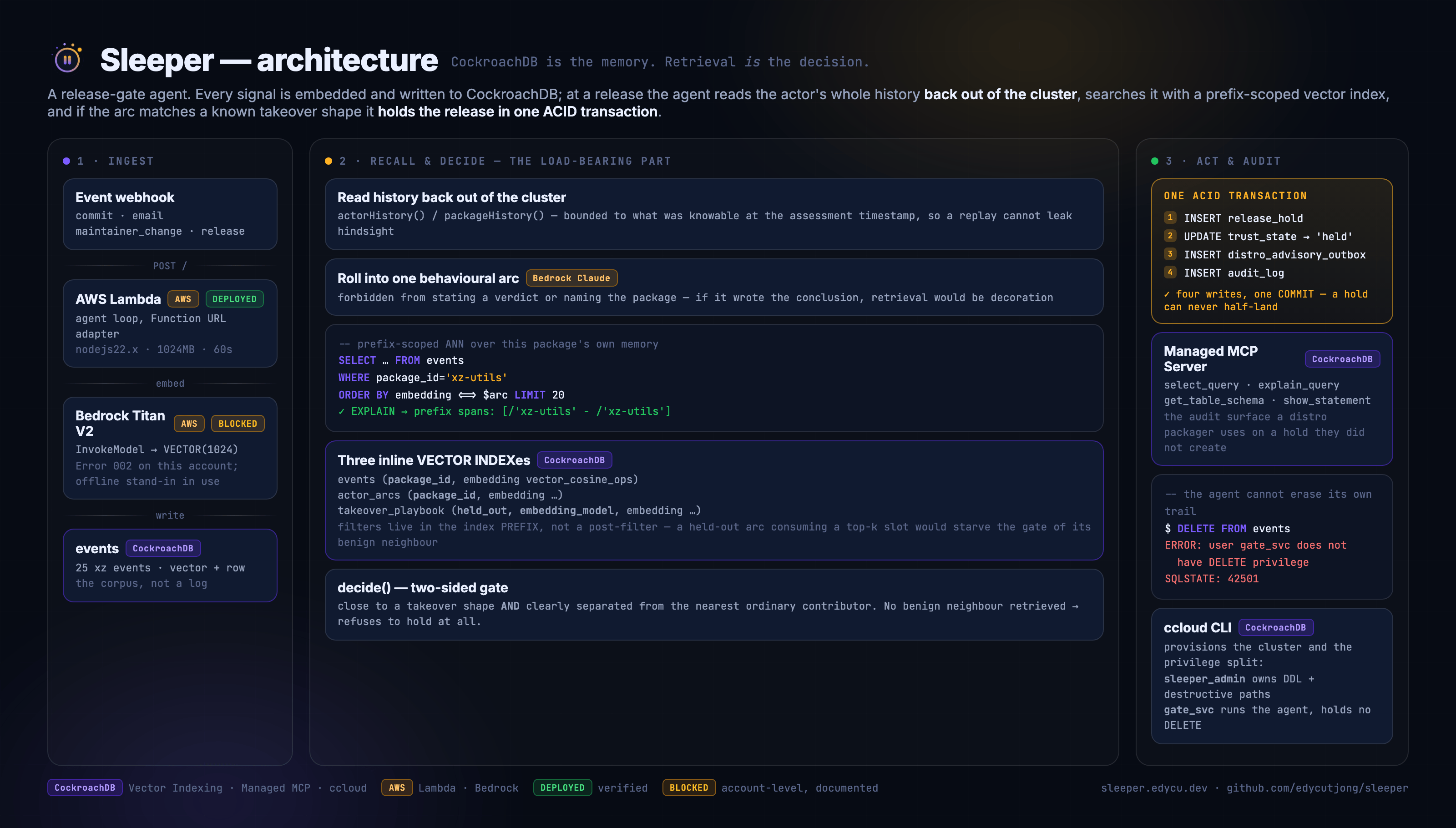
Ingest to CockroachDB, prefix-scoped vector recall, then a four-write ACID hold. Badges show what is deployed and what is blocked.
-
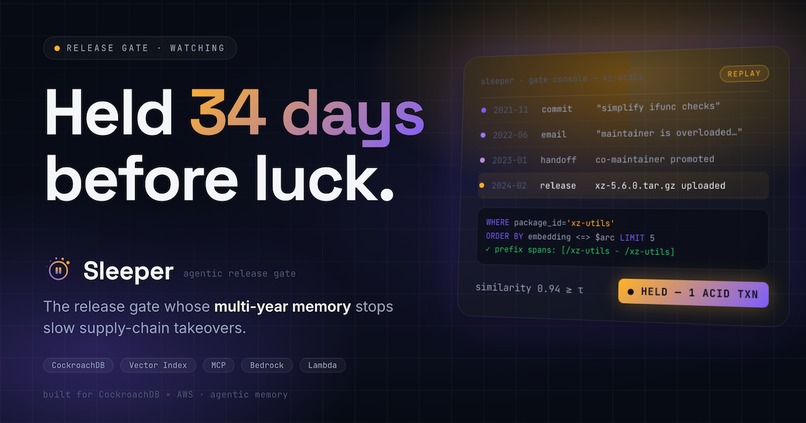
xz 5.6.0 shipped 2024-02-24. The world found the backdoor 34 days later, by luck. Sleeper holds it at the upload.
-
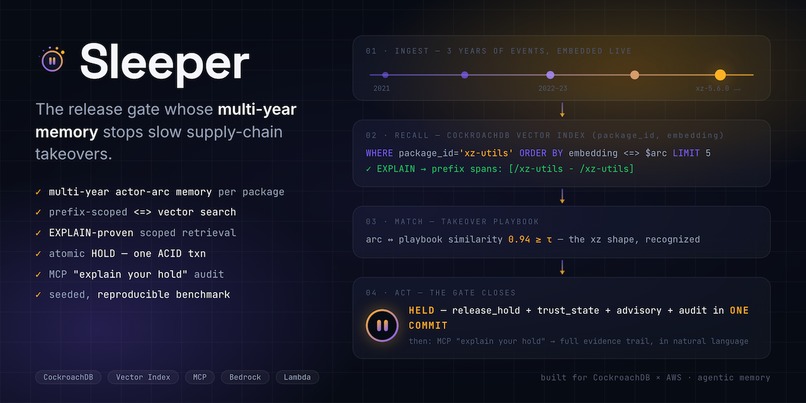
Ingest, recall, match, act. EXPLAIN proves the ANN scan was prefix-scoped to one package instead of scanning the whole cluster.
-
Sleeper - a release gate whose multi-year memory in CockroachDB sees the takeover no single code review can.
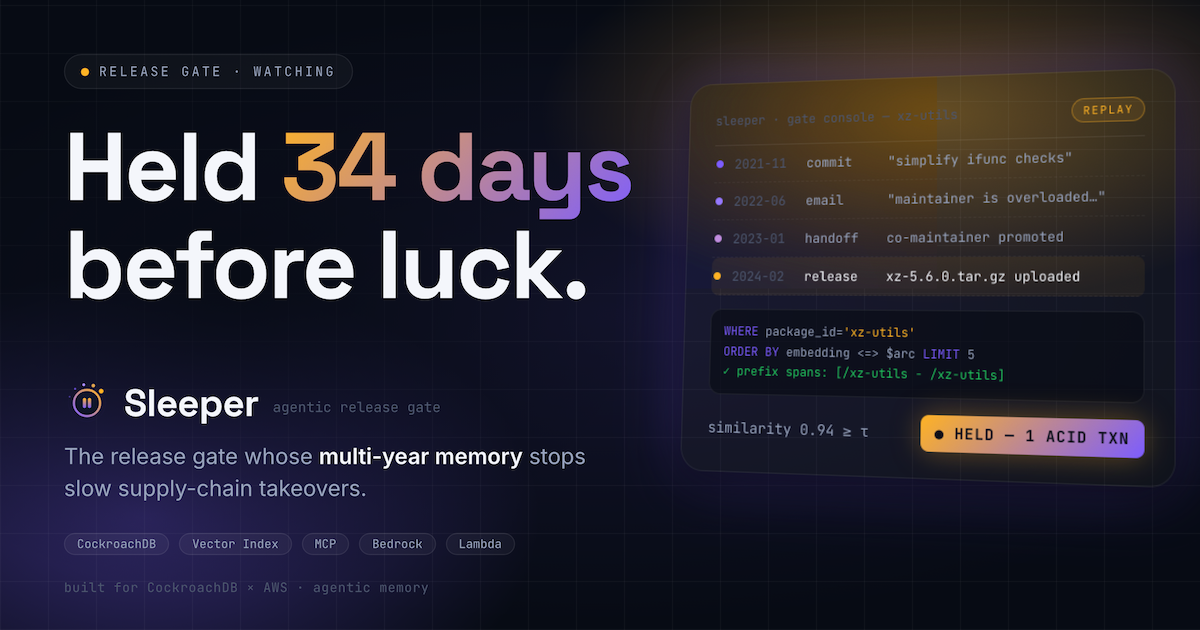
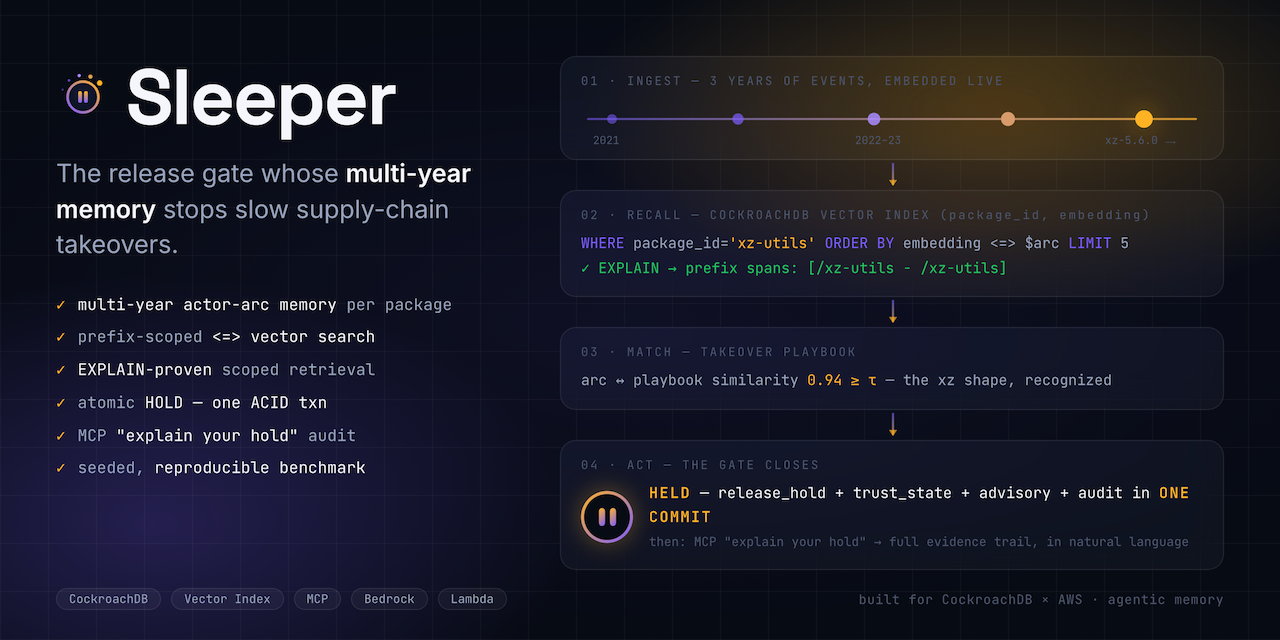
Sleeper watches a critical open-source package the way no human reviewer can: continuously, for years, remembering every commit, email and maintainer change. When a release is about to ship it rolls the contributor's entire trajectory into one behavioural arc, searches its own memory with CockroachDB's distributed vector index, and if that arc matches the shape of a known takeover it holds the release — atomically, with an audit trail a distro packager can query in one statement. Replaying the real public xz-utils timeline, it holds at the 5.6.0 upload: the moment the backdoor actually shipped, and 34 days before the real world found it by luck — 5.6.0 went out 2024-02-24, the backdoor was disclosed 2024-03-29.
Inspiration
On 2024-03-29 a backdoor was found in xz-utils (CVE-2024-3094), a compression library running on essentially every Linux machine on Earth. It had been planted over roughly two and a half years by a contributor who built trust one innocuous commit at a time — real bug fixes, plausible mailing-list posts, patient helpfulness toward an exhausted sole maintainer, two sockpuppet accounts pressuring him to hand over control, and finally release-signing authority.
What stayed with us is that no single commit was suspicious, and no single code review could have caught it. The tell existed only in the shape of the arc. And it was found five weeks after the poisoned tarball shipped, because one engineer got curious about 500 ms of unexplained SSH login latency. That is not a process — that is luck, and luck does not scale to the next one.
That framing made the memory layer the entire product rather than a feature of it. If the signal only exists across years of accumulated context, then whatever holds that context is the detector. Everything else is plumbing around it.
What it does
Sleeper is a release gate for a critical open-source package.
- Every signal — commit, mailing-list post, maintainer change, release — is embedded with AWS Bedrock Titan Text Embeddings V2 and written into CockroachDB.
- When a release event arrives, the agent reads that actor's history back out of the cluster (never out of the seed file), bounded to what was knowable at that timestamp, and rolls it into a single behavioural arc summary with Claude on Bedrock.
- The arc is embedded and searched two ways: a prefix-scoped ANN query over this package's own memory, and an unscoped query against a playbook of known takeover and ordinary-contributor arc shapes.
- If the arc is both close to a takeover shape and clearly separated from the nearest ordinary contributor shape, Claude composes a hold rationale and a distro advisory, and Sleeper commits the hold as one ACID transaction: insert the hold, flip the package's trust state, queue the advisory, write the audit row.
- A maintainer or downstream packager then asks "why did you hold my release?" and gets the whole
evidence trail back — the matched arc, the similarity, the threshold in force, the
EXPLAINverdict and the structural evidence.
Step 5 is safe to paste as written. That read path now runs over the Cloud Managed MCP Server
and has been verified end to end against https://cockroachlabs.cloud/mcp — all four read tools,
with explain_query returning the prefix spans proof computed by CockroachDB itself. The
transcript is committed at build/DEMO.md §2c. Direct SQL remains the tested fallback, and every
run prints which path served the evidence.
(This block previously warned against claiming MCP at all, because the integration was unwired. Two of the three CockroachDB tools were at risk of failing Stage One. That is resolved.)
One thing in that list has not actually executed, and we would rather say it here than let you
find it. Steps 1 and 2 describe Bedrock in the present tense because that is what the code does —
but Bedrock is blocked account-wide on our AWS account. Every InvokeModel/Converse call, for
Amazon Titan and Amazon Nova as well as Anthropic, in us-east-1 and us-west-2, from the Bedrock
console playground as much as the SDK, returns ValidationException: Error 002: Access to Bedrock
models is not allowed for this account. The Anthropic use case form is submitted and on file, and
GetFoundationModelAvailability reports AUTHORIZED/AVAILABLE, so this is an account entitlement
issue with an open AWS support case — not a missing integration.
What that means for everything else in this submission: no number here came from Bedrock. Every
embedding in the live cluster carries embedding_model = offline-fnv1a-1024, and the single
release_hold row is from the preview lane and labels itself [TEMPLATED TEXT — NOT MODEL OUTPUT]
in its own reason column. The demo video says this on camera rather than glossing it.
What is real and reproducible, all of it visible in the video: the CockroachDB Cloud cluster with
its three vector indexes, EXPLAIN proving the ANN scan was prefix-scoped to one package, the
attack ranked out of memory by vector similarity, the four-write atomic hold, the privilege split
refusing gate_svc a DELETE with SQLSTATE 42501, and the agent loop deployed and answering on
AWS Lambda (aws lambda invoke on /health returns {"ok":true}).
How we built it
CockroachDB is the engine, not the store. Three inline VECTOR INDEX declarations. events is
scoped on (package_id, embedding vector_cosine_ops), so ANN search is pre-filtered to one
package's history rather than scanning the cluster. takeover_playbook is scoped on
(held_out, embedding_model, embedding vector_cosine_ops) — both exclusions live in the index
prefix rather than in a WHERE clause, because a held-out arc consuming a top-k slot would starve the
two-sided gate of the benign neighbour it needs to measure a margin against.
We do not assert prefix-scoping in prose. EXPLAIN runs on the live query, the test suite fails if
prefix spans disappears, and — the part we care about most — the same proof now comes back from
CockroachDB Cloud's Managed MCP Server: explain_query returns
prefix spans: [/'xz-utils' - /'xz-utils'] computed server-side, over the same statement the agent
runs, to a client that could not have fabricated it.
The atomic hold is why this is CockroachDB rather than a vector database bolted onto a relational one: the vector search that produces the decision and the transactional state change that acts on it are the same system, so a hold can never half-land. There is no window where a release is blocked with no advisory queued, or an advisory goes out for a hold that was rolled back. We test that by killing a transaction mid-write and asserting nothing survives.
The Managed MCP Server serves the audit surface — the reads a distro packager performs on a hold
they did not create. src/mcp.ts drives select_query, explain_query, get_table_schema and
show_statement, binding argument names to the schema the server advertises in tools/list rather
than hardcoding them. That decision paid on first contact: the real argument is query, not sql,
and database is required on three of the four tools. The write path never uses MCP — one statement
per call cannot express a four-write transaction, and pretending otherwise would break the one
invariant the project rests on.
AWS Bedrock does all inference — Titan Text Embeddings V2 (InvokeModel) for every event and
arc vector, Claude (Converse) for the arc rollup, the hold rationale and the advisory. Lambda
hosts the agent loop, webhook-shaped: one event arrives, is embedded, written, and assessed against
everything already in memory. ccloud provisions the cluster and a privilege split along the line
that actually exists in the code — setup versus runtime: sleeper_admin owns DDL and the
destructive setup paths, gate_svc runs the agent and holds no DELETE on any table, so the running
agent cannot erase an event, a hold, an advisory or an audit row. Verified by execution rather than
asserted: gate_svc attempting DELETE FROM events is refused with SQLSTATE 42501.
The stack is deliberately small — TypeScript on Node 22, pg, the Bedrock SDK, and Node's own http
module for the demo. No framework, so everything a judge reads is the actual mechanism.
Challenges we ran into
Proving the retrieval was scoped, not just believing it. "Vector search on CockroachDB" is easy
to claim and hard to verify. Getting EXPLAIN output that names the vector index and shows a
bounded prefix span, then wiring that assertion into CI and putting it on camera, took longer than
writing the query — and it is the single most load-bearing thing in the demo.
Not letting the benchmark be circular. The obvious version of this project trains on xz and then detects xz, which proves nothing. We split the corpus: the real xz timeline is the ground-truth hero replay and contributes to no reported number, while accuracy is measured only on held-out synthetic arcs that are excluded from every retrieval the agent runs. Thresholds are fitted by leave-one-out on the playbook split alone, never on the evaluation set, and the fitted file is gitignored so a threshold from a different embedding model cannot silently move the gate. We also run a lexical baseline over the same queries, because a similarity number means nothing without knowing what keyword matching alone would have scored.
Designing a gate that does not cry wolf. A bare "similarity ≥ X" rule flags every new, prolific contributor — which describes most good first-time maintainers, and would make the tool worse than useless in a real project. The decision became two-sided: hold only when the arc is close to a takeover shape and meaningfully closer to it than to the nearest ordinary-contributor shape. Several benign arcs in the playbook are written to superficially resemble takeovers so that second test has teeth.
Keeping the rules out of the decision. We compute structural signals — tenure, how fast trust escalated, what share of commits touch build machinery, which accounts pushed for a handover without contributing code. It was tempting to let them vote. We kept them strictly evidentiary, cited in the rationale but excluded from the decision, because mixing a hand-tuned rule engine into it would have turned the benchmark into a measurement of our rules rather than of the memory.
Accomplishments that we're proud of
- The agent picks the suspect itself. With no actor configured, replaying the real xz timeline
ranks candidates out of memory and assesses
jia-tan— and the two runners-up aredennis-ensandjigar-kumar, the actual sockpuppet accounts that pressured the maintainer into the handover. Nobody told it where to look. - The
prefix spansproof is produced by CockroachDB, not by us. It is in the demo, innpm run explain, in the test suite, and — via the Managed MCP Server's ownexplain_query— returned by the server to a client that could not have faked it. - The atomic hold survives an explicit mid-transaction kill test with no partial state, and
commitUnholdgives it an exit that appends a resolution rather than deleting the record. - The structural evidence the agent extracts from memory is, independently, a correct reconstruction of the real attack: 862 days of tenure, privilege escalation 188 days after first activity, 43% of commits touching build machinery, two no-code accounts that argued for the handover and then went silent.
- 588 tests. On a fresh clone with no database and no AWS account,
npm testprints522 passed | 66 skipped— and aDATABASE_URLthat is set but unreachable skips those 66 with the reason printed (including the exact commands to start a cluster), because a stale credential should not look like broken code. Against a live CockroachDB node the full 588 run green. - The honesty scaffolding — held-out splits, leave-one-out calibration, a lexical baseline, and a bench script that refuses to compute accuracy when inference is stubbed, because a quality number derived from a hash function is a property of the hash.
What we learned
That "agentic memory" is a real architectural claim, not a synonym for a vector table. The moment we made the agent read its history back out of CockroachDB rather than from the file it ingested, the design got simpler and the point-in-time correctness problem became visible — a replay can otherwise leak hindsight into a past decision without anyone noticing.
We also learned how much of the work in a detection system is defending against your own optimism. Most of the engineering effort here went into making the result harder to believe: splitting the corpora, keeping calibration blind, adding a baseline, and building a mode that loudly refuses to produce numbers.
And the sharpest lesson came from the first live call to the Managed MCP Server, which disproved
three things we believed. We had documented the audit path as "read-only at the protocol layer" on
the assumption that a narrow cluster role yields a read-only tool list. It does not: tools/list
is not role-filtered, insert_rows is advertised to an identity that cannot execute a single call,
and no CockroachDB Cloud role grants MCP reads without also granting writes. The guard we had
written to enforce that belief was worse than the belief — it refused any session advertising a
write tool, which is every real session, so it would have silently disabled MCP in production while
printing a security-shaped reason for the outage. What actually keeps that path read-only is that
our client only ever builds SELECT, EXPLAIN and SHOW. That is discipline, not a boundary, and the
difference is worth saying out loud. The enforced boundary is at the SQL layer, where gate_svc
genuinely cannot DELETE.
The general version: binding to what a service advertises at runtime, rather than to what you assume it accepts, is the difference between an afternoon and a rewrite.
What's next for Sleeper
Multi-package monitoring with cross-package arc matching (an actor operating across several
ecosystems is a much stronger signal than one in isolation). S3-backed build-vs-source tarball
diffing, since in the real xz attack the malicious code lived only in the distributed tarball's
build-to-host.m4 and never in git. Real webhook ingestion against live repositories. And
calibration against a much larger corpus of reconstructed historical takeovers — the mechanic is
only as good as the playbook it matches against.
Built With
- amazon-bedrock
- amazon-titan-embeddings
- amazon-web-services
- aws-lambda
- ccloud
- claude
- cockroachdb
- cockroachdb-mcp-server
- cockroachdb-vector-index
- mermaid
- node.js
- postgresql
- server-sent-events
- typescript
- vitest

Log in or sign up for Devpost to join the conversation.