-
Application at Work
Inspiration
The inspiration for SleepAdvisor arose from a deep concern for the well-being of labor and construction workers. These hardworking individuals often face physically demanding and exhausting work environments. Fatigue, due to insufficient sleep and strenuous work hours, can lead to reduced productivity, increased accidents, and detrimental health effects. We wanted to use technology to address these challenges and improve the overall quality of life for these workers.
What it does
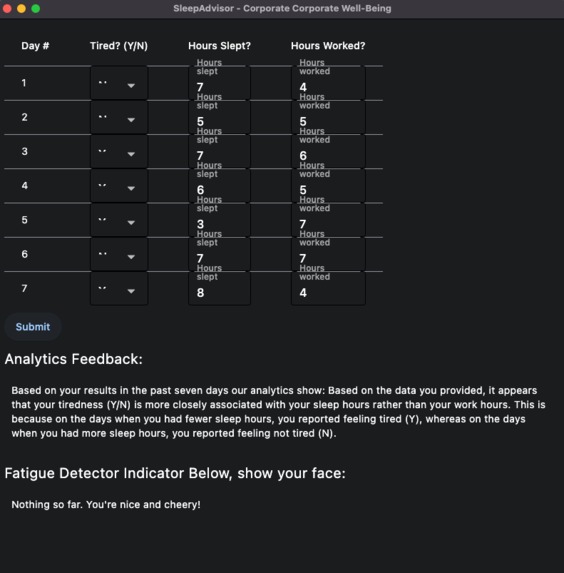
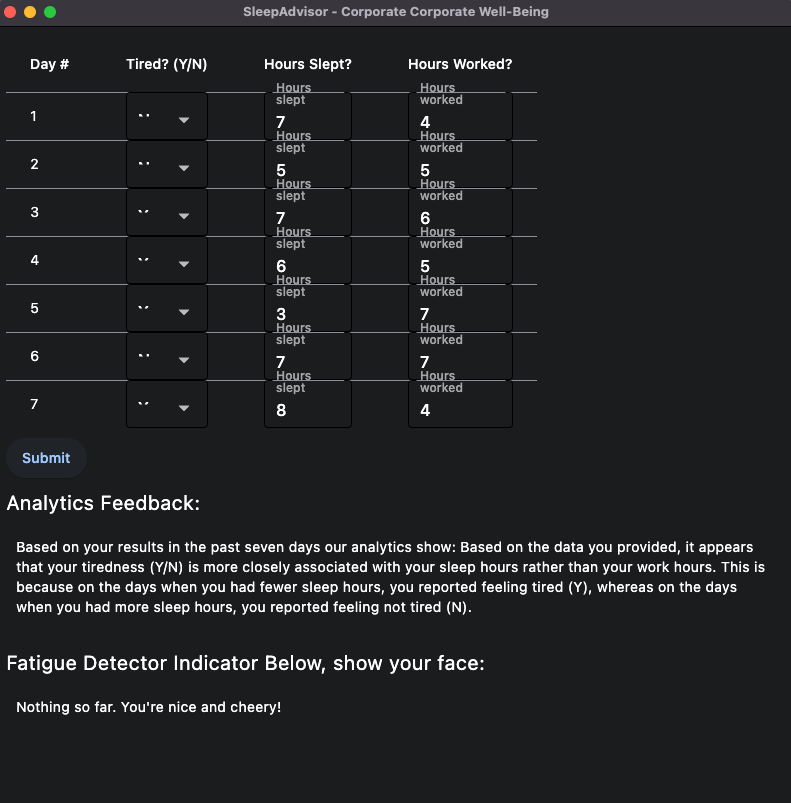
SleepAdvisor is a facial recognition software that is designed to detect signs of fatigue in a person's face. It utilizes artificial intelligence to analyze facial features and expressions, providing real-time assessments of a worker's alertness and energy levels. In addition, SleepAdvisor collects and stores data on the worker's sleep hours, work hours, and self-reported tiredness (yes or no) for the past seven days. The software then combines this data to make intelligent recommendations for each worker based on their unique circumstances.
How we built it
We built SleepAdvisor through a multi-step process:
Data Collection: We gathered a dataset of facial images and expressions to train our facial recognition model. We also collected historical data on sleep hours, work hours, and self-reported tiredness for each worker.
AI Development: We developed the facial recognition model using deep learning techniques. This model can assess a worker's fatigue level based on their facial features and expressions.
Data Analysis: We analyzed the collected data to understand the relationships between sleep, work, and fatigue levels. Machine learning algorithms were employed to find patterns and correlations.
Recommendation Engine: We designed an AI-driven recommendation engine that processes the worker's historical data and real-time facial assessments to suggest appropriate actions. These recommendations could include taking breaks, adjusting work hours, or getting more sleep.
User Interface: SleepAdvisor features a user-friendly interface for both workers and supervisors to access and understand the recommendations. Workers can input their daily tiredness status, and supervisors can monitor the workforce.
Deployment: The software is deployed on-site, utilizing cameras for facial recognition and integrating with existing time tracking and scheduling systems.
Challenges we ran into
Developing SleepAdvisor presented several challenges, including:
Data Privacy: Ensuring that the facial recognition and worker data remained secure and adhered to privacy regulations.
Accuracy: Achieving high accuracy in detecting fatigue through facial expressions, as it's a complex and subtle task.
Real-time Processing: Ensuring that the AI model can provide real-time assessments without causing delays in the workflow.
Integration: Integrating the software with existing systems used by construction and labor companies.
Accomplishments that we're proud of
Our team is proud of several accomplishments:
Successfully training a robust facial recognition model for fatigue detection.
Developing a recommendation engine that takes into account individual worker data for tailored suggestions.
Ensuring compliance with data privacy regulations and security standards.
Building an intuitive user interface for both workers and supervisors.
What we learned
While developing SleepAdvisor, we gained valuable insights into:
The complexities of facial recognition technology and its practical applications.
The importance of data privacy and security in AI-driven solutions.
The challenges and rewards of integrating AI into the labor and construction industry.
The potential for technology to significantly enhance worker safety and well-being.
What's next for SleepAdvisor
In the future, SleepAdvisor aims to:
Expand its user base and continue refining the facial recognition model for greater accuracy.
Incorporate more comprehensive health and safety features, such as monitoring vital signs.
Partner with labor and construction companies to implement SleepAdvisor on a broader scale.
Explore opportunities for real-time feedback and interventions, such as alerting a supervisor when a worker is at risk of fatigue-related accidents.
Contribute to the reduction of workplace accidents and the improvement of worker health and productivity in high-demand industries.

Log in or sign up for Devpost to join the conversation.