

Inspiration
According to Pew Research, 9 in 10 adults have transitioned to the online media for news sources. This online era for news collides with the rising trend towards short form content seen in mediums like TikToks, Tweets, and Youtube Shorts. These mediums accommodate for the decreasing attention span of the average individual. However news sites still lag behind, providing in-depth articles for readers who are consistently decreasing their time spent on these entries, with visitation times on news sites decreasing from 2.13 minutes to 1.95 minutes from 2019 to 2020. These articles are often skimmed over and information becomes misconstrued within the reader’s opinion. Online news also lacks credibility. The age of the internet comes with a renewed access to choices, some better or worse than the other. Fake news is pervasive throughout the internet and with these fake news and fake headlines permeates the misinformation spreading within America’s communities. Sleek looks to offer in-depth analysis of articles and journal entries, modernizing the outdated news format into the new age format of short digestible content, making up for the lack of depth most readers have neglected in recent years.
What it does
Our project serves high quality, and relevant insights to our users utilizing state of the art text analytic techniques, including text vectorizers and transformers. Given a url of an article, our project will give the user three insights: 1. The most important sentences in article 2. A summary of the article 3. Whether or not the article is fake or not. Using a custom transformer model, we can identify whether an article contains fake elements, and using a tfidfvectorizer, we obtain the most important sentences. This is all with the intentions of serving our users with an optimal learning experience.
How we built it
We utilized the Flask framework for Python to integrate both HTML and CSS into a front end with a python backend. We decided on Python due to its access to machine learning and various NLP processors, which we could use for our final product.
Challenges we ran into
We struggled with the similar article accuracy at first, as the model was not trained long enough to yield acceptable results. We fixed this by retraining it overnight, and it was much more accurate. It was also a struggle to communicate jobs between team members, and we fixed this by locking in jobs and tasks that each of us could accomplish independently. The final challenge we faced was hosting the website externally, through Azure. It worked at first with a template webpage, but ultimately failed due to size limitations and complications with the code.
Accomplishments that we're proud of
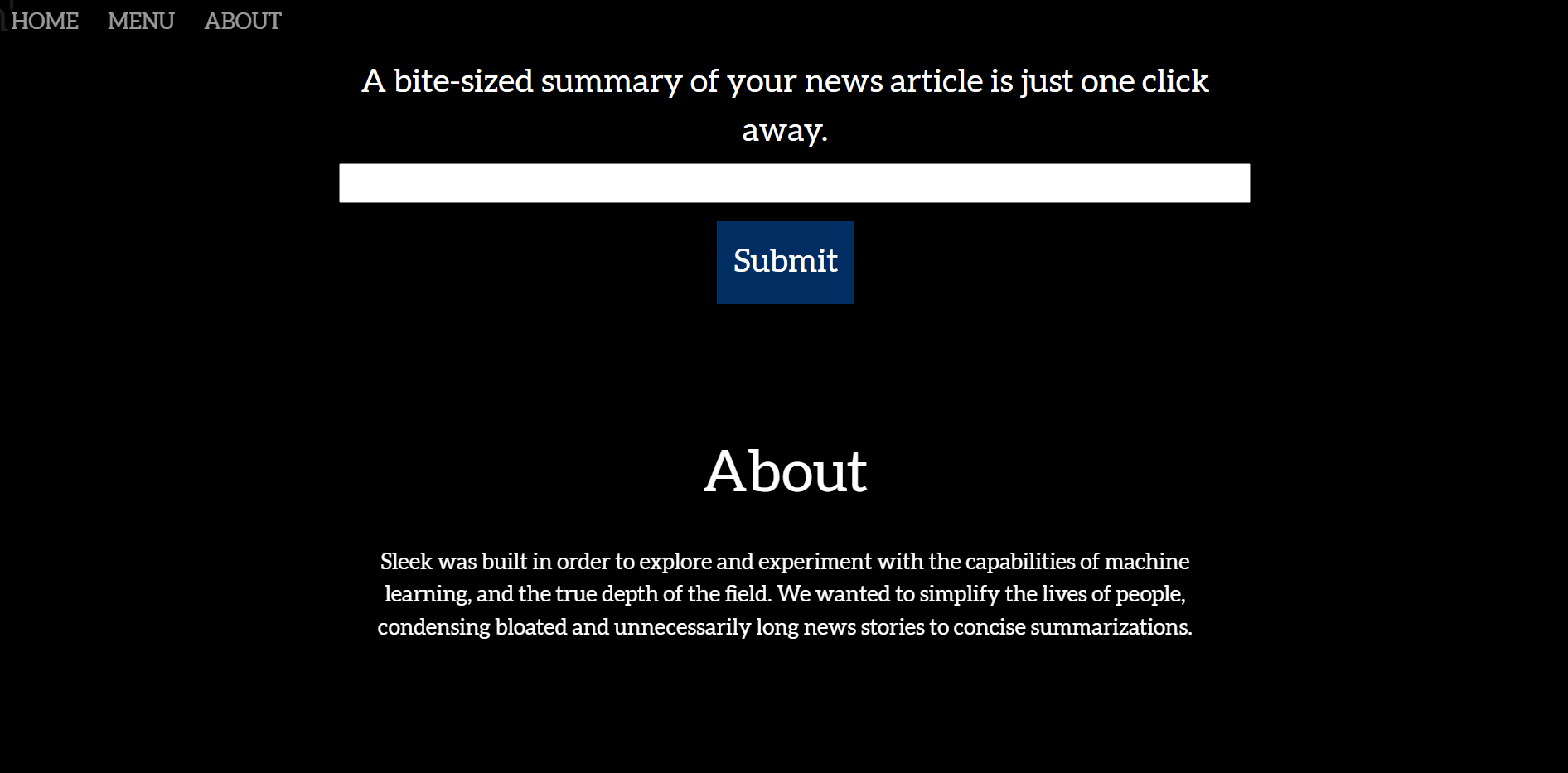
The front end was something we were really proud of, due to its simplistic look combined with a myriad of HTML magic behind the scenes. We also were proud of our relatively quick model training system, which involved splitting the models between us and individually training them.
What we learned
Starting early and getting code on the webpage is really important, because that enables us to work on the backend much more. Having a lot of meetings is also really important, because it allows us to coordinate work and ask for help.
What's next for Sleek News
The first step would be to set up an external web service so anyone can access the service. We have reached out to various news sites with paywalls to provide access for our service so that it opens new outlets of information for the customer.


Log in or sign up for Devpost to join the conversation.