The 1 a.m. problem
At 1 a.m., after a fourteen-hour day, three people on a film crew are still working.
The script supervisor is finishing the lined script and the facing pages — which setup covered which line, which takes the director circled, where the boom dipped into frame. The production office is reconciling the day's progress report: scenes shot, pages against plan, setups, wrap, overtime. And tomorrow morning an assistant editor will sit down with two to four hours of dailies and watch all of it, so that somebody in the cutting room knows what is in there.
Call it three crew-hours per shooting day. Over a thirty-day feature:
$$3\ \tfrac{\text{h}}{\text{day}} \times 30\ \text{days} \;=\; 90\ \text{hours} \;\approx\; \text{two crew-weeks, per production}$$
And at the end of it the knowledge lands in PDFs and spreadsheets, where nobody can ask it anything.
The hours are the cheap part. The expensive failure is the circled take that turns out soft when the editor finally sees it — a single reshoot day on a mid-budget feature runs well into six figures once cast, crew, locations and equipment come back. SlateIQ finds that take the same night, in 65 milliseconds.
The strange part is that a film set already generates beautifully structured data: takes, slates, timecode, rolls, lenses, circled takes, continuity notes, camera and sound reports. It is a time-series problem wearing a clipboard. So we gave a production a real analytical database — and agents that both fill it from the raw footage and answer from it.
What it does
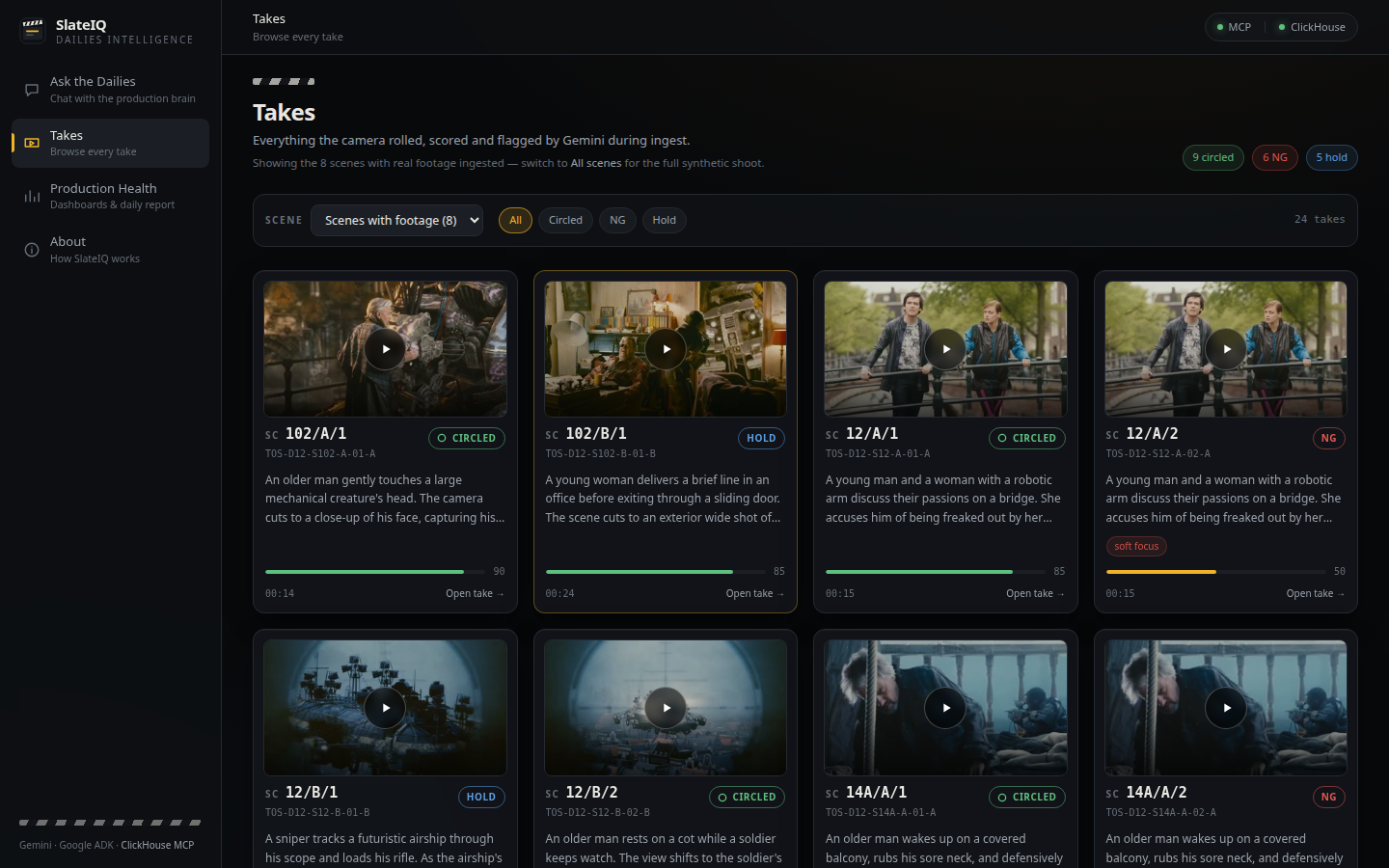
1 — Gemini watches the dailies. Every clip goes to Gemini 3.5 Flash under a strict JSON schema: transcript with speakers, action beats, quality flags (boom in shot, soft focus, line flub, audio clipping, crew in shot, frame-edge drift), emotional intensity, and a circle-worthy recommendation. In parallel ffmpeg measures the clip itself at 25 Hz — focus, exposure, motion, audio peak in dBFS — so every semantic judgement has an independent physical measurement sitting next to it. It all lands in ClickHouse: 2,503 takes, 26,750 timestamped events, 120 scenes, 66 continuity notes and 3,074,957 rows of frame telemetry across a 30-day shoot.
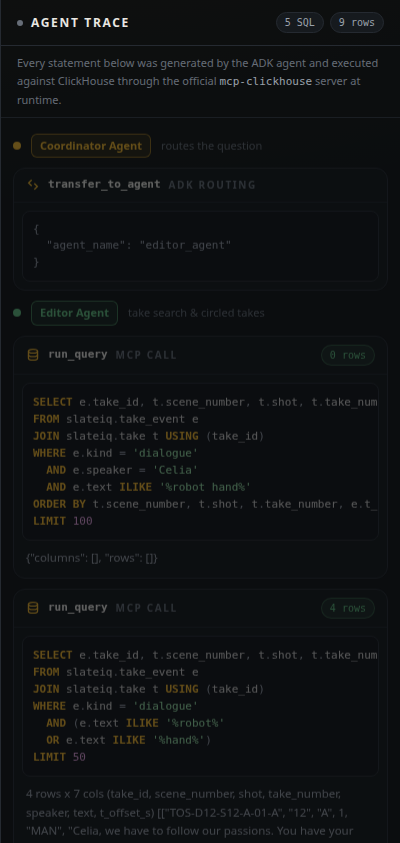
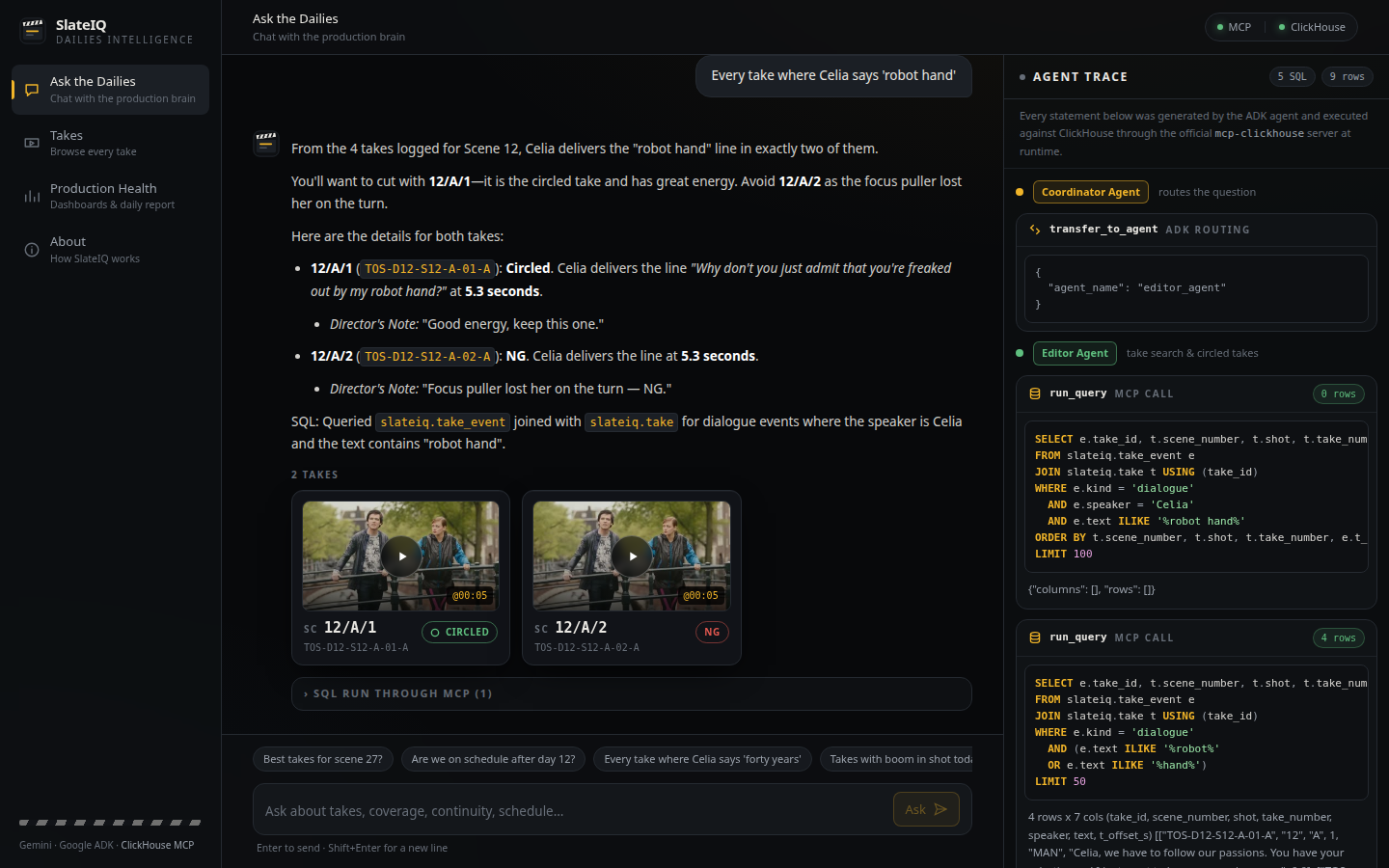
2 — You ask it things, in English. A Google Cloud Agent Builder (ADK) network — a coordinator and four specialists modelled on the four people who would actually open this at 10 p.m. — writes SQL and runs it through the official mcp-clickhouse MCP server at runtime. The trace panel shows every tool call, every query and every row count as it happens. There is no hidden database driver on the reasoning path: each agent has exactly one data tool.
"Every take where Celia mentions her robot hand — I need the timecode." → the take, the line, the offset in seconds, and a player that seeks straight to it.
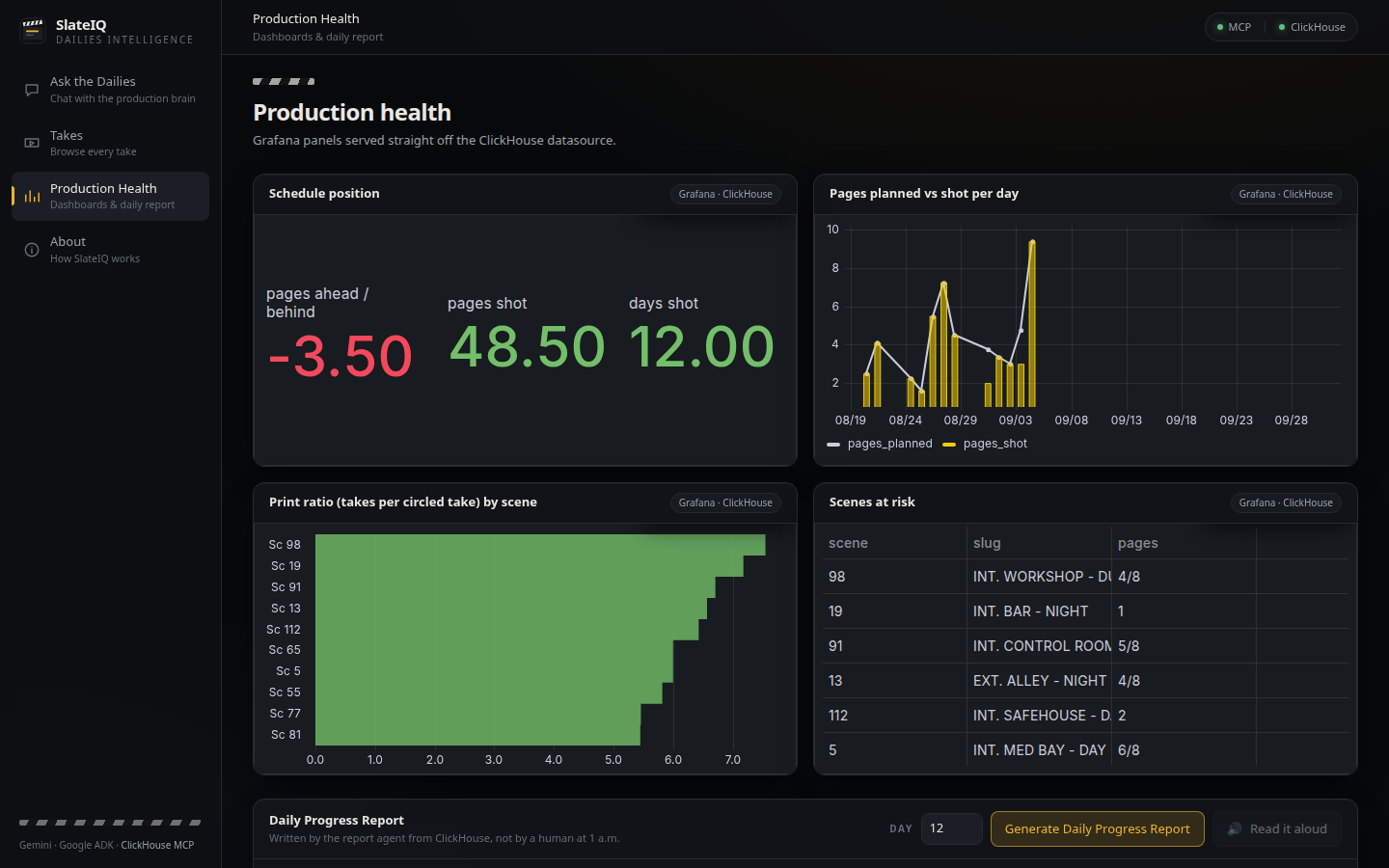
"Are we on schedule after day 12?" → 48 4/8 pages shot of 52 planned — 3 4/8 pages behind, about half a day. It reconstructs the deficit itself: days 8 and 11 lost setups to rain. Then it forecasts from the achieved rate $\bar p = 4.04$ pages/day: $$d_{\text{needed}} = \left\lceil \frac{P_{\text{remaining}}}{\bar p} \right\rceil = \left\lceil \frac{66\ 7/8}{4.04} \right\rceil = 17 \text{ days against } 18 \text{ remaining}$$ Nobody typed that in. It read the call sheets.
3 — It catches what the humans missed. This is the part no dailies tool does today, because it needs the semantic layer and the measured layer inside the same query. Define soft-focus dwell over a take's telemetry samples $\phi_i$ at $f_s = 25$ Hz:
$$t_{\text{soft}} \;=\; \frac{1}{f_s}\sum_{i=1}^{N} \mathbb{1}!\left[\phi_i < 0.55\right]$$
"Which circled takes are measurably soft?" →
TOS-D12-S12-B-02-B— scene 12, setup B, take 2 — was circled by the director ("Cleaner. Print."), and $t_{\text{soft}} = 13.0\ \text{s}$ of its 16.2 seconds, averaging $\bar\phi = 0.521$ and dipping to 0.424. The director printed a soft take and nobody caught it. Six more circled takes come back behind it.
That query joins Gemini's judgement against the telemetry table and returns in 65 ms — 3.09 million rows scanned, 1.14 GB/s. That is why ClickHouse is in this product and not a warehouse: the answer arrives before the producer has finished asking. It is the first suggested prompt on the Ask screen, one click from the front door.
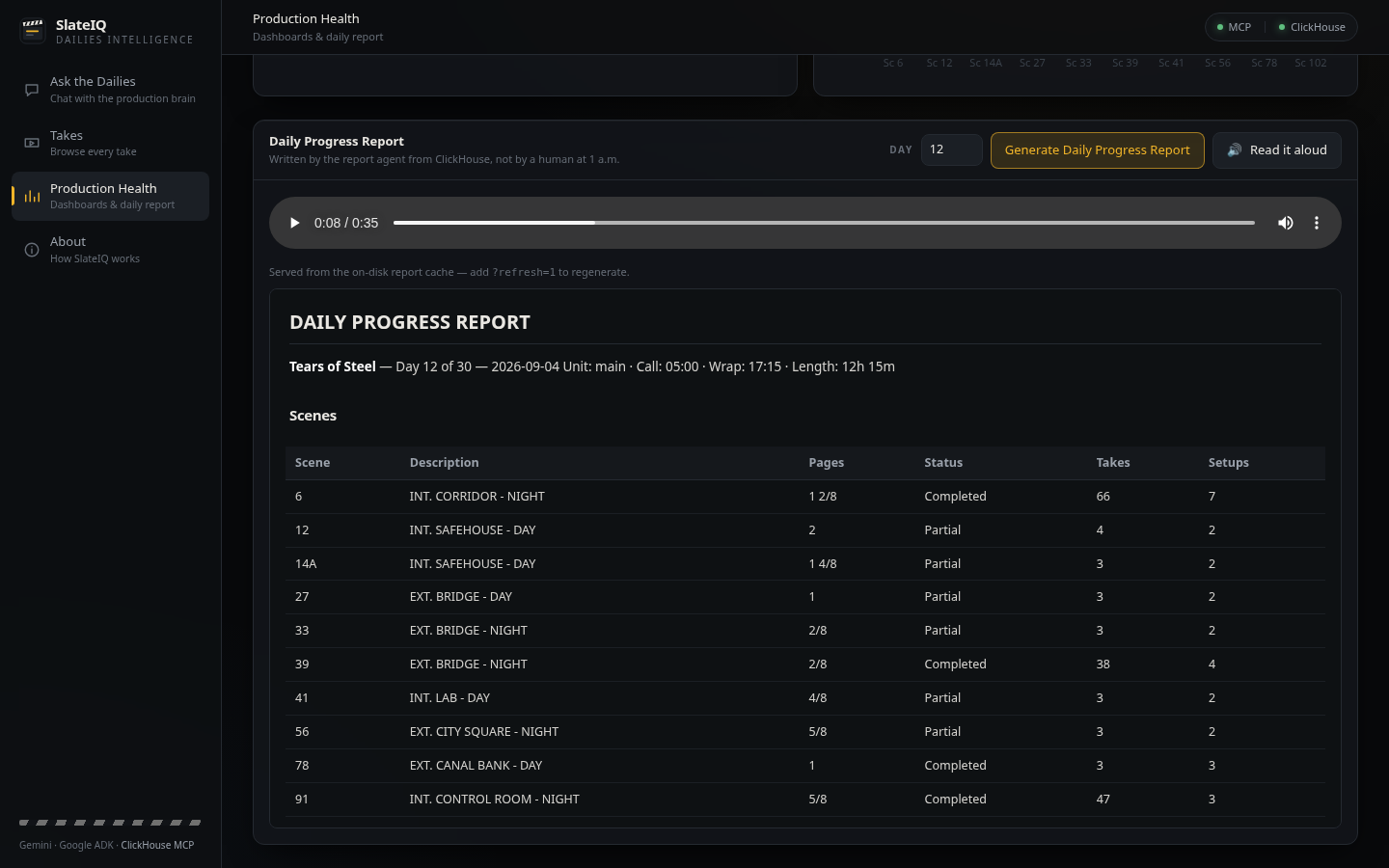
4 — It writes the paperwork. The Daily Progress Report (scenes, pages in eighths, setups, takes, circled, NG, print ratio, wrap and overtime) and the Editor's Log — the digital form of the script supervisor's facing pages — generated entirely from live queries, in industry format, ready to paste into an email or exported as CSV and ALE (Avid Log Exchange) so circled takes land in Avid or Resolve without anybody retyping them. Gemini TTS reads the ninety-word version aloud for the drive home.
Day 12 of the demo shoot, generated end to end: 31 setups, 175 takes, 38 circled, 42 NG, 9 3/8 pages, wrapped 15 minutes over.
Why this doesn't already exist
It half does, and it is worth being precise about which half.
- Frame.io Camera to Cloud and Moxion own transport — proxies and secure review seconds after the cut. They move dailies brilliantly. They do not reason about them.
- Strada is the closest thing to us: AI tagging, transcription, agents. But it searches media. It cannot tell you whether you are three and a half pages behind.
- ScriptE genuinely produces a progress report and an editor report — from a script supervisor typing into forms all day. It answers the questions its forms were designed for.
- Filmustage answers questions in natural language, but about the pre-production breakdown.
Nobody joins the set-generated structured data to the media and opens both to analytical query. That join is the whole product.
How we built it
| Layer | What |
|---|---|
| Reasoning | Google Cloud Agent Builder — Agent Development Kit (ADK) 2.8, coordinator + editor / production / continuity / report specialists, transfer_to_agent routing |
| Models | Gemini 3.5 Flash — multimodal take analysis with a Pydantic response_schema, and all agent reasoning; Gemini TTS for the spoken report |
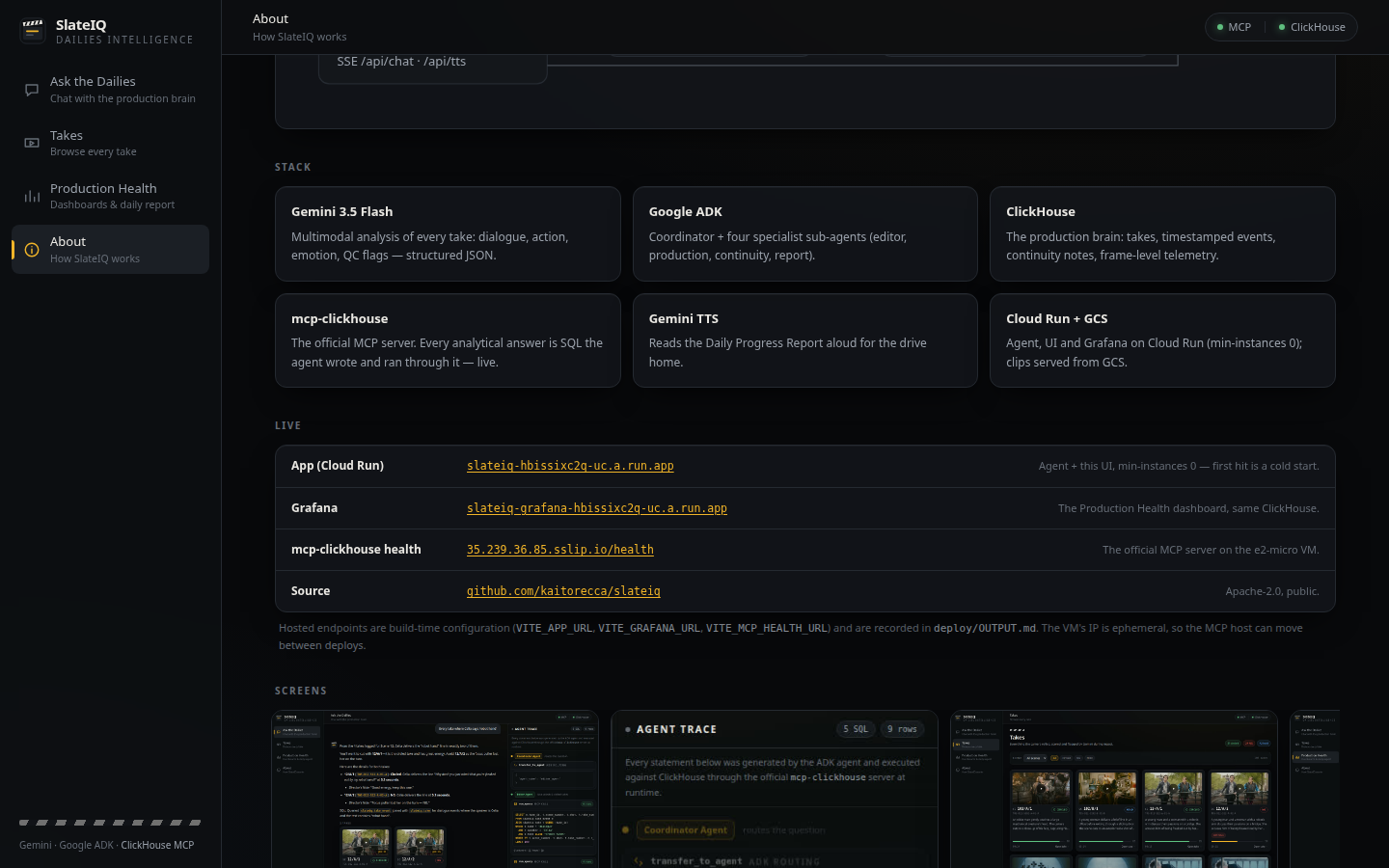
| Partner (ClickHouse track) | The official mcp-clickhouse MCP server 0.6.0 over StreamableHTTP, reached by a single shared ADK McpToolset. Every analytical answer in the product is SQL the agent wrote and executed through it |
| Store | ClickHouse 25.6 — take, take_event, take_analysis, continuity_note, frame_telemetry, plus AggregatingMergeTree roll-ups behind the daily_progress / scene_progress / flag_summary views |
| Google Cloud | Cloud Run (agent API + React UI, and Grafana; min-instances 0), Compute Engine e2-micro for the data plane, Cloud Storage for clips, Secret Manager, Artifact Registry, Cloud Build, Cloud Scheduler |
| Front end | React 18 + Vite + TypeScript + Tailwind — Ask (streaming chat + live MCP trace), Takes browser with a player that seeks to the flagged frame, Production Health with embedded Grafana, About |
| Ingest | ffmpeg scene detection and telemetry extraction, Gemini File API, results disk-cached and committed so a clean clone replays for free |
Guardrails, because SQL written by a model is still SQL. A before_tool_callback on every run_query enforces a single SELECT/WITH statement, rejects DDL, DML, system.* reads and the url() / file() / remote() table functions, and appends or clamps the LIMIT rather than bouncing the call — so the model does not burn a round trip on a fixable mistake — then records the executed SQL for the trace. An after_tool_callback truncates oversized results and tells the model to re-query more tightly. Underneath, the database user the MCP server connects with holds nothing but GRANT SHOW, SELECT ON slateiq.* with readonly=1 and a 300 MB memory ceiling.
Evidence, not assertion. agent/evals/ runs 28 real questions across all five agents against the real MCP server, recording routing, every tool call, the SQL and the latency, and Gemini-judges each answer against a per-question rubric. The harness fails the run if any question marked must_query produced an answer without touching MCP. Latest committed run: 27/27 live questions reached run_query on mcp-clickhouse (100%) — the 28th is a report served from the on-disk cache and is excluded from that denominator rather than counted as a hit — 27/28 routed to the expected specialist, judge mean 4.89/5, median 5.0, median latency 26.3 s. Plus 126 unit tests and a 43-check schema verifier. Every SQL statement and every judge rationale is committed in agent/evals/last_run.md.
Challenges we ran into
ADK pins MCP SDK 1.x; mcp-clickhouse needs 2.x. Unresolvable in one process. We split them: the MCP server runs as its own containerised service reached over HTTPS with a bearer token — which turned out to be the correct production shape anyway, not a workaround. It also meant handling reconnection ourselves, so the toolset now heals a dropped MCP session and retries once instead of failing the turn.
Making generated SQL trustworthy. db/SCHEMA.md is a single contract file, re-read at runtime and injected into every agent's instructions, so the model never guesses at column names. Then the SELECT-only guardrail, then the eval suite. The failure mode we cared about most was not a bad query — it was a confident answer produced without one, so that is the one the harness hard-fails on.
Fitting a 3M-row analytical database on a free-tier e2-micro. 1 GiB of RAM, ClickHouse capped per query, and the seed shipped as take-id-ranged Parquet chunks so peak memory stays bounded regardless of table size:
$$\text{chunk}(t) = \operatorname{cityHash64}(\texttt{take_id}) \bmod n$$
Total hosting cost: \$0 on free tier, bar the one external IPv4.
Getting the vocabulary right. Shooting ratio is material shot versus material in the finished cut. It is not takes divided by circled takes — that is a print ratio:
$$\text{print ratio} = \frac{\text{takes}}{\max(\text{circled takes},\,1)} = 4.61:1 \text{ on day 12}$$
Eight-eighths of a page is written "1 page". The director circles a take; the script supervisor records it. Getting these wrong is the fastest way to lose a room of film people, so we renamed a database column at 2 p.m. on the last build day rather than ship the wrong word.
What we learned
That a shoot is an event-stream problem, and the moment you model it as one, questions that used to live in somebody's memory become one query.
And that the interesting agent-design decision was subtraction. Giving each specialist exactly one tool — the ClickHouse MCP toolset — made behaviour dramatically more reliable than handing them a toolbox. The corollary was that the schema, not the prompt, is the real interface: once SCHEMA.md was precise, the model stopped inventing columns.
We also learned to distrust our own demo. Driving the product like a judge, screen by screen, found four crashes and a trace panel that had been reporting "1 row" for every query in the one place whose entire job is to prove the partner integration.
What's next
The full 2nd-AD Daily Production Report; camera and sound reports emitted per roll (the schema already carries roll, sound roll, lens, fps, ISO and timecode); live ingest straight from camera cards on set; the lined script reconstructed from coverage; and per-production Grafana alerts on print ratio and overtime.
Credits & licence
Demo dailies are cut from Tears of Steel © Blender Foundation, mango.blender.org, licensed CC BY 3.0. SlateIQ is not affiliated with the Blender Foundation. All schedule, scene and telemetry data for the 30-day shoot is synthetic. SlateIQ is open source under Apache-2.0.
Cloud Run runs at
min-instances 0, so a cold first hit costs about 16 s (the ADK import, not the database); warm requests are ~0.6 s. The Daily Progress Report and the spoken summary are pre-warmed and return in well under a second.
Built With
- adk
- clickhouse
- gemini
- python
- typescript

Log in or sign up for Devpost to join the conversation.