-
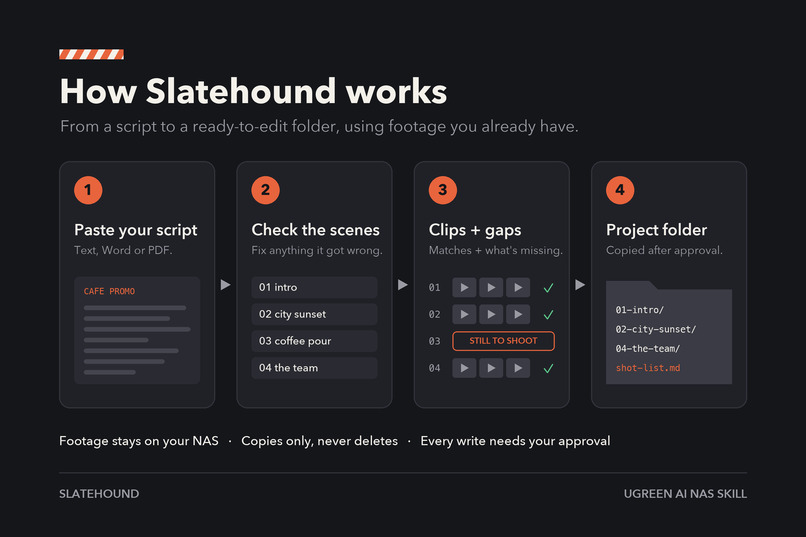
Paste a script, check the scenes, get matching clips and a gap list, then approve a ready-to-edit folder. Footage never leaves your NAS.
-
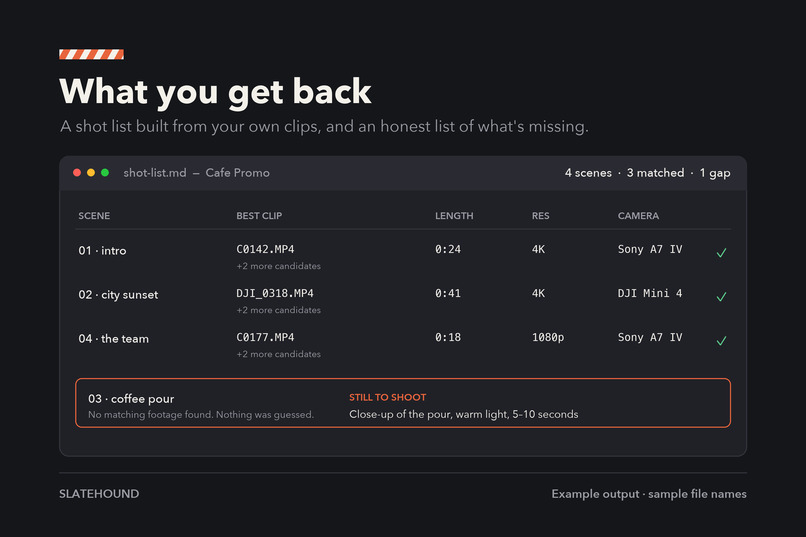
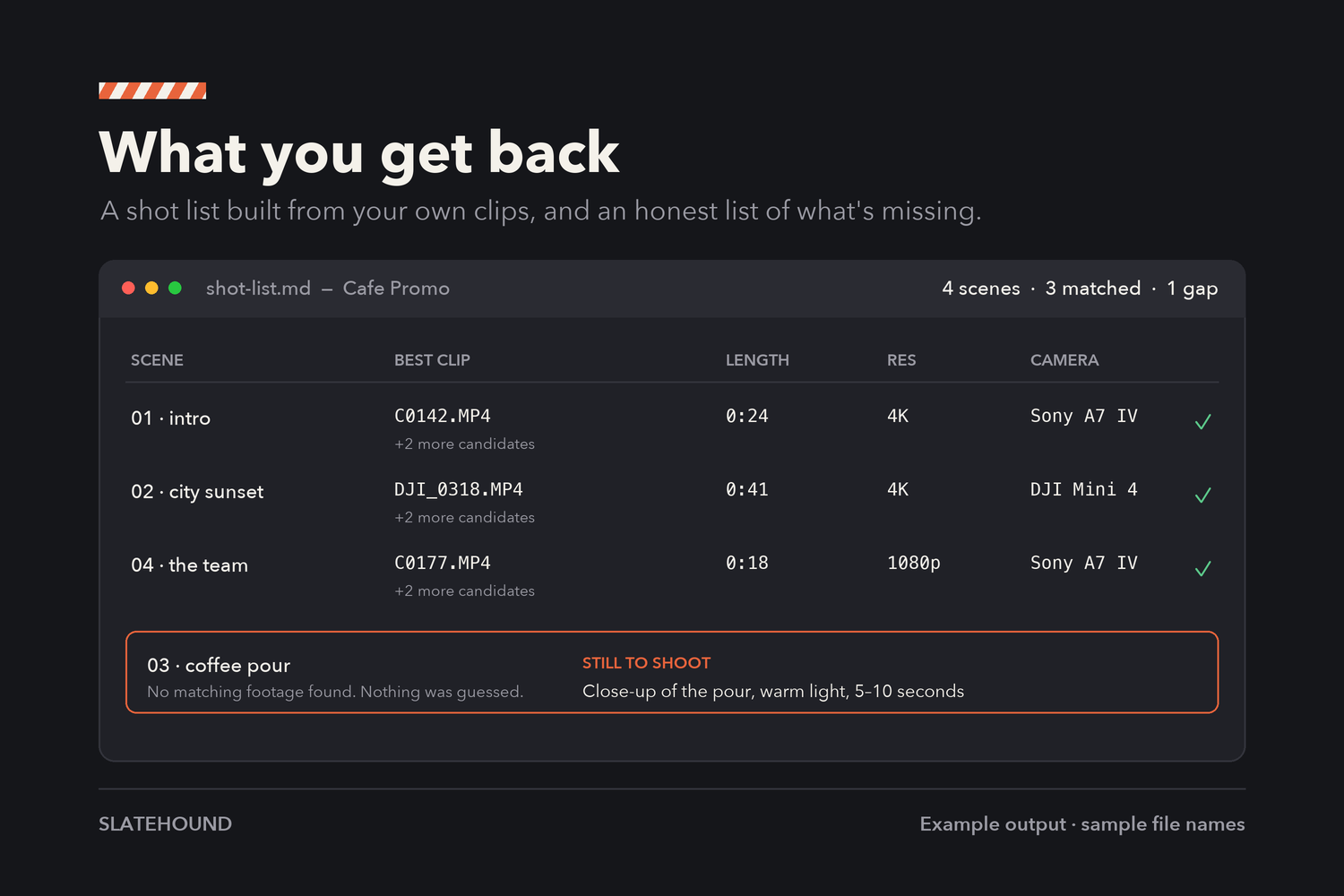
Sample shot list: clips matched to each scene, plus one honest gap. When nothing fits, Slatehound says so and tells you what to shoot.
Inspiration
I'm not a video creator, but I watch a lot of people who are, and the same complaint keeps coming up: the editing isn't the slow part, finding the footage is. Creators sit on years of clips, forget what they already shot, film it again, or find out halfway through an edit that a shot is missing. When I learned that a UGREEN NAS can recognize what's inside photos and videos, it felt like the missing piece. The footage is already there. Something just needs to go and get it.
What it does
You paste a video script. Slatehound breaks it into scenes, and you check the list. Then it searches your NAS footage by what's actually in the picture, not just file names, and suggests up to three clips per scene.
If nothing fits a scene, it says so. The scene goes on a "still to shoot" list instead of getting a bad guess. Once you're happy, you approve, and it copies your picks into a project folder with one numbered folder per scene, plus a shot-list.md.
After you film the missing shots, run it again. It only searches the gaps and tells you which ones are now covered.
How I built it
Slatehound is a UGREEN AI NAS Skill, so there's no app and no code. It's a SKILL.md that tells the NAS assistant which expert agents to call and in what order:
- photo-agent searches footage by content (
ug-photo search-screen, limited to video) - file-agent reads the script, falls back to file-name search, reads clip details like duration and resolution, creates the folders and copies the clips
- document-agent reads scripts saved as Word or PDF
- knowledge-agent saves the shot list
Every step only uses real file paths that the step before it returned, so nothing gets made up along the way. It passes UGREEN's official Skill checker with zero errors and zero warnings.
I used Claude Code (Anthropic) to research the rules and the capability catalog, draft the Skill files and run the checker. All of that is disclosed in the package.
Challenges
- I don't have a NAS yet. I designed everything from the official capability catalog and wrote down exactly what still needs checking on a real device: whether content search returns video paths, how batch copy handles folders, and reading metadata from video files.
- Not inventing matches. The easy version of this tool would always return something. I made "no match" a real result that turns into a shoot list, because a wrong clip wastes more time than an honest gap.
- Keeping it safe. It only looks in folders you allow, every write needs approval, it only copies, and it never moves or deletes your originals.
- Scope. I wanted to build a whole creator toolkit. I cut it down to one flow that works well.
What I learned
I came into this knowing almost nothing about NAS devices. The biggest lesson is that the value isn't the AI on its own. It's the AI sitting right next to your files, so private footage never has to be uploaded anywhere. I also learned how much a good "I couldn't find it" matters in an AI tool.
What's next
If Slatehound makes the finals, I'll test it on a real NAS with a six-scene script and about 100 test clips, including a scene that can't possibly match, to make sure it stays honest.
Built With
- ai-nas
- claude-code
- markdown
- ugos
- ugreen
- uliya