-
-
Preview
-
Preview
-
Preview
-

Daily Checkins
-
Todo
Inspiration
The most expensive planning failures are not missed checkboxes. They are invisible tradeoffs: accepting one more request, quietly sacrificing a promise, and discovering the problem only after someone is waiting on you.
Calendars know when we are booked. To-do lists know what exists. Neither answers the question that matters in the moment: If I say yes to this, what promise am I quietly breaking?
Slate Up was built to answer that question honestly, then help the user act with care.
What it does
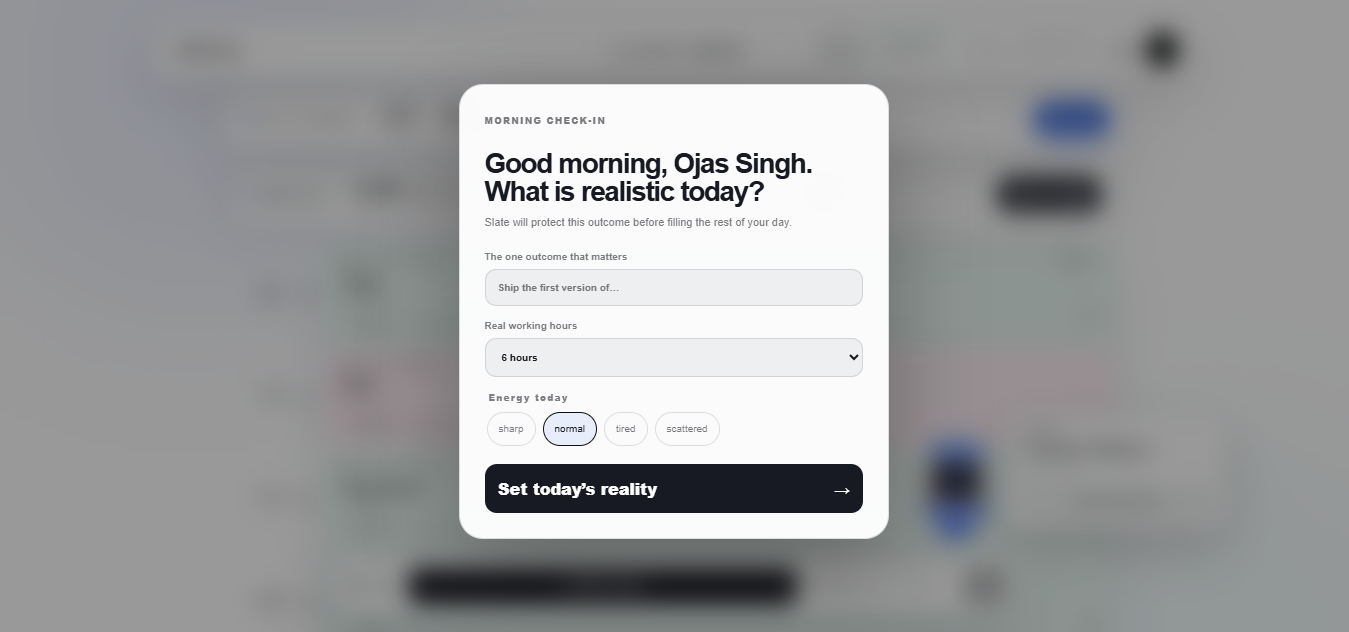
- Captures a day from natural-language planning, Google Calendar, Gmail, or manual tasks.
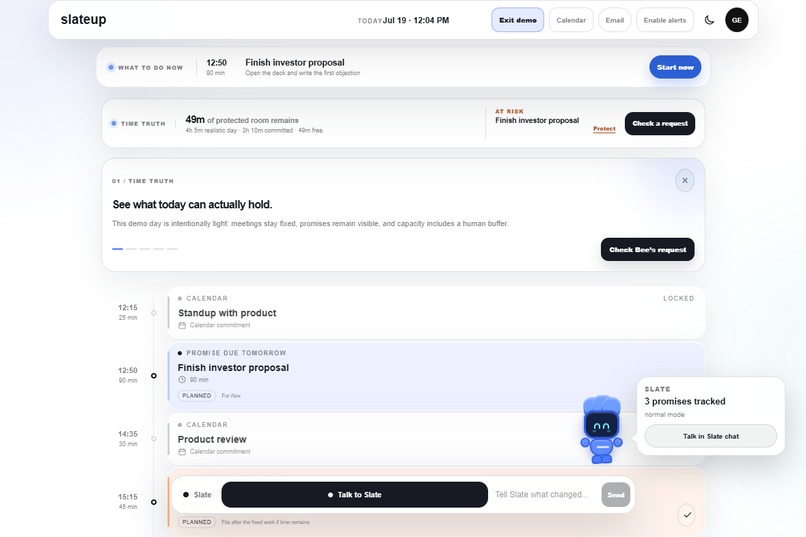
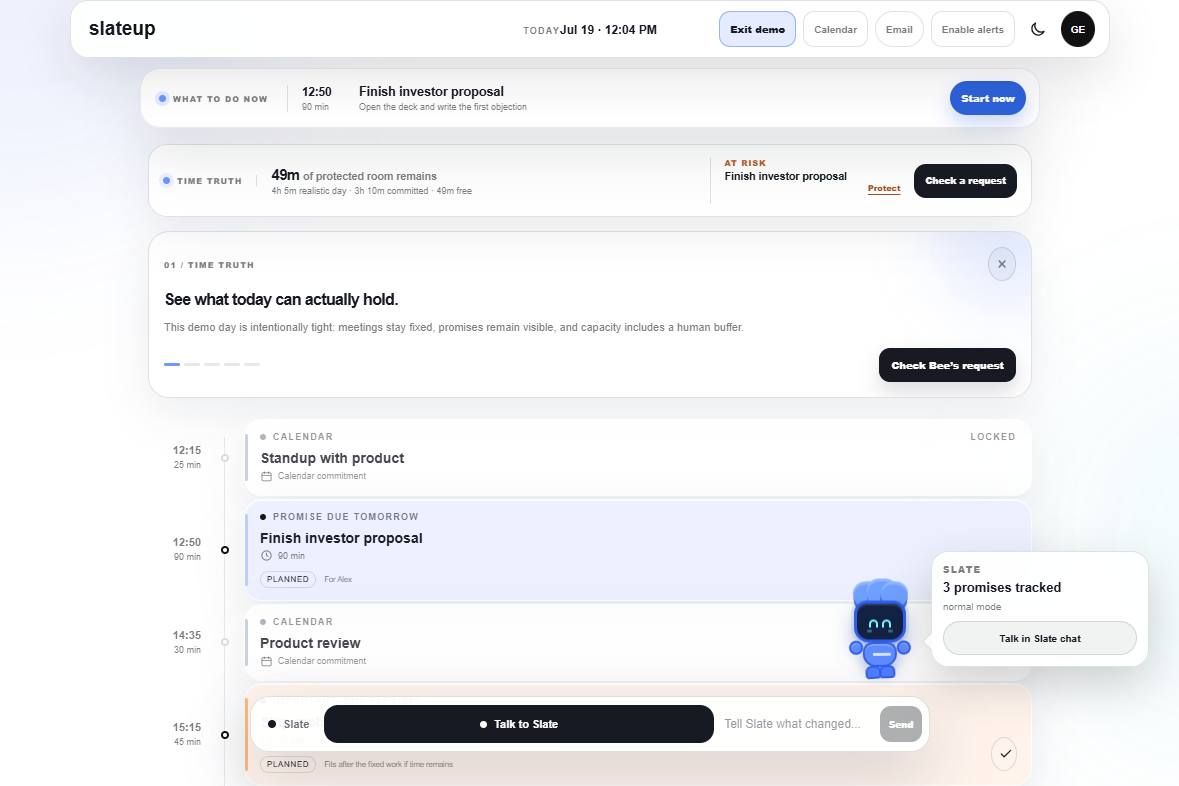
- Builds Time Truth: a realistic capacity view that accounts for the remaining work window, energy, and already committed work.
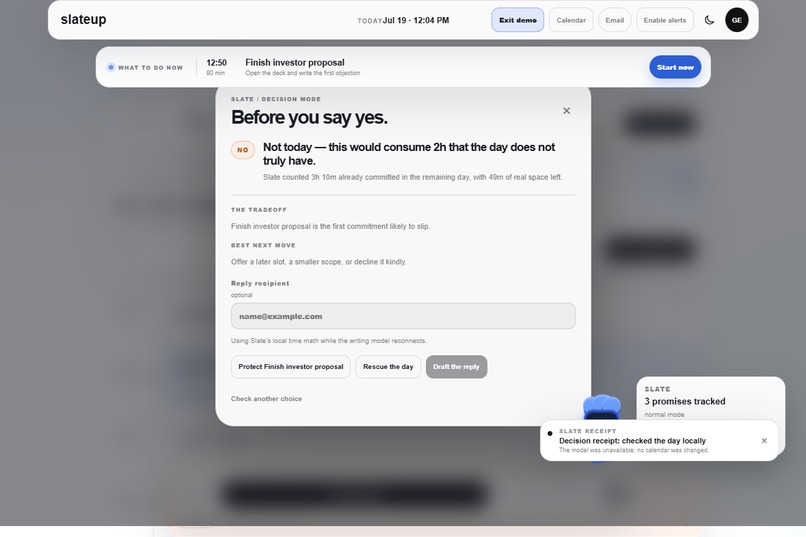
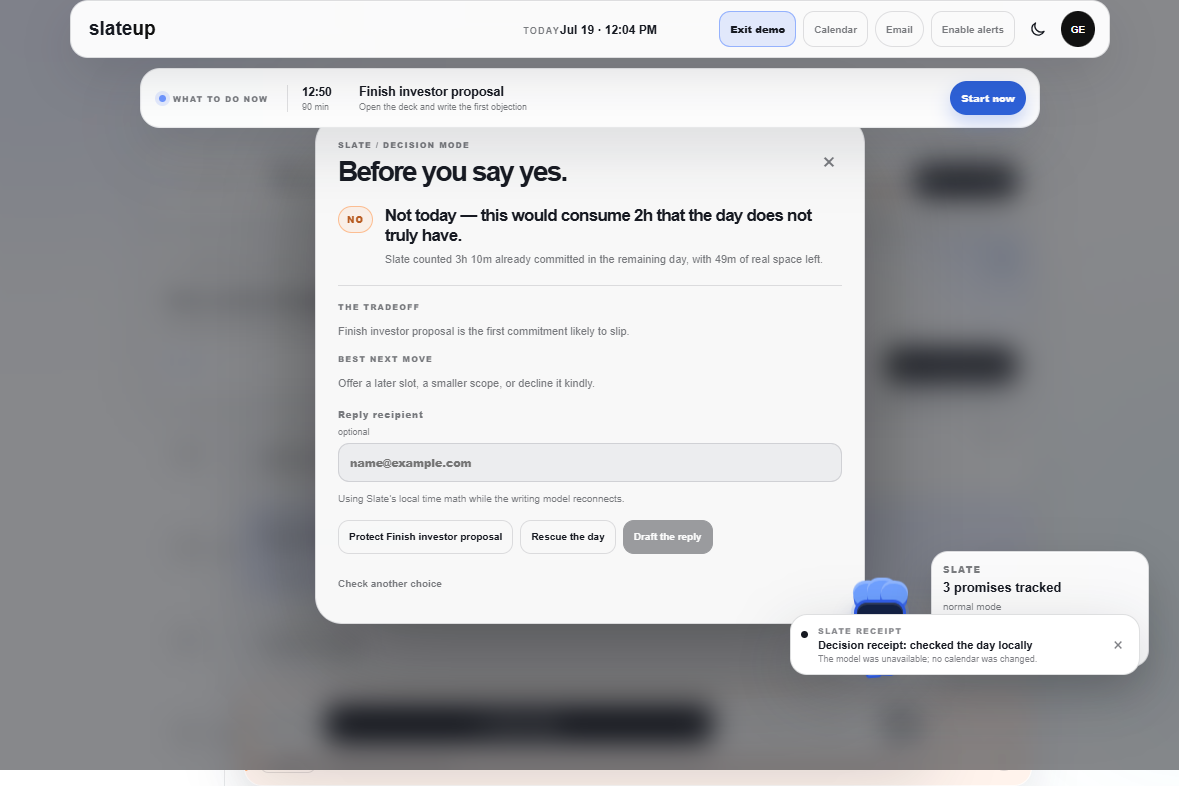
- Opens Decision Mode when the user asks whether a request fits. It returns a clear yes, no, or conditional answer, names the tradeoff, and prepares an honest alternative.
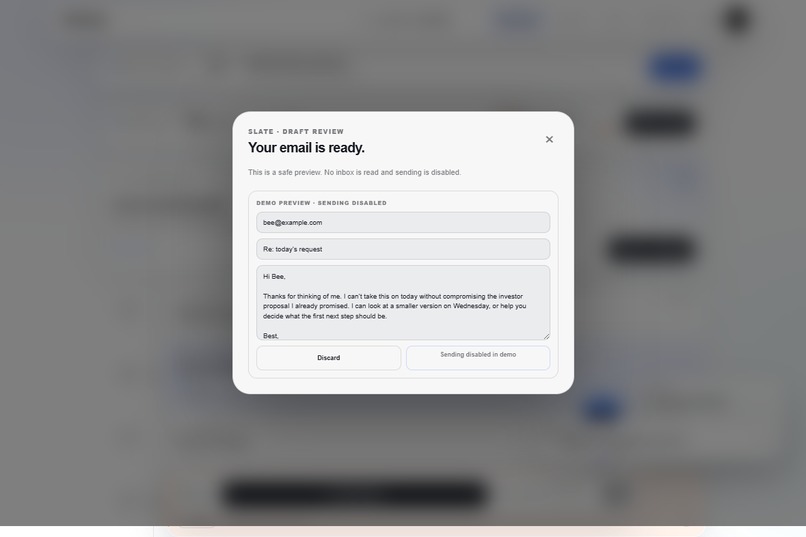
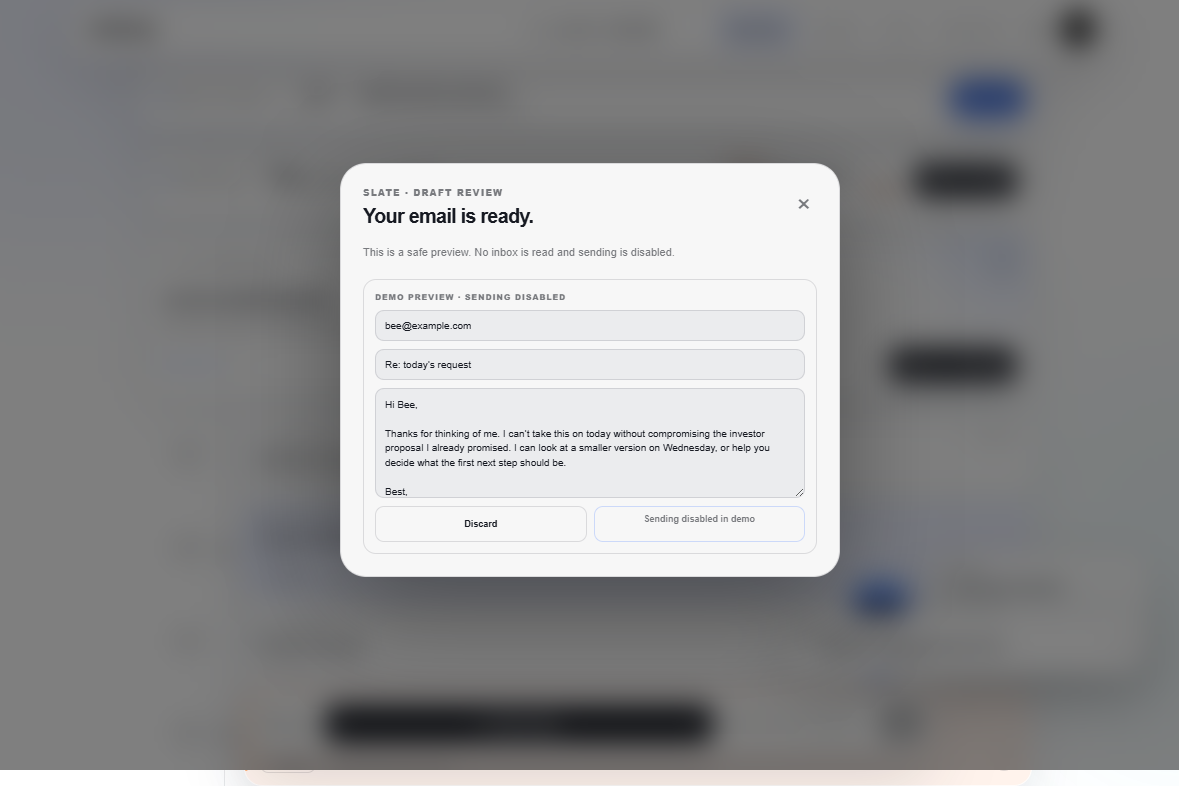
- Creates a reviewable Gmail draft. Nothing sends until the user explicitly accepts it.
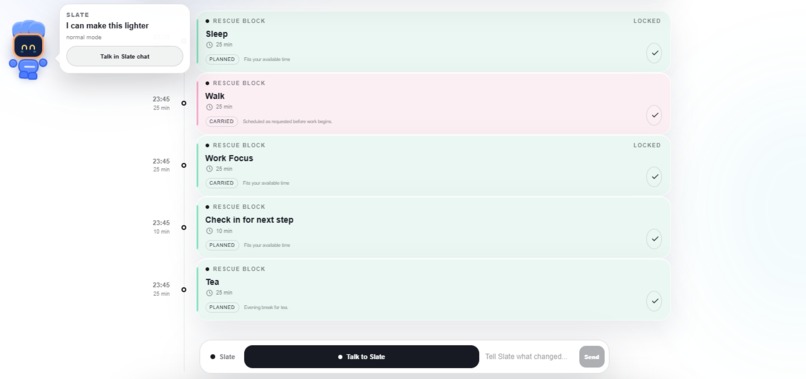
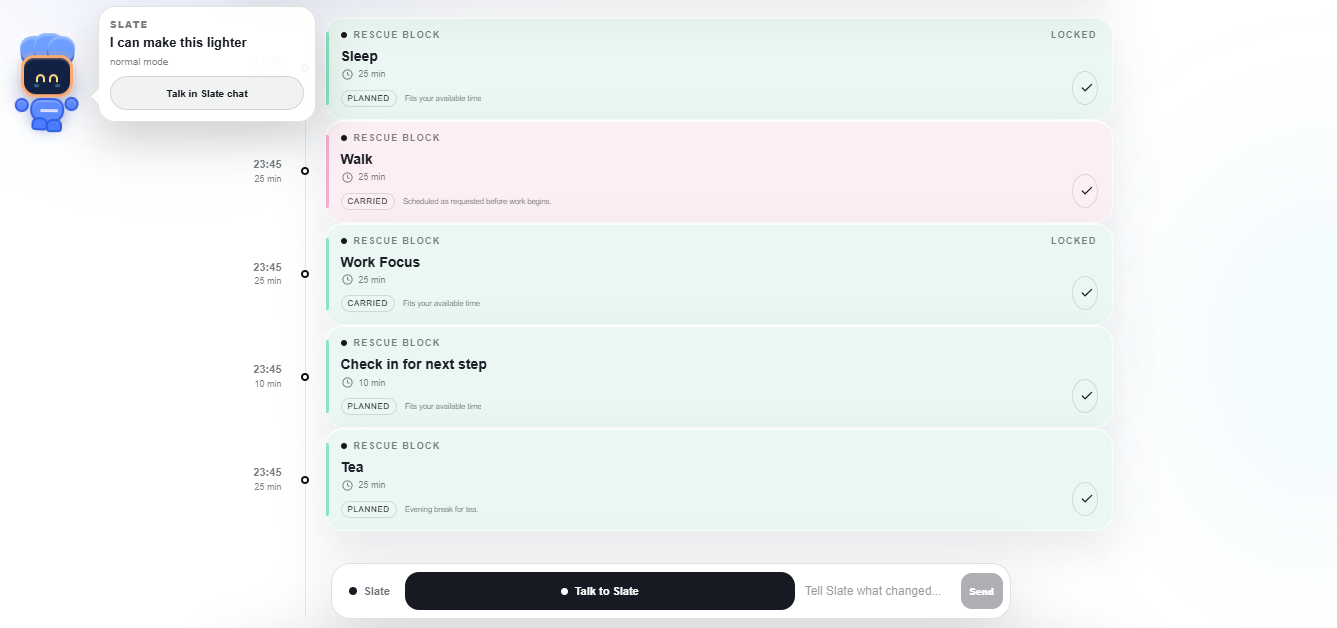
- Recovers slipped work around genuine openings. If there is no honest capacity left today, it carries work forward instead of fabricating a late-night plan.
- Learns from estimate checks and uses that timing history to make later plans more realistic.
What makes it different
- Integrity over inbox zero: Slate protects commitments, not just task counts.
- No-fiction recovery: it refuses to make an impossible day look organized.
- Personal timing calibration: completed-task feedback makes later scheduling less optimistic.
- Respectful autonomy: actions are visible, reviewable, and reversible. Email sends always require an explicit acceptance.
- A real executive interaction: users can speak to Slate, ask it to plan or protect time, and see the changes occur in the planner.
How we built it
- React + Vite for the responsive fluid-glass planner.
- Express on Vercel for planning, chat, decision, Gmail, Calendar, push, and Gemini Live token routes.
- Firebase Authentication and Firestore for user identity and persistent planner state.
- Google OAuth with encrypted refresh-token storage for Gmail and Calendar.
- Gemini Live for voice, Gemma for planning/text, an optional NVIDIA-hosted text path, and deterministic local fallbacks for time-critical planner behavior.
- Server-authorized Calendar mutations so event creates, updates, and deletes use the durable Google connection rather than a browser-held OAuth token.
How Codex and GPT-5.6 were used
Codex, powered by GPT-5.6, was the development partner for Slate Up. It helped turn the initial product thesis into the React architecture, implement the planner and approval flows, harden runtime failure paths, refine the responsive no-gradient material system, and build the evaluation and release checks.
This use was in the development workflow through Codex. It is deliberately separate from Slate Up's live runtime model choices, which remain configurable and are documented above.
Challenges we ran into
- A polished planner is easy to make visually busy. We reduced the main surface to the next action, Time Truth, and the chronological plan.
- AI responses can be malformed or slow. Planner, decision, and email routes have structured parsing plus deterministic fallbacks so a user can still make a decision.
- Google integration must not turn into invisible automation. OAuth tokens are encrypted server-side; sending email and impactful schedule changes stay approval-first.
- A recovery feature can accidentally lie by squeezing work into the evening. Slate now carries work forward when the stated day has no honest opening.
Accomplishments we are proud of
- A usable, safe Demo Mode that tells the complete product story without touching a real planner, inbox, calendar, or notification setting.
- A decision flow that turns a vague capacity question into a concrete tradeoff and respectful email draft.
- A small but meaningful closed loop: actual-time feedback changes the estimate assumptions used for future plans.
- A public, reproducible repository with an environment template, planner checks, build checks, and deployment-ready configuration.
What is next for Slate Up
- Deeper commitment extraction from email and calendar, always behind a review step.
- Calendar-aware travel, focus, and recurring-commitment safeguards.
- More precise personal calibration by task type and time of day.
- A shared accountability mode for managers, students, and teams that preserves each person's consent and privacy.
Built With
- api
- codex
- css3
- express.js
- firebase
- gemini
- gpt
- html5
- javascript
- neon
- node.js
- openai
- postgresql
- push
- react
- vite
- web


Log in or sign up for Devpost to join the conversation.