-
-
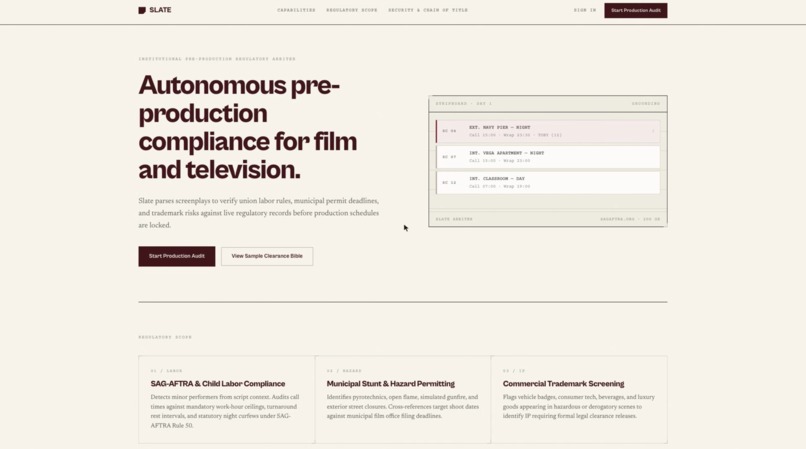
Slate Dashboard
-
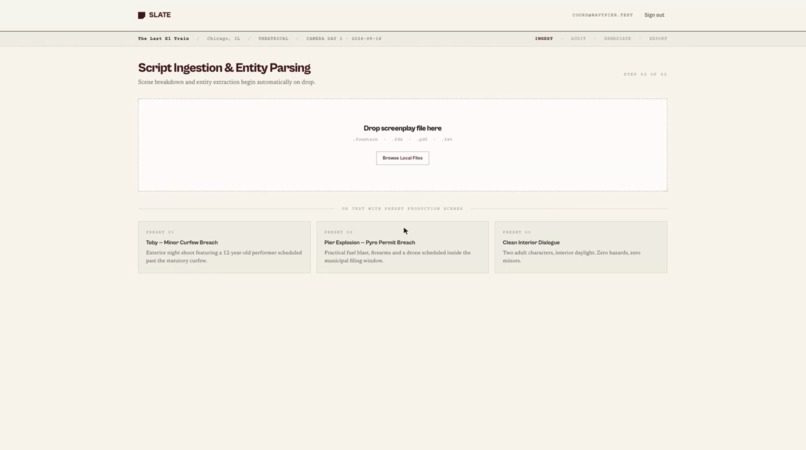
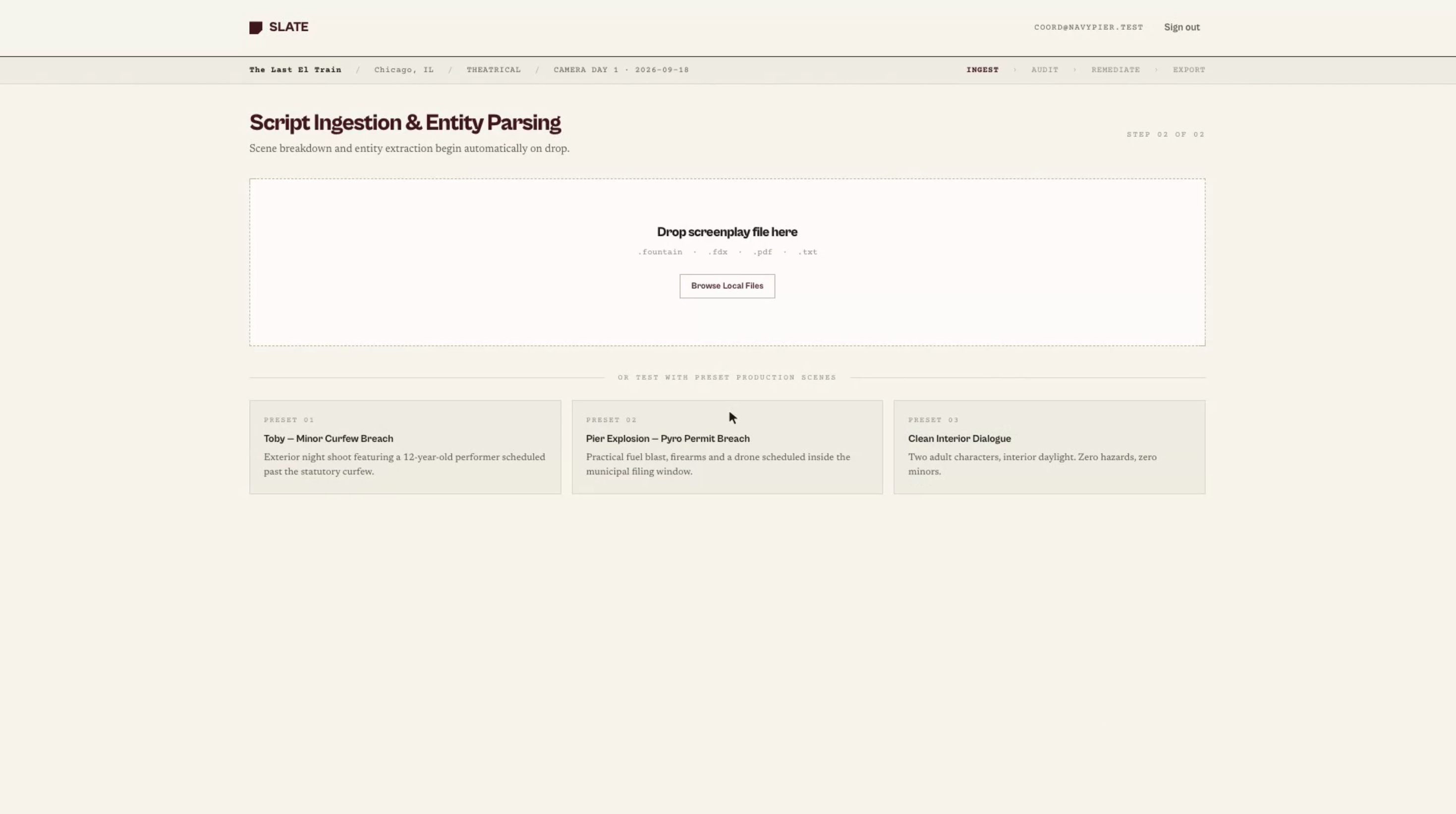
Strip Ingestion & Entity Parsing
-
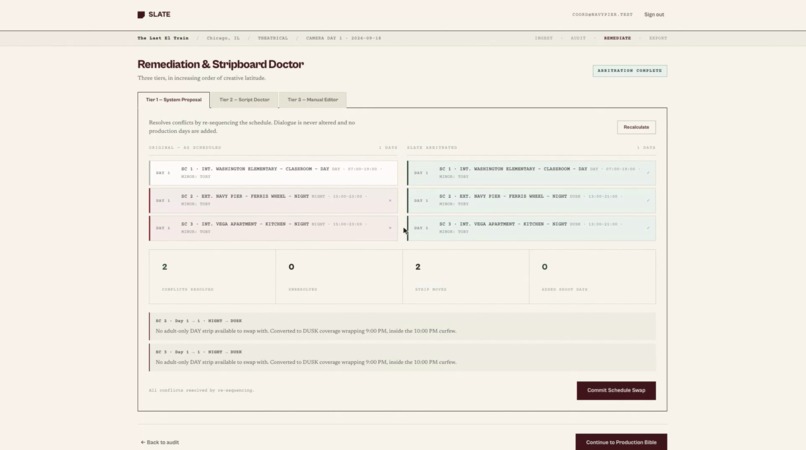
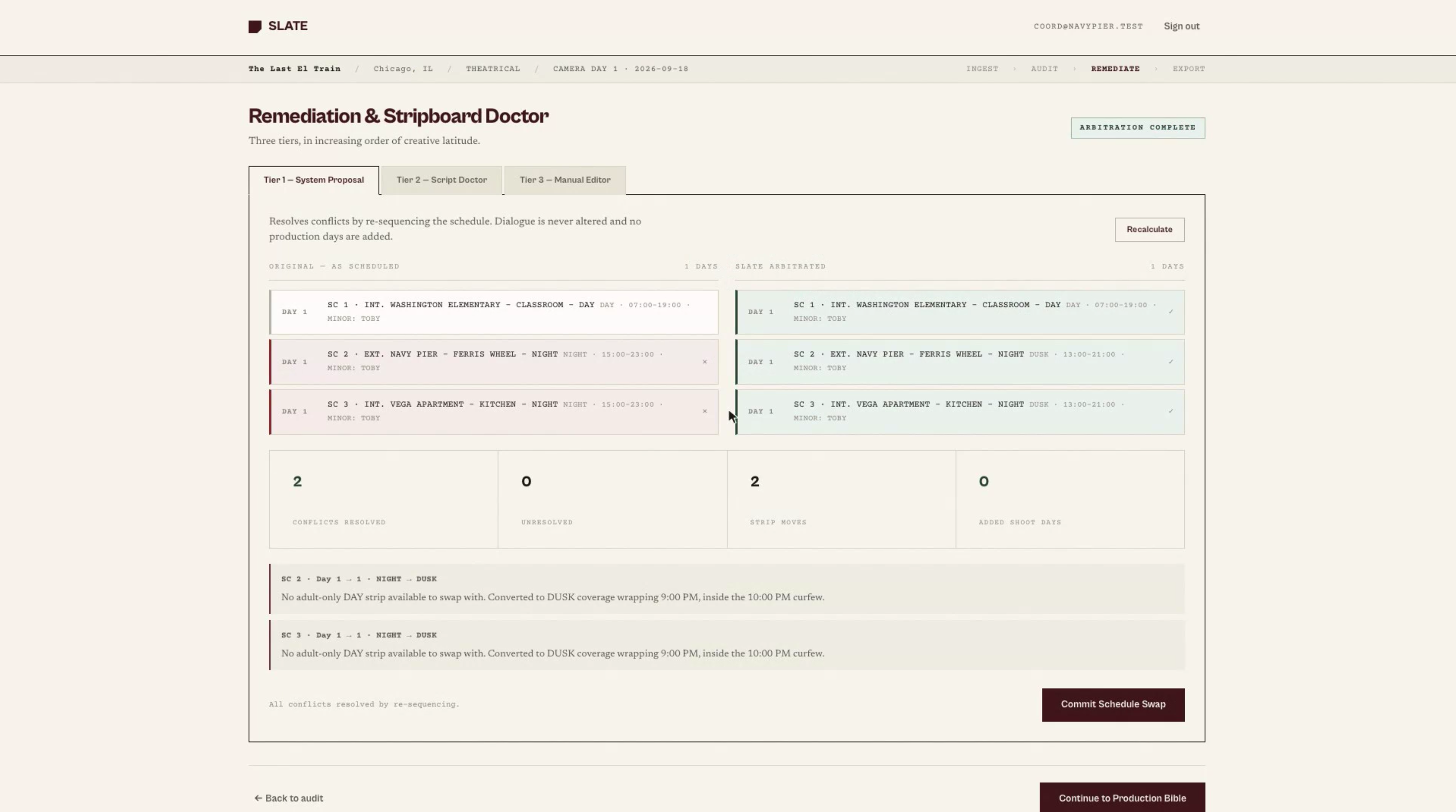
Remediation & Stripboard Doctor
-
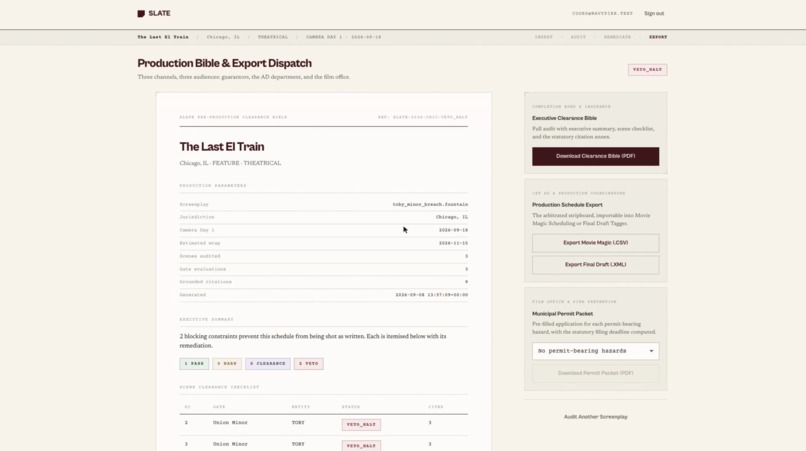
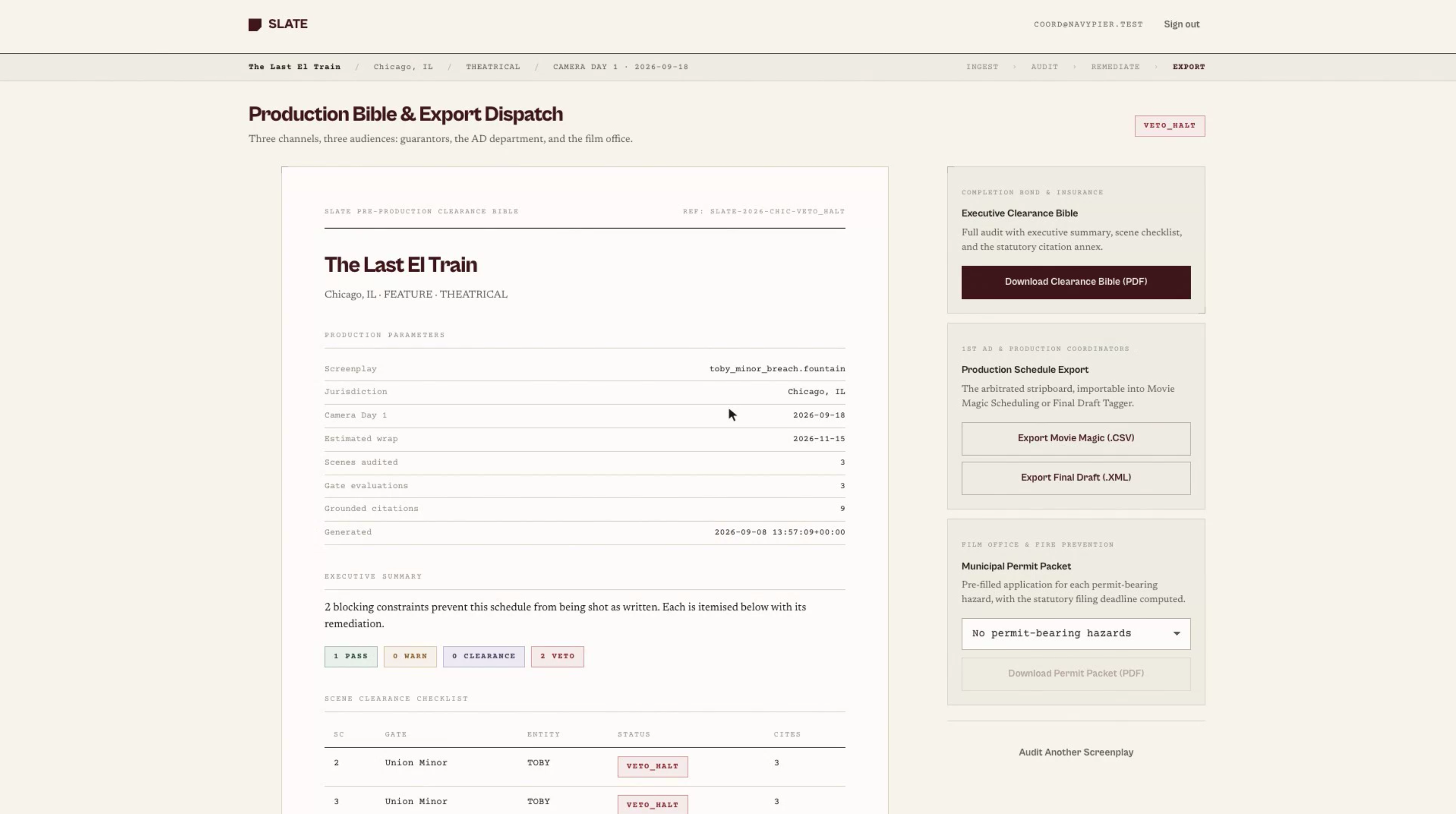
Production Bible & Export Dispatch
-
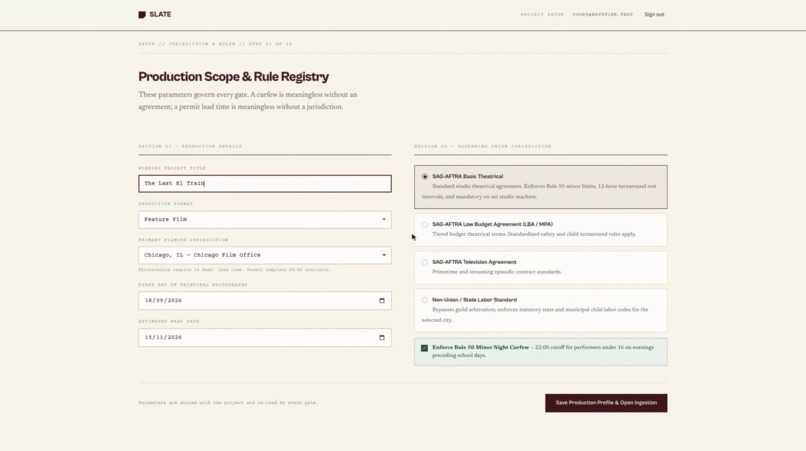
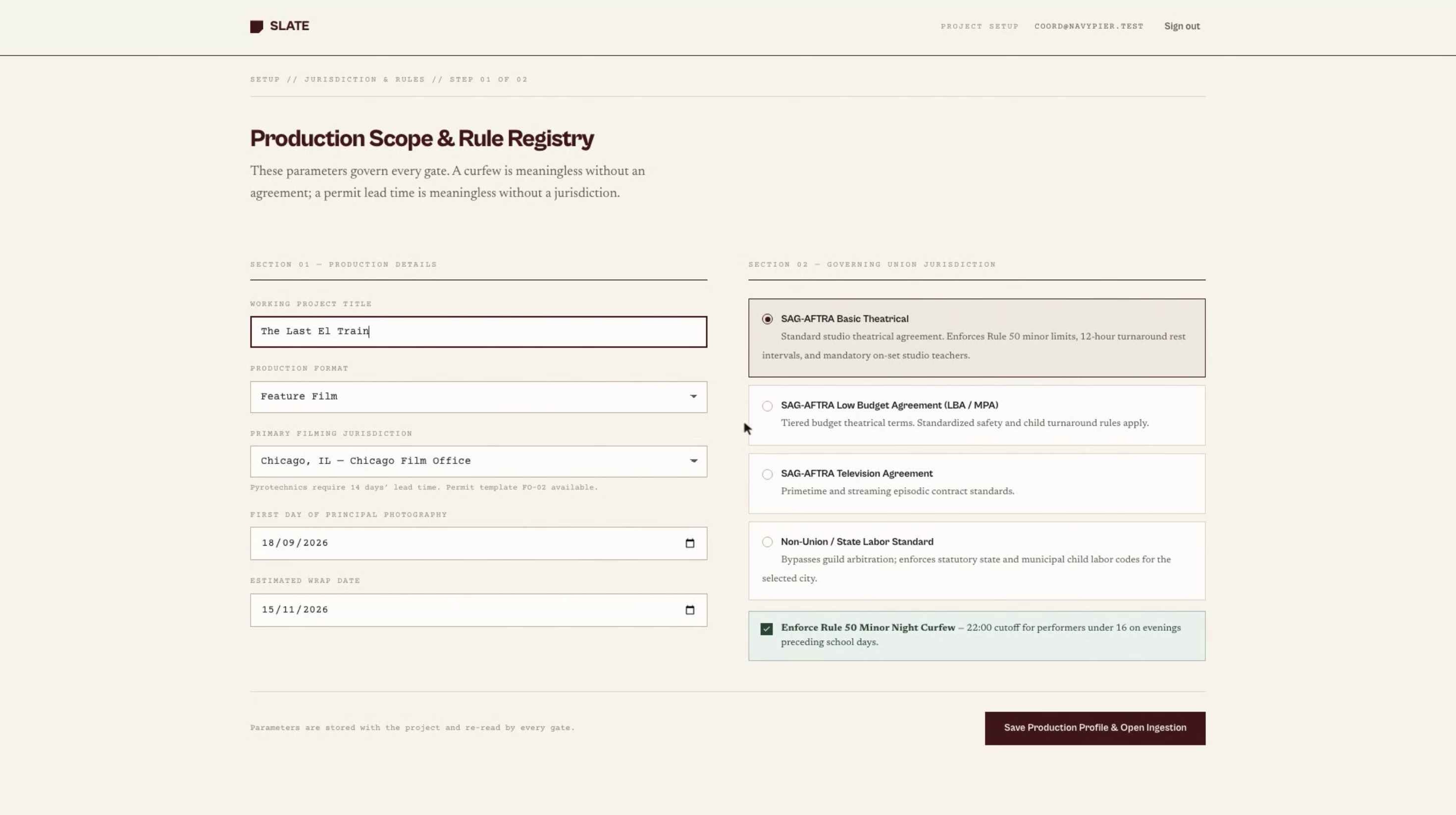
Production Scope & Role Registry
-
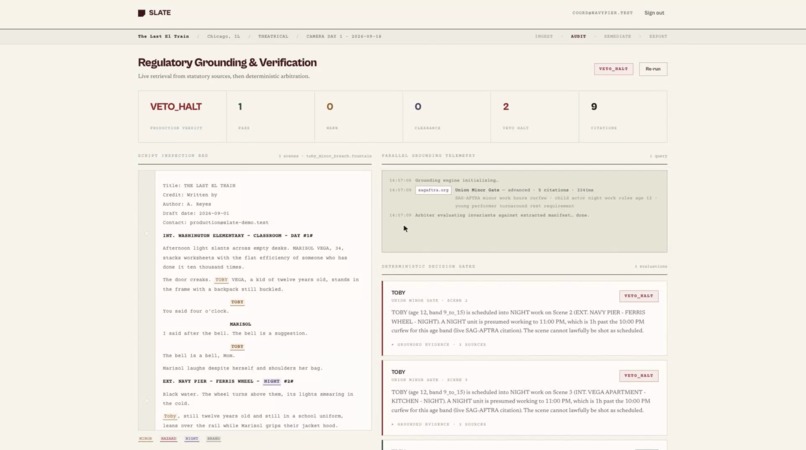
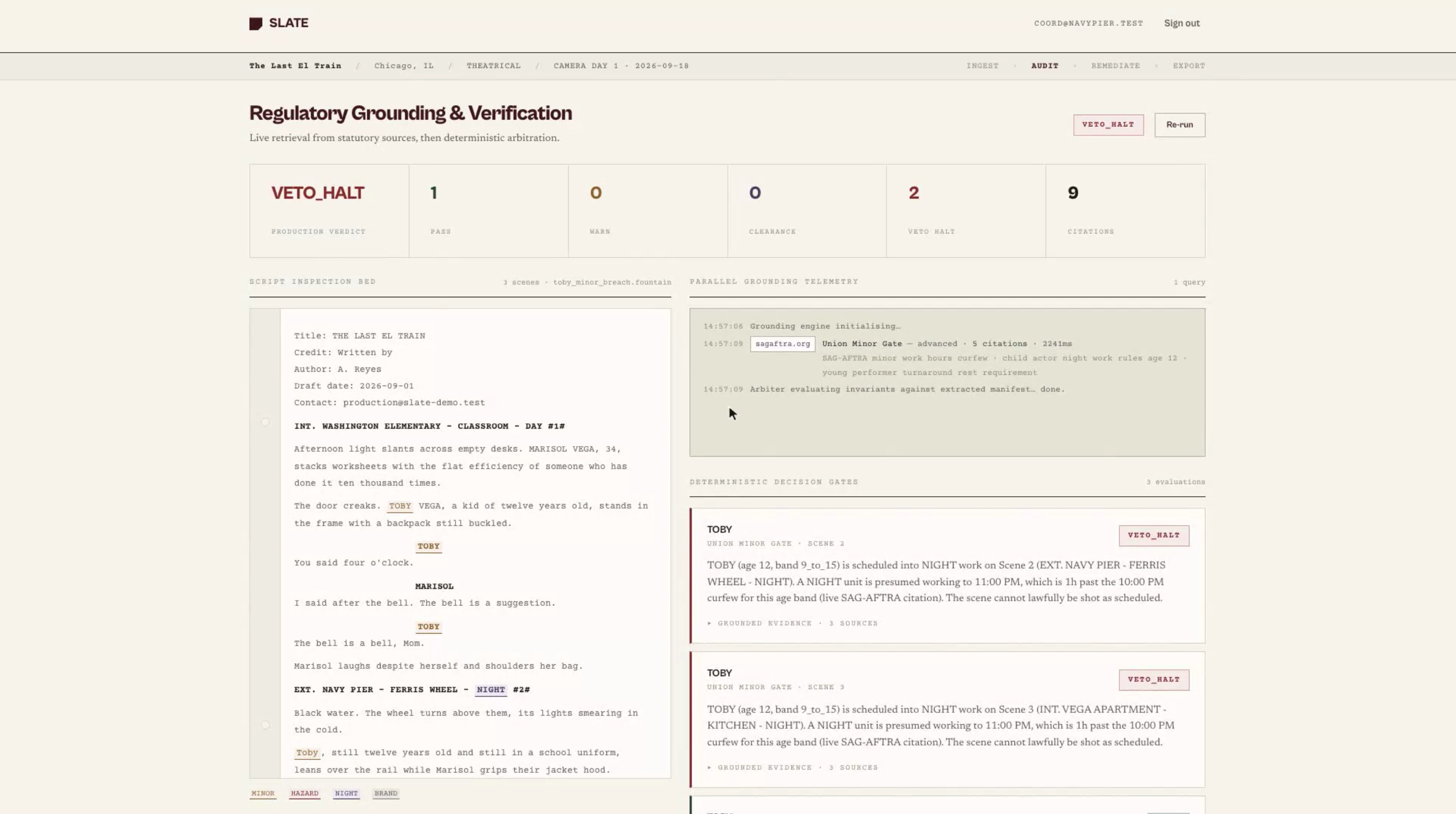
Regulatory Grounding & Verification
Inspiration
Every major studio production balances creative vision against catastrophic legal and operational liability. Behind the camera, line producers, 1st ADs, and bond guarantors navigate an intricate web of statutory mandates: SAG-AFTRA turnaround windows, municipal pyrotechnic permitting schedules, and intellectual property clearances. A minor working twenty minutes past their statutory turnaround under union rules or a pyro sequence scheduled inside a mandatory municipal inspection window does not just trigger fines; it halts a multi-million-dollar set. Today, this verification happens manually across disparate physical binders, email chains, and static call sheets, with critical conflicts routinely identified days too late. We built SLATE to eliminate pre-production compliance deadlock by converting unstructured screenplays into a deterministic, legally grounded, and autonomously remediated workflow before the camera ever rolls.
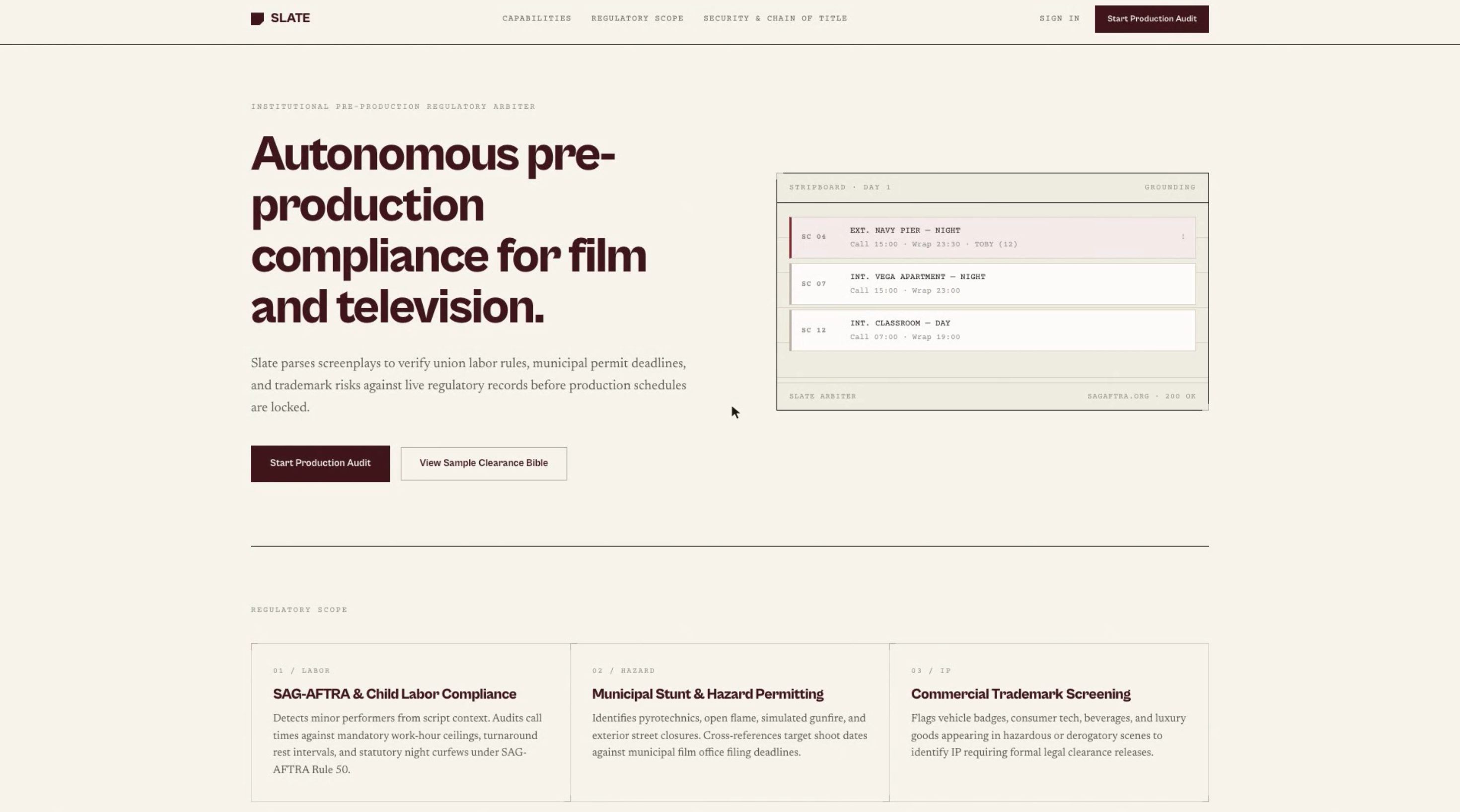
Alongside solving this operational liability, a core driver for us was the tactile, creative atmosphere of the studio itself. Compliance has historically felt like bureaucratic friction: disconnected spreadsheets, frantic legal back-and-forths, and administrative hurdles that yank filmmakers directly out of their creative flow. When architecting SLATE, our priority was preserving that creative momentum by designing a platform with deep production familiarity. We structured the interface to feel like a natural, living extension of the studio backlot rather than another piece of detached corporate enterprise software. By embedding statutory rigor directly into the natural rhythm of script breakdown, schedule management, and stripboard planning, SLATE keeps filmmakers in a continuous state of making. It transforms pre-production compliance from an anxious administrative bottleneck into a quiet, native safeguard that protects the production without ever interrupting the art.
What It Does
SLATE is an autonomous pre-production compliance engine and statutory arbiter that bridges unstructured cinematic storytelling with hard, deterministic law. Operating as a unified studio system, it analyzes raw screenplay drafts, isolates real-world labor and safety liabilities, verifies them against live statutory datasets, programmatically resolves schedule conflicts, and generates bond-ready legal packets for studio heads and completion guarantors. Instead of offering conversational suggestions, SLATE takes operational custody of production compliance from script ingestion to municipal permit clearance:
- Structured Script Extraction: Uses Gemini 3.6 Flash to ingest shooting drafts and perform schema decomposition, extracting scene entities, cast members, stunts, pyrotechnics, night calls, and minor working constraints in sub-seconds.
- Statutory Grounding via Parallel: Replaces speculative LLM advice with deterministic regulatory verification. SLATE calls the Parallel SDK at runtime to query live statutory datasets, verifying SAG-AFTRA Codified Basic Agreement rules (such as Rule 14-B minor rest windows) and municipal safety ordinances (such as Chicago Fire Department FO-02 permit timelines) with zero hallucination.
- Dual Arbiter Gating: Categorizes risks into strict operational gates (
VETO_HALT,FLAG_CLEARANCE_REQUIRED, andWARN), backed by exact statutory provenance links, citation rankings, and official regulatory clauses. - 3-Tier Stripboard Remediation Doctor: Rather than merely reporting bottlenecks, SLATE provides an algorithmic solver that resolves violations. It re-sequences call sheets to guarantee statutory rest periods without expanding the shoot calendar, compensating for permit lead times and recommending clearance substitutions.
- Bond-Ready Artifact Dispatch: Compiles an Executive Clearance Bible (PDF) with full citation provenance and pre-fills municipal permit packets ready for legal, union, and completion bond sign-off.
How We Built It
SLATE was architected as a modular, deterministic compliance pipeline:
- Parsing & Extraction Engine: Built with Python and structured Pydantic schemas powered by Gemini 3.6 Flash, enforcing strict structural invariants on entity extraction from raw screenplay text. The extraction pipeline isolates operational parameters: character demographics, day-versus-night shooting requirements, interior/exterior practical setups, pyrotechnics, and trademarked set dressing.
- Legal Grounding Layer via Parallel: Integrated directly with the Parallel SDK to issue domain-isolated statutory queries across municipal fire codes, guild union rulebooks, and trademark registries dynamically. Rather than passing unranked search dumps to an LLM, SLATE uses a custom claim-to-evidence relevance scorer that matches extracted screenplay hazards directly against retrieved statutory clauses.
- Deterministic Arbiter & Remediation Engine: Implemented an algorithmic stripboard solver that optimizes call-sheet schedules under strict linear constraints:
$$\Delta t_{\text{rest}} \ge T_{\text{statutory}}$$
Where Toby's rest window is enforced against mandatory union curfews (22:00) and the statutory turnaround threshold (T_statutory = 12 hours) while holding total production duration constant (ΔD_shoot = 0).
- Interface & Cinema Design System: Built on FastAPI with an Alabaster and Studio Cordovan design language, reflecting high-density production tools rather than generic software templates. The UI is architected around the working surfaces of a production office: script breakdown views, live telemetry feeds, visual arbitration drawers, and interactive stripboard doctor cards.
* Automated Audit & Programmatic Dispatch: Powered by ReportLab and Turso (libSQL over HTTPS) to export auditable, print-ready compliance packets, complete with pre-filled municipal permit applications and tamper-proof audit logs.
Challenges We Faced
- Eliminating Hallucinated Compliance: In film law, an AI hallucinating an ordinance can trigger six-figure shutdown penalties. We solved this by decoupling entity extraction from legal evaluation: Gemini handles deep unstructured script decomposition, while the Parallel SDK acts as an immutable factual grounding layer with verifiable statutory provenance.
- Semantic Invariants in Screenplay Extraction: Unstructured scripts broke standard entity parsers in subtle ways. A character described as "twelve years old" in prose was missed by basic numeric token matching, which would have silently failed the headline minor-turnaround veto. In co-referencing expressions like "Toby, still twelve, while Marisol grips their hood," an adult character accidentally inherited the minor age tag, triggering a false-positive halt. We solved this by pairing Gemini 3.6 Flash structured extraction with strict schema validation invariants: enforcing
is_minor=Trueprogrammatically for any age under 18 regardless of the raw text representation. - Retrieval Quality Over Citation Count: When our Parallel live keys were initialized, we had over twenty live citations, but our top displayed excerpt was pulling navigation chrome and hotline disclaimers because ranking initially favored raw excerpt length. Furthermore, distinct hazards initially fired generic duplicate queries: the firearms gate and drone permits were erroneously arbitrated against pyrotechnic lead times. We had to build a dedicated claim-to-evidence relevance scorer and decouple queries so that each operational gate pulls domain-isolated statutory records.
- State Rollback in Security Handlers: We uncovered a critical transaction vulnerability where raising an exception inside a
with connect()database block rolled back the OTP attempt counter. This allowed brute-force limits to be bypassed entirely because failed attempts were discarded on error. We re-architected the authentication state to enforce persistent, tamper-proof attempt tracking outside the transactional rollback scope. - Silent Failure of Defensive Fallbacks: An early fallback mechanism caught API deprecation errors so gracefully that local extraction appeared to succeed when no live endpoint was answering. We refactored the pipeline to eliminate silent degradation: SLATE now explicitly stamps the responding model engine, version, and execution status into the immutable audit trail.
- Dynamic Schedule Remediation: Building an algorithmic stripboard doctor that resolves minor turnaround violations without causing cascade delays across multi-cast shooting schedules required balancing strict constraint satisfaction against real-world production limitations. The engine shifts dependent call sheets to clear mandatory rest windows while holding total shoot days constant:
$$\Delta t_{\text{rest}} \ge T_{\text{statutory}}$$
Where Toby’s turnaround time buffer $\Delta t_{\text{rest}}$ is guaranteed against the required guild threshold $T_{\text{statutory}} = 12\text{ hours}$ while minimizing schedule delta $\Delta D_{\text{shoot}} = 0$.
- Studio-Grade Interface Fidelity: Moving beyond standard web dashboards to build an authoritative interface suited for studio production heads, giving them immediate creative comfort while handling hard statutory boundaries.
What We Learned
- Deterministic Arbitration Over Free-Form Conversation: Building SLATE demonstrated that enterprise-grade agentic systems require deterministic arbitration over chat interfaces. Film sets do not need a chatbot offering vague legal tips; they need strict schema enforcement, verifiable regulatory citations, and automated remediation engines that take direct responsibility for resolving production bottlenecks.
- The Deterministic Core Must Rule the Gate: No language model should ever directly issue a legal verdict. In SLATE, Gemini decomposes unstructured script text into structured schemas, but the deterministic Arbiter alone decides whether a production can roll. Grounding data from the Parallel SDK can only tighten a statutory boundary: taking the minimum for rest curfews or the maximum for permit lead times. An adversarial or noisy external citation can close a gate further, but it can never unsafely force one open.
- Live Evidence Should Alter Outcomes: When running offline, our pyrotechnics sequence returned a cautious
WARN, but running against live Parallel and USPTO registries escalated the status toCLEARANCE_REQUIREDbecause the vehicle being destroyed was verified as an active trademark. Live external evidence changing an operational verdict is not a regression; it proves the agent is actively grounding decisions in real-world law rather than cached assumptions. - Citation Presence Does Not Equal Grounding: A system that merely attaches twenty URLs to a response is not grounded. True enterprise grounding requires verifying that the retrieved legal excerpt directly substantiates the exact operational claim being made, scored specifically for domain relevance.
- Schema Validation Eliminates Probabilistic Drift: Defensive code cannot rely purely on prompt steering. Hard programmatic invariants at the schema level make entire classes of LLM extraction failures structurally impossible rather than merely improbable.
What's Next for SLATE
SLATE is already a functional, fully operational pre-production compliance engine in real time: it ingests real shooting drafts, enforces strict schema decomposition, grounds decisions in live statutory records via Parallel, programmatically remediates stripboard conflicts, and generates legally auditable packets. Because the runtime architecture and arbitration engine are already proven, our immediate roadmap focuses on scaling SLATE from an independent studio tool into the shared operating standard for film financing, guild operations, and on-set production logistics.
- Multi-Guild & International Regulatory Adapters: While our initial implementation focuses on SAG-AFTRA minor turnaround rules and municipal pyrotechnic codes, production liability spans multiple labor bodies. We are expanding our statutory ingestion engine across DGA turnaround standards, WGA credit-arbitration metadata, and IATSE safety bulletins (including camera-car rigging, live gunfire protocols, and hazardous environmental exposure limits). Internationally, we plan to ingest regional co-production treaty requirements (such as Eurimages and the British Film Institute), allowing multinational productions to arbitrate cross-border tax credit compliance and local labor statutes simultaneously.
- Bi-Directional Call-Sheet & Stripboard Synchronization: SLATE currently exports clean, deterministic schedule swaps and bond-ready documentation. The next step is continuous, bi-directional integration with standard Hollywood production software, including Movie Magic Scheduling, Final Draft, and StudioBinder. When a director calls an audible on set or weather delays an exterior shoot by three hours, SLATE's remediation doctor will dynamically re-evaluate the revised call sheet in real time, alerting the 1st AD before a rolling delay triggers downstream union turnaround penalties or invalidates a municipal filming window.
- Automated Insurance Underwriting & Completion Bond Integration: The completion bond industry underwrites hundreds of millions of dollars in production risk based on static paperwork and manual reviews. We are developing direct API integrations with entertainment insurance carriers and completion guarantors. By streaming cryptographically signed audit logs and verified clearance packets directly to underwriters, SLATE can enable instantaneous policy clearance, algorithmic premium discounting for mathematically verified schedules, and real-time contingency monitoring throughout principal photography.
- Automated Municipal Permit Dispatch & Electronic Filing: SLATE already pre-fills municipal permit applications like the Chicago Fire Department FO-02 packet with zero manual data entry. We are expanding this into a direct e-filing bridge with municipal film offices in major production hubs, including Los Angeles (FilmLA), New York (MOME), Atlanta, and London. Instead of line producers manually submitting static PDFs, SLATE will dispatch digitally signed permit packets directly into municipal agency review queues, tracking permit status transitions programmatically inside the studio dashboard.


Log in or sign up for Devpost to join the conversation.